
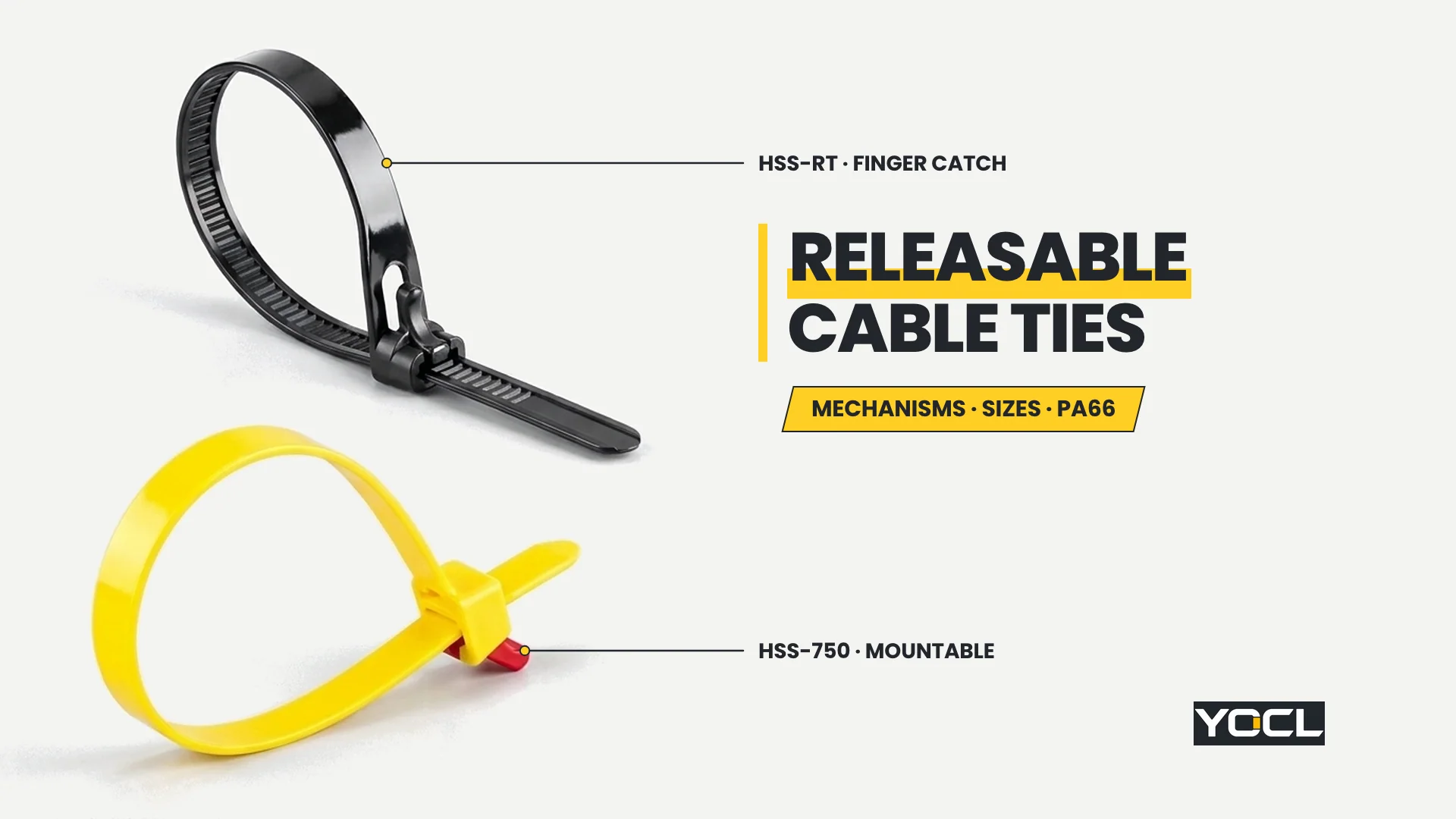
Bridas liberables son elementos de sujeción de nailon 66 (PA66) cuyo cabezal de bloqueo incorpora un gatillo de liberación o un canal de cinta de roscado inverso, lo que permite abrir el bucle sin cortar la cinta. En las cinco series de bridas reutilizables de YOCL ELECTRIC, los modelos abarcan longitudes de 100 a 750 mm y diámetros de haz de 22 a 220 mm.
Una brida estándar se bloquea con un gatillo de trinquete unidireccional: una vez que la cinta dentada se tira hacia adelante a través del cabezal, abrir el haz implica cortar y desechar la brida. Las bridas reutilizables (a menudo buscadas con el término sencillo de reutilizables) existen para mazos de cables y haces de mangueras cuyo contenido cambia con el tiempo, incluyendo prototipos y montajes de paneles por etapas, bucles de servicio accesibles, cableado temporal en obra, bancos de pruebas y equipos estacionales. Para mantener separados los temas relacionados, el corte seguro de bridas unidireccionales pertenece a cómo quitar bridas, los fundamentos generales de la resistencia del bucle pertenecen a la tabla de tamaños y resistencia a la tracción de las bridas, y el control de tensión con herramientas pertenece a pistolas para bridas: cómo elegir y ajustar la tensión.
Cómo funcionan las bridas reutilizables: comparación de tres mecanismos de liberación
Todas las bridas reutilizables resuelven el mismo problema mecánico (liberar los dientes de la cinta dentada del trinquete de bloqueo sin cortar la banda), pero el catálogo de YOCL ELECTRIC logra esa liberación mediante tres geometrías de cabezal distintas: un cierre de palanca manual, un canal de roscado inverso y un cabezal de doble bloqueo.
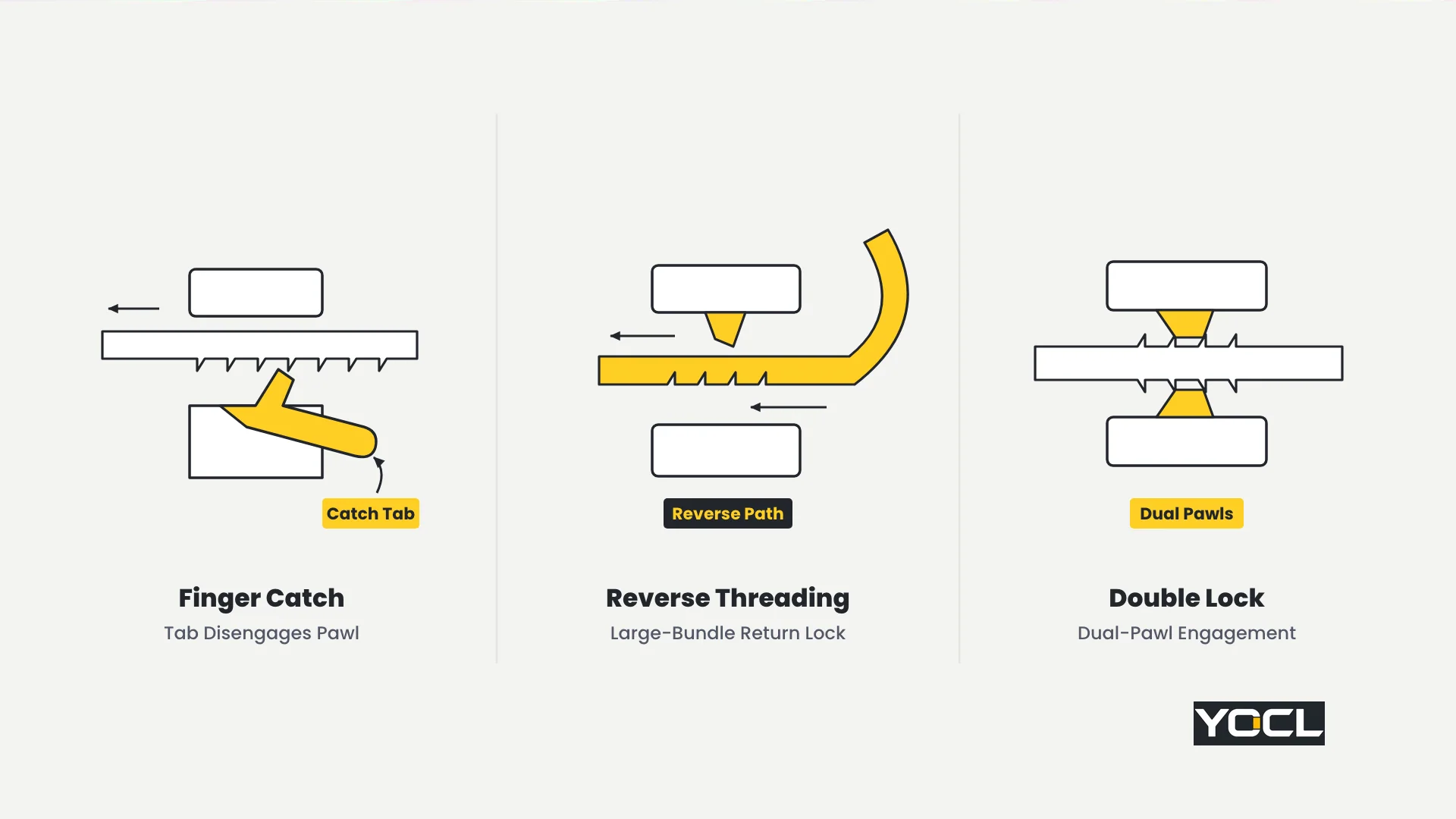
Elegir entre estos estilos de cabezal es una decisión práctica de manipulación en el panel o en la placa de cableado, más que una preferencia estética:
- Liberación por palanca (HSS-RT, serie de amarre HSS-RTI, YC y HSS-750): Una palanca o lengüeta extendida sobresale directamente del trinquete de bloqueo dentro del cabezal. Presionar o levantar dicha lengüeta con la punta del dedo hace pivotar el trinquete, separándolo de los dientes de la cinta para que esta se deslice hacia atrás fuera del cabezal. Los cabezales con palanca son adecuados para mazos de cables pequeños a medianos y haces montados en paneles donde el instalador puede alcanzar el cabezal con una mano para añadir o redirigir un conductor.
- Liberación por rosca inversa (serie HSS-RCT): En lugar de depender de una palanca de pulgar externa en un cabezal compacto, la brida se inserta y se enrosca a través del cabezal en orientación inversa, de modo que el mecanismo de bloqueo puede liberarse y extraerse para realizar agrupaciones repetidas. En la gama de YOCL, el enroscado inverso está destinado a bridas largas (350–500 mm) y grandes diámetros de agrupación (90–150 mm), donde las bandas anchas (6.8–9 mm) envuelven tendidos de cables múltiples pesados o mangueras flexibles.
- Diseño de doble bloqueo (HSS7100): Como tercera variante de mecanismo en el catálogo de YOCL, HSS7100 las bridas reutilizables utilizan un diseño de cabezal de doble bloqueo en tres configuraciones enumeradas.
Tamaños, diámetros de haz y datos de tracción en cinco familias de YOCL
La comparación de las dimensiones entre las cinco familias liberables de YOCL muestra dos rasgos estructurales consistentes: las bridas liberables tienen correas más anchas que las bridas unidireccionales estándar de longitud comparable (7.2–7.6 mm en modelos de gama media HSS-RT, 6.8–9 mm en HSS-RCT, y 13 mm en HSS-750) para alojar el cabezal de liberación, mientras que las cifras de resistencia a la tracción del bucle de liberación manual se sitúan en el 40–75 lb banda.
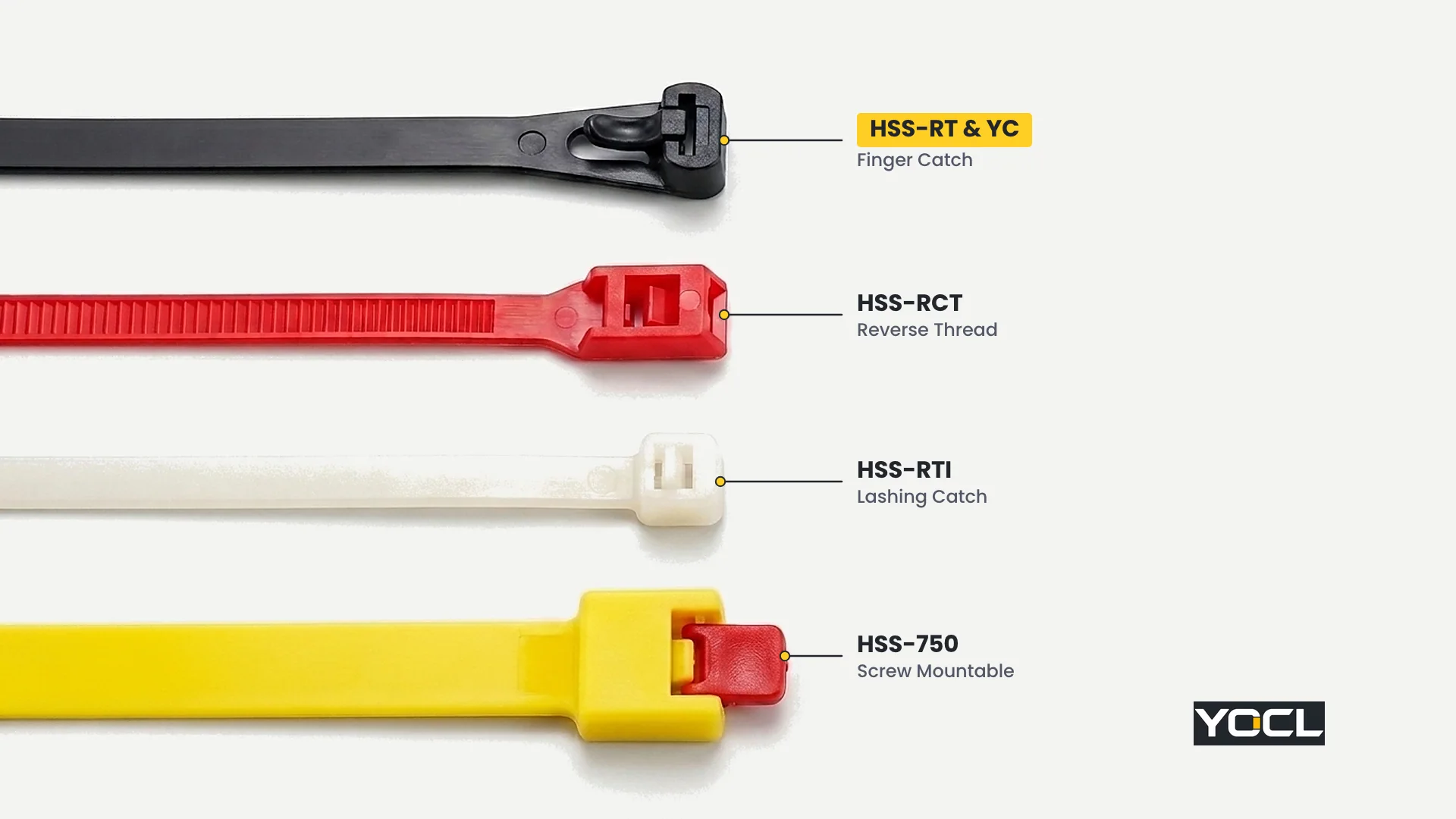
Antes de leer las tablas de modelos, aplique tres reglas de catálogo de las páginas de especificaciones de YOCL:
- Límite de clasificación de material e inflamabilidad: Cada familia a continuación está moldeada a partir de Nylon 66 (PA66). Cuando una página de producto indica UL 94 V-2 (en las páginas HSS-RT, HSS-RTI y YC), esa designación es estrictamente una clasificación de inflamabilidad del material—no la considere nunca como una homologación de producto acabado ni como una certificación de producto de terceros.
- Las cifras de tracción son datos del producto, no cargas de trabajo: Cada cifra de tracción reproducida a continuación sigue el propio marco de las páginas de producto: la resistencia a la tracción es una cifra mínima de prueba de bucle y no una clasificación de carga de trabajo. (Para saber cómo se relacionan los valores de tracción de bucle con el tamaño del haz en las bridas estándar, consulte la tabla de tamaños y resistencia a la tracción de las bridas.) Observe también que el modelo con montaje por tornillo HSS-750 salta a 200 lb / 90 kgf en un 13 mm strap—confirmando que el 40–65 lb techo de la serie de liberación manual más pequeña refleja la geometría compacta de la cabeza de liberación en lugar de los límites de material PA66.
- Secuencia de selección: Elija el mecanismo de liberación según la frecuencia con la que cambia el conjunto y cómo se accede a la cabeza, coincidir diámetro máximo del conjunto con el grupo de cables terminado, y verificar el valor de tracción impreso para la fila elegida.
Familia 1: HSS-RT Bridas liberables con gancho de dedo (9 Modelos)
de YOCL HSS-RT bridas liberables are Nylon 66 (PA66) ties with a stated UL 94 V-2 material flammability classification, supplied in packs of 100 unidades across 9 models. Each tie stays locked around the bundle until its finger catch is lifted.
Note the exact width and model progression printed on the product page: standard RT rows from 150 mm to 450 mm use wide 7.2 mm y 7.6 mm straps, HSS-500RT uses a 4.8 mm strap for bundles up to 170 mm, and the two RTA rows (HSS-150RTA at 150 mm and HSS-300RTA at 200 mm length) carry narrower 3.6 mm y 4.8 mm straps at 40 lb / 18 kgf tensile strength.
| Modelo | Longitud L (mm) | Anchura W (mm) | Max. Bundle Ø (mm) | Tensile Strength (lb) | Tensile Strength (kgf) |
|---|---|---|---|---|---|
| HSS-150RT | 150 | 7.2 | 35 | 50 | 22 |
| HSS-200RT | 200 | 7.2 | 50 | 50 | 22 |
| HSS-250RT | 250 | 7.6 | 65 | 50 | 22 |
| HSS-300RT | 300 | 7.6 | 80 | 50 | 22 |
| HSS-400RT | 400 | 7.6 | 100 | 50 | 22 |
| HSS-450RT | 450 | 7.6 | 110 | 50 | 22 |
| HSS-500RT | 500 | 4.8 | 170 | 50 | 22 |
| HSS-150RTA | 150 | 3.6 | 35 | 40 | 18 |
| HSS-300RTA | 200 | 4.8 | 50 | 40 | 18 |
Regla de selección: Elija HSS-RT (7.2–7.6 mm wide, 50 lb / 22 kgf) when you want a broad finger-catch tab on 35–110 mm bundles; select HSS-500RT for light 170 mm diameter loops at 4.8 mm width, or HSS-150RTA / HSS-300RTA when narrow panel slots require 3.6–4.8 mm straps.
Family 2: HSS-RCT Reverse-Threading Releasable Cable Ties (4 Models)
de YOCL HSS-RCT releasable cable ties use Nylon 66 (PA66) construction and a reverse-threading lock configuration across 4 long-strap models covering 90–150 mm maximum bundle diameters.
| Modelo | Longitud L (mm) | Anchura W (mm) | Max. Bundle Ø E (mm) | Min. Loop Tensile (lb) | Min. Loop Tensile (kgf) |
|---|---|---|---|---|---|
| HSS-350RCT | 350 | 6.8 | 90 | 50 | 22 |
| HSS-400RCT | 400 | 8 | 105 | 50 | 22 |
| HSS-450RCT | 450 | 8 | 118 | 50 | 22 |
| HSS-500RCT | 500 | 9 | 150 | 65 | 30 |
Regla de selección: Elija HSS-RCT when bundling thicker 90–150 mm cable groups or hoses where reverse-threading a wide 6.8–9 mm strap (up to 65 lb / 30 kgf on HSS-500RCT) is easier to handle than a compact finger lever.
Family 3: HSS-RTI Releasable Lashing Cable Ties (5 Models)
de YOCL HSS-RTI releasable lashing cable ties are Nylon 66 (PA66) lashing-form ties with a release catch, a stated UL 94 V-2 material flammability classification, and a 100 unidades pack quantity across 5 models from 100 mm a 300 mm.
| Modelo | Longitud L (mm) | Anchura W (mm) | Max. Bundle Ø (mm) | Tensile Strength (lb) | Tensile Strength (kgf) |
|---|---|---|---|---|---|
| HSS-100RTI | 100 | 3.6 | 22 | 40 | 18 |
| HSS-150RTI | 150 | 4.7 | 35 | 50 | 22 |
| HSS-200RTI | 200 | 4.7 | 50 | 50 | 22 |
| HSS-250RTI | 250 | 4.8 | 65 | 50 | 22 |
| HSS-300RTI | 300 | 4.7 | 65 | 50 | 22 |
Regla de selección: Elija HSS-RTI when you need narrower 3.6–4.8 mm lashing straps or the shortest 100 mm releasable tie (HSS-100RTI, 22 mm max bundle diameter) for compact control-cabinet harnesses.
Family 4 (YC Series) and Family 5 (HSS-750 Mountable Tie)
Two specialized Nylon 66 (PA66) series round out YOCL’s releasable range—one adding documented temperature and UV-black options, and the other combining a heavy-duty releasable strap with screw mounting:
- YC releasable nylon cable ties (YC series): Covers 8 models (YC-150RT, YC-200RT, YC-202RT, YC-250RT, YC-300RT, YC-370RT, YC-400RT, y YC-505RT) spanning 150–500 mm lengths, 4.6 mm / 7.5 mm / 8.5 mm widths, 35–140 mm maximum bundle diameters, and 40 / 50 / 75 lbf (18 / 22 / 34 kgf) minimum tensile strengths, with stated UL 94 V-2 material flammability. Colours include natural, black, and UV black (with other colours on request). In YOCL’s releasable catalogue, this YC family alone publishes temperature ratings: an operating temperature range of −40 °C a +85 °C and an installation temperature range of −20 °C a +85 °C (do not assume or transfer those figures to the HSS families, whose pages publish no temperature ratings).
- HSS-750 releasable mountable cable tie (HSS-750): A single heavy-duty PA66 model measuring 750 mm long and 13 mm wide, covering 5–220 mm bundle diameters with a 200 lb / 90 kgf tensile strength. Unlike free-hanging ties, HSS-750 anchors the bundle to a panel or frame via a screw passed through its head; note that the product page explicitly leaves the mounting screw size and hole dimensions unspecified, so verify physical fastener fit on a sample before drilling panels.
| YC Model | Longitud L (mm) | Anchura W (mm) | Max. Bundle Ø E (mm) | Min. Tensile (lbf) | Min. Tensile (kgf) |
|---|---|---|---|---|---|
| YC-150RT | 150 | 7.5 | 35 | 50 | 22 |
| YC-200RT | 200 | 7.5 | 45 | 50 | 22 |
| YC-202RT | 200 | 4.6 | 45 | 40 | 18 |
| YC-250RT | 250 | 7.5 | 60 | 50 | 22 |
| YC-300RT | 300 | 7.5 | 75 | 50 | 22 |
| YC-370RT | 370 | 7.5 | 95 | 50 | 22 |
| YC-400RT | 400 | 7.5 | 100 | 50 | 22 |
| YC-505RT | 500 | 8.5 | 140 | 75 | 34 |
Regla de selección: Especificar YC models when your project documentation requires published operating (−40 °C a +85 °C) and installation (−20 °C a +85 °C) temperatures or a UV black option; specify HSS-750 when a large 5–220 mm bundle requires both releasable access and screw-fixed panel anchoring.
The Trade-Off: When to Use Releasable Ties vs Standard One-Way Ties
Choosing between a releasable tie and a standard one-way tie comes down to one engineering trade-off: a locking head designed to be opened by hand can also be opened unintentionally, and repeated opening and re-locking gradually wears the pawl engagement.
- No guaranteed reuse-cycle rating: As stated directly in YOCL’s HSS-RT, HSS-RCT, and HSS-RTI selection guides, the supplied product data does not specify a guaranteed number of reuse cycles. No YOCL releasable cable tie carries a rated cycle count. Each release and re-tensioning pass flexes the nylon pawl and rubs against the strap teeth, so service life depends on how hard the strap is pulled and how cleanly the catch is lifted before sliding the strap back.
- Accidental or unauthorised release risk: In public corridors, exposed machinery frames, or vibration-prone harnesses where snagging clothing or tools could lift an external finger catch—or where tampering must be prevented—a release tab is a liability rather than a convenience.
- Where releasable ties belong: Specify releasable ties on bundles whose wire count or routing is expected to change and whose heads remain accessible for visual inspection: prototype control cabinets, staged commissioning runs, temporary event or construction power looms, laboratory test benches, and service loops.
- Where standard one-way ties belong: Specify standard one-way ties whenever a harness is finalized, enclosed behind permanent covers, sealed inside equipment where an opened tie would go unnoticed, or intended to stay untouched for the life of the installation.
- Cost framing in practice: On a per-piece basis, a releasable tie costs more than an equivalent standard tie because of its larger head moulding and wider strap, but offsets that outlay where repeated circuit additions would otherwise consume new ties and technician cutting-and-retying labour at every revision.
Installation and Routing Notes for Accessible Release Heads
A releasable tie only delivers non-destructive maintenance if installers orient the head so fingers can reach the catch, apply moderate hand tension rather than crushing the pawl, and retire ties whose teeth show wear.
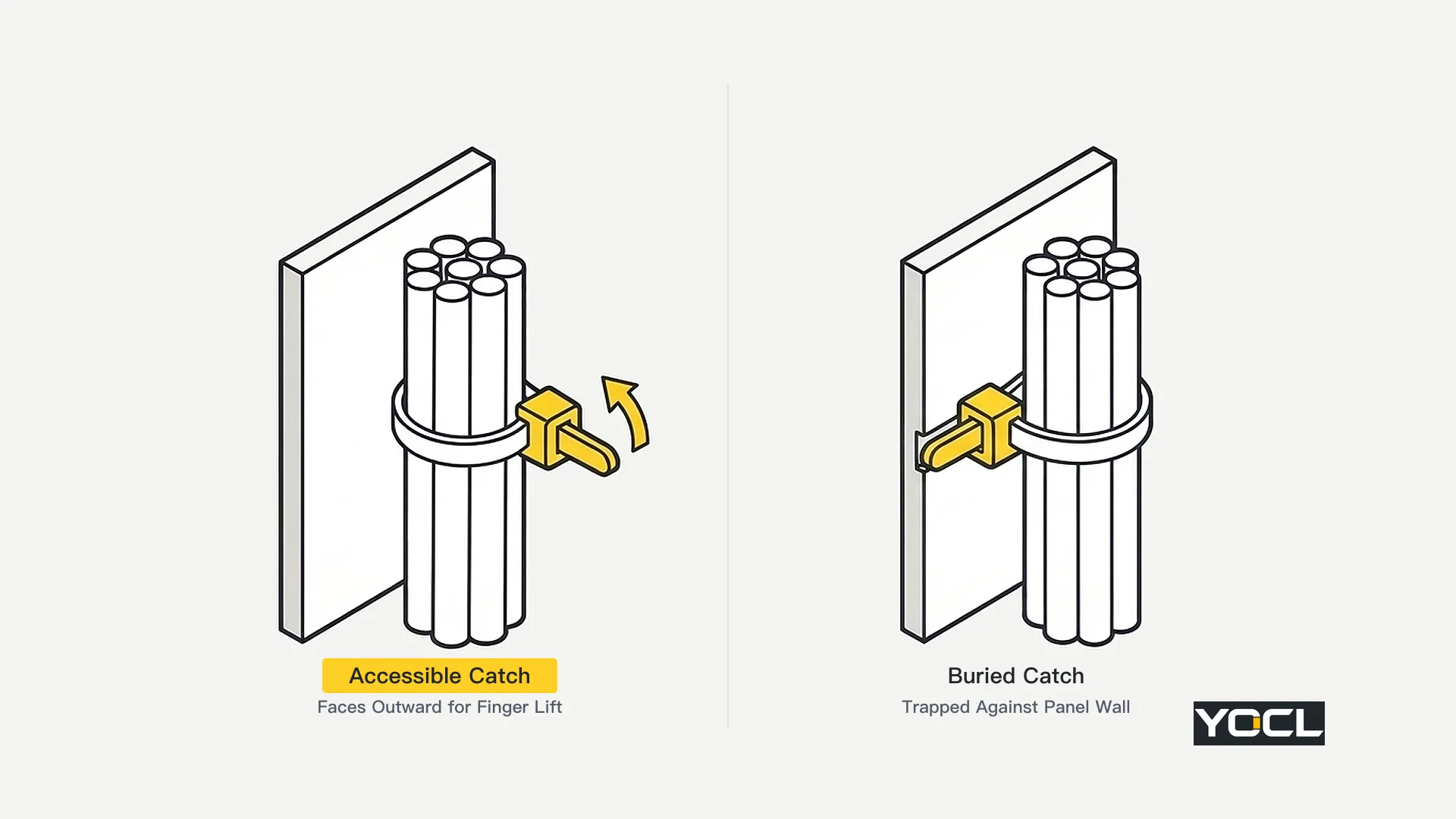
Keep three field habits in place during harness assembly:
- Leave the release catch accessible: Before snugging the loop, rotate the head so the finger catch or reverse-threaded tail faces outward toward the technician’s hand clearance. A catch pulled tight against a backplate, DIN-rail trough, or bulkhead corner cannot be lifted with a finger—turning a releasable tie back into a cut-off tie (if a trapped tie must be cut out, follow cómo quitar bridas).
- Do not over-tension ties intended for cycling: Pull the strap snug by hand until the bundle is orderly without deforming the cable jackets or jamming the pawl deep against the serration root; where tensioning tools are used on permanent ties, see pistolas para bridas: cómo elegir y ajustar la tensión. Also leave sufficient tail length beyond the head so you can grip and re-tension the strap on the next closure.
- Inspect and replace at end of life: Every time a tie is opened and re-closed, feel for positive pawl engagement and check that the loop holds tension without creeping backward. Any tie whose catch is bent, whose teeth are rounded, or that slips under hand pull has reached end of life and should be replaced immediately.
Preguntas frecuentes
How many times can a releasable cable tie be opened and closed?
No rated cycle count exists. YOCL’s HSS-RT, HSS-RCT, and HSS-RTI pages state explicitly that the supplied data does not specify a guaranteed number of reuse cycles. Because pawl wear depends on hand tension and release technique, inspect the locking engagement at each change and replace the tie whenever the strap slips or fails to hold tension.
Are releasable cable ties weaker than standard ties?
Compare the printed minimum tensile strength in the tables above against standard ties in the same width class rather than assuming a percentage difference. Hand-release series sit mostly at 40–75 lbf across 3.6–9 mm widths because the release mechanism occupies head space, while the 13 mm screw-mounted HSS-750 reaches 200 lb / 90 kgf—showing the compromise sits in the compact release head, not the Nylon 66 strap.
Can I use releasable cable ties outdoors?
All five YOCL releasable families are moulded from Nylon 66 (PA66), the same base polymer used in standard nylon cable ties. Within this group, only the YC series offers a UV black colour option alongside natural and black, and only the YC series publishes operating (−40 °C a +85 °C) and installation (−20 °C a +85 °C) temperature ranges; the pages publish no outdoor service-life duration claims.
Should I choose releasable nylon ties or hook-and-loop straps?
They are different product types built for different tasks. YOCL’s releasable families (HSS-RT, HSS-RCT, HSS-RTI, YC, y HSS-750) are moulded Nylon 66 pawl-and-tooth ties with published loop tensile figures from 40 lb to 200 lb and rigid bundle containment; YOCL publishes no hook-and-loop strap range within this releasable cable-tie family.
Referencias
- Información del producto ELECTRIC YOCL — HSS-RT Bridas de Cables Desmontables: Nylon 66 finger-catch specifications, UL 94 V-2 material flammability classification, no-guaranteed-cycles note, and 9-model table (RT and RTA rows).
- Información del producto ELECTRIC YOCL — HSS-RCT Bridas de Cables Desmontables: Nylon 66 reverse-threading specifications, no-guaranteed-cycles note, and 4-model table (350–500 mm).
- Información del producto ELECTRIC YOCL — HSS-RTI Bridas de Amarre Desmontables: Nylon 66 release-catch lashing specifications, UL 94 V-2 material flammability classification, and 5-model table (100–300 mm).
- Información del producto ELECTRIC YOCL — Bridas de Nylon Desmontables YC: Nylon 66 RT-suffix specifications, operating (−40 °C to +85 °C) and installation (−20 °C to +85 °C) temperatures, natural/black/UV-black options, and 8-model table.
- Información del producto ELECTRIC YOCL — HSS-750 Brida de Cable Desmontable con Soporte: Nylon 66 750 × 13 mm screw-mountable releasable tie specifications (200 lb / 90 kgf tensile; screw and hole dimensions unspecified).