
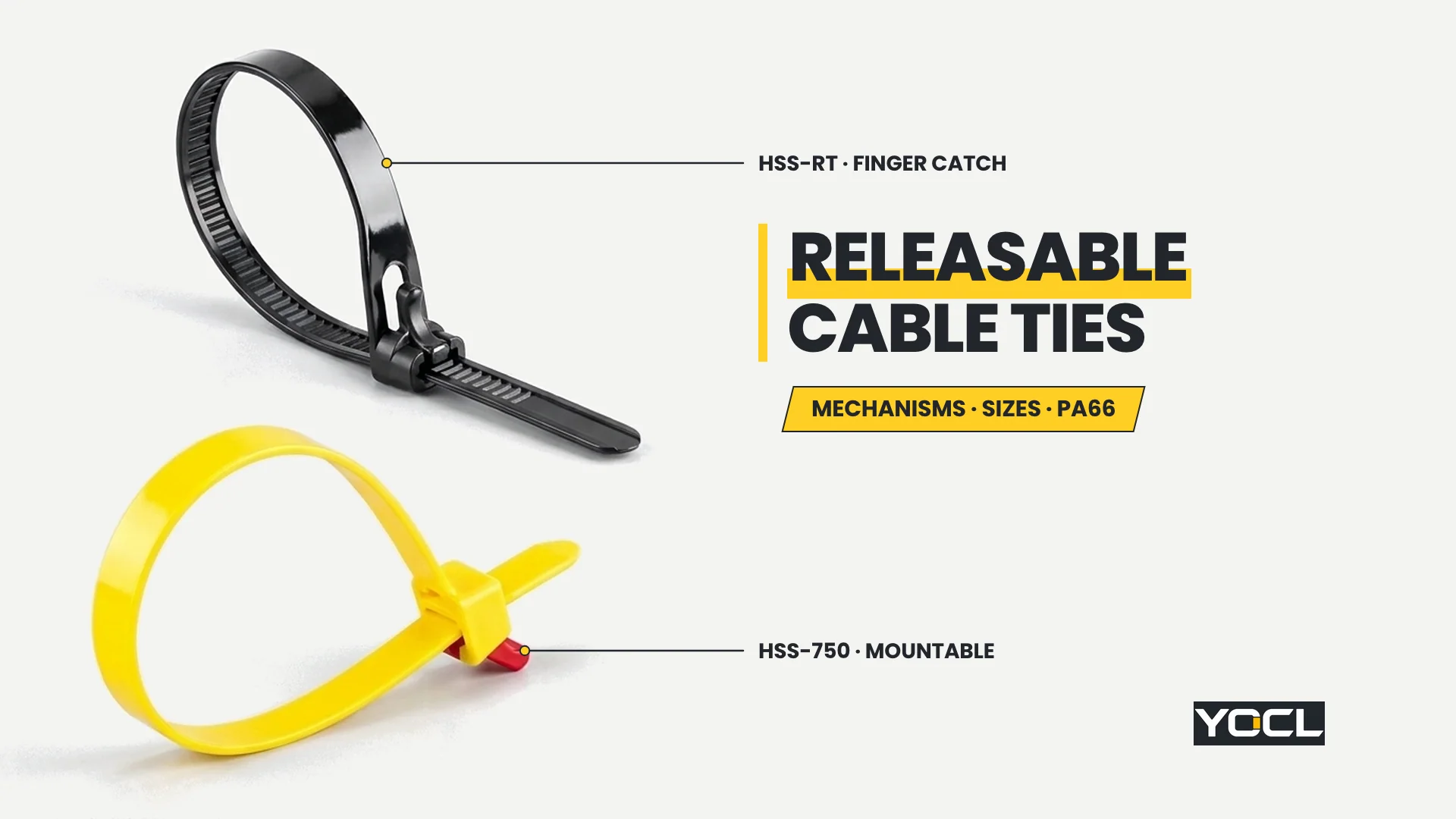
Releasable cable ties are Nylon 66 (PA66) bundling fasteners whose locking head incorporates a disengageable pawl catch or a reverse-threading strap channel, allowing the loop to open without cutting the strap. Across YOCL ELECTRIC’s five releasable series, models span 100–750 mm lengths and 22–220 mm bundle diameters.
A standard cable tie locks with a one-way ratchet pawl: once the serrated strap pulls forward through the head, opening the bundle means cutting and discarding the tie. Releasable—often searched in plain language as reusable—ties exist for wire harnesses and hose bundles whose contents change over time, including prototype and staged panel builds, accessible service loops, temporary site cabling, test rigs, and seasonal equipment. To keep neighbouring topics separate, safely cutting one-way ties belongs to how to remove cable ties, general loop-strength fundamentals belong to the cable tie size and tensile strength chart, and tool tension control belongs to cable tie guns: how to choose and set tension.
How Releasable Cable Ties Work: Three Release Mechanisms Compared
All releasable cable ties solve the same mechanical problem—freeing the serrated strap teeth from the locking pawl without severing the band—but YOCL ELECTRIC’s catalogue achieves that release through three distinct head geometries: a finger-lifted catch, a reverse-threading channel, and a double-locking head.
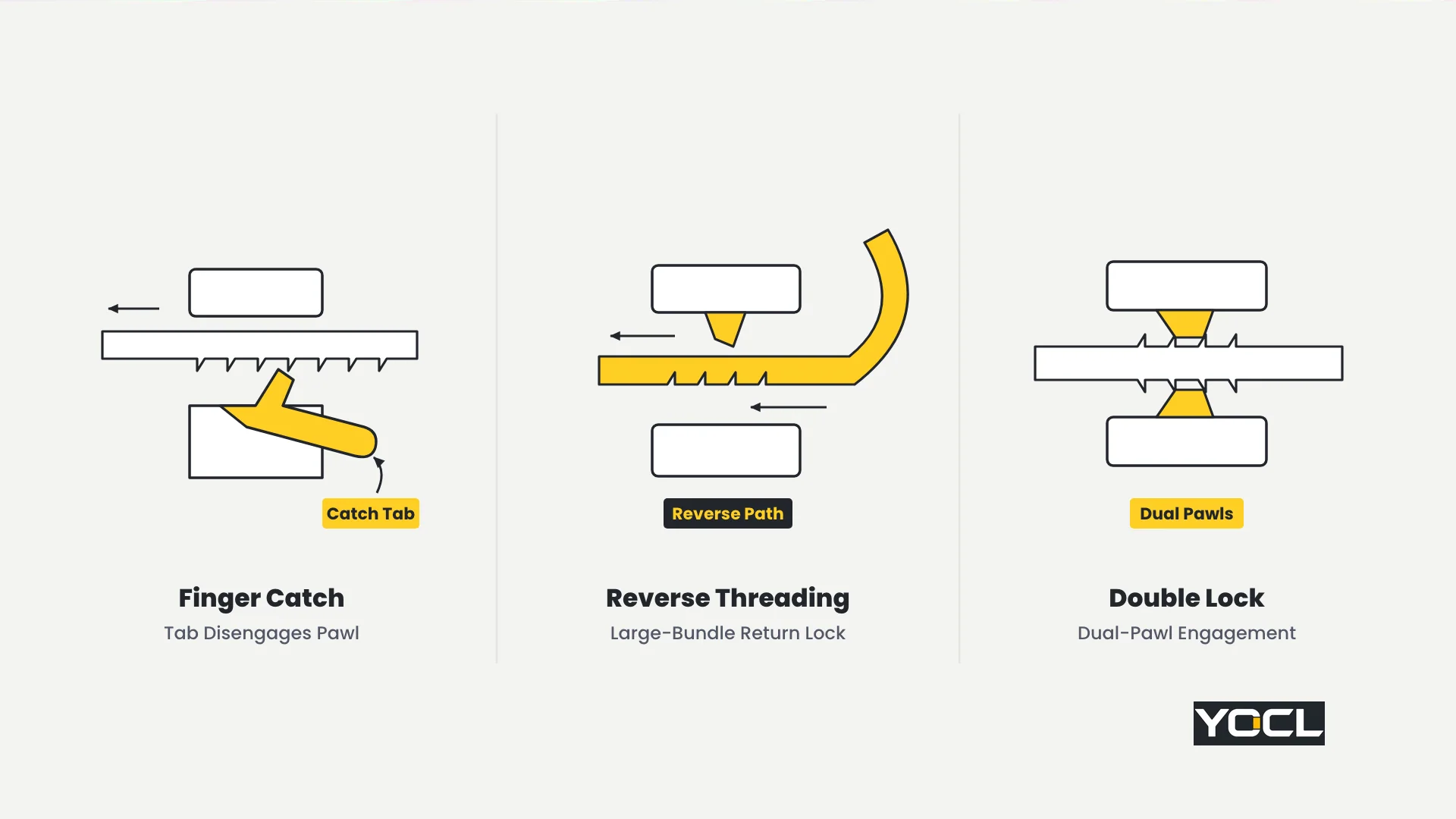
Choosing between these head styles is a practical handling decision on the panel or harness board rather than a cosmetic preference:
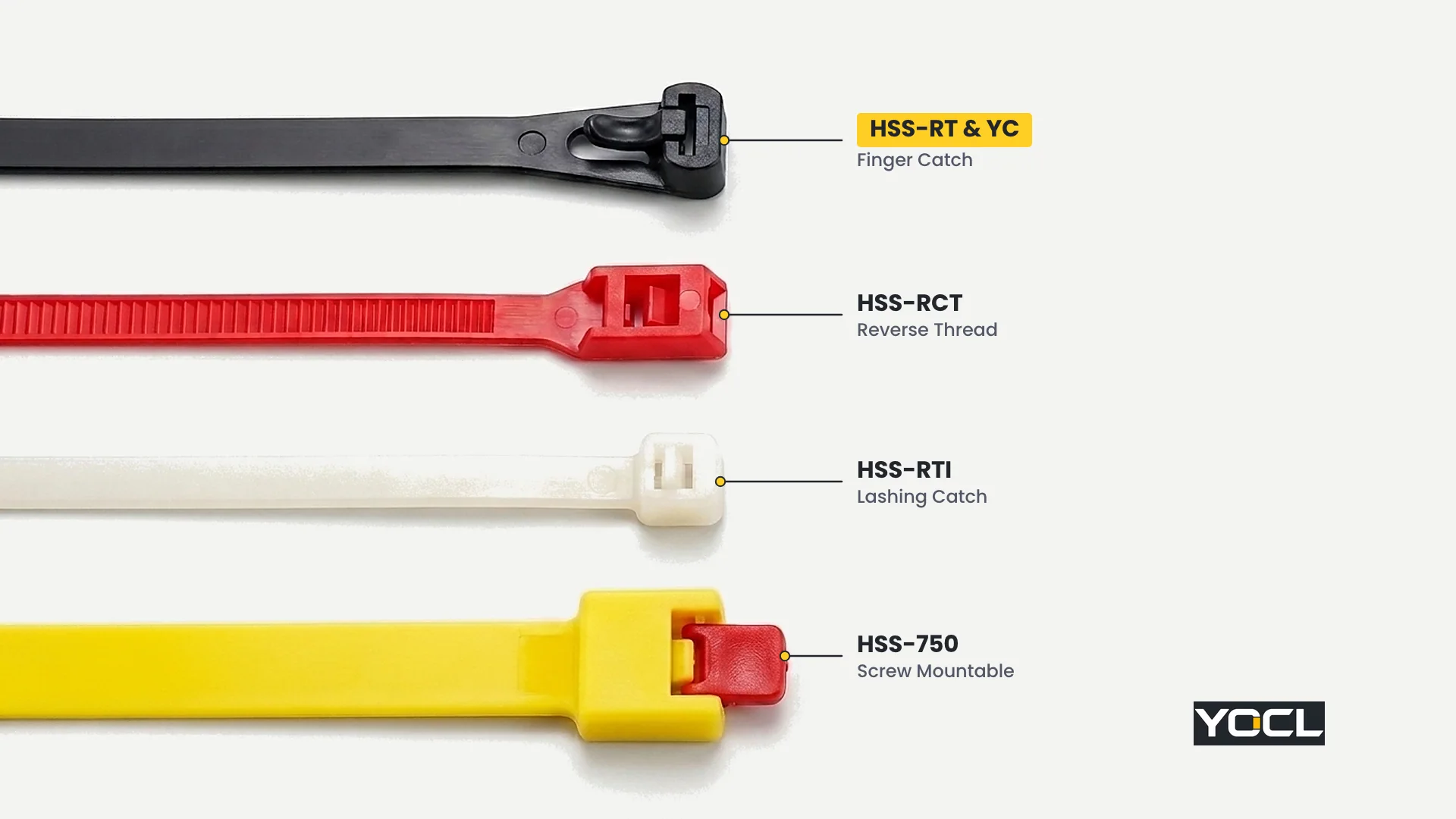
- Finger-catch release (HSS-RT, HSS-RTI lashing series, YC, and HSS-750): An extended lever or catch tab protrudes directly from the locking pawl inside the head. Pressing or lifting that catch with a fingertip pivots the pawl clear of the strap serrations so the strap slides backward out of the head. Finger-catch heads suit small-to-medium harnesses and panel-mounted bundles where an installer can reach the head with one hand to add or reroute a conductor.
- Reverse-threading release (HSS-RCT series): Instead of relying on an external thumb lever on a compact head, the strap enters and threads through the head in reverse orientation so the locking engagement can be released and backed out for repeated bundling. In YOCL’s range, reverse threading is dedicated to long straps (350–500 mm) and large bundle diameters (90–150 mm), where wide bands (6.8–9 mm) wrap heavy multi-cable runs or flexible hoses.
- Double-locking design (HSS7100): As a third mechanism variant in YOCL’s catalogue, HSS7100 reusable ties use a double-locking head design across three listed configurations.
Sizes, Bundle Diameters, and Tensile Data Across Five YOCL Families
Comparing dimensions across YOCL’s five releasable families shows two consistent structural traits: releasable ties carry wider straps than standard one-way ties of comparable length (7.2–7.6 mm on mid-range HSS-RT models, 6.8–9 mm on HSS-RCT, and 13 mm on HSS-750) to house the release head, while hand-release loop tensile figures sit in the 40–75 lb band.
Before reading the model tables, apply three catalogue rules from YOCL’s specification pages:
- Material and flammability classification boundary: Every family below is moulded from Nylon 66 (PA66). Where a product page states UL 94 V-2 (on the HSS-RT, HSS-RTI, and YC pages), that designation is strictly a material flammability classification—never treat it as a finished-product listing or third-party product certification.
- Tensile figures are product data, not working loads: Every tensile figure reproduced below follows the product pages’ own framing: tensile strength is a minimum loop test figure and is not a working-load rating. (For how loop tensile values relate to bundle sizing across standard ties, see the cable tie size and tensile strength chart.) Notice too that the screw-mountable HSS-750 jumps to 200 lb / 90 kgf on a 13 mm strap—confirming that the 40–65 lb ceiling on the smaller hand-release series reflects compact release-head geometry rather than PA66 material limits.
- Selection sequence: Choose the release mechanism according to how frequently the bundle changes and how the head is accessed, match maximum bundle diameter to the finished cable group, and verify the printed tensile value for the chosen row.
Family 1: HSS-RT Finger-Catch Releasable Cable Ties (9 Models)
YOCL’s HSS-RT releasable cable ties are Nylon 66 (PA66) ties with a stated UL 94 V-2 material flammability classification, supplied in packs of 100 pieces across 9 models. Each tie stays locked around the bundle until its finger catch is lifted.
Note the exact width and model progression printed on the product page: standard RT rows from 150 mm to 450 mm use wide 7.2 mm and 7.6 mm straps, HSS-500RT uses a 4.8 mm strap for bundles up to 170 mm, and the two RTA rows (HSS-150RTA at 150 mm and HSS-300RTA at 200 mm length) carry narrower 3.6 mm and 4.8 mm straps at 40 lb / 18 kgf tensile strength.
| Model | Length L (mm) | Width W (mm) | Max. Bundle Ø (mm) | Tensile Strength (lb) | Tensile Strength (kgf) |
|---|---|---|---|---|---|
| HSS-150RT | 150 | 7.2 | 35 | 50 | 22 |
| HSS-200RT | 200 | 7.2 | 50 | 50 | 22 |
| HSS-250RT | 250 | 7.6 | 65 | 50 | 22 |
| HSS-300RT | 300 | 7.6 | 80 | 50 | 22 |
| HSS-400RT | 400 | 7.6 | 100 | 50 | 22 |
| HSS-450RT | 450 | 7.6 | 110 | 50 | 22 |
| HSS-500RT | 500 | 4.8 | 170 | 50 | 22 |
| HSS-150RTA | 150 | 3.6 | 35 | 40 | 18 |
| HSS-300RTA | 200 | 4.8 | 50 | 40 | 18 |
Selection Rule: Choose HSS-RT (7.2–7.6 mm wide, 50 lb / 22 kgf) when you want a broad finger-catch tab on 35–110 mm bundles; select HSS-500RT for light 170 mm diameter loops at 4.8 mm width, or HSS-150RTA / HSS-300RTA when narrow panel slots require 3.6–4.8 mm straps.
Family 2: HSS-RCT Reverse-Threading Releasable Cable Ties (4 Models)
YOCL’s HSS-RCT releasable cable ties use Nylon 66 (PA66) construction and a reverse-threading lock configuration across 4 long-strap models covering 90–150 mm maximum bundle diameters.
| Model | Length L (mm) | Width W (mm) | Max. Bundle Ø E (mm) | Min. Loop Tensile (lb) | Min. Loop Tensile (kgf) |
|---|---|---|---|---|---|
| HSS-350RCT | 350 | 6.8 | 90 | 50 | 22 |
| HSS-400RCT | 400 | 8 | 105 | 50 | 22 |
| HSS-450RCT | 450 | 8 | 118 | 50 | 22 |
| HSS-500RCT | 500 | 9 | 150 | 65 | 30 |
Selection Rule: Choose HSS-RCT when bundling thicker 90–150 mm cable groups or hoses where reverse-threading a wide 6.8–9 mm strap (up to 65 lb / 30 kgf on HSS-500RCT) is easier to handle than a compact finger lever.
Family 3: HSS-RTI Releasable Lashing Cable Ties (5 Models)
YOCL’s HSS-RTI releasable lashing cable ties are Nylon 66 (PA66) lashing-form ties with a release catch, a stated UL 94 V-2 material flammability classification, and a 100 pieces pack quantity across 5 models from 100 mm to 300 mm.
| Model | Length L (mm) | Width W (mm) | Max. Bundle Ø (mm) | Tensile Strength (lb) | Tensile Strength (kgf) |
|---|---|---|---|---|---|
| HSS-100RTI | 100 | 3.6 | 22 | 40 | 18 |
| HSS-150RTI | 150 | 4.7 | 35 | 50 | 22 |
| HSS-200RTI | 200 | 4.7 | 50 | 50 | 22 |
| HSS-250RTI | 250 | 4.8 | 65 | 50 | 22 |
| HSS-300RTI | 300 | 4.7 | 65 | 50 | 22 |
Selection Rule: Choose HSS-RTI when you need narrower 3.6–4.8 mm lashing straps or the shortest 100 mm releasable tie (HSS-100RTI, 22 mm max bundle diameter) for compact control-cabinet harnesses.
Family 4 (YC Series) and Family 5 (HSS-750 Mountable Tie)
Two specialized Nylon 66 (PA66) series round out YOCL’s releasable range—one adding documented temperature and UV-black options, and the other combining a heavy-duty releasable strap with screw mounting:
- YC releasable nylon cable ties (YC series): Covers 8 models (YC-150RT, YC-200RT, YC-202RT, YC-250RT, YC-300RT, YC-370RT, YC-400RT, and YC-505RT) spanning 150–500 mm lengths, 4.6 mm / 7.5 mm / 8.5 mm widths, 35–140 mm maximum bundle diameters, and 40 / 50 / 75 lbf (18 / 22 / 34 kgf) minimum tensile strengths, with stated UL 94 V-2 material flammability. Colours include natural, black, and UV black (with other colours on request). In YOCL’s releasable catalogue, this YC family alone publishes temperature ratings: an operating temperature range of −40 °C to +85 °C and an installation temperature range of −20 °C to +85 °C (do not assume or transfer those figures to the HSS families, whose pages publish no temperature ratings).
- HSS-750 releasable mountable cable tie (HSS-750): A single heavy-duty PA66 model measuring 750 mm long and 13 mm wide, covering 5–220 mm bundle diameters with a 200 lb / 90 kgf tensile strength. Unlike free-hanging ties, HSS-750 anchors the bundle to a panel or frame via a screw passed through its head; note that the product page explicitly leaves the mounting screw size and hole dimensions unspecified, so verify physical fastener fit on a sample before drilling panels.
| YC Model | Length L (mm) | Width W (mm) | Max. Bundle Ø E (mm) | Min. Tensile (lbf) | Min. Tensile (kgf) |
|---|---|---|---|---|---|
| YC-150RT | 150 | 7.5 | 35 | 50 | 22 |
| YC-200RT | 200 | 7.5 | 45 | 50 | 22 |
| YC-202RT | 200 | 4.6 | 45 | 40 | 18 |
| YC-250RT | 250 | 7.5 | 60 | 50 | 22 |
| YC-300RT | 300 | 7.5 | 75 | 50 | 22 |
| YC-370RT | 370 | 7.5 | 95 | 50 | 22 |
| YC-400RT | 400 | 7.5 | 100 | 50 | 22 |
| YC-505RT | 500 | 8.5 | 140 | 75 | 34 |
Selection Rule: Specify YC models when your project documentation requires published operating (−40 °C to +85 °C) and installation (−20 °C to +85 °C) temperatures or a UV black option; specify HSS-750 when a large 5–220 mm bundle requires both releasable access and screw-fixed panel anchoring.
The Trade-Off: When to Use Releasable Ties vs Standard One-Way Ties
Choosing between a releasable tie and a standard one-way tie comes down to one engineering trade-off: a locking head designed to be opened by hand can also be opened unintentionally, and repeated opening and re-locking gradually wears the pawl engagement.
- No guaranteed reuse-cycle rating: As stated directly in YOCL’s HSS-RT, HSS-RCT, and HSS-RTI selection guides, the supplied product data does not specify a guaranteed number of reuse cycles. No YOCL releasable cable tie carries a rated cycle count. Each release and re-tensioning pass flexes the nylon pawl and rubs against the strap teeth, so service life depends on how hard the strap is pulled and how cleanly the catch is lifted before sliding the strap back.
- Accidental or unauthorised release risk: In public corridors, exposed machinery frames, or vibration-prone harnesses where snagging clothing or tools could lift an external finger catch—or where tampering must be prevented—a release tab is a liability rather than a convenience.
- Where releasable ties belong: Specify releasable ties on bundles whose wire count or routing is expected to change and whose heads remain accessible for visual inspection: prototype control cabinets, staged commissioning runs, temporary event or construction power looms, laboratory test benches, and service loops.
- Where standard one-way ties belong: Specify standard one-way ties whenever a harness is finalized, enclosed behind permanent covers, sealed inside equipment where an opened tie would go unnoticed, or intended to stay untouched for the life of the installation.
- Cost framing in practice: On a per-piece basis, a releasable tie costs more than an equivalent standard tie because of its larger head moulding and wider strap, but offsets that outlay where repeated circuit additions would otherwise consume new ties and technician cutting-and-retying labour at every revision.
Installation and Routing Notes for Accessible Release Heads
A releasable tie only delivers non-destructive maintenance if installers orient the head so fingers can reach the catch, apply moderate hand tension rather than crushing the pawl, and retire ties whose teeth show wear.
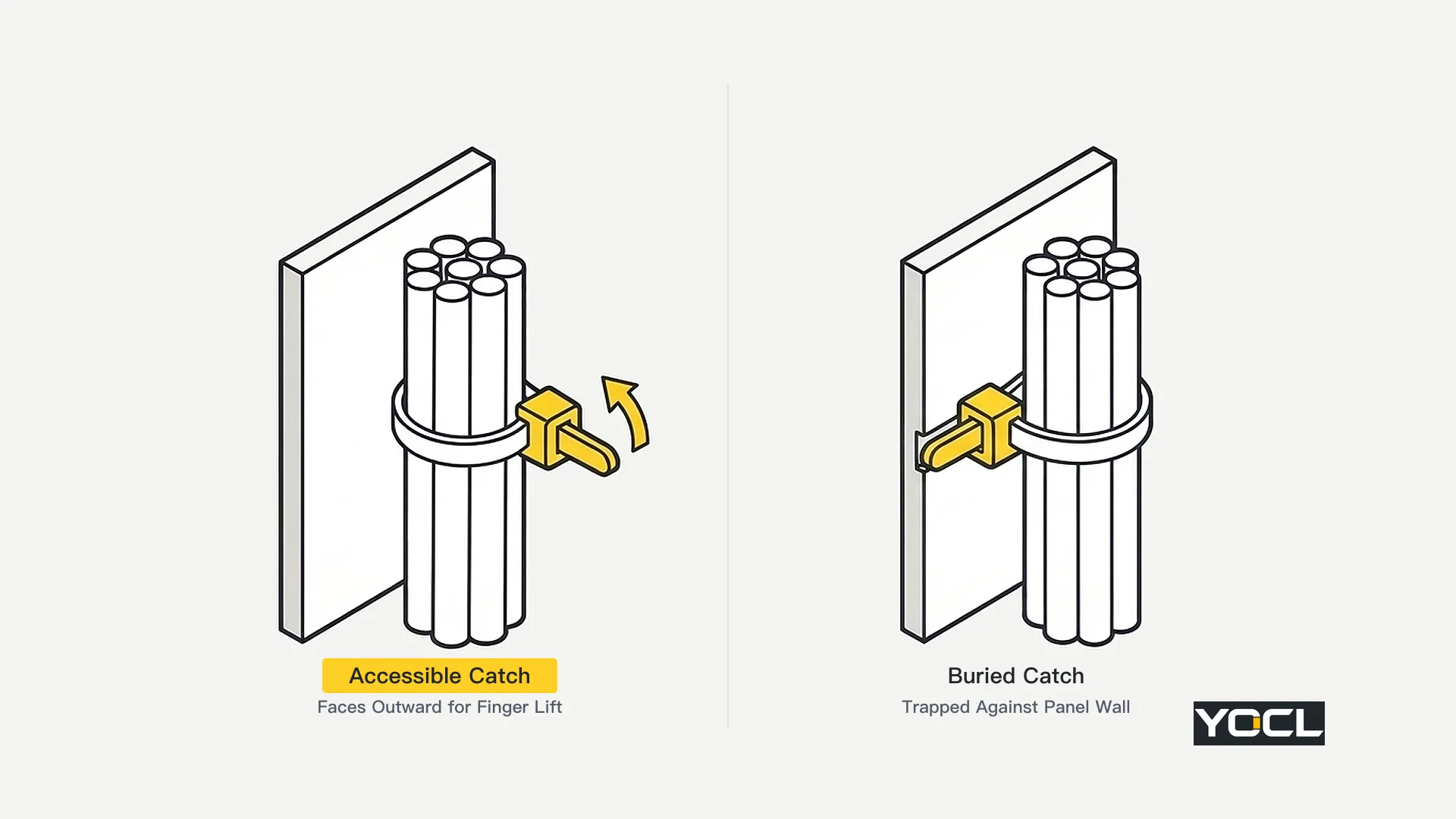
Keep three field habits in place during harness assembly:
- Leave the release catch accessible: Before snugging the loop, rotate the head so the finger catch or reverse-threaded tail faces outward toward the technician’s hand clearance. A catch pulled tight against a backplate, DIN-rail trough, or bulkhead corner cannot be lifted with a finger—turning a releasable tie back into a cut-off tie (if a trapped tie must be cut out, follow how to remove cable ties).
- Do not over-tension ties intended for cycling: Pull the strap snug by hand until the bundle is orderly without deforming the cable jackets or jamming the pawl deep against the serration root; where tensioning tools are used on permanent ties, see cable tie guns: how to choose and set tension. Also leave sufficient tail length beyond the head so you can grip and re-tension the strap on the next closure.
- Inspect and replace at end of life: Every time a tie is opened and re-closed, feel for positive pawl engagement and check that the loop holds tension without creeping backward. Any tie whose catch is bent, whose teeth are rounded, or that slips under hand pull has reached end of life and should be replaced immediately.
Frequently Asked Questions
How many times can a releasable cable tie be opened and closed?
No rated cycle count exists. YOCL’s HSS-RT, HSS-RCT, and HSS-RTI pages state explicitly that the supplied data does not specify a guaranteed number of reuse cycles. Because pawl wear depends on hand tension and release technique, inspect the locking engagement at each change and replace the tie whenever the strap slips or fails to hold tension.
Are releasable cable ties weaker than standard ties?
Compare the printed minimum tensile strength in the tables above against standard ties in the same width class rather than assuming a percentage difference. Hand-release series sit mostly at 40–75 lbf across 3.6–9 mm widths because the release mechanism occupies head space, while the 13 mm screw-mounted HSS-750 reaches 200 lb / 90 kgf—showing the compromise sits in the compact release head, not the Nylon 66 strap.
Can I use releasable cable ties outdoors?
All five YOCL releasable families are moulded from Nylon 66 (PA66), the same base polymer used in standard nylon cable ties. Within this group, only the YC series offers a UV black colour option alongside natural and black, and only the YC series publishes operating (−40 °C to +85 °C) and installation (−20 °C to +85 °C) temperature ranges; the pages publish no outdoor service-life duration claims.
Should I choose releasable nylon ties or hook-and-loop straps?
They are different product types built for different tasks. YOCL’s releasable families (HSS-RT, HSS-RCT, HSS-RTI, YC, and HSS-750) are moulded Nylon 66 pawl-and-tooth ties with published loop tensile figures from 40 lb to 200 lb and rigid bundle containment; YOCL publishes no hook-and-loop strap range within this releasable cable-tie family.
References
- YOCL ELECTRIC Product Information — HSS-RT Releasable Cable Ties: Nylon 66 finger-catch specifications, UL 94 V-2 material flammability classification, no-guaranteed-cycles note, and 9-model table (RT and RTA rows).
- YOCL ELECTRIC Product Information — HSS-RCT Releasable Cable Ties: Nylon 66 reverse-threading specifications, no-guaranteed-cycles note, and 4-model table (350–500 mm).
- YOCL ELECTRIC Product Information — HSS-RTI Releasable Lashing Cable Ties: Nylon 66 release-catch lashing specifications, UL 94 V-2 material flammability classification, and 5-model table (100–300 mm).
- YOCL ELECTRIC Product Information — YC Releasable Nylon Cable Ties: Nylon 66 RT-suffix specifications, operating (−40 °C to +85 °C) and installation (−20 °C to +85 °C) temperatures, natural/black/UV-black options, and 8-model table.
- YOCL ELECTRIC Product Information — HSS-750 Releasable Mountable Cable Tie: Nylon 66 750 × 13 mm screw-mountable releasable tie specifications (200 lb / 90 kgf tensile; screw and hole dimensions unspecified).