
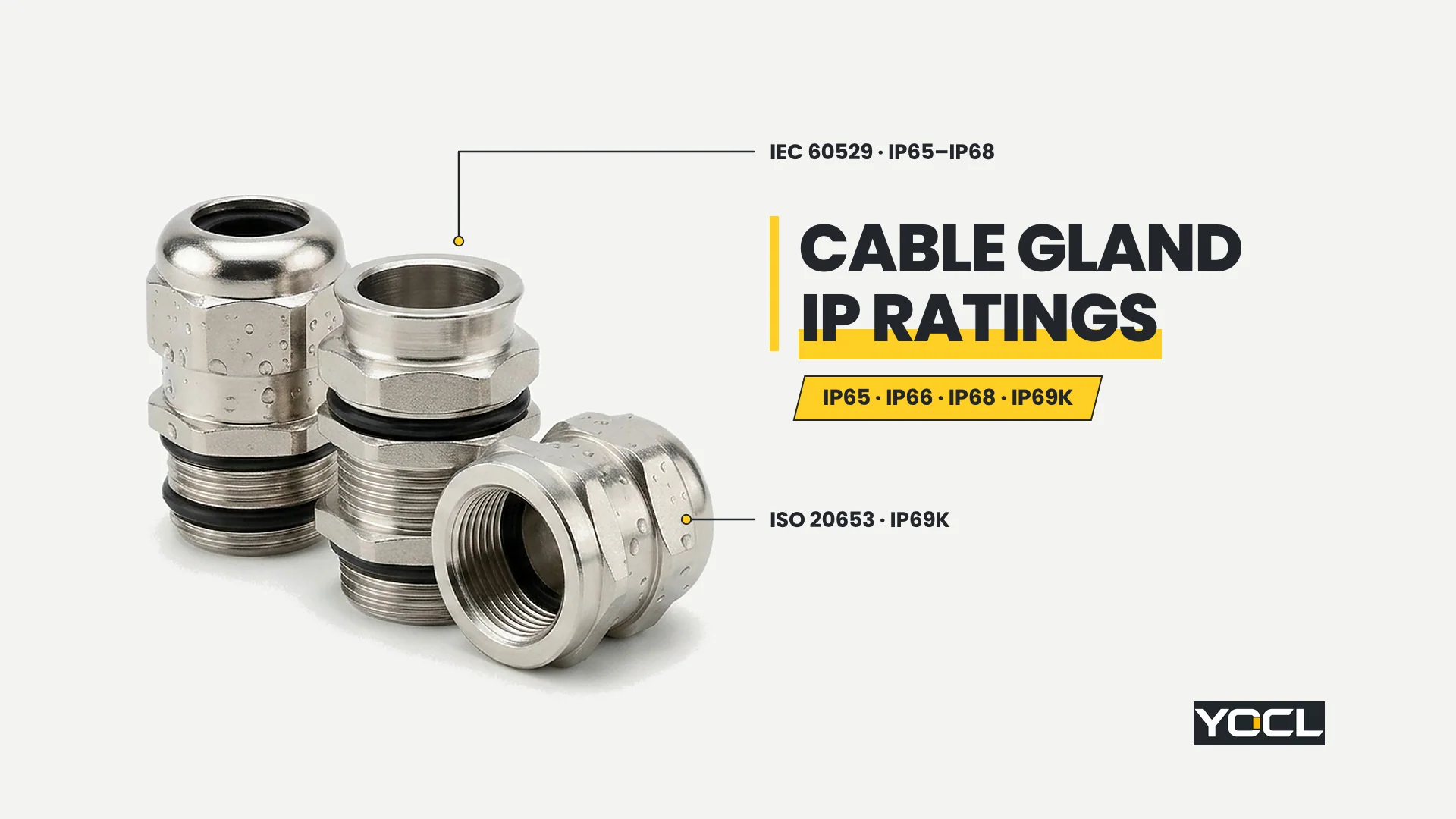
A classificação de bucim IP é um código de proteção de entrada de dois dígitos que define a estanqueidade ao pó e as condições de teste em água doce que uma entrada de bucim e caixa montada superou — sob IEC 60529 para códigos como IP65, IP66, IP67, IP68 e IPX9, ou sob ISO 20653 quando uma ficha técnica especifica IP69K.
Os compradores leem frequentemente os números de proteção como uma escala crescente única — assumindo que IP68 supera automaticamente IP66 em todos os ambientes húmidos, ou tratando uma etiqueta simples “IP68” numa folha de catálogo como uma especificação técnica completa. Nenhuma das suposições é válida ao abrigo das normas de teste subjacentes. Para manter os tópicos relacionados distintos, a anatomia básica do bucim pertence a o que é um bucim: tipos, peças e aplicações, o dimensionamento completo de roscas e materiais pertence a como escolher uma prensa-cabo, o diagnóstico de uma junta húmida em serviço pertence a porque é que o meu bucim está a verter: uma lista de verificação vedante a vedante, e a acumulação de humidade interna pertence a condensação em invólucros elétricos estanques.
Como ler os dois algarismos: um resultado de teste de montagem, não uma propriedade do material
Em IEC 60529, o código IP consiste nas letras IP seguidas por dois algarismos característicos independentes: o primeiro algarismo classifica a proteção contra objetos estranhos sólidos e poeiras, enquanto o segundo algarismo (de 0 para 9) graus de proteção contra a entrada de água.
Em bucins industriais, essa estrutura estabelece duas regras fundamentais antes de comparar quaisquer páginas de produtos:
- O primeiro numeral 6 significa estanque ao pó: Na escala de sólidos, o numeral 6 é o nível mais elevado possível — estanque ao pó. Uma vez que um vedante de compressão elastomérico e uma interface de rosca de entrada suficientemente apertados para bloquear água pressurizada ou imersão também bloqueiam o pó em suspensão, os bucins industriais estanques quase universalmente combinam 6 como o primeiro dígito (IP65, IP66, IP67, IP68, ou IP69) com o numeral de água que corresponde à exposição a humidade.
- Uma classificação pertence a um conjunto testado, nunca a metal ou polímero em bruto: O latão, o aço inoxidável e a poliamida não possuem uma classificação IP por si só. Um código IP é um resultado de teste laboratorial verificado numa entrada montada completa — o que significa que o corpo do bucim, o vedante de aperto elastomérico, o revestimento do cabo dentro da sua janela de diâmetro especificada, a interface da parede do invólucro e o vedante de rosca (quando necessário) atuam em conjunto. Altere as condições de montagem e sairá da configuração testada.
Tabela de Dígitos de Classificação IP de Bucins: IP65, IP66, IP67, IP68, IPX9 e IP69K
Comparar um classificação de bucim IP com outro requer a leitura do teste de água laboratorial exato por detrás do segundo numeral, em vez de adivinhar a partir de adjetivos de marketing como “resistente às intempéries” ou “submersível”. Todos os parâmetros de teste abaixo provêm diretamente da IEC 60529 (incluindo a Emenda 2, 2013 para IPX9) e ISO 20653 (para IP69K).
| Filiação de Códigos e Normas | Parâmetros de Teste de Água do Segundo Algarismo | Exposição em Contexto Real Correspondente | O que este código NÃO prova |
|---|---|---|---|
| IP65 (IEC 60529: Estanque ao pó + IPX5 jatos de água) | 6.3 mm bocal, 12.5 L/min fluxo de água, 2.5–3 m distance, 1 min per m² of enclosure surface, minimum 3 min | Driven rain, low-pressure hose-down, splash and general outdoor weather spray | High-volume washdown (IPX6), temporary or continuous immersion (IPX7 / IPX8), or hot high-pressure cleaning |
| IP66 (IEC 60529: Estanque ao pó + IPX6 powerful water jets) | 12.5 mm bocal, 100 L/min fluxo de água, 2.5–3 m distance, 1 min per m² of enclosure surface, minimum 3 min | Heavy Industrial hose washdown, powerful deck or outdoor storm spray, high-volume water jets (and includes IPX5) | Temporary or continuous standing-water immersion (IPX7 / IPX8) or close-range 80 °C high-pressure fan jets |
| IP67 (IEC 60529: Estanque ao pó + IPX7 temporary immersion) | 30 minutes immersion; for enclosures under 850 mm high, the lowest point sits 1 m below the water surface | Brief accidental flooding, shallow sump rise, or short-term standing water | Resistance to hose spray or powerful water jets (IPX5 / IPX6), or continuous immersion beyond 30 min / 1 m |
| IP68 (IEC 60529: Estanque ao pó + IPX8 continuous immersion) | Conditions agreed between manufacturer and user, and must be more severe than IPX7 (standard fixes não single depth or duration) | Continuous or deeper static water immersion strictly within the manufacturer’s stated pressure/depth and seal conditions | Water-jet or pressure-wash resistance (IPX5 / IPX6 / IPX9)—and means little if no conditions are stated |
| IP69 / IPX9 (IEC 60529 Amendment 2, 2013: high-pressure, high-temperature jets) | Fan-jet nozzle, water at 80 ±5 °C, close range, sprayed at 0° / 30° / 60° / 90° para 30 s each on small enclosures | Close-range hot high-pressure hygienic or industrial washdown specified to IEC 60529 | Continuous water immersion (IPX8) unless dual-coded, or automatic equivalence with an ISO 20653 automotive spec |
| IP69K (ISO 20653, descending from DIN 40050-9 — descreve an IEC 60529 numeral) | Hot high-pressure close-range jet test under the ISO 20653 road-vehicle standard lineage | Washdown and mobile/industrial equipment specifications citing ISO 20653 / IP69K | Standing-water immersion (IPX7 / IPX8), or interchangeability with IEC 60529 without checking which standard the datasheet cites |
Regra de Seleção: Match the second numeral to the physical water mechanism—impinging momentum jets (5 / 6), static hydrostatic head (7 / 8), or close-range 80 °C washdown (IPX9 under IEC 60529 or IP69K under ISO 20653)—and require dual coding whenever two mechanisms occur on the same site.
Notice the strict standards distinction at the bottom of the table. IPX9 was added to IEC 60529 by Amendment 2 (2013), whereas IPX9K (almost always written on cable glands as IP69K) belongs to a different standard altogether: ISO 20653 for road vehicles, whose K suffix descends from DIN 40050-9. Although both tests direct close-range, high-temperature, high-pressure water jets at the specimen, IPX9 e IPX9K are not interchangeable codes—always check the supplier’s datasheet to see whether it cites IEC 60529 ou ISO 20653, and never describe IP69K as an IEC 60529 numeral.
The Ladder Break: Why IP68 Does Not Include IP66
The single most expensive mistake in cable-gland specification is assuming that IP68 automatically covers IP65 e IP66. Under IEC 60529, the water scale breaks into separate branches above numeral 6: immersion ratings do not imply water-jet compliance.
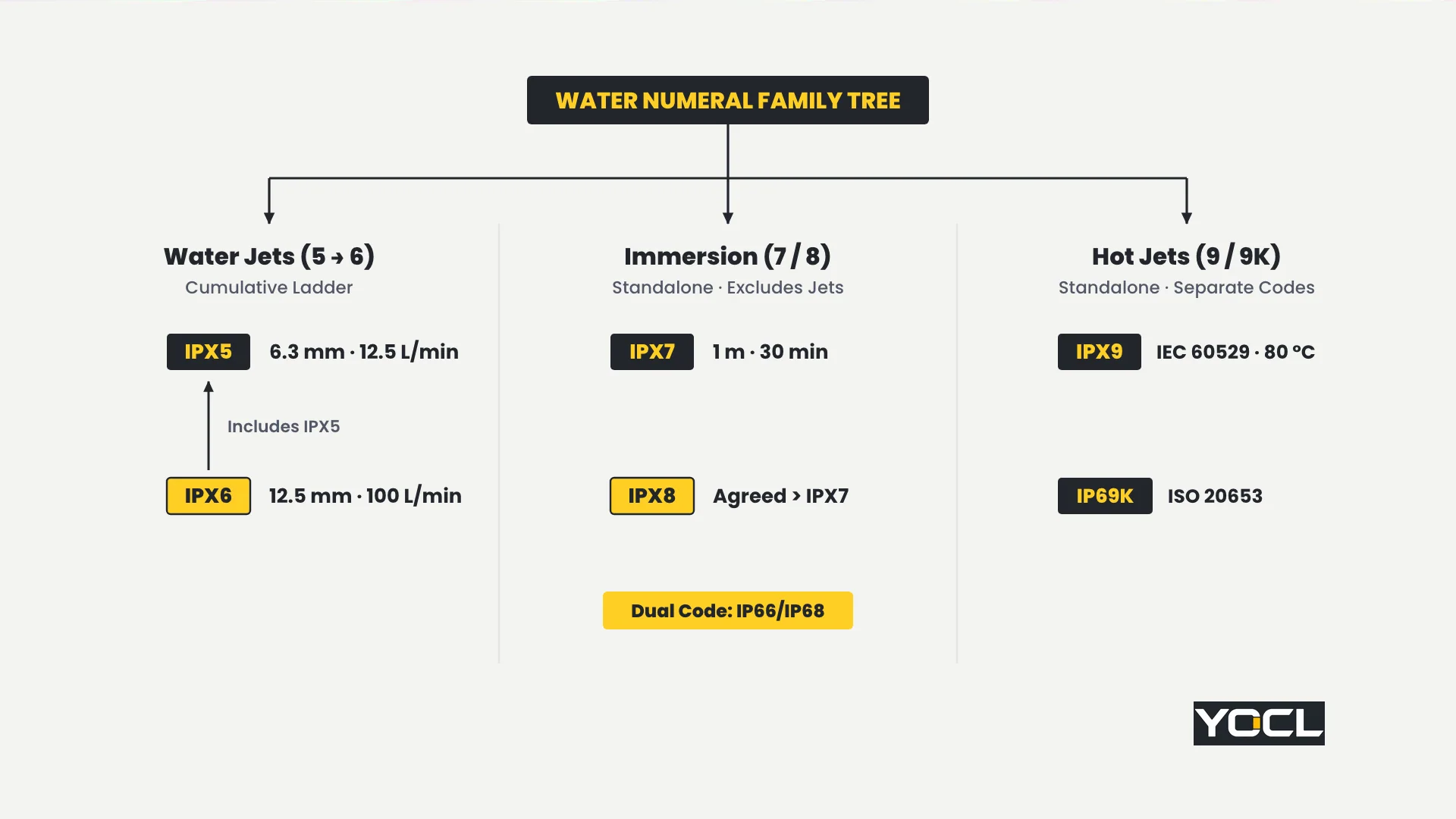
Here is the exact IEC 60529 ladder rule and why it governs real-world gland selection:
- Up to and including numeral 6, higher numerals include lower ones: A gland assembly tested and marked IP66 (12.5 mm nozzle at 100 L/min) automatically satisfies IP65 (6.3 mm nozzle at 12.5 L/min) as well as lower drip and spray numerals beneath it. Within the jet ladder, stepping up from 5 to 6 genuinely means more severe protection of the same kind.
- Numerals 7, 8, and 9 stand alone: Under IEC 60529, an item coded only IPX7 ou IPX8 is considered unsuitable for exposure to water jets (such as IPX5 ou IPX6) unless it has also been tested for jets and carries a dual code. Physically, static immersion (IPX7 / IPX8) applies steady omnidirectional hydrostatic pressure around a seal at rest, whereas a 100 L/min water jet (IPX6) or an 80 ±5 °C close-range fan jet (IPX9) hammers one side of the seal lip with high-velocity dynamic impact and thermal shock. A seal geometry that holds steady static head does not automatically resist dynamic jet deflection, and vice versa.
- The dual-coding consequence (IP66/IP68): Whenever a cable entry faces both impinging spray—such as outdoor wind-driven rain or routine hose washdown—e potential flooding or submergence, neither a standalone IP66 rating nor a standalone IP68 rating covers both hazards. The specification must call for dual coding, written as IP66/IP68 (or triple/dual combinations with IP69 where hot washdown also applies), proving that both separate test regimes were passed.
Why IP68 Is a Claim With Conditions: Lessons From Three YOCL Series
Unlike IPX5, IPX6, e IPX7—where IEC 60529 fixes the exact nozzle, flow rate, distance, depth, and time—IPX8 tem no fixed depth or duration in the standard. IEC 60529 states only that IPX8 test conditions are agreed between manufacturer and user and must be more severe than IPX7. Consequently, an IP68 claim without its conditions stated is incomplete information.
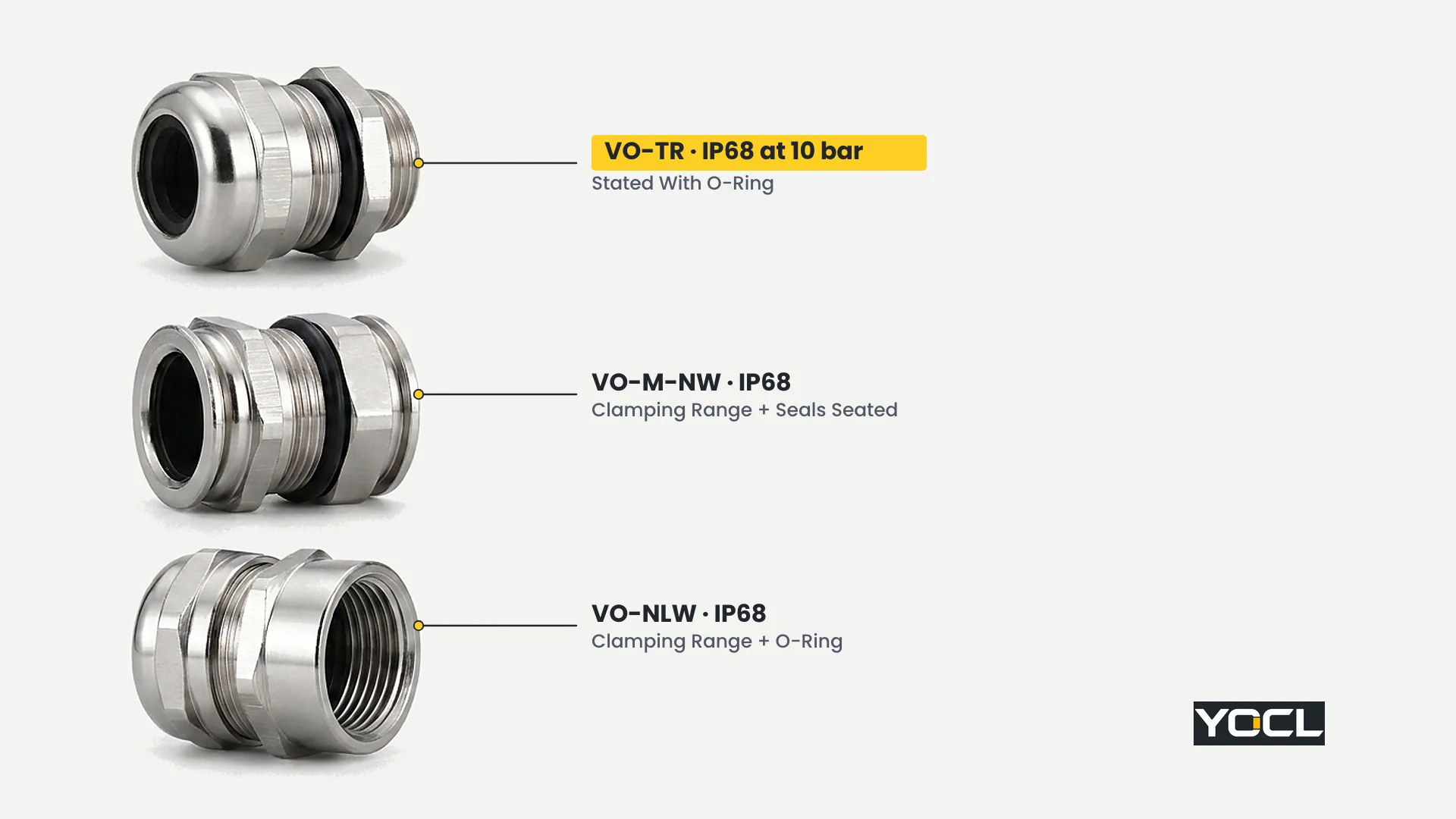
Examining the exact published wording on three YOCL ELECTRIC metal cable-gland pages shows how to read conditioned statements—and how to separate a catalogue claim from test-report evidence:
- Pressure plus hardware condition stated — VO-TR metal cable glands: YOCL’s VO-TR catalogue page states IP68 protection at 10 bar when the O-ring is used. Because IPX8 leaves severity open in IEC 60529, stating both the pressure (10 bar) and the required sealing hardware (with O-ring) supplies the severity parameter and assembly configuration that turn “IP68” from an open label into a concrete claim.
- Clamping-window and seal-seating condition stated — VO-M-NW metal internal and external thread cable glands: YOCL’s VO-M-NW page states: “IP68 protection grade: stated for installation within the specified clamping range with the seals correctly seated.” That wording makes explicit that the rating applies only when the installed cable diameter falls inside the model’s clamping window and the internal seals sit properly in their seats—while also showing a buyer that depth or duration would still need to be confirmed if continuous submergence at a specific head is planned.
- Assembly condition stated plus honest evidence transparency — VO-NLW internal-thread metal cable glands: YOCL’s VO-NLW page reports catalogue-stated IP68 conditioned on using a cable within the specified clamping range and properly seating the O-ring—and candidly adds on the page itself: “No test report was supplied with the images.”
That single sentence on the VO-NLW page captures the most practical procurement rule in this entire guide: a stated IP rating on a product page or catalogue sheet is a claim; the laboratory test report is the evidence behind it. Whenever a project requires verified continuous-immersion performance, high-pressure jet survival, or third-party sign-off, ask the supplier for two things before ordering: the exact test conditions (depth/pressure, duration, and mounting setup) and the corresponding test report. A bare “IP68” printed with no conditions and no report is a marketing label, not an engineering specification.
The Rating Belongs to the Installed Gland: Clamping Range and Seal Seating
Notice the condition shared across every YOCL statement above: within the specified clamping range e with the O-ring / seals properly seated. Even a gland backed by a complete laboratory report holds its IP rating only when installed in the same mechanical state that was tested.
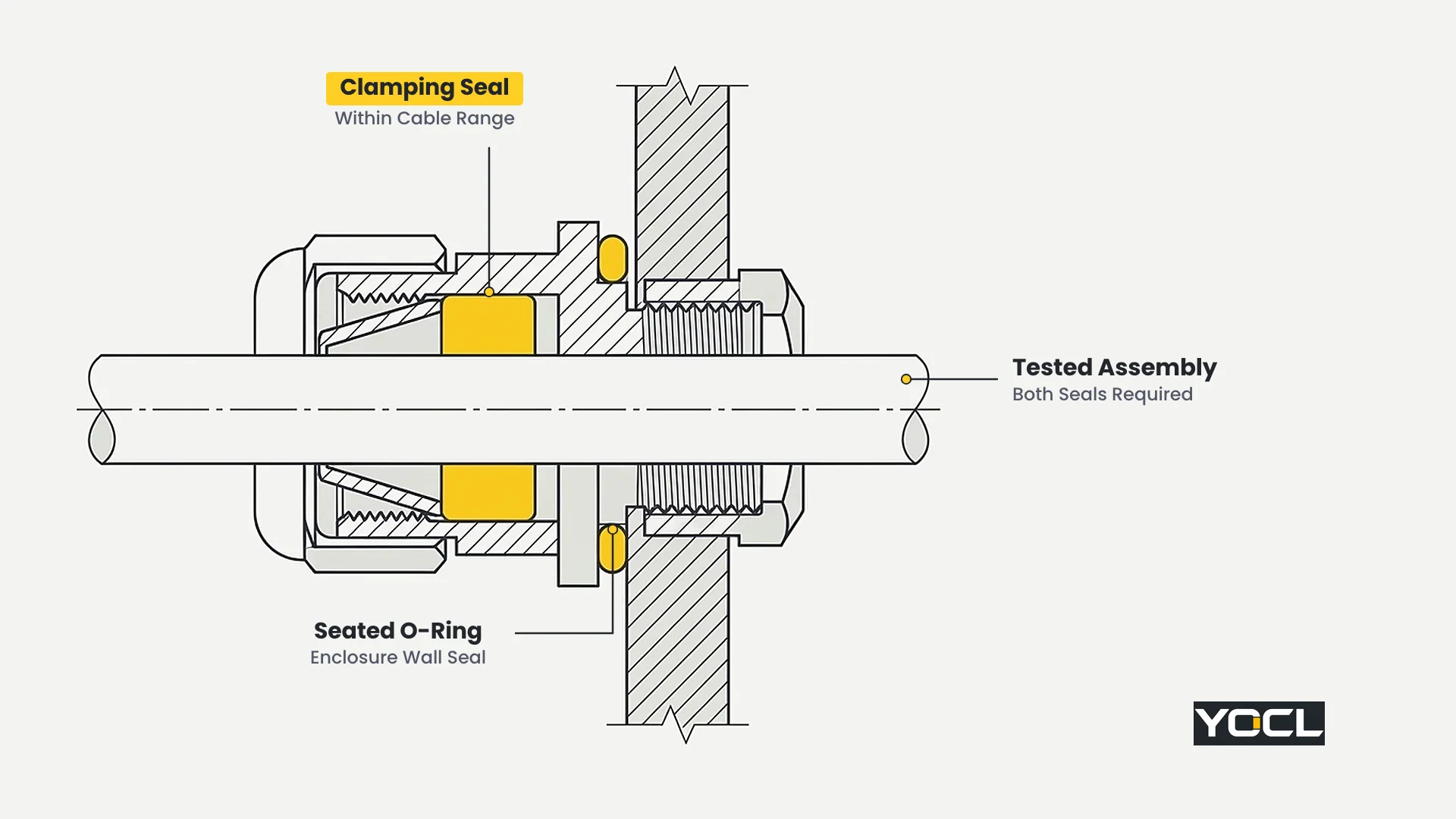
Every cable entry must close two distinct water paths simultaneously—around the cable jacket and through the enclosure knockout or threaded hole. If a technician installs an undersized cable below the gland’s minimum clamping diameter, forces an oversized or out-of-round cable through the insert, omits the entry-thread O-ring on a clearance hole, or pinches the O-ring out of its groove against a rough enclosure face, the installed assembly no longer matches the tested configuration and the stated IP rating no longer applies in practice. (If an existing installation is already letting water in, work through porque é que o meu bucim está a verter: uma lista de verificação vedante a vedante.)
Choosing by Exposure — and Knowing Where IP Stops
To choose the right classificação de bucim IP without over-paying for the wrong test or leaving a blind spot in wet service, map the actual water exposure on site first (and pair that choice with thread, body material, and cable-diameter selection in como escolher uma prensa-cabo):
- Outdoor rain, splash, and routine hose spray: Choose from the cumulative water-jet ladder—IP65 (6.3 mm bocal, 12.5 L/min) for light spray and weather, or IP66 (12.5 mm bocal, 100 L/min) where heavy storm spray or powerful industrial hose washdown occurs.
- Close-range hot high-pressure washdown: Require IPX9 (IEC 60529, 80 ±5 °C fan jet at 0°/30°/60°/90°) or IP69K (ISO 20653, checking which standard the project specification cites) in addition to the required jet or immersion rating.
- Standing water, flooded pits, or submergence risk: Escolha IP67 (1 m para 30 min on enclosures under 850 mm high) for brief accidental flooding, or IP68 with explicit pressure/depth and seal conditions stated for continuous immersion—and require dual coding (such as IP66/IP68) if the gland is also exposed to rain spray or hose jets above water.
- Clean, dry indoor control panels: Where liquid spray and flooding are absent, the first numeral (6 = dust-tight) for conductive dust exclusion and mechanical strain relief matters far more than chasing high water numerals.
Finally, respect the strict scope limit of IEC 60529: every IP water test uses clean fresh water over a short laboratory window and says nothing about UV ageing, salt or chemical corrosion, mechanical impact, or internal condensation. An IP66 or IP68 code is never an outdoor-lifespan rating—and sealing an outdoor enclosure airtight at IP68 does not stop humid internal air from cooling below its dew point overnight; for managing pressure differentials and moisture inside tight boxes, see condensação em invólucros elétricos estanques.
Perguntas Frequentes
Is IP68 better than IP66 on a cable gland?
No—they test completely different water mechanisms. Under IEC 60529, IP66 tests high-volume dynamic water jets (12.5 mm bocal, 100 L/min), whereas IP68 tests continuous static water immersion under manufacturer-stated conditions. Because numerals 7 e 8 stand outside the cumulative jet ladder, IP68 does not include IP66. Choose by actual site exposure, or specify dual-coded IP66/IP68 when both jets and immersion apply.
What does IP69K mean on a cable gland datasheet?
IP69K comes from ISO 20653 (the road-vehicle ingress standard whose K line descends from DIN 40050-9), testing resistance to close-range, high-pressure, high-temperature water jets. It is descreve an IEC 60529 code—IEC 60529’s comparable hot fan-jet test (80 ±5 °C at 0°/30°/60°/90°) is written IP69 (IPX9). Because the two standards are not interchangeable, check which standard the supplier’s datasheet cites.
My cable gland says IP68 — can it handle pressure washing?
Not on the basis of an IP68 code alone. Under IEC 60529, an assembly marked only IPX7 ou IPX8 is considered unsuitable for water jets unless it is also tested and dual-marked for jets. Hose and washdown spray belong to IP65 / IP66, and close-range hot high-pressure cleaning belongs to IEC 60529 IP69 ou ISO 20653 IP69K.
Does an IP68 rating mean a cable gland is waterproof forever?
No. An IP rating is a fresh-water test result achieved on a newly assembled gland under stated conditions (such as YOCL’s VO-TR rating of IP68 at 10 bar with O-ring, ou VO-M-NW e VO-NLW within their specified clamping ranges with seals properly seated). IEC 60529 does not test UV weathering, chemical attack, thermal cycling, or elastomer compression-set ageing over years in service.
Referências
- IEC 60529 (including Amendment 2, 2013) — Degrees of protection provided by enclosures (IP Code): first-numeral dust-tight (6) and second-numeral water test definitions for IPX5, IPX6, IPX7, IPX8, IPX9, and the cumulative vs standalone numeral rules.
- ISO 20653 (descending from DIN 40050-9) — Road vehicles — Degrees of protection (IP code) — Protection of electrical equipment against foreign objects, water and access: standard lineage for IPX9K / IP69K hot high-pressure jet testing.
- Informação do Produto ELÉTRICO YOCL — VO-M-NW Prensa-cabos metálicos com rosca interna e externa: IP68 protection grade stated for installation within the specified clamping range with seals correctly seated.
- Informação do Produto ELÉTRICO YOCL — VO-TR Metal Cable Glands: catalogue-stated IP68 protection at 10 bar when the O-ring is used.
- Informação do Produto ELÉTRICO YOCL — VO-NLW Garras de Cabo Metálicas com Rosca Interna: catalogue-stated IP68 conditioned on cable within the specified clamping range and properly seated O-ring, with explicit note that no test report was supplied with the images.