
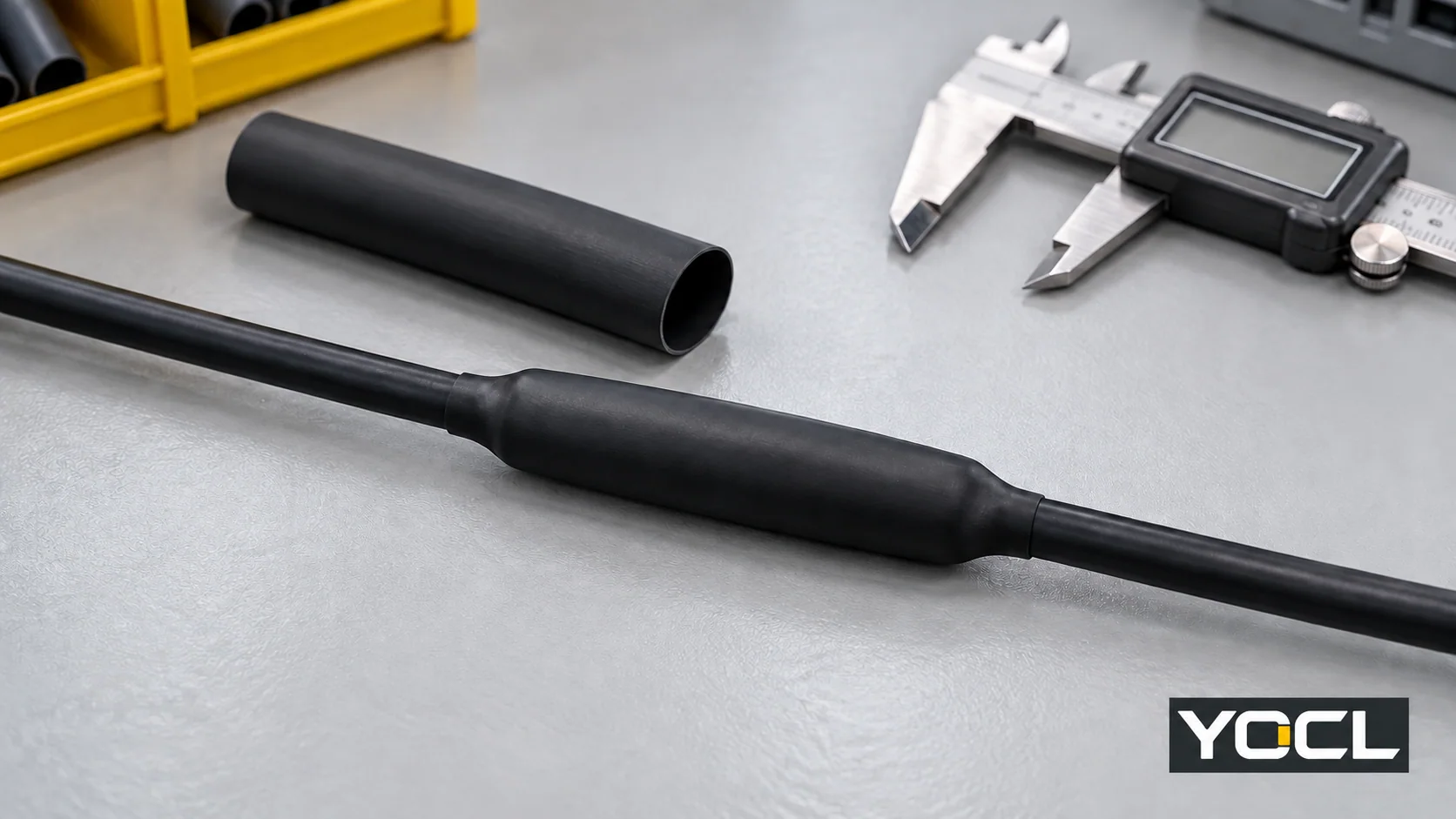
اختر أنبوب الانكماش الحراري الذي يمر فوق أكبر جزء من الوصلة، ويستعيد شكله تحت أصغر قطر للتركيب، ويحافظ على التغطية المطلوبة بعد الانكماش. قم بقصه وتحميله مسبقًا قبل إغلاق الوصلة، وقبل الوصلة الكهربائية، ضع الأنبوب، ثم قم باستعادته باستخدام عملية التسخين المحددة، ثم قم بالتبريد والفحص وإكمال اختبارات التجميع المطلوبة.
تغطي هذه الإجراءات وصلة مستقيمة مدمجة محددة. أنابيب الانكماش الحراري يوفر العزل أو الحماية المحددة؛ لا يقوم بالاتصال الكهربائي. تحتاج الوصلات المحمية، والمتعددة النوى، والجهد المتوسط أو العالي إلى تعليمات تجميع خاصة بها. الأنبوب المنكمش بإحكام ليس دليلاً على أن الوصلة مقبولة كهربائيًا أو مختومة بيئيًا.
1. تأكيد تعليمات العمل والعزل
قبل قطع الكابل أو تطبيق الحرارة، احصل على رسم الوصلة، وتعليمات الربط، وبيانات الأنبوب الدقيقة، وعملية التطبيق، ومتطلبات القبول. اعمل على دائرة معزولة تم التحقق من فصلها عن الطاقة وفقًا لإجراءات المعدات والموقع. في U.S. أماكن العمل،, OSHA 1910.333(b) يحدد إجراءات القفل/وضع العلامات والتحقق من قبل شخص مؤهل.
استخدم سجل وظيفة لربط القياسات بقرار القبول النهائي:
| التسجيل قبل البدء | القرار الذي يتحكم فيه |
|---|---|
| تحديد الكابل/الغلاف، الوصلة، والأكمام | توافق المواد والتعليمات المطبقة |
| أكبر ميزة في مسار إدخال الغلاف | القطر الداخلي المطلوب المزود |
| أقطار خارجية للهبوط الأيسر والأيمن | الاستعادة المطلوبة على كلا الجانبين |
| امتداد الوصلة والتداخل المحدد على كل جانب | الحد الأدنى للتغطية النهائية |
| الواجب الكهربائي والبيئة والمساحة المتاحة | الملاءمة الإنشائية والجدارية والتجميعية |
| تعليمات التسخين والتبريد والقبول | حدود العملية وفحوصات الإصدار |
توفر أدوات القياس المناسبة، وقاطع، وأدوات الربط المحددة، ومصدر حرارة متحكم فيه مسموح به. احتفظ بالعمل إذا كان هناك تعليمات مطلوبة أو معيار قبول مفقود.
2. اختر البناء وتحقق من كلا القطرين
اختر البناء للمهمة المحددة. نطاق أنابيب الانكماش الحراري من YOCL يشمل أنابيب الجدار المفرد HTS وأنابيب مبطنة باللاصق HS3X/HS4X. يمكن أن تخدم الأكمام غير المبطنة متطلب العزل/الحماية؛ تتطلب الأكمام المبطنة باللاصق واجهة غلاف متوافقة وعملية تطبيق تم التحقق منها عند الحاجة إلى الختم. استخدم دليل الجدار المفرد مقابل الجدار المزدوج إذا ظل هذا القرار غير محسوم.
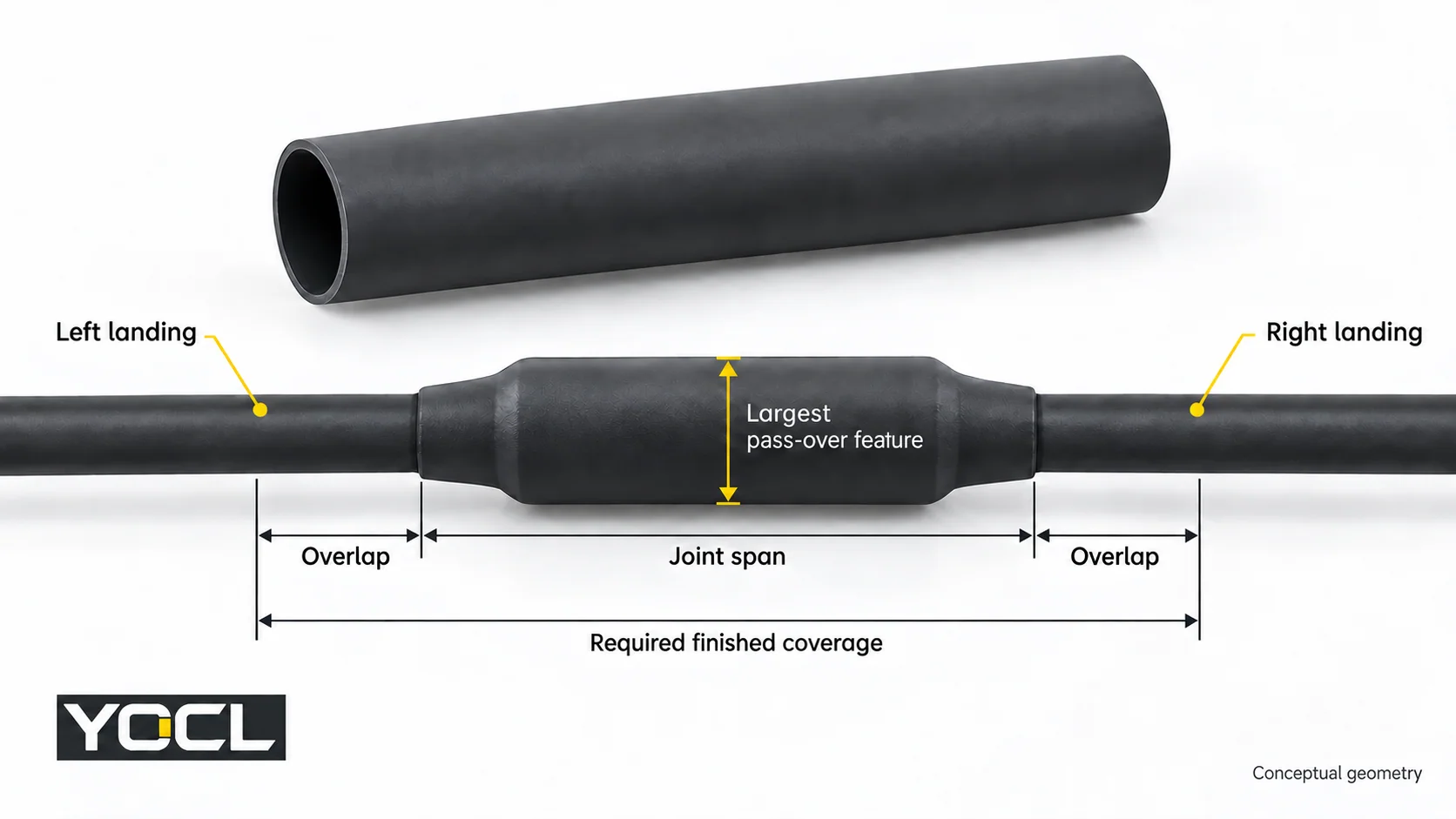
قم بقياس مسار الإدخال الكامل، بما في ذلك أي كتف موصل يجب أن تعبره الأكمام. سجل كلا القطرين الهابطين بشكل منفصل؛ مساحة المقطع العرضي للموصل ليست قطر غلاف. تحقق من الحد الأدنى للقطر الداخلي المزود مقابل أكبر ميزة تجاوز والحد الأقصى للقطر الداخلي المسترد مقابل أصغر هبوط.
يظهر مبدأ الأكبر قبل/الأصغر بعد في KSC-E-165 المراجعة F، §3.8.1.1.1(أ), ، وهو مواصفات لمعدات التحكم والمراقبة الأرضية KSC. يدعم هذه الشاشة البعدية، وليس هامش تثبيت عالمي.
على سبيل المثال، افترض 7.4 mm أكبر ميزة تجاوز و 4.0 mm أصغر هبوط. الجدول الحالي YOCL HS3X يعطي:
| HS3X nominal size | Supplied ID | Recovered ID | Preliminary result |
|---|---|---|---|
| 6.4 mm | ≥6.4 mm | ≤2.2 mm | Guaranteed supplied minimum does not clear 7.4 mm |
| 9.5 mm | ≥9.5 mm | ≤3.2 mm | Clears both basic diameter checks |
The 9.5 mm row is a dimensional candidate, not an approved sealed splice. Confirm the required insertion allowance, tolerances, wall/space, duty and jacket compatibility. Consult the size chart for other rows; use the shrink-ratio comparison when passage and landing geometry demand another ratio.
3. Determine cut length and preload the sleeve
Finished coverage must include the joint span and the specified overlap on each side. Allow for longitudinal change using the applicable process data. Do not substitute an arbitrary extra-length percentage or a laboratory axial-change value for an established installation allowance.
Where the instructions establish a maximum shortening fraction s, a planning calculation is:
Minimum cut length = (joint span + left overlap + right overlap) ÷ (1 − s)
Use the specified overlap and validated s for that application, round up to the permitted cut length, and verify actual coverage after cooling. If those inputs are unknown, the calculation cannot release the sleeve for cutting.
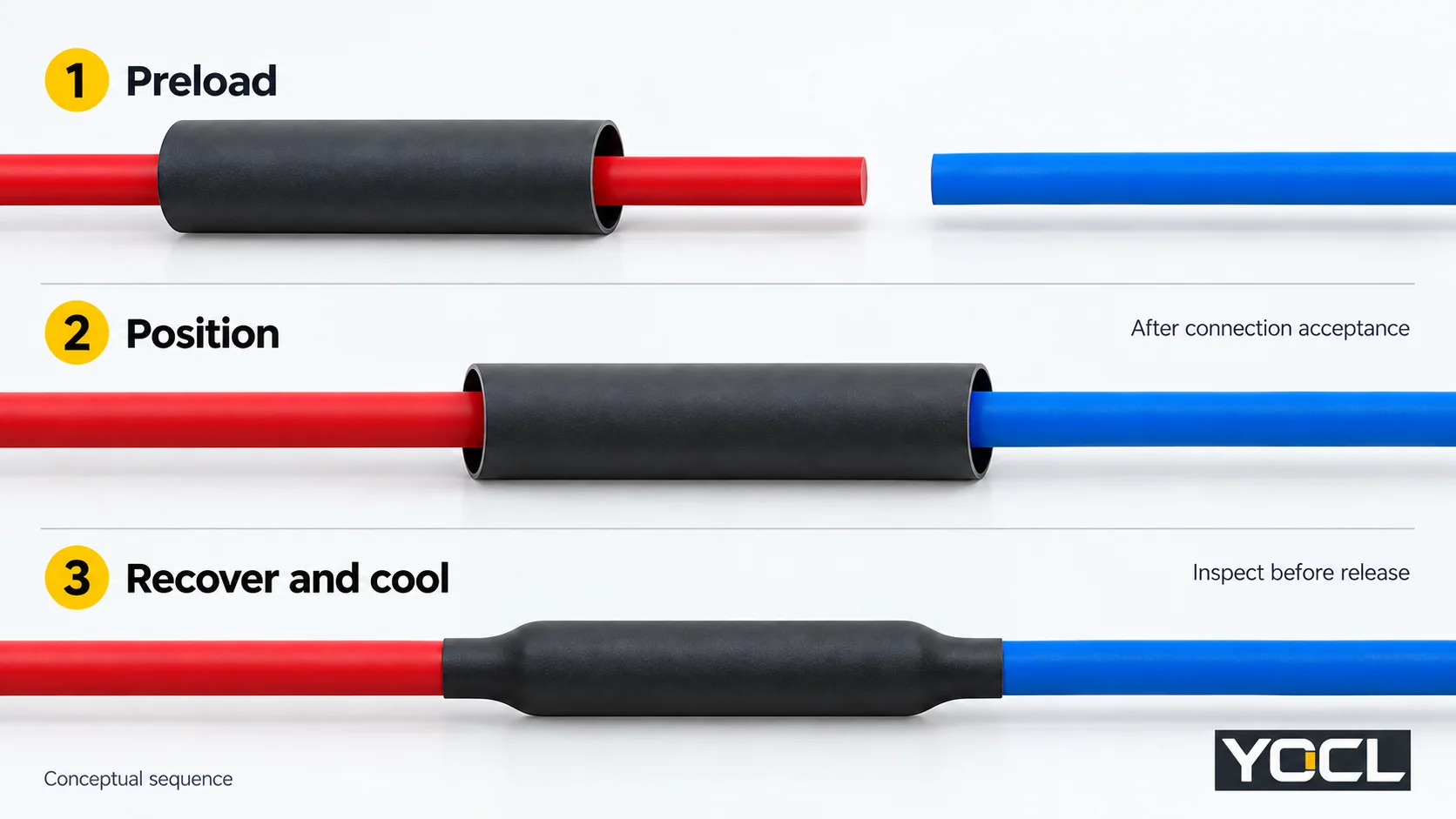
YOCL’s HTS installation notes direct cutting to the required length and sliding tubing on before completing the connection when necessary. Preload the selected sleeve while access remains. Park it clear of the connection-making area under the joining instructions.
If access has been closed without preloading, stop for an approved correction; slitting a standard closed tube does not make it an approved wraparound sleeve.
4. Complete and accept the connection before covering it
Make the splice using its specified connector, conductor combination and joining procedure. Complete the required connection inspection before the sleeve conceals the joint. A failed or undocumented connection remains on hold even if the tubing fits.
Prepare the landing surfaces according to the selected jacket, sleeve and adhesive instructions. If they require cleaning, priming or drying, follow those material-specific directions. Do not improvise a solvent or abrasion method. For an adhesive-lined sealing job, unresolved surface compatibility or preparation means the sleeve is not ready for application.
5. Position the sleeve to the drawing
Move the sleeve into its specified position and check coverage at both ends.
Expected result: the joint and both required landing overlaps lie within the intended finished coverage. Reposition before heating if one end lacks coverage; extra material on the other end does not satisfy that requirement.
6. Recover with the specified heating process
HTS requires uniform recovery with controlled, even heat; other models need their applicable process.
Use the heat source, heating sequence, exposure limits and completion criteria established for the actual assembly. A catalogue shrink temperature is not a heat-gun dial setting, nozzle distance or dwell time. If these process requirements are unresolved, obtain the applicable instructions before heating.
NASA-STD-8739.4A Change 4, §9.9, in its NASA mission-hardware scope, ties heat and exposure to tubing size/type and requires protection of the covered item and nearby heat-sensitive parts. These are useful workmanship boundaries; they do not establish settings for a YOCL splice.
Hold the assembly if the specified recovery cannot be completed within its thermal limits or visible heat damage develops.
7. Cool and inspect the application
Let HTS cool before handling; follow the selected assembly’s cooling and inspection instructions. Check:
- Position and actual finished coverage against the drawing.
- Uniform recovery and grip where required.
- Cracks, punctures, blisters or burned areas, plus damage to the cable jacket.
- Any model-specific adhesive and interface acceptance criteria.
NASA-STD-8739.4A §§9.10–9.11 provide scoped examples of positioning, recovery/grip and visible defect checks. Appearance alone does not establish electrical performance or a complete hidden adhesive bond. An adhesive bead can be a specified local process cue; by itself it does not prove an environmental seal.
Route defects or unresolved sealing to the applicable rework process. The split-or-fail-to-seal guide explains the separate diagnosis task; do not keep reheating without authorized rework instructions.
8. Complete the release record before restoration
Record three separate decisions: connection accepted, sleeve workmanship accepted, ، و required assembly tests passed. Enter the cable/splice and sleeve identification, measured coverage, process reference and test results. A missing seal-verification requirement cannot be replaced with “looks tight.”
Complete the specified electrical and, where required, environmental acceptance tests using the assembly procedure. Hold failed or incomplete results. Restore service only through the equipment/site authorization process; OSHA 1910.333(b)(2)(v) sets out restoration checks for its U.S. workplace scope.
For YOCL model selection, provide the pass-over dimension, both landing diameters, required coverage, jacket material and duty when requesting the applicable tubing and process documentation. That information turns a catalogue size candidate into a reviewable application choice.
المراجع
- OSHA — 29 CFR 1910.333, electrical work practices, verification and restoration.
- YOCL — Heat Shrink Tubing, current product families.
- NASA KSC — KSC-E-165 Revision F, §3.8.1.1.1(a), dimensional selection.
- YOCL — HS3X 3:1 Dual-Wall Tubing, supplied/recovered size table.
- YOCL — HTS 2:1 Single-Wall Tubing, Installation Notes.
- NASA — NASA-STD-8739.4A Change 4, §§9.9–9.11, heating and workmanship.