
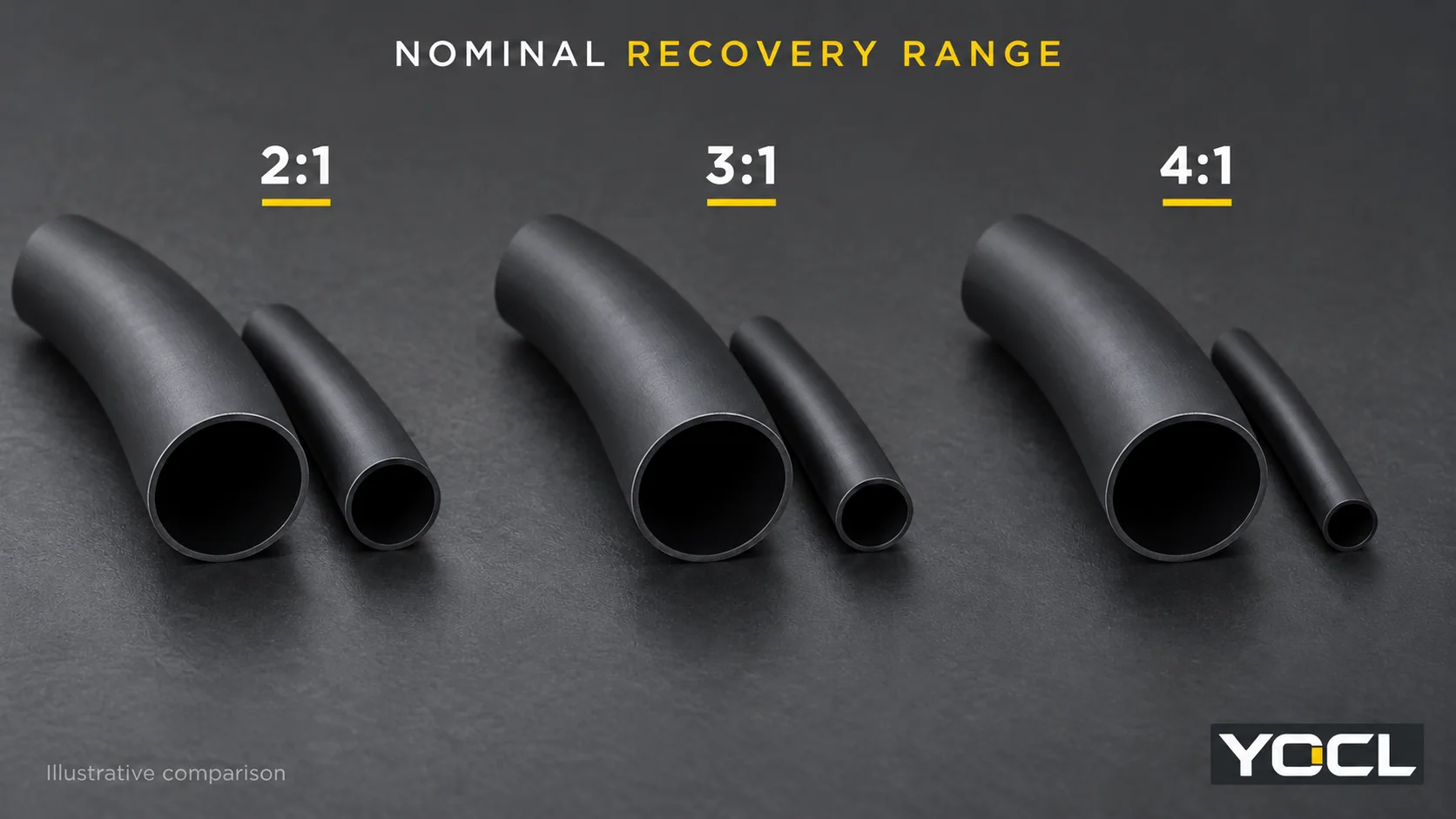
اختر نسبة الانكماش من انتقال القطر الذي يجب أن تسده الأنبوب. يجب أن تسمح الفتحة المزودة بأكبر ميزة، ويجب أن تكون فتحتها المستعادة بحرية أصغر من أضيق سطح تحتاج إلى الإمساك به. يمكن لحجم 2:1 المناسب إكمال هذه المهمة بالفعل. ضع في اعتبارك 3:1 أو 4:1 عندما تتطلب الأبعاد الفعلية نطاق استعادة أوسع.
النسبة الأعلى وحدها لا توفر مادة لاصقة أو اتصالًا محكمًا أو تصنيفًا كهربائيًا أعلى. قارن الهندسة أولاً، ثم تحقق من بناء المنتج الدقيق وواجباته.
قارن 2:1 و 3:1 و 4:1 على نفس الهندسة
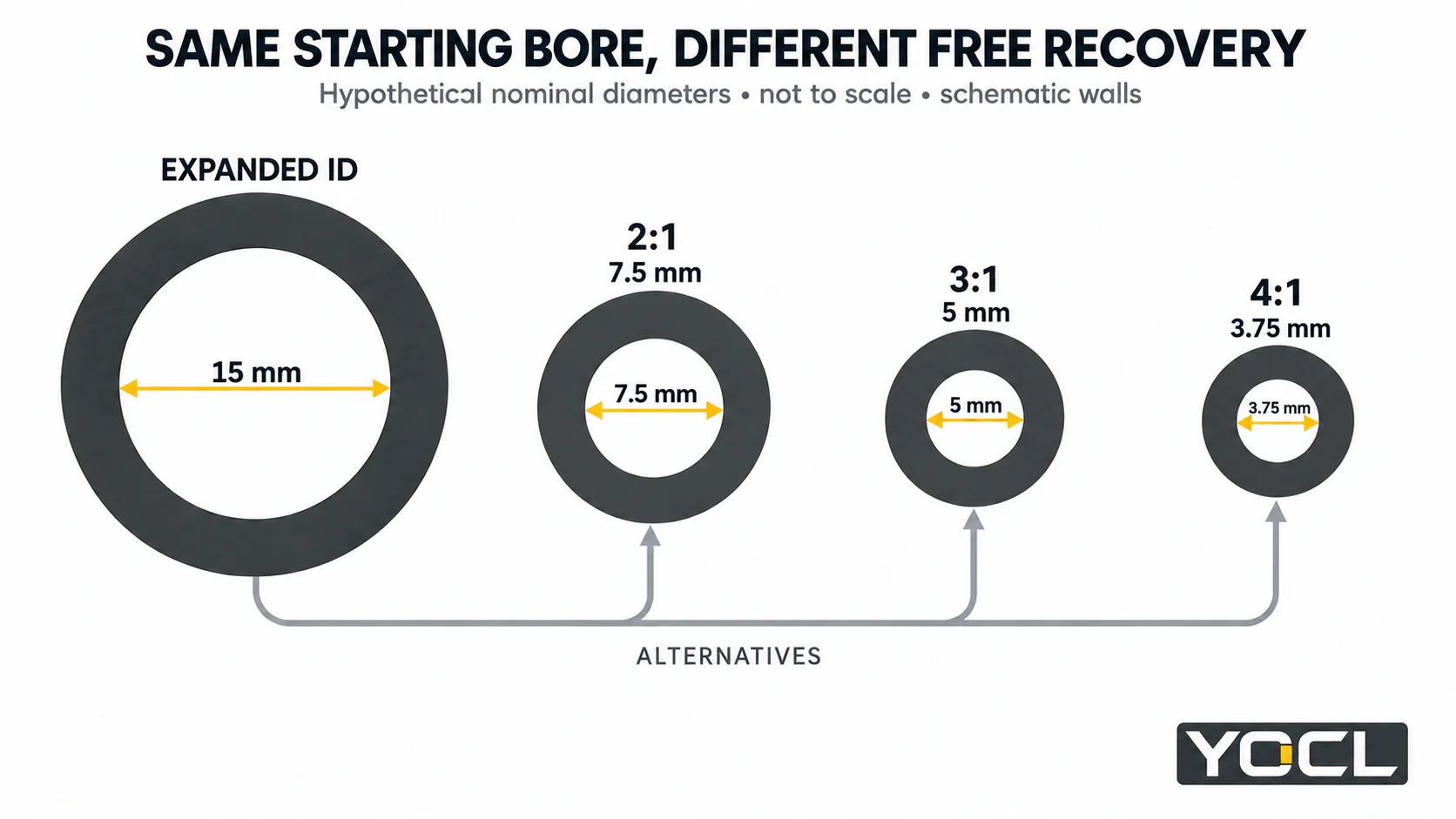
تصف نسبة الانكماش العلاقة الاسمية بين القطر الداخلي الموسع (ID) و القطر الداخلي المستعاد بحرية. للحسابات المثالية:
معرف الاسترداد الحر = المعرف الموسع ÷ رقم النسبة
بنفس فتحة التمدد الافتراضية 15 mm، 2:1 تعطي 7.5 mm، 3:1 تعطي 5 mm، و4:1 تعطي 3.75 mm. هذه نقاط نهاية توضيحية بدون جسم داخلي يقيد الاسترداد، بدلاً من أبعاد مضمونة لثلاثة منتجات في الكتالوج. تصف النسبة استرداد القطر؛ فهي لا تقسم طول القطع أو تحدد عدد الجدران. الـ دليل مصطلحات أنابيب الانكماش الحراري يشرح تلك الحقول المنفصلة.
الآن أمسك بأكبر ميزة دائرية يجب أن تمر الأنبوبة فوقها عند 13 mm قطر خارجي (OD). قم بتغيير السطح الدائري الأصغر فقط حيث يجب أن تستقر. تبدأ الأكمام الافتراضية الثلاثة بنفس الفتحة 15 mm، لذا فإن المقارنة تعزل نطاق استردادها.
| أصغر قطر خارجي للهبوط | 2:1: معرف مجاني 7.5 mm | 3:1: معرف مجاني 5 mm | 4:1: معرف مجاني 3.75 mm | نسبة كافية في ظل هذه الافتراضات |
|---|---|---|---|---|
| 9 mm | أسفل قطر خارجي للهبوط | أسفل قطر خارجي للهبوط | أسفل قطر خارجي للهبوط | الثلاثة جميعًا؛ 2:1 يكفي بالفعل هندسيًا |
| 6 mm | كبير جدًا | أسفل قطر خارجي للهبوط | أسفل قطر خارجي للهبوط | 3:1 أو 4:1؛ 3:1 يكفي هندسيًا بالفعل |
| 4.5 mm | كبير جدًا | كبير جدًا | أسفل قطر خارجي للهبوط | 4:1 فقط |
| 3 mm | كبير جدًا | كبير جدًا | كبير جدًا | لا شيء من هؤلاء المرشحين الثلاثة |
هذه مقارنة افتراضية مضبوطة, وليست قائمة أحجام معتمدة. الفرق 2 mm بين التجويف الموسع المفترض وقطر المرور الخارجي هو فجوة مثال، وليس خلوصًا موصى به. يجب التحقق من التفاوتات الفعلية، وسماح التركيب، ونطاق التطبيق المسموح به.
الصف الأخير مهم: حتى 4:1 قد يكون غير كافٍ. نسبة أعلى توسع النطاق الاسمي، ولكن لا يوجد ملصق يضمن الملاءمة عبر كل انتقال. على العكس من ذلك، لا يعطي الصف الأول سببًا بعديًا لرفض 2:1 لمجرد توفر 4:1.
تحويل مرشح نسبة إلى حجم أنبوبي دقيق
للأجزاء الدائرية والأنابيب مفتوحة الطرفين، تحقق من كلا الحدين من صف واحد بالحجم الدقيق:
- Minimum supplied ID > largest pass-over OD
- Maximum freely recovered ID < smallest landing OD
ناسا KSC-E-165 المراجعة F، §3.8.1.1.1(أ) uses this expanded-larger/recovered-smaller principle within Kennedy Space Center electrical ground-support-equipment fabrication. It supports the dimensional relationship, without approving a YOCL product or assembly.
Retain the table’s minimum, maximum and ± signs, component tolerances and specified application allowance. Equality supplies no assured margin. A model’s stated application range may further restrict the usable diameters, even where the preliminary inequalities pass.
If you increase the supplied size to clear a connector, recheck the recovered limit of that larger row. Changing the first diameter can also change the second. Use the مخطط أحجام أنابيب الانكماش الحراري for the full lookup and limit conventions.
Free recovery is different from installed fit
A sleeve installed over a cable stops contracting against the surface inside it. In the hypothetical 4:1 example, a 4.5 mm jacket prevents the bore reaching its empty 3.75 mm endpoint. The endpoint therefore does not specify installed ID, outside diameter or wall thickness.
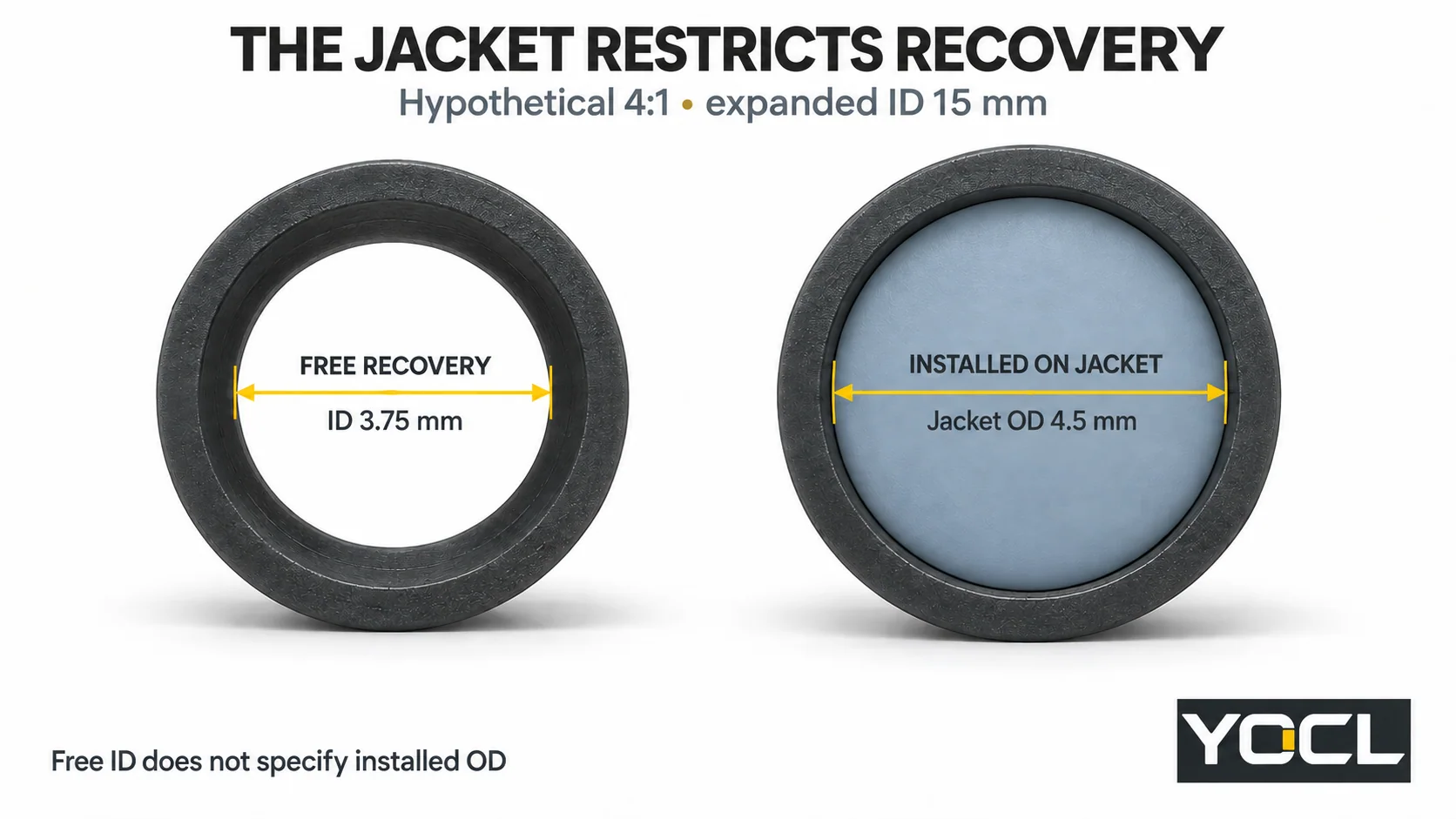
For a sleeve spanning several surfaces, check the smallest required landing as well as the largest feature it crosses. Irregular connectors, flat busbars, bundles and branches need their actual envelope and contact geometry reviewed; one round OD cannot describe every gap or valley.
A real YOCL 3:1 vs 4:1 comparison
الـ 3:1 Zero-Halogen single-wall product و 4:1 Zero-Halogen single-wall product offer a useful same-construction comparison. Both declare no internal adhesive. Their 20 mm supplied-bore entries have different recovered limits:
| Published field | 3:1 single wall | 4:1 single wall |
|---|---|---|
| Size entry | 20.0/6.7 mm | 20.0/5.0 mm |
| Minimum supplied ID | 20.0 mm | ≥20.0 mm |
| Maximum ID after recovery | 6.7 mm | ≤5.0 mm |
| لاصق داخلي | لا يوجد | لا يوجد |
These are manufacturer declarations from the respective dimension tables, checked 9 October 2026. The 3:1 page establishes minimum and maximum through its column headings; the 4:1 page also prints the inequalities in each row.
For hypothetical 18 mm pass-over and 6 mm landing dimensions, both supplied minima clear the large feature. The 3:1 row’s 6.7 mm recovered maximum does not establish contraction below 6 mm; the 4:1 row’s 5.0 mm maximum does. That makes the latter a dimensional candidate, still subject to allowance and application review. It does not prove a sealed joint.
Keep the published 6.7 mm limit. Replacing it with 20 ÷ 3 would substitute nominal arithmetic for the actual declaration.
Check construction and duty alongside the ratio
The unlined 4:1 example shows why ratio cannot identify adhesive. Where a bonded interface is required, select an appropriate lined product and assess compatibility, contact geometry and sealing evidence. Use the مقارنة الجدار الأحادي مقابل الجدار المزدوج for that decision.
Compare actual wall fields and their measurement states rather than assuming 4:1 is thicker or stronger. Also check coverage and declared longitudinal change, permitted recovery conditions, service temperature, electrical duty and required environmental evidence for the exact grade. Diameter ratio supplies none of those values.
A tight exterior or visible adhesive at an end cannot by itself verify the complete sealing interface. If an installed sleeve is already loose, damaged or has an unverified seal, the heat-shrink failure guide addresses that separate investigation.
Make the final choice from the products that pass
Keep 2:1 in consideration when its exact size meets both fit checks and the required function. Move to 3:1 or 4:1 when their documented recovery range solves a transition the lower-ratio candidate cannot cover. If several products pass, compare their construction, installed space, process and duty. If none passes, revise the exact size or connection arrangement instead of assuming extra heat will deliver extra recovery.
For a YOCL size review, provide the largest pass-over dimension, smallest landing dimension, required coverage, jacket material and intended duty through the مجموعة منتجات أنابيب الانكماش الحراري. Request the matching size limits, permitted application range and installation information so the final selection identifies a product and size, not just “4:1 heat shrink.”
المراجع
- مركز كينيدي للفضاء التابع لناسا — KSC-E-165 Revision F, 20 December 2021, Electrical Ground Support Equipment Fabrication, Specification for. §3.8.1.1.1(a), printed page 59; scoped expanded/recovered size principle.
- YOCL معلومات المنتج — 3:1 أنبوب انكماش حراري أحادي الجدار خالٍ من الهالوجين. 20.0/6.7 mm row, dimension headings and absence of adhesive; checked 9 October 2026.
- YOCL معلومات المنتج — 4:1 أنبوب انكماش حراري أحادي الجدار خالٍ من الهالوجين. 20.0/5.0 mm row, supplied/recovered bounds and absence of adhesive; checked 9 October 2026.