
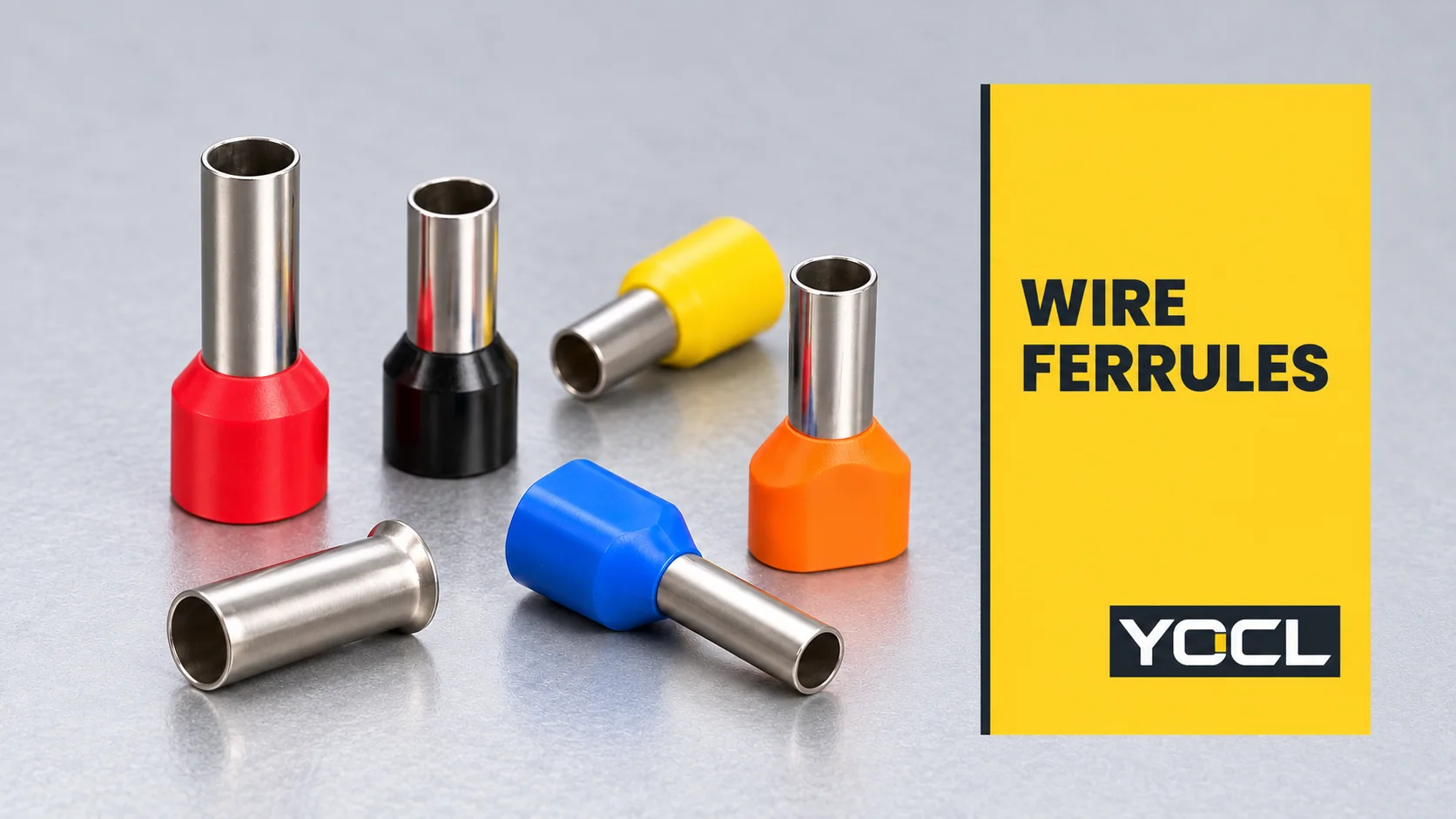
Ferrule kawat adalah selongsong logam berbentuk tabung yang dikerutkan di sekeliling untaian konduktor yang terkelupas untuk mempersiapkan ujungnya agar dapat dimasukkan ke dalam terminal yang kompatibel. Ferrule mengumpulkan untaian menjadi ujung yang tertampung. Terminal masih menyediakan sambungan penjepit; jenis, ukuran, dan bentuk akhir ferrule harus sesuai dengan sambungan tersebut.
Juga disebut bootlace ferrule, wire-end sleeve atau cord-end ferrule, komponen ini ditentukan oleh lebih dari sekadar warna kerah. Untuk memahami ferrule, pisahkan kapasitas konduktornya, geometri selongsongnya, dan penggunaan yang diizinkan di terminal penerima.
Apa fungsi ferrule kawat?
Selongsong logam mengelilingi untaian konduktor yang terbuka. Pengepresan membentuk selongsong di sekelilingnya sehingga ujung yang telah disiapkan dapat ditangani dan dimasukkan sebagai satu bundel yang terkandung. Dalam versi berkerah, entri plastik mengelilingi ujung entri kawat; bagian logam yang menonjol masuk ke area kontak terminal.
Cakupan publik dari UL 486F, Ferrule Polos dan Berpelindung mendeskripsikan ferrule sebagai persiapan ujung konduktor yang memfasilitasi koneksi kawat untai dan mencegah untaian kembali selama penyisipan. Ini mencakup desain untuk satu konduktor tembaga untai atau dua dengan ukuran yang sama.
Fungsi ini berbeda dari lug yang dibaut ke stud atau konektor yang menyambungkan dua ujung kabel. Ferrule menyiapkan ujung untuk perangkat koneksi lain. UL 486F juga memisahkan ferrule dari adaptor pin yang dicakup oleh standar konektor lain; ujung logam yang terlihat serupa tidak menetapkan pertukaran.
DIN 46228-4:2020-03 mengidentifikasi selongsong ujung tubular dengan selongsong plastik. Pengenalan resminya menjelaskan penahanan untaian dan penyisipan terminal yang lebih mudah. Hal itu mendukung tujuan komponen, tanpa menetapkan bahwa setiap terminal memerlukannya.
Jenis ferrule kawat utama
Perbedaan pertama yang paling berguna adalah satu konduktor atau dua, diikuti oleh konstruksi berkerah atau tanpa kerah. Katalog YOCL mengaturnya ke dalam seri E, EN, dan TE:
| Konstruksi | Susunan yang terlihat | Apa yang perlu diperiksa secara terpisah |
|---|---|---|
| Ferrule kawat tunggal terisolasi E | Satu selongsong tubular dengan kerah isolasi | Ukuran konduktor tunggal, panjang selongsong, dan jarak kerah |
| Ferrule kawat tunggal tanpa insulasi EN | Selongsong logam polos dengan bukaan melebar | Ukuran konduktor, dimensi tabung, dan susunan insulasi peralatan |
| Ferrule kawat kembar berinsulasi TE | Selongsong umum dan kerah yang lebih lebar untuk dua konduktor | Ukuran setiap konduktor dan penerimaan terminasi dua kawat yang sudah selesai |
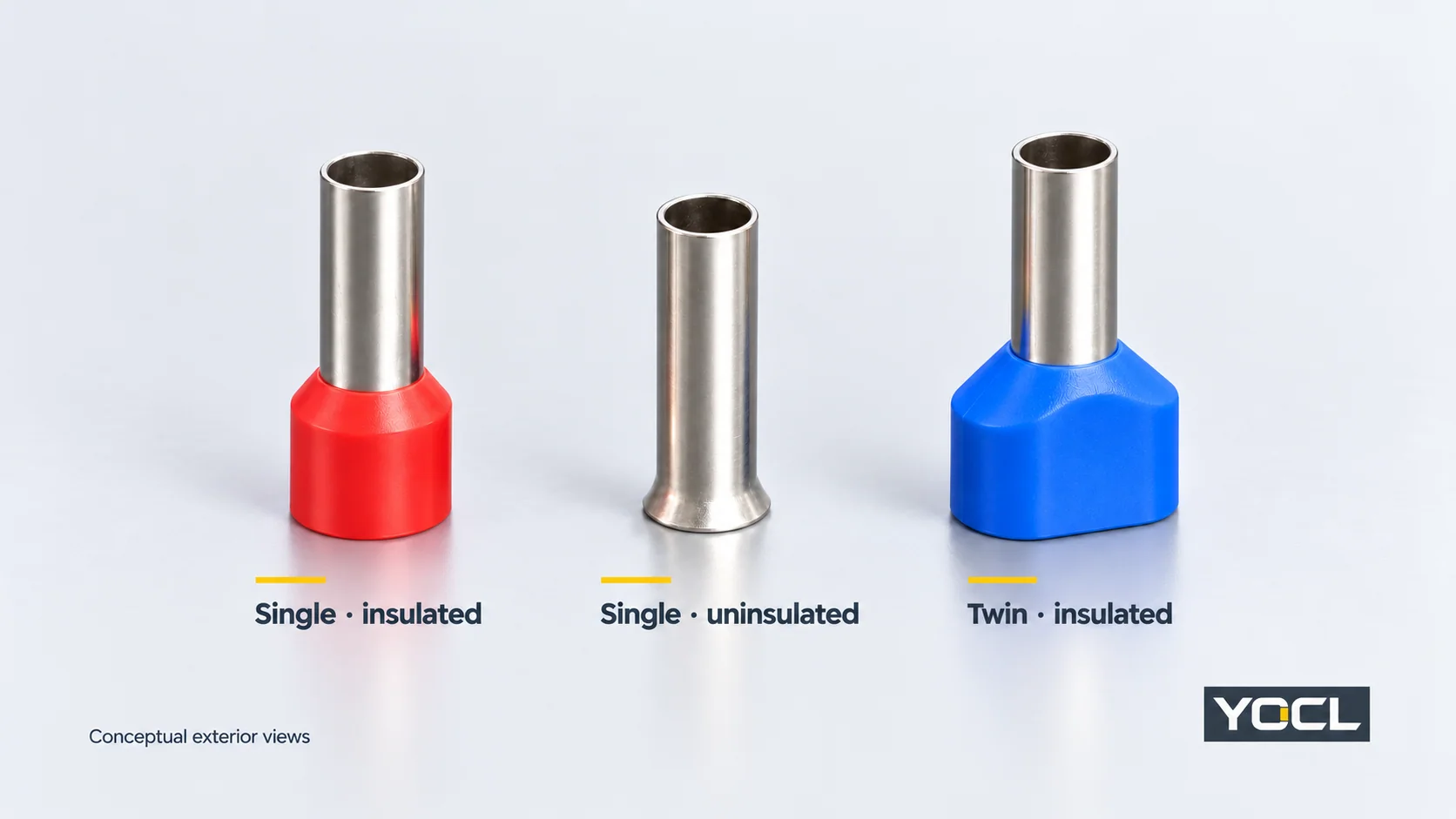
Ini adalah nama seri YOCL, bukan sistem penamaan universal untuk setiap pemasok. “Berinsulasi” mengidentifikasi konstruksi kerah; itu tidak memberikan peringkat tegangan untuk sambungan yang sudah selesai. Demikian pula, “kembar” mengidentifikasi susunan konduktor yang dimaksud, bukan izin untuk memasukkan dua kawat ke terminal mana pun.
Cara membaca ukuran ferrule kabel
Luas penampang konduktor berbeda dari diameter
Penamaan seperti 1.5 mm² merujuk pada luas penampang konduktor. Ini bukan diameter luar kabel, diameter lubang ferrule, atau diameter kerah plastiknya.
Read the ferrule’s declared conductor size alongside its drawing. The conductor determines the capacity needed inside the sleeve; the ferrule’s external dimensions affect the space needed at the terminal. Cable insulation and collar geometry add another fit question at the entry.
American Wire Gauge (AWG) is another conductor-size designation. Use the exact AWG or metric sizes declared for the chosen product and conductor. A catalogue pairing is not a reason to assume every nearby AWG/mm² size is an approved substitute.
Sleeve length is different from overall length
Ferrules of the same conductor capacity can have different sleeve lengths. On YOCL’s E-series drawing, F identifies the sleeve-length segment and L the overall length including the collar. These letter labels belong to that drawing; check the exact series before transferring their meanings.
The published E-series dan TE-series tables provide a useful example:
| YOCL model | Susunan konduktor yang dinyatakan | F sleeve length | L overall length |
|---|---|---|---|
| E1508 | One × 1.5 mm² | 8.0 mm | 15.0 mm |
| E1512 | One × 1.5 mm² | 12.0 mm | 19.0 mm |
| TE 1508 | Two × 1.5 mm² | 8.0 mm | 15.5 mm |
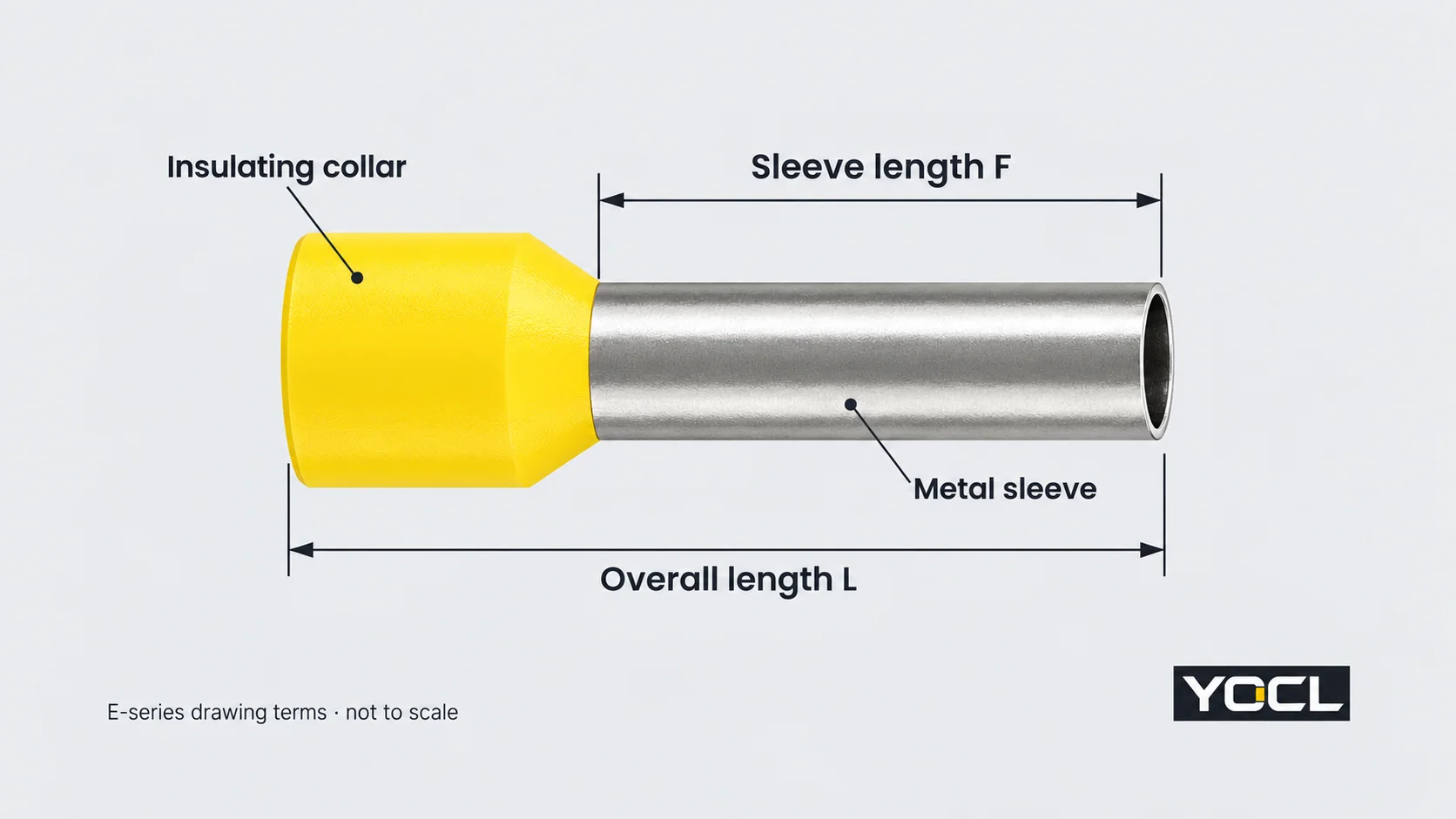
These are catalogue dimensions, not measurements of an installed connection. E1508 and E1512 accept the same declared conductor area but have different lengths. TE 1508 shares an 8 mm F dimension with E1508 while describing a different conductor arrangement. Neither area nor sleeve length alone determines terminal compatibility.
The receiving terminal’s insertion depth and preparation instructions determine which length is appropriate. Overall length cannot substitute for sleeve length when comparing the metal portion with the terminal’s contact space.
Twin notation and collar colour need their own reading
2 × 1.5 mm² means two conductors, each 1.5 mm². Their nominal areas add to 3 mm², but that arithmetic does not turn the twin ferrule into a single-wire 3 mm² model. Entry geometry, sleeve capacity, tooling and the permitted terminal arrangement remain separate requirements.
Colour is useful only within the specified catalogue coding. YOCL’s E-series lists colour options by size group. Its TE 7508 and TE 7510 models both declare 2 × 0.75 mm², yet list blue and grey collars respectively. Confirm the model and conductor designation rather than selecting a ferrule from colour alone.
What makes a ferrule compatible with a terminal?
Compatibility involves three interfaces:
- Conductor to ferrule: the conductor material, size and count must match the ferrule’s declared arrangement.
- Ferrule to crimping tool: the applicable tool and die must produce the required termination for that ferrule. Tool capacity alone does not establish the correct finished profile.
- Finished ferrule to terminal: the receiving device must permit the prepared conductor arrangement and accommodate its sleeve, crimp profile and collar.
“Screw terminal”, “spring terminal” and “push-in terminal” name connection mechanisms. They do not provide a universal answer to whether a ferrule is required, optional or unsuitable. Use the exact device’s instructions and any declared range for ferruled conductors. A ferrule that physically enters the opening has passed only a geometry check.
There is also an explicit scope boundary: UL 486F’s public scope excludes insulation-displacement connection (IDC) terminal blocks. Do not treat a prepared metal sleeve as a general replacement for the insulated wire that an IDC contact is designed to engage.
For a twin ferrule, verify acceptance of the two-conductor arrangement and its finished dimensions. A larger opening, a sufficient nominal area or a broad plastic collar cannot supply that authorization. Square and hexagonal crimp names also need to be checked against the actual ferrule, tooling and terminal documentation; neither is a universal compatibility rule.
What do standards and certification tell you?
Standard identity, product dimensions and connection approval answer different questions. DIN’s published title identifies a construction family; UL 486F’s public scope identifies its intended use and exclusions. A supplier’s reference to either standard is not, by itself, a model-specific certification record.
UL Solutions’ explanation of Component Recognition distinguishes a component’s assessment from certification of a complete end product. Recognized components have conditions of acceptability governing their use. Where certification is required, check the exact product record and applicable conditions alongside the receiving equipment’s documentation.
The YOCL dimensions above are first-party product declarations. They help interpret size fields; this article does not assert UL certification, a current rating or an approved terminal combination for those models.
Which document should you check next?
| Pertanyaan Anda | The next document to use |
|---|---|
| Which construction describes the part I need? | The single, bare or twin product-family information |
| What conductor does this model accept? | Its declared conductor size, material and count |
| What do its length and diameter fields mean? | The exact model/series drawing and dimension table |
| Which tool produces the required crimp? | The applicable ferrule and tooling instructions |
| Is the prepared end permitted in my terminal? | The exact receiving device’s wiring instructions and connection data |
| What evidence covers the intended equipment or market? | Relevant model certification records, conditions and equipment requirements |
The YOCL wire-ferrule catalogue routes these construction and dimension questions to the E, EN and TE product information. When asking for a model review, include the conductor size and count, required sleeve length and receiving terminal reference so the enquiry describes the complete interface.
Referensi
- UL Standar & Keterlibatan — UL 486F: Bare and Covered Ferrules, Edition 3, 2024, revised August 2026. Official public scope, §§1.2, 1.6 and 1.8; function, conductor arrangement and exclusions.
- DIN Media — DIN 46228-4:2020-03: Tubular end-sleeves with plastic sleeve. Official publication identity and public introduction; the paid full standard was not consulted.
- Informasi produk YOCL — Ferrule Kawat Pra-Isolasi Seri E. Construction, model dimensions, drawing and declared colour options.
- Informasi produk YOCL — EN Ferrule Ujung Kabel Tanpa Isolasi. Bare flared-entry construction and dimension fields.
- Informasi produk YOCL — TE Konektor Ujung Kabel Ganda. Two-conductor notation, model dimensions and model-specific collar colours.
- Solusi UL — The UL Component Recognition Classification. Component conditions of acceptability and the end-product certification boundary.