
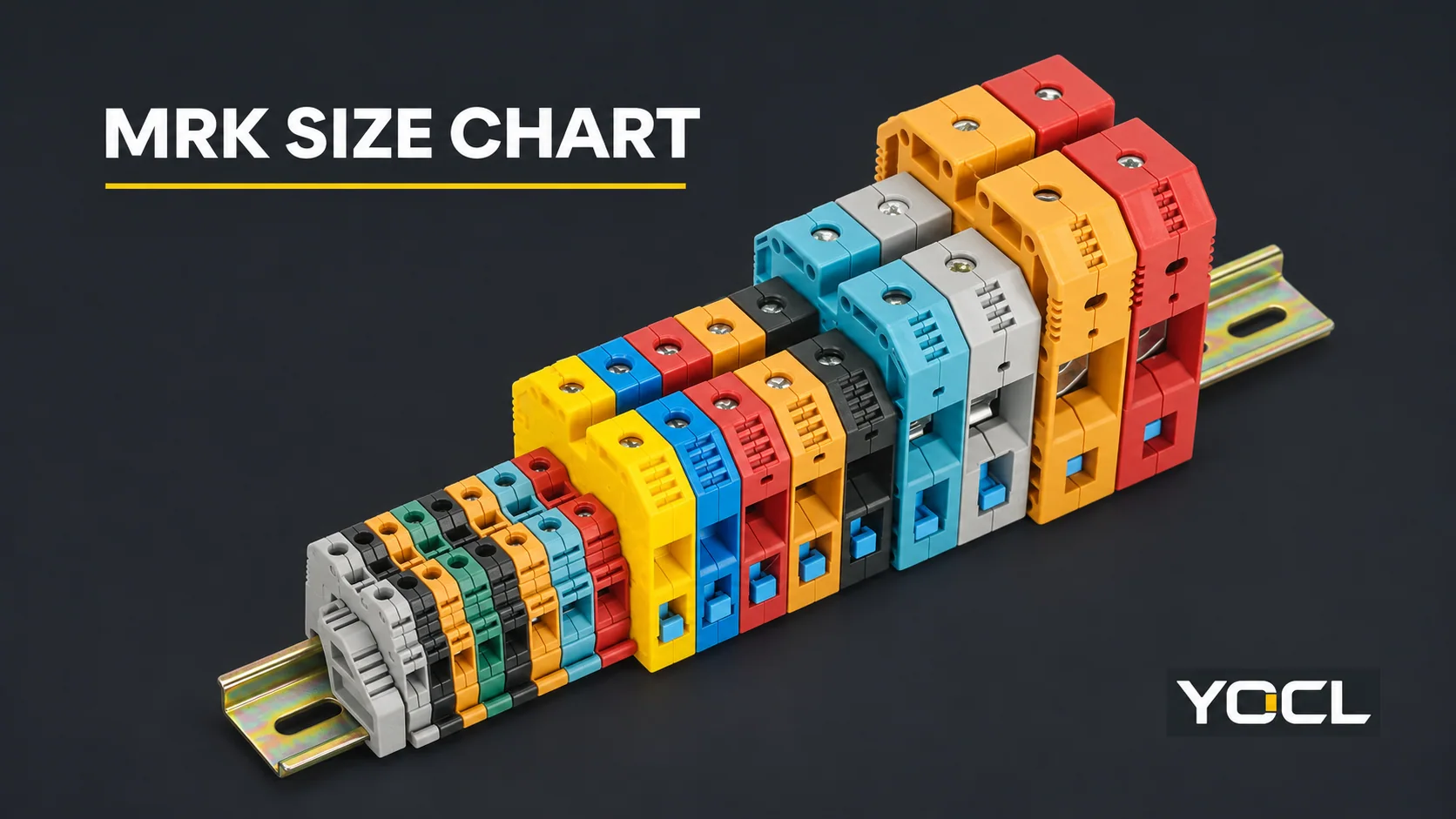
Neste Tabela de tamanhos de blocos terminais MRK, the number after “MRK-” identifies the model’s listed conductor cross-section in mm². Each model is one self-contained row: its cross-section, voltage rating and current rating belong together. Start with the conductor cross-section, then check both electrical ratings on that same row. A larger model’s rating cannot be borrowed for a smaller one.
MRK Terminal Block Size Chart
The following values are YOCL’s MRK product-page declarations, reproduced model by model. Read across a row to identify a candidate; use the columns to compare candidates without combining their ratings.
| Modelo | Listed cross-section | Tensão nominal | Corrente nominal |
|---|---|---|---|
| MRK-2.5 | 2.5 mm² | 750 V | 24 A |
| MRK-4 | 4 mm² | 750 V | 32 A |
| MRK-6 | 6 mm² | 750 V | 40 A |
| MRK-10 | 10 mm² | 750 V | 57 A |
| MRK-16 | 16 mm² | 750 V | 82 A |
| MRK-25 | 25 mm² | 750 V | 100 A |
| MRK-35 | 35 mm² | 750 V | 125 A |
| MRK-50 | 50 mm² | 750 V | 150 A |
| MRK-70 | 70 mm² | 750 V | 192 A |
| MRK-95 | 95 mm² | 1000 V | 232 A |
| MRK-120 | 120 mm² | 1000 V | 269 A |
YOCL lists Nailón housings and Cobre conductors for every row. The product page describes the housing’s UL 94 V-0 flammability classification and snap-on mounting to standard 35 mm DIN rails. The housing classification concerns flammability; it is not a certification claim for the complete terminal block or panel.
The units keep the columns distinct: mm² is conductor cross-sectional area, V identifies the listed voltage rating, and A identifies the listed current rating. Preserve the decimal in MRK-2.5 when copying a model name; it corresponds to the 2.5 mm² row. Read the suffix as an area designation rather than a diameter measurement. The chart contains discrete catalogue models, so an unlisted intermediate size has no row or electrical rating to read from it.
How to Read One MRK Row
Treat the model name as the starting point for a complete catalogue record. The suffix provides the cross-section lookup; it does not express the current rating, voltage rating or physical width. Those are different fields, and only the first two electrical fields are supplied in this chart.
Para uma 10 mm² termination, begin with MRK-10. Its row reads 10 mm² / 750 V / 57 A. The useful result is that whole record, rather than “MRK-10” alone. Check whether the circuit’s required voltage and current are covered by those same listed ratings before carrying the model forward.
Read the row in this order:
- Find the cross-section. Use the conductor cross-section required at the connection, rather than starting with the largest current figure in the table.
- Check the row’s voltage. Keep the voltage beside the selected model. A rating elsewhere in the series does not change it.
- Check the row’s current. Compare the circuit requirement with this model’s current figure, keeping the conductor’s own capacity separate.
If any of the three fails, the candidate has failed the chart check. Return to the table and look for a model whose complete row satisfies the requirements. Do not retain the original cross-section while copying a higher current or voltage from another line. Any proposed change of model must also suit the conductor actually being terminated.
For comparison, MRK-25 is a different record: 25 mm² / 750 V / 100 A. Its higher listed current belongs to that model and cross-section. It cannot be attached to the MRK-10 entry on a schedule. Similarly, MRK-6’s declared current is 40 A; use that figure when identifying that model.
When transferring a candidate into an enquiry or bill of materials, keep the model, listed cross-section, voltage and current together. This makes a substitution review straightforward: compare the replacement’s complete row with the original requirement. A quotation that names only “MRK terminal block” has omitted the information needed to distinguish the catalogue entries.
Do not estimate a missing current by interpolating between adjacent rows or assume that current rises in the same proportion as the model suffix. Use the published value for the actual model. If a required combination cannot be established from a complete row and the confirmed conductor acceptance, the chart has not established a suitable candidate; identify another documented connection rather than constructing a new rating from the table.
Where the Voltage Changes from 750 V to 1000 V
A YOCL table has a specific voltage boundary: MRK-2.5 through MRK-70 are listed at 750 V; only MRK-95 and MRK-120 are listed at 1000 V. Increasing cross-section within the lower group does not increase its listed voltage.
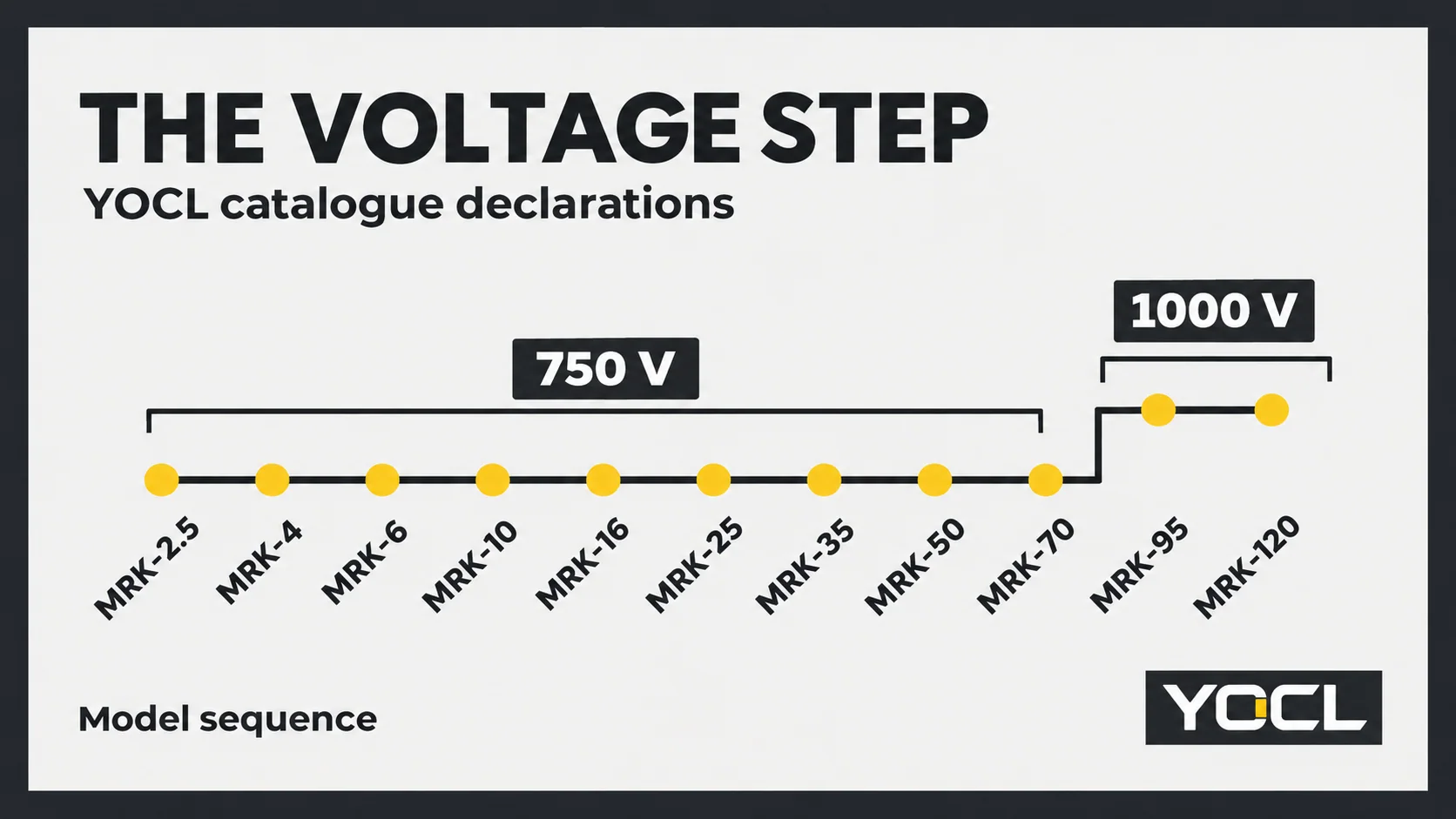
Ler MRK-70 — 70 mm² — 750 V — 192 A beside MRK-95 — 95 mm² — 1000 V — 232 A to locate the change. Both cross-section and electrical ratings remain attached to their respective models. The voltage step does not make the MRK-95 row a general voltage upgrade for every conductor size below it.
A series heading or purchasing description that quotes only the highest model’s voltage would conceal this distinction. Keep the split explicit when summarising the range, and retain the individual voltage field when ordering. If the circuit requirement exceeds a candidate row’s voltage rating, that candidate does not pass simply because another MRK model carries the higher value.
Bigger Is Not Automatically Safer
The current column gives the block’s listed rating with its listed cross-section. It does not give a permitted current for every wire that might physically enter that block. Choosing a larger MRK model does not increase what a smaller conductor may carry.
This matters when reading the top of the chart. MRK-120 está listado como 120 mm² / 1000 V / 269 A. That row is not permission to pass the same current through a smaller conductor placed in it. The conductor’s capacity must be established separately; the anchor product page supplies no conductor ampacity figures, so none are inferred here.
There is also a connection-fit question. YOCL’s anchor page does not publish a connectable wire range below each model’s listed cross-section. The listed cross-section therefore cannot be read as an undocumented minimum-to-maximum acceptance range. A larger opening or body in a photograph does not establish that range either.
Before terminating a much smaller wire in a large block, confirm the accepted conductor range for the exact model and the proposed conductor type. If acceptance is confirmed, use the documented combination; if it is not confirmed, choose a documented compatible connection instead of assuming that unused space makes the larger block suitable.
A conductor far below a clamp’s intended size can make a poor, high-resistance contact, and a loose contact creates a heating risk; the terminal-block overheating guide covers that separate problem.
A conductor larger than the model’s listed cross-section does not belong in that model. Never trim strands to make an oversize conductor fit. Resolve the conductor-to-terminal match by choosing the appropriate documented connection, rather than altering the conductor to force it into a smaller entry.
What to Confirm Before Ordering
The chart answers the model-and-rating lookup. Completing an order also requires the connection, installation and layout information for the exact model. The following details are not published on the anchor page; requesting them is the normal next step when turning a catalogue candidate into an order.
Accepted Conductor Range and Types
Ask: “What conductor cross-section range and conductor types does this exact model accept?” Identify the conductor you plan to use and its proposed end preparation. The reply must cover that combination, rather than merely repeat the model suffix.
This answer resolves whether the connection is permitted, including a proposed smaller conductor in a larger model. Keep the confirmed range with the selected part record. The table’s single cross-section is enough to locate a row, but it does not settle every conductor-acceptance question.
Tightening and Stripping Instructions
Ask: “What tightening torque and stripping length, where applicable, are specified in the installation instructions for this model?” Request the instructions that belong to the actual part being supplied. These are preparation and assembly fields, so a value associated with a similar-looking terminal cannot complete them.
The model suffix supplies neither setting. Use YOCL’s exact-model instructions to establish the connection method and preparation requirements; this chart does not identify or prescribe a clamping technology for MRK.
Dimensions and Rail Space
Ask: “Can you provide the per-model dimensional drawing, including the width occupied along the rail?” A cross-section in mm² measures conductor area, not block width. The suffix cannot be converted into a rail-space allowance.
Use the confirmed block dimensions and the actual accessory arrangement when completing the terminal-row layout. The TS35 DIN rail dimensions reference explains rail-profile fields; it does not supply missing MRK dimensions. Knowing that the series mounts on a standard rail does not tell you how much rail length the chosen row will occupy.
Applicable Product Standard or Certification
Ask: “Which product standard or certification, if required for our project, applies to this exact series and supplied model, and what supporting document is available?” Keep the response tied to the ordered product and the project’s requirement.
The anchor page does not publish an applicable product standard or series certification. Its housing flammability classification should remain in the housing-material field; it does not answer a request for evidence covering the complete terminal product. Confirm the relevant documentation before treating the catalogue candidate as meeting that procurement requirement.
Jumpers, End Plates and Other Accessories
Ask: “Which jumper and end-plate part numbers are compatible with the selected MRK model and intended arrangement?” The anchor page does not publish that compatibility information. A common series name or similar appearance does not provide an accessory match.
Once compatibility is established, carry the confirmed accessory part numbers into the order alongside the terminal model and quantity. For the separate task of arranging the rail, use the terminal-block organisation guide. It covers layout and grouping without establishing unpublished MRK accessory compatibility.
Keep these supplier replies with the quotation and the exact model identification. A later model substitution should trigger a comparison of the changed connection data, dimensions and accessories, as well as the electrical row. This preserves the link between the chart entry reviewed by the panel builder and the part actually ordered.
Where the MRK Series Fits
YOCL presents these DIN rail terminal blocks as feed-through connection points for industrial automation and machinery control panels, power distribution panels and switchgear, e building management and heating, ventilation and air-conditioning control systems. These are the applications named on the product page; they do not change the ratings of an individual row.
Use the chart to identify the MRK catalogue candidate within that work. For the full conductor-to-terminal selection process, continue to how to choose a DIN rail terminal block. For terminology and distinctions between terminal forms, see what a terminal block is.
Questions About the MRK Chart
Is the Whole MRK Series Rated 1000 V?
No. Only MRK-95 and MRK-120 are listed at 1000 V. MRK-2.5 through MRK-70 are listed at 750 V.
What Does the Number in MRK-25 Mean?
It identifies that model’s listed cross-section, 25 mm². Its complete row is MRK-25 — 25 mm² — 750 V — 100 A.
Can I Put a Much Smaller Wire in a Larger MRK Model?
The chart publishes no accepted range below each listed cross-section. Confirm the accepted conductor range and type for the exact model first.
Does a Larger Model Let My Wire Carry More Current?
No. The row’s current rating belongs to the block with its listed cross-section. Selecting a larger block does not raise the conductor’s capacity.
Referências
- YOCL ELÉTRICA, Blocos de Terminais DIN Calha MRK — YOCL product information: model rows, materials, housing flammability classification, mounting and declared applications.