
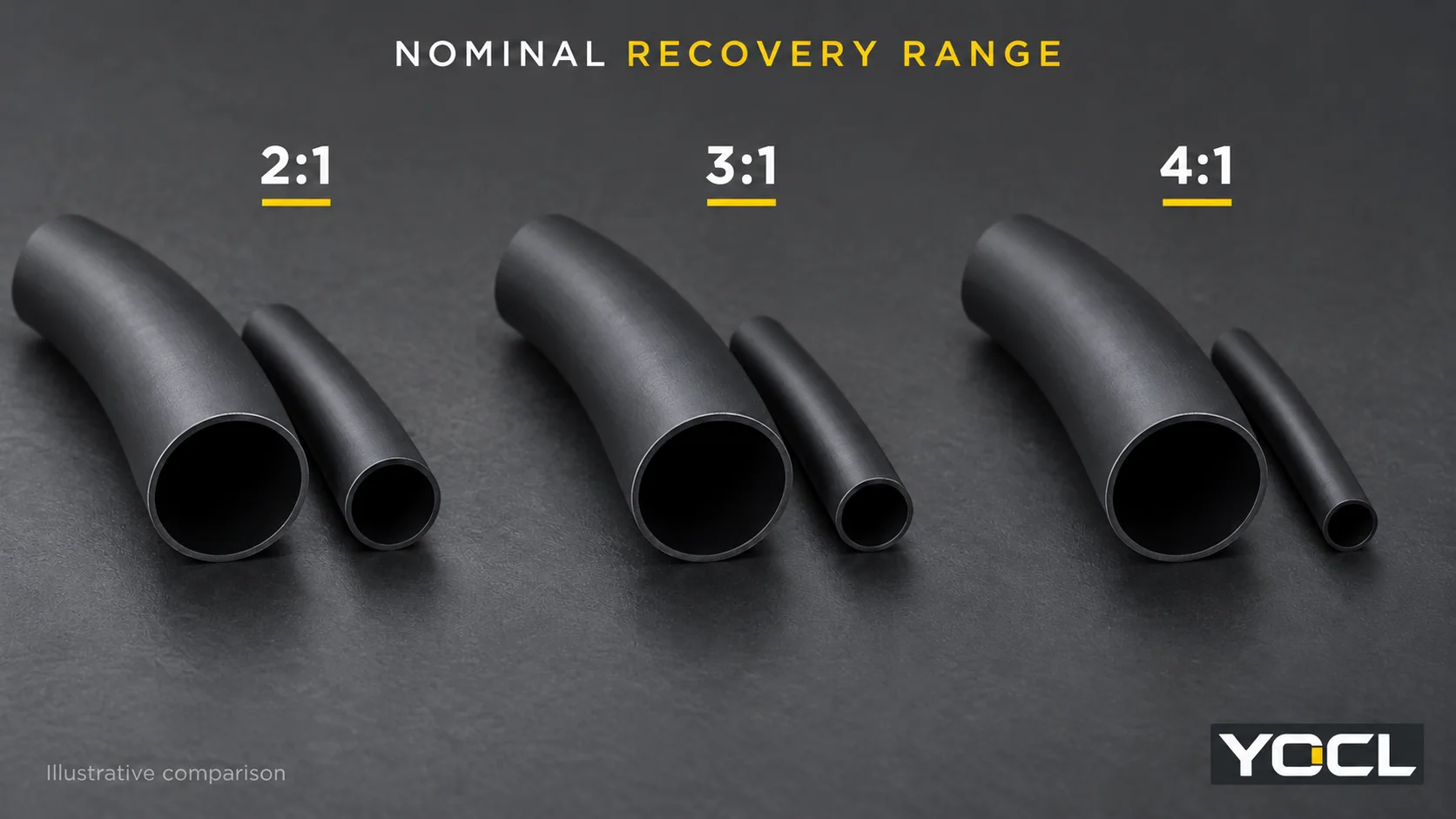
Elija la relación de retracción de la transición de diámetro que debe cubrir el tubo. El diámetro interior suministrado debe ser mayor que la característica más grande, y su diámetro interior recuperado libremente debe ser menor que la superficie más estrecha que necesita sujetar. Un tamaño 2:1 adecuado puede completar esa tarea. Considere 3:1 o 4:1 cuando las dimensiones reales requieran un rango de recuperación más amplio.
Una mayor relación por sí sola no proporciona adhesivo, una conexión sellada ni una mayor clasificación eléctrica. Compare primero la geometría, luego verifique la construcción y el uso exactos del producto.
Compare 2:1, 3:1 y 4:1 en la misma geometría
La relación de retracción describe la relación nominal entre el diámetro interior (ID) expandido y el ID recuperado libremente. Para una aritmética idealizada:
ID de recuperación libre = ID expandido ÷ número de relación
Con el mismo 15 mm de calibre expandido hipotético, 2:1 da 7.5 mm, 3:1 da 5 mm, y 4:1 da 3.75 mm. Estos son puntos finales ilustrativos sin un objeto interno que restrinja la recuperación, en lugar de dimensiones garantizadas de tres productos del catálogo. La relación describe la recuperación del diámetro; no divide la longitud cortada ni identifica el número de paredes. El guía de terminología de tubos termorretráctiles explica esos campos separados.
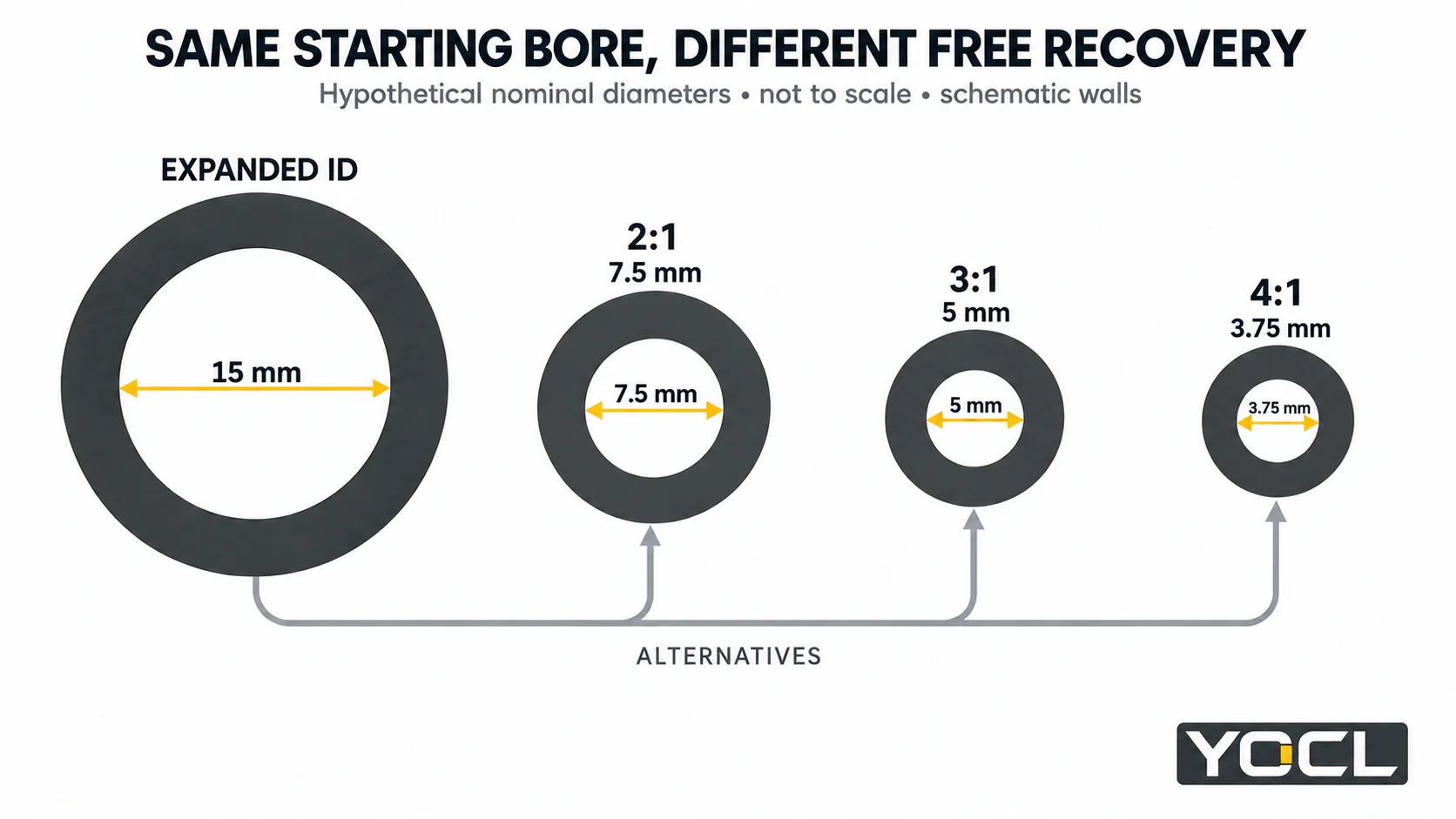
Ahora sostenga la característica redonda más grande que el tubo debe atravesar en 13 mm de diámetro exterior (OD). Cambie solo la superficie redonda más pequeña donde debe aterrizar. Las tres fundas hipotéticas comienzan con el mismo 15 mm de calibre, por lo que la comparación aísla su rango de recuperación.
| Diámetro exterior de aterrizaje más pequeño | 2:1: ID libre 7.5 mm | 3:1: ID libre 5 mm | 4:1: ID libre 3.75 mm | Relación suficiente bajo estas suposiciones |
|---|---|---|---|---|
| 9 mm | Por debajo del diámetro exterior de aterrizaje | Por debajo del diámetro exterior de aterrizaje | Por debajo del diámetro exterior de aterrizaje | Los tres; 2:1 ya es suficiente geométricamente |
| 6 mm | Demasiado grande | Por debajo del diámetro exterior de aterrizaje | Por debajo del diámetro exterior de aterrizaje | 3:1 o 4:1; 3:1 ya es suficiente geométricamente |
| 4.5 mm | Demasiado grande | Demasiado grande | Por debajo del diámetro exterior de aterrizaje | 4:1 solamente |
| 3 mm | Demasiado grande | Demasiado grande | Demasiado grande | Ninguno de estos tres candidatos |
Esto es un comparación hipotética controlada, no una lista de tamaños aprobada. La diferencia 2 mm entre el diámetro interior expandido asumido y el diámetro exterior de paso es una brecha de ejemplo, no una holgura recomendada. Las tolerancias reales, la holgura de instalación y el rango de aplicación permitido quedan por comprobar.
La última fila importa: incluso 4:1 puede ser insuficiente. Una relación más alta extiende el rango nominal, pero ninguna etiqueta garantiza el ajuste en cada transición. Por el contrario, la primera fila no da ninguna razón dimensional para rechazar 2:1 simplemente porque 4:1 esté disponible.
Convertir un candidato de relación en un tamaño exacto de tubo
Para piezas redondas y tubos de extremo abierto, compruebe ambos límites de una fila de tamaño exacto:
- Minimum supplied ID > largest pass-over OD
- Maximum freely recovered ID < smallest landing OD
de la NASA KSC-E-165 Revision F, §3.8.1.1.1(a) uses this expanded-larger/recovered-smaller principle within Kennedy Space Center electrical ground-support-equipment fabrication. It supports the dimensional relationship, without approving a YOCL product or assembly.
Retain the table’s minimum, maximum and ± signs, component tolerances and specified application allowance. Equality supplies no assured margin. A model’s stated application range may further restrict the usable diameters, even where the preliminary inequalities pass.
If you increase the supplied size to clear a connector, recheck the recovered limit of that larger row. Changing the first diameter can also change the second. Use the tabla de tamaños de tubo termorretráctil for the full lookup and limit conventions.
Free recovery is different from installed fit
A sleeve installed over a cable stops contracting against the surface inside it. In the hypothetical 4:1 example, a 4.5 mm jacket prevents the bore reaching its empty 3.75 mm endpoint. The endpoint therefore does not specify installed ID, outside diameter or wall thickness.
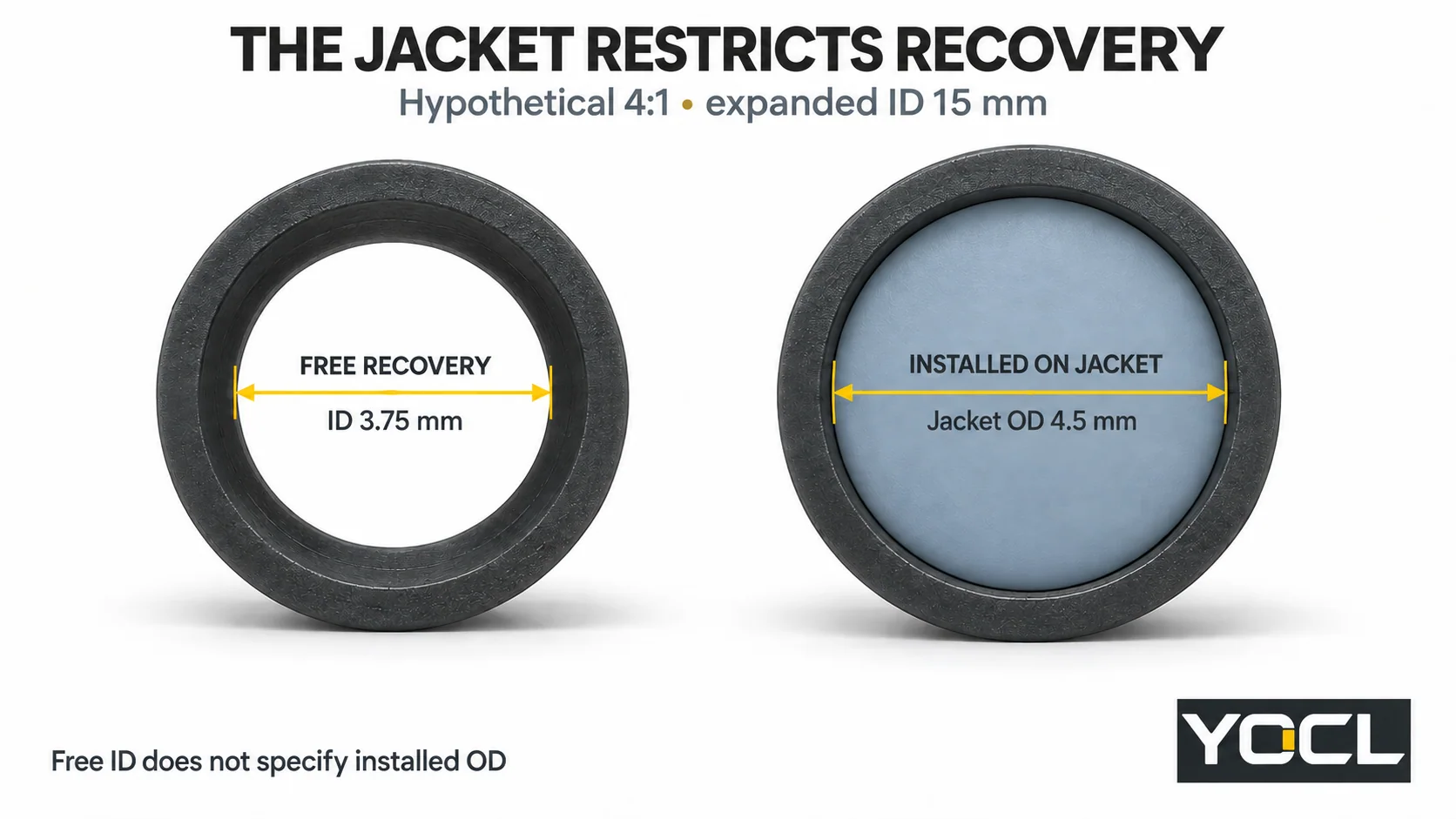
For a sleeve spanning several surfaces, check the smallest required landing as well as the largest feature it crosses. Irregular connectors, flat busbars, bundles and branches need their actual envelope and contact geometry reviewed; one round OD cannot describe every gap or valley.
A real YOCL 3:1 vs 4:1 comparison
La 3:1 Zero-Halogen single-wall product y 4:1 Zero-Halogen single-wall product offer a useful same-construction comparison. Both declare no internal adhesive. Their 20 mm supplied-bore entries have different recovered limits:
| Campo publicado | 3:1 single wall | 4:1 single wall |
|---|---|---|
| Size entry | 20.0/6.7 mm | 20.0/5.0 mm |
| Minimum supplied ID | 20.0 mm | ≥20.0 mm |
| Maximum ID after recovery | 6.7 mm | ≤5.0 mm |
| Adhesivo interno | Ninguno | Ninguno |
These are manufacturer declarations from the respective dimension tables, checked 9 October 2026. The 3:1 page establishes minimum and maximum through its column headings; the 4:1 page also prints the inequalities in each row.
For hypothetical 18 mm pass-over and 6 mm landing dimensions, both supplied minima clear the large feature. The 3:1 row’s 6.7 mm recovered maximum does not establish contraction below 6 mm; the 4:1 row’s 5.0 mm maximum does. That makes the latter a dimensional candidate, still subject to allowance and application review. It does not prove a sealed joint.
Keep the published 6.7 mm limit. Replacing it with 20 ÷ 3 would substitute nominal arithmetic for the actual declaration.
Check construction and duty alongside the ratio
The unlined 4:1 example shows why ratio cannot identify adhesive. Where a bonded interface is required, select an appropriate lined product and assess compatibility, contact geometry and sealing evidence. Use the comparación de pared simple frente a pared doble for that decision.
Compare actual wall fields and their measurement states rather than assuming 4:1 is thicker or stronger. Also check coverage and declared longitudinal change, permitted recovery conditions, service temperature, electrical duty and required environmental evidence for the exact grade. Diameter ratio supplies none of those values.
A tight exterior or visible adhesive at an end cannot by itself verify the complete sealing interface. If an installed sleeve is already loose, damaged or has an unverified seal, the heat-shrink failure guide addresses that separate investigation.
Make the final choice from the products that pass
Keep 2:1 in consideration when its exact size meets both fit checks and the required function. Move to 3:1 or 4:1 when their documented recovery range solves a transition the lower-ratio candidate cannot cover. If several products pass, compare their construction, installed space, process and duty. If none passes, revise the exact size or connection arrangement instead of assuming extra heat will deliver extra recovery.
For a YOCL size review, provide the largest pass-over dimension, smallest landing dimension, required coverage, jacket material and intended duty through the gama de productos de tubo termorretráctil. Request the matching size limits, permitted application range and installation information so the final selection identifies a product and size, not just “4:1 heat shrink.”
Referencias
- Centro Espacial Kennedy de la NASA — KSC-E-165 Revision F, 20 December 2021, Electrical Ground Support Equipment Fabrication, Specification for. §3.8.1.1.1(a), printed page 59; scoped expanded/recovered size principle.
- Información del producto YOCL — 3:1 Tubo termorretráctil de pared simple sin halógenos. 20.0/6.7 mm row, dimension headings and absence of adhesive; checked 9 October 2026.
- Información del producto YOCL — 4:1 Tubo termorretráctil de pared simple sin halógenos. 20.0/5.0 mm row, supplied/recovered bounds and absence of adhesive; checked 9 October 2026.