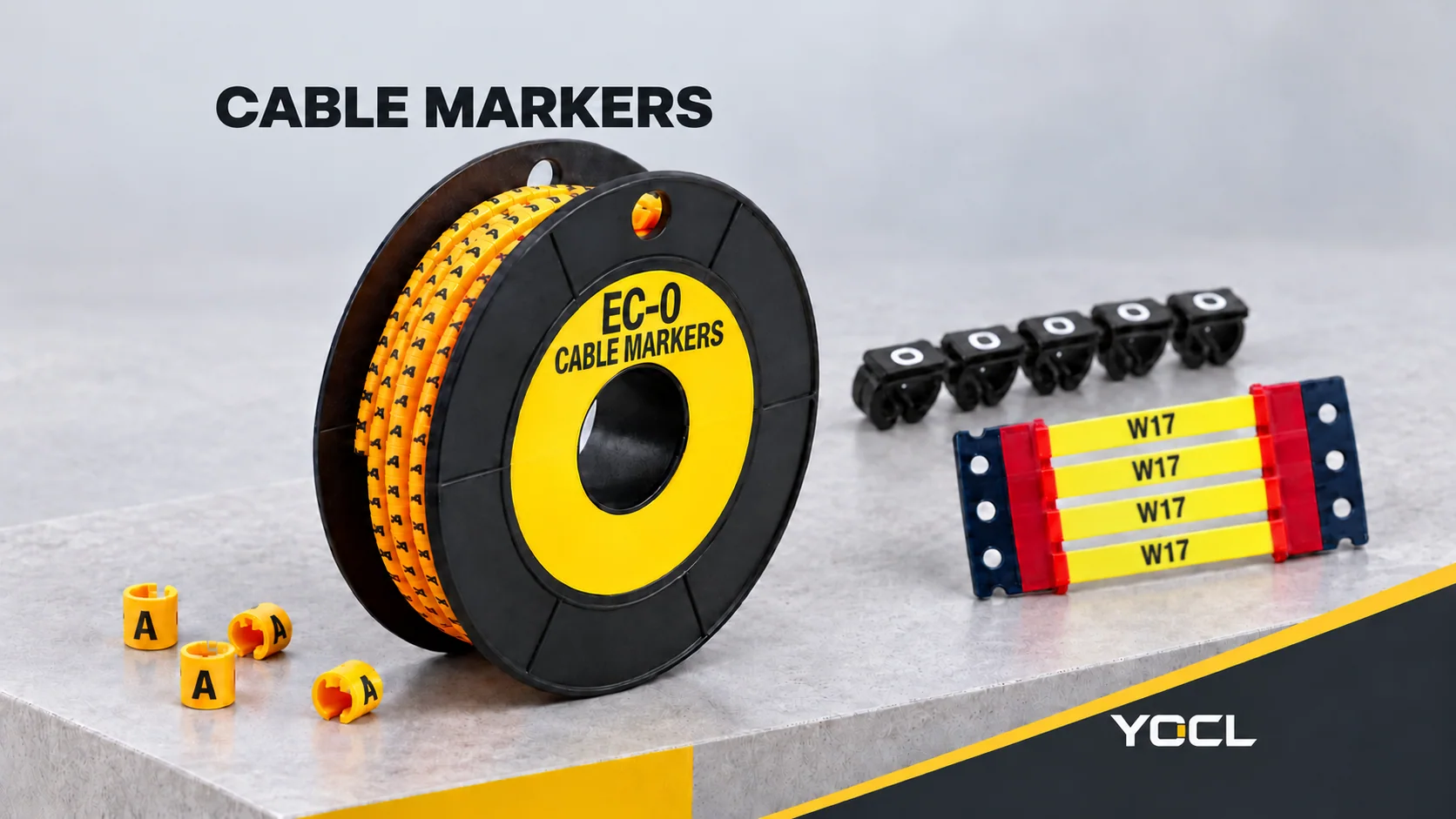
Las marcas de cables llevan identificadores en cables y alambres para que el cableado físico pueda cotejarse con planos, listas y registros de equipos. Las fundas llevan caracteres o inserciones, las marcas de clip se acoplan a caracteres individuales desde el lateral y las etiquetas termorretráctiles se ajustan alrededor del cable. La distinción útil es cómo se ajusta la marca, cuándo se puede ajustar y qué información lleva.
Las marcas de alambres identifican un conductor o cable; no realizan su conexión eléctrica, no aseguran un haz ni establecen un índice de aislamiento. El alcance público de IEC 62491:2008 sitúa el etiquetado de cables y núcleos industriales en esta relación de documentación-equipo.
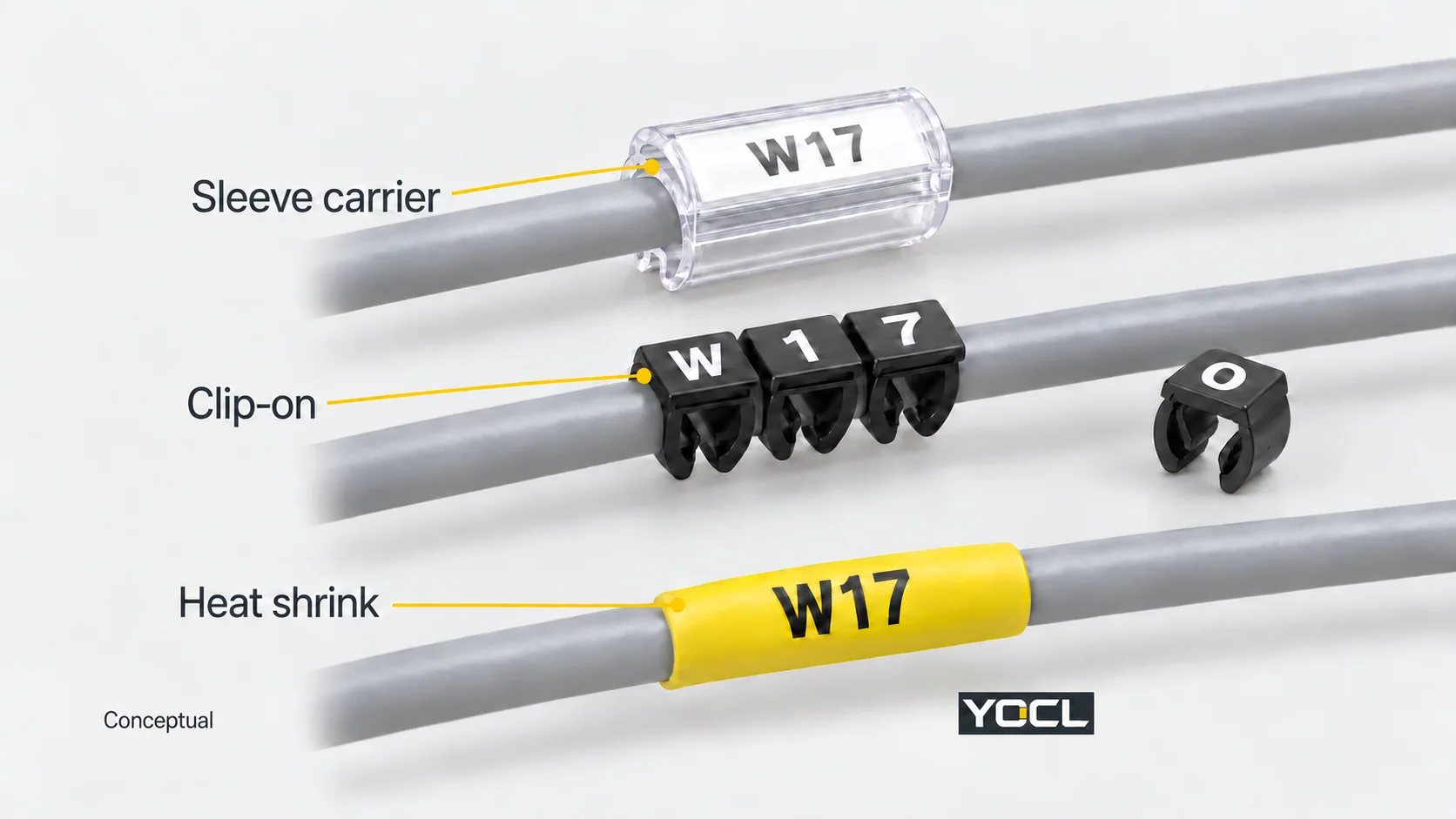
Tres formatos, tres formas de llevar la leyenda
| Formato | ¿Qué lleva la identificación? | Primera pregunta a resolver |
|---|---|---|
| Manguitos y portamarcas | Caracteres individuales en manguito, o un inserto sujeto por un manguito/portamarca | ¿Encaja el perfil seleccionado en el cable aislado y cómo se monta? |
| Caracteres de clip | Clips separados con números, letras o símbolos | ¿Puede el perfil abierto asentarse en este cable en la ubicación disponible? |
| Etiquetas termorretráctiles | Una leyenda impresa en un manguito recuperable | ¿Puede pasar al cable, recuperar el ajuste requerido y ser procesado con el sistema de impresión especificado? |
Los nombres se solapan: una etiqueta termorretráctil es también un manguito. Aquí, “manguitos” se refiere a caracteres o soportes no retráctiles, mientras que “termorretráctil” identifica la construcción recuperable. Esta distinción evita pedir un manguito marcador ordinario cuando el trabajo requiere una etiqueta impresa retráctil.
Manguitos: Caracteres individuales o un inserto
Los caracteres individuales construyen un código pieza a pieza. YOCL’s Marcadores de cable EC PVC utilizan cloruro de polivinilo blando (PVC) con un perfil interior cóncavo flexible. La gama incluye dígitos, letras mayúsculas, símbolos y espacios en blanco. Por lo tanto, un identificador de varios caracteres requiere un esquema de caracteres, así como la selección del tamaño del marcador.
Otros manguitos llevan un inserto separado. La referencia exterior para YOCL’s Manguitos marcadores 201–205 muestra un portador transparente con una abertura longitudinal y una superficie de identificación. Su tabla de productos especifica por separado el área del conductor, el diámetro recomendado del cable y el diámetro máximo.
No infiera el método de montaje solo por “manguito”. Un manguito cerrado de inserción necesita acceso al extremo del cable; un portador abierto tiene una geometría diferente. Confirme el método de montaje y la compatibilidad de inserción del modelo seleccionado antes de planificarlo en un ensamblaje ya cableado.
Marcadores de clip: Entrada lateral al cable
de YOCL Marcadores de clip SM utilizan poliacetal rígido (POM). Su perfil de patas abiertas permite el montaje después de la instalación del cable. Los números, letras y símbolos se pueden ensamblar en un código corto en el cable.
Esto hace que el acceso lateral sea útil cuando una terminación existente obstruye un manguito cerrado. Aún necesita espacio alrededor del cable y el tamaño correcto del marcador. Un clip que puede alcanzar el cable no es necesariamente un clip que se asienta correctamente en su cubierta. Verifique el ajuste real en lugar de asumir que la misma área del conductor garantiza la retención.
Etiquetas termorretráctiles: Un manguito impreso
Un marcador termorretráctil lleva la leyenda en un manguito que se contrae bajo su proceso de calentamiento especificado. Un identificador completo se puede imprimir en una sola pieza en lugar de ensamblarlo a partir de caracteres individuales.
de YOCL marcadores de cable termorretráctiles sin halógenos utilice este formato de manguito. Para un manguito cerrado normal, planifique el acceso al extremo y colóquelo antes de que una terminación impida pasarlo por el cable. Confirme el rango de tamaño de cable permitido y las instrucciones de procesamiento para el producto real.
La impresión añade otra cuestión de compatibilidad: las dimensiones del manguito, el formato de suministro, la impresora, la cinta y la durabilidad de impresión requerida deben funcionar conjuntamente. El término “termorretráctil imprimible” no identifica un cartucho de impresora o una cinta universales. Para la terminología de recuperación detrás de esta comprobación de ajuste, consulte ¿Qué es el tubo termorretráctil?.
Ajuste al cable aislado, no solo al tamaño de su conductor
Conductor cross-section is expressed in mm². The diameter of the insulated wire is expressed in mm. These are different measurements: two wires with the same copper area can have different jacket diameters.
The 201–205 sleeve table makes another distinction visible:
| YOCL sleeve model | Recommended conductor area | Recommended cable outside diameter | Separate maximum cable diameter |
|---|---|---|---|
| 201 | 0.25–1.5 mm² | 1.5–3.0 mm | 5.2 mm |
| 202 | 0.5–2.5 mm² | 2.0–4.0 mm | 6.5 mm |
These values come from the 201–205 product table. Its selection guidance explicitly keeps the maximum diameter separate from the recommended fit range.
For an illustrative 0.75 mm² wire with a measured 3.4 mm outside diameter, the conductor area falls within both rows. The diameter falls within model 202’s recommended range but outside model 201’s. Model 201’s 5.2 mm maximum does not turn 3.4 mm into a recommended fit.
This is a table-reading example, not a tested installation. Use the same model row for both measurements, then confirm the sample on the actual wire. For a flat cable, provide width and thickness instead of forcing its shape into a round-wire diameter assumption.
A Wire Identifier Is Different from a Terminal Identifier
Agree what the legend means before choosing characters or printing labels. It may identify a wire, cable, core, circuit or destination under the project’s documentation scheme. Those meanings are not interchangeable.
For example, an illustrative schedule can identify one wire as W17, running from terminal X1:4 a X2:7. Under that scheme, W17 remains the wire identifier at both ends, while the terminal identifiers differ. Printing only “4” on one end and “7” on the other would communicate terminal positions, not the agreed wire ID.
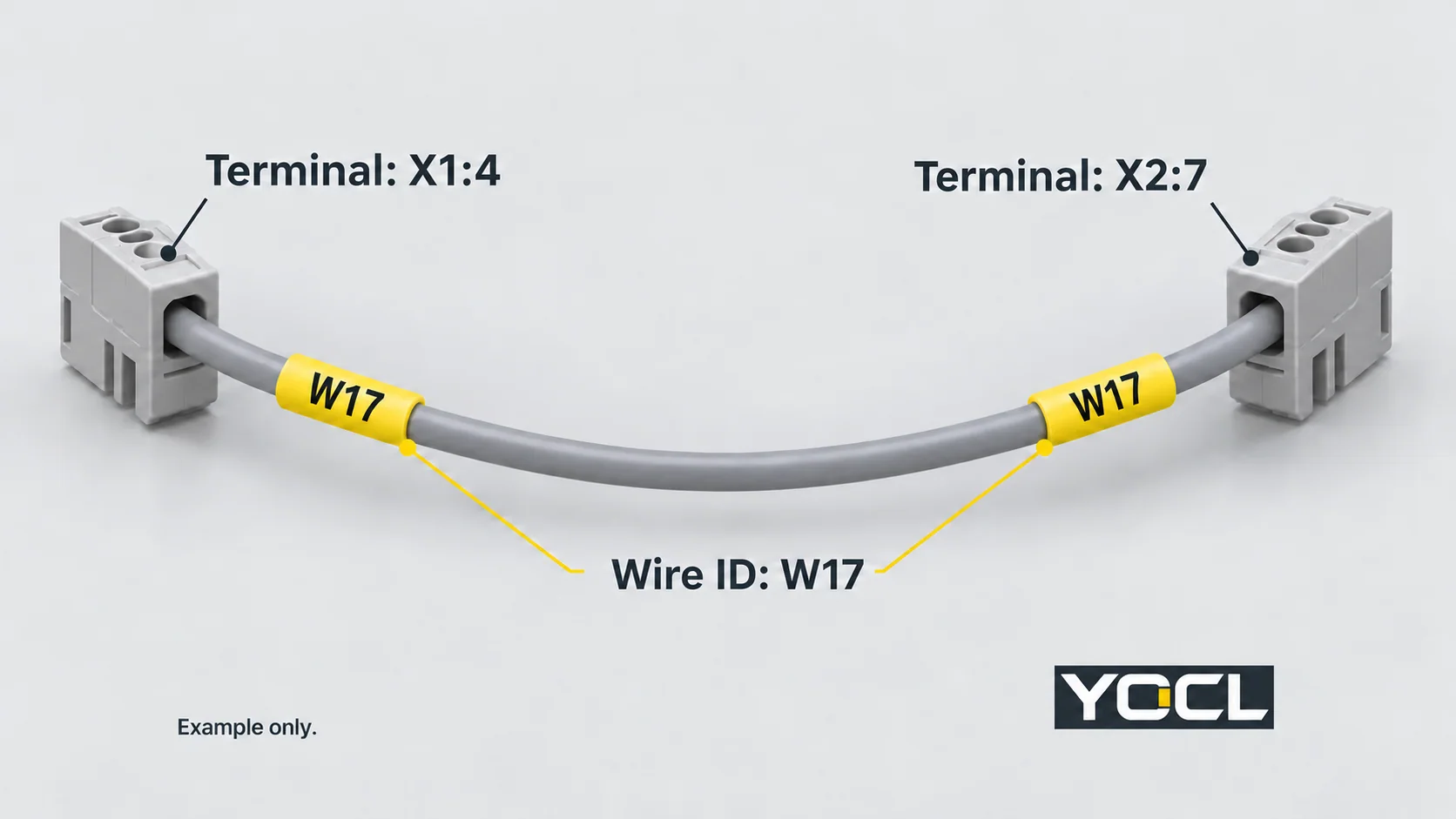
A cable identifier can also refer to an outer multi-core cable, while separate core identifiers distinguish the wires inside it. A label on the outer jacket does not identify every internal core. Likewise, a terminal marker belongs to the terminal assembly; the guía de bloques de terminales explains that accessory context.
Keep project IDs consistent with required conductor-function identification. The public scope of IEC 60445:2021+AMD1:2026 covers equipment-terminal identification and designated conductor identification using colours or alphanumeric notation. A yellow marker carrying W17 is not a substitute for the applicable functional identification scheme. The example above is not a prescribed IEC numbering format.
Readability Depends on the Marker and the Print System
Assess the legend after fitting, not only while it is on a roll or carrier. Check character order, viewing direction, space between adjacent markers and whether the installed wire bend hides the text. For printed sleeves, include a processed sample when confirming the specification.
de YOCL heat-shrink marker product record declares halogen-free, low-smoke and flame-retardant characteristics and a 125°C temperatura nominal. It distinguishes that rating from installation heating conditions. Those declarations do not apply to every PVC sleeve or POM clip, and they do not supply a heat-gun setting or a project-specific test certificate.
For safety-related marking evidence, UL Solutions’ marking and labelling program evaluates permanence under specified conditions. Its printing-material category identifies acceptable printing inks within the recognition. This illustrates why label stock and printing material must be assessed together; it does not establish recognition of these YOCL examples or coverage of every non-adhesive marker format.
de UL program FAQ also separates marking permanence from electrical, flammability and structural ratings. A durable identifier is useful for traceability; it does not establish the electrical duty of the wire or connection beneath it.
Find the Next Document by the Unresolved Question
| Tu próxima pregunta | Relevant information |
|---|---|
| Which format suits available access? | Selected sleeve/carrier or clip model’s fitting information |
| Which size fits this insulated wire? | Exact model’s conductor and cable-dimension table, followed by sample fit |
| Which characters and quantities are needed? | Approved identification schedule and quantities per character or complete legend |
| Can this printer produce the required shrink labels? | Marker supply format, printer/ribbon compatibility and processed sample |
| Will the legend remain readable in service? | Required exposure conditions and applicable marking-system evidence |
Strips, holders and marker boxes provide other identification areas and insert arrangements. Marker cable ties combine a tie with a marking area; they serve bundling as well as identification. These accessories require their own dimensions and fixing checks rather than inheriting a sleeve’s fit.
Utilice el gama de marcadores de cables YOCL to locate the relevant family. For an enquiry, send the wire dimensions, installation stage, model or format, legend schedule, character or label quantities, and any printing or exposure requirements.
Lecturas relacionadas: Ver heat-shrink cable-end sealing y clip-on, slide-on and heat-shrink marker comparison.
Lecturas relacionadas: marker sizing and sleeve fit.
Referencias
- IEC — IEC 62491:2008, Labelling of cables and cores — public abstract on the relationship between industrial wiring and technical documentation; full standard not consulted.
- YOCL product information — EC PVC Cable Markers — character choices, material and exterior profile.
- YOCL product information — 201–205 Cable Marker Sleeves — exterior reference and separate recommended/maximal fit fields.
- YOCL product information — SM Type Clip-On Cable Markers — material, open profile and post-installation fitting.
- YOCL product information — Halogen-Free Heat Shrink Cable Markers — sleeve format and declared characteristics/temperature.
- IEC — IEC 60445:2021+AMD1:2026, consolidated edition 7.1 — public scope for equipment-terminal and conductor identification; full standard not consulted.
- UL Solutions — Marking and Labeling Systems Program — evaluated permanence, printing-material compatibility and certification scope.
- UL Solutions — Marking and Labeling Systems FAQs — boundary between marking permanence and other ratings.