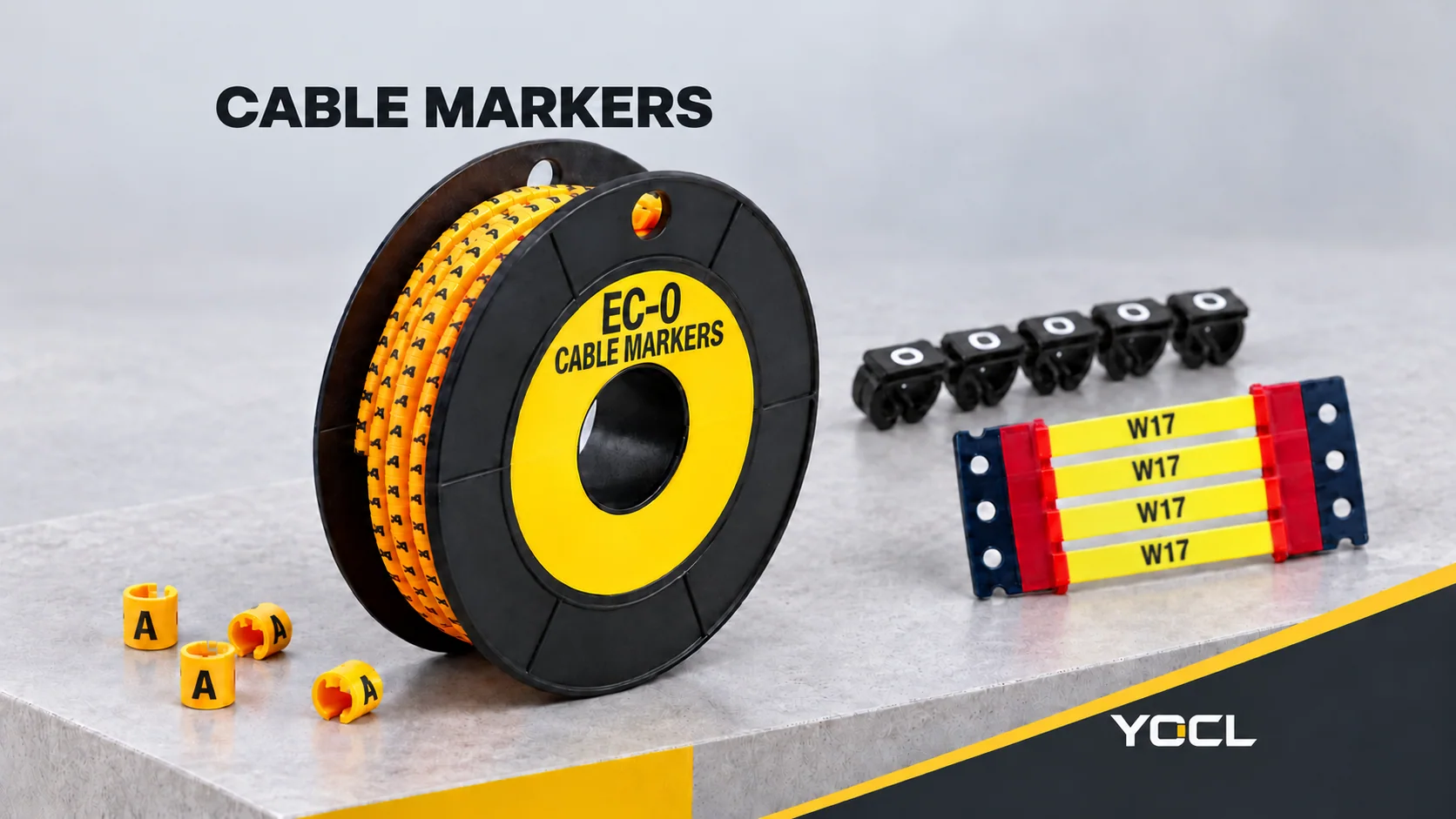
Os marcadores de cabos transportam identificadores em fios e cabos para que a cablagem física possa ser comparada com desenhos, esquemas e registos de equipamentos. As bainhas transportam caracteres ou inserções, os marcadores de encaixe fixam caracteres individuais pela lateral e as etiquetas termo-retráteis recuperam à volta do cabo. A distinção útil é como o marcador se encaixa, quando pode ser instalado e que informação transporta.
Os marcadores de fios identificam um condutor ou cabo; não efetuam a sua ligação elétrica, não fixam um feixe nem estabelecem um índice de isolamento. O âmbito público de IEC 62491:2008 coloca a etiquetagem de cabos e núcleos industriais nesta relação de documentação para equipamento.
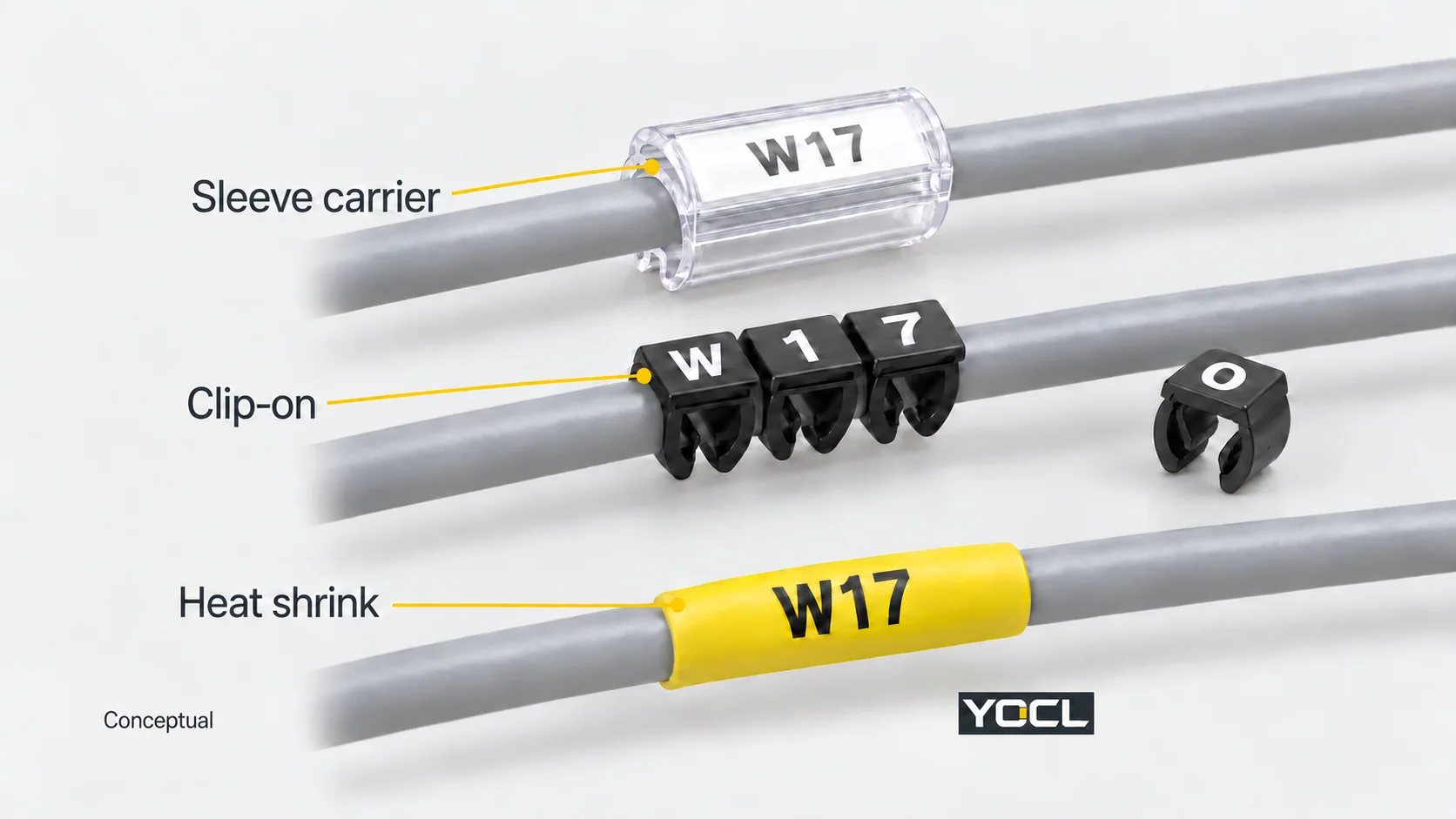
Três Formatos, Três Maneiras de Transportar a Legenda
| Formato | O que transporta a identificação? | Primeira questão a resolver |
|---|---|---|
| Manga e suportes de marcadores | Caracteres individuais em manga, ou um inserto suportado por uma manga/suporte | O perfil selecionado encaixa no fio isolado e como é montado? |
| Caracteres de encaixe | Clipes separados com números, letras ou símbolos | O perfil aberto pode assentar neste fio na localização disponível? |
| Etiquetas termo-retráteis | Uma legenda impressa numa manga recuperável | Pode passar para o cabo, recuperar para o ajuste necessário e ser processado com o sistema de impressão especificado? |
Os nomes sobrepõem-se: uma etiqueta termo-retrátil é também uma manga. Aqui, “mangas” significa caracteres ou suportes não retráteis, enquanto “termo-retrátil” identifica a construção recuperável. Esta distinção impede a encomenda de uma manga de marcação comum quando o trabalho exige uma etiqueta impressa retrátil.
Mangas: Caracteres Individuais ou um Inserção
Caracteres individuais constroem um código peça a peça. YOCL’s Marcadores de cabo EC PVC utilizam cloreto de polivinilo mole (PVC) com um perfil interior côncavo flexível. A gama lista dígitos, letras maiúsculas, símbolos e espaços em branco. Um identificador de vários caracteres requer, portanto, uma lista de caracteres, bem como a seleção do tamanho do marcador.
Outras mangas suportam uma inserção separada. A referência exterior para YOCL’s Mangas de marcador 201–205 apresenta um suporte transparente com uma abertura longitudinal e uma superfície de identificação. A sua tabela de produtos especifica separadamente a área do condutor, o diâmetro recomendado do cabo e o diâmetro máximo.
Não infira o método de montagem apenas pela “manga”. Uma manga fechada de encaixe necessita de acesso à extremidade do cabo; um suporte aberto tem uma geometria diferente. Confirme o método de montagem e a compatibilidade de inserção do modelo selecionado antes de o planear numa montagem já com cablagem.
Marcas de Encaixe: Acesso Lateral ao Fio
YOCL’s Marcas de encaixe SM utilizam polioximetileno (POM) rígido. O seu perfil de pernas abertas permite a montagem após a instalação do cabo. Números, letras e símbolos podem ser montados num código curto no fio.
Isto torna o acesso lateral útil quando uma terminação existente obstrui uma manga fechada. Ainda necessita de espaço à volta do fio e do tamanho correto da marca. Uma marca que consegue alcançar o fio não é necessariamente uma marca que assenta corretamente na sua cobertura. Verifique o ajuste real em vez de assumir que a mesma área do condutor garante a retenção.
Etiquetas Termoretráteis: Uma Manga Impressa
Uma marca termoretrátil transporta a legenda numa manga que contrai sob o seu processo de aquecimento especificado. Um identificador completo pode ser impresso numa única peça em vez de ser montado a partir de caracteres individuais.
YOCL’s marcadores de cabos termo-retráteis sem halogéneos utilize este formato de manga. Para uma manga fechada comum, planeie o acesso às extremidades e posicione-a antes de uma terminação impedir a sua passagem pelo cabo. Confirme a gama de tamanhos de cabo permitida e as instruções de processamento para o produto real.
A impressão acrescenta outra questão de compatibilidade: as dimensões da manga, o formato de fornecimento, a impressora, a fita e a durabilidade de impressão necessária devem funcionar em conjunto. “Termo-retrátil imprimível” não identifica uma cartucho de impressora ou fita universal. Para a terminologia de recuperação por trás desta verificação de ajuste, consulte O que é o Tubo Termo-retrátil?.
Ajuste o Fio Isolado, Não Apenas o Tamanho do seu Condutor
Conductor cross-section is expressed in mm². The diameter of the insulated wire is expressed in mm. These are different measurements: two wires with the same copper area can have different jacket diameters.
The 201–205 sleeve table makes another distinction visible:
| YOCL sleeve model | Recommended conductor area | Recommended cable outside diameter | Separate maximum cable diameter |
|---|---|---|---|
| 201 | 0.25–1.5 mm² | 1.5–3.0 mm | 5.2 mm |
| 202 | 0.5–2.5 mm² | 2.0–4.0 mm | 6.5 mm |
These values come from the 201–205 product table. Its selection guidance explicitly keeps the maximum diameter separate from the recommended fit range.
For an illustrative 0.75 mm² wire with a measured 3.4 mm outside diameter, the conductor area falls within both rows. The diameter falls within model 202’s recommended range but outside model 201’s. Model 201’s 5.2 mm maximum does not turn 3.4 mm into a recommended fit.
This is a table-reading example, not a tested installation. Use the same model row for both measurements, then confirm the sample on the actual wire. For a flat cable, provide width and thickness instead of forcing its shape into a round-wire diameter assumption.
A Wire Identifier Is Different from a Terminal Identifier
Agree what the legend means before choosing characters or printing labels. It may identify a wire, cable, core, circuit or destination under the project’s documentation scheme. Those meanings are not interchangeable.
For example, an illustrative schedule can identify one wire as W17, running from terminal X1:4 para X2:7. Under that scheme, W17 remains the wire identifier at both ends, while the terminal identifiers differ. Printing only “4” on one end and “7” on the other would communicate terminal positions, not the agreed wire ID.
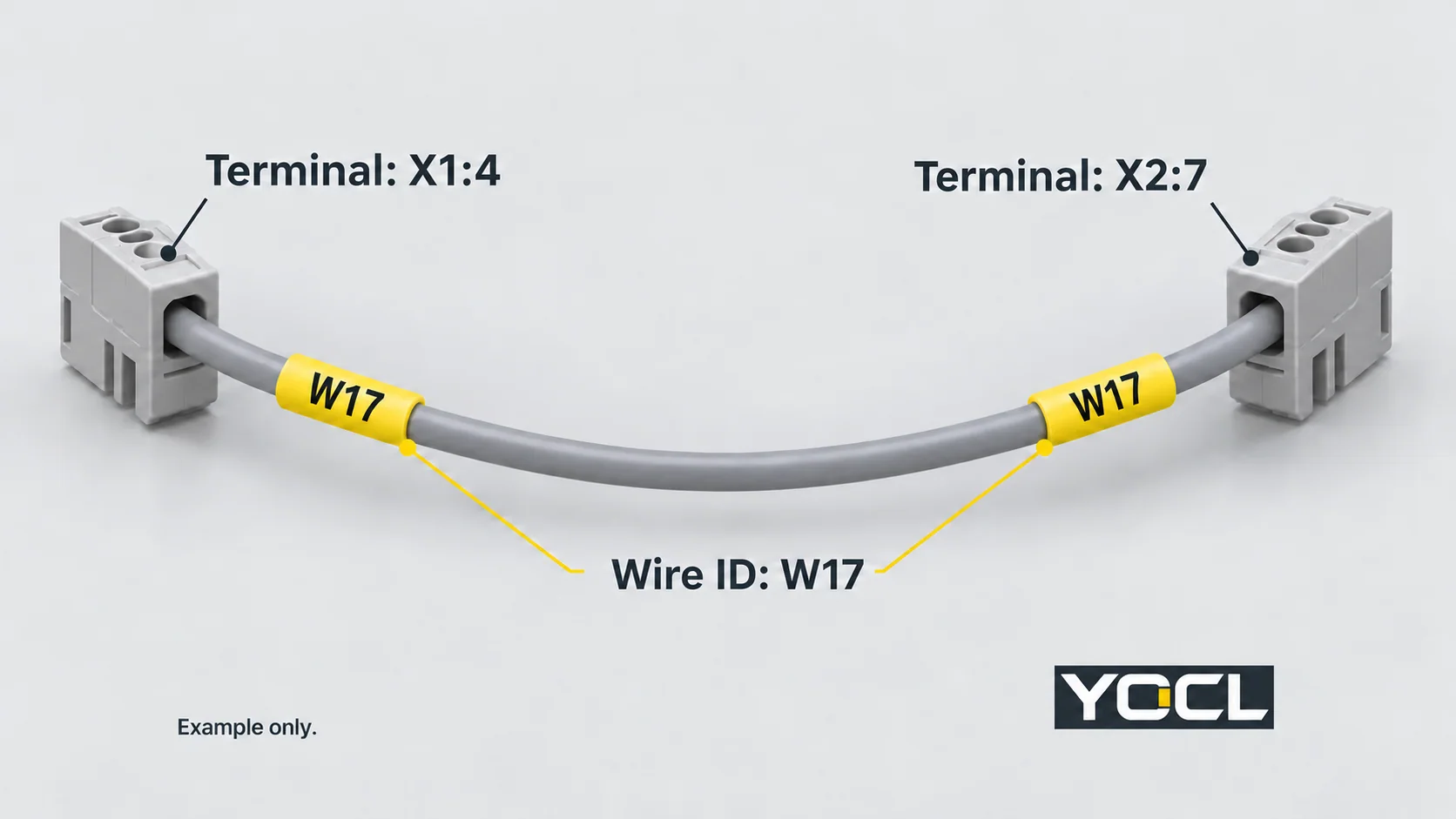
A cable identifier can also refer to an outer multi-core cable, while separate core identifiers distinguish the wires inside it. A label on the outer jacket does not identify every internal core. Likewise, a terminal marker belongs to the terminal assembly; the guia de bloco de terminais explains that accessory context.
Keep project IDs consistent with required conductor-function identification. The public scope of IEC 60445:2021+AMD1:2026 covers equipment-terminal identification and designated conductor identification using colours or alphanumeric notation. A yellow marker carrying W17 is not a substitute for the applicable functional identification scheme. The example above is not a prescribed IEC numbering format.
Readability Depends on the Marker and the Print System
Assess the legend after fitting, not only while it is on a roll or carrier. Check character order, viewing direction, space between adjacent markers and whether the installed wire bend hides the text. For printed sleeves, include a processed sample when confirming the specification.
YOCL’s heat-shrink marker product record declares halogen-free, low-smoke and flame-retardant characteristics and a 125°C temperatura nominal. It distinguishes that rating from installation heating conditions. Those declarations do not apply to every PVC sleeve or POM clip, and they do not supply a heat-gun setting or a project-specific test certificate.
For safety-related marking evidence, UL Solutions’ marking and labelling program evaluates permanence under specified conditions. Its printing-material category identifies acceptable printing inks within the recognition. This illustrates why label stock and printing material must be assessed together; it does not establish recognition of these YOCL examples or coverage of every non-adhesive marker format.
de UL program FAQ also separates marking permanence from electrical, flammability and structural ratings. A durable identifier is useful for traceability; it does not establish the electrical duty of the wire or connection beneath it.
Find the Next Document by the Unresolved Question
| A sua próxima questão | Relevant information |
|---|---|
| Which format suits available access? | Selected sleeve/carrier or clip model’s fitting information |
| Which size fits this insulated wire? | Exact model’s conductor and cable-dimension table, followed by sample fit |
| Which characters and quantities are needed? | Approved identification schedule and quantities per character or complete legend |
| Can this printer produce the required shrink labels? | Marker supply format, printer/ribbon compatibility and processed sample |
| Will the legend remain readable in service? | Required exposure conditions and applicable marking-system evidence |
Strips, holders and marker boxes provide other identification areas and insert arrangements. Marker cable ties combine a tie with a marking area; they serve bundling as well as identification. These accessories require their own dimensions and fixing checks rather than inheriting a sleeve’s fit.
Utilizar o YOCL intervalo de marcações de cabos to locate the relevant family. For an enquiry, send the wire dimensions, installation stage, model or format, legend schedule, character or label quantities, and any printing or exposure requirements.
Leitura relacionada: Ver heat-shrink cable-end sealing e clip-on, slide-on and heat-shrink marker comparison.
Leitura relacionada: marker sizing and sleeve fit.
Referências
- IEC — IEC 62491:2008, Labelling of cables and cores — public abstract on the relationship between industrial wiring and technical documentation; full standard not consulted.
- YOCL product information — EC PVC Cable Markers — character choices, material and exterior profile.
- YOCL product information — 201–205 Cable Marker Sleeves — exterior reference and separate recommended/maximal fit fields.
- YOCL product information — SM Type Clip-On Cable Markers — material, open profile and post-installation fitting.
- YOCL product information — Halogen-Free Heat Shrink Cable Markers — sleeve format and declared characteristics/temperature.
- IEC — IEC 60445:2021+AMD1:2026, consolidated edition 7.1 — public scope for equipment-terminal and conductor identification; full standard not consulted.
- UL Solutions — Marking and Labeling Systems Program — evaluated permanence, printing-material compatibility and certification scope.
- UL Solutions — Marking and Labeling Systems FAQs — boundary between marking permanence and other ratings.