
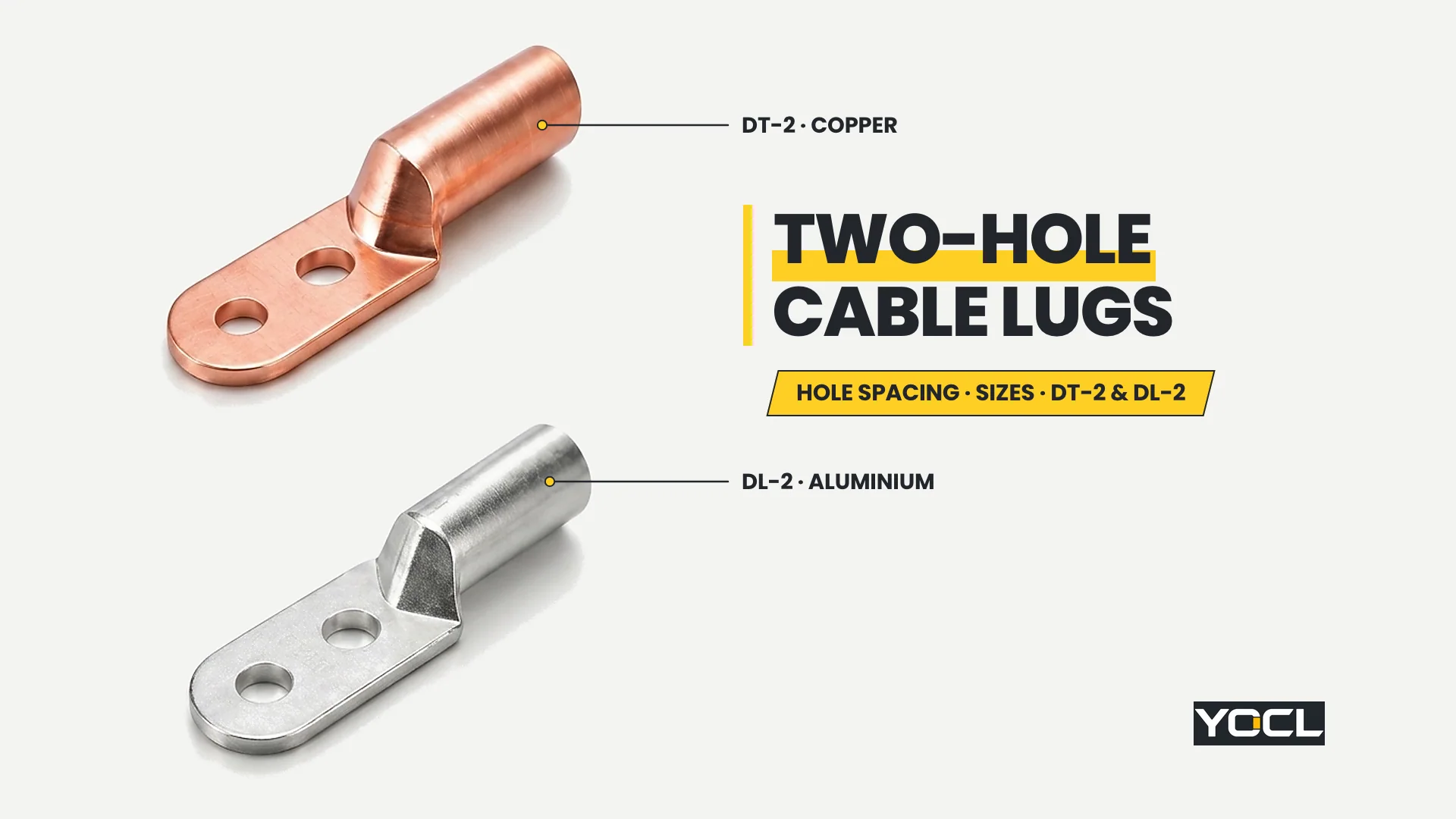
Terminales de cable de dos agujeros son terminales tubulares de compresión fabricados con un cuerpo para el conductor y una pala de montaje plana extendida perforada con dos agujeros para tornillos en línea, lo que bloquea la orientación angular de la pala en terminales de equipos y barras colectoras de dos espárragos. En las series de cobre DT-2 y aluminio DL-2 de YOCL ELECTRIC, los modelos 27 cubren de 16 a 630 mm².
Especificar una pala de dos agujeros requiere algo más que hacer coincidir la sección transversal del cable y el diámetro del tornillo. Debido a que dos tornillos pasan a través de la misma pala rígida, el terminal solo encaja en el terminal del equipo cuando tanto el diámetro del agujero de montaje Φ como la distancia entre centros de los agujeros L3 coinciden simultáneamente con el patrón de agujeros del terminal. Para mantener distintos los temas relacionados, las dimensiones de los terminales de un solo agujero y generales pertenecen a la tabla de tamaños de terminales de cable, mientras que la correspondencia entre los metales del conductor y del terminal pertenece a terminales de cobre frente a aluminio frente a bimetálicos, la preparación de la unión para barriles de aluminio pertenece a compuesto antioxidante para terminales de aluminio, y la herramienta de compresión pertenece a cómo combinar terminales de cable, matrices de crimpado y conductores.
Qué es un terminal de dos agujeros: bloqueo de orientación frente a rotación de un solo tornillo
Un terminal de dos agujeros combina un barril conductor cilíndrico con una pala plana alargada que lleva dos agujeros de montaje en línea. El segundo agujero no es un punto de fijación de repuesto: apretar dos tornillos a lo largo de la línea central de la pala fija la orientación de la misma y elimina la libertad de rotación alrededor del eje del tornillo.
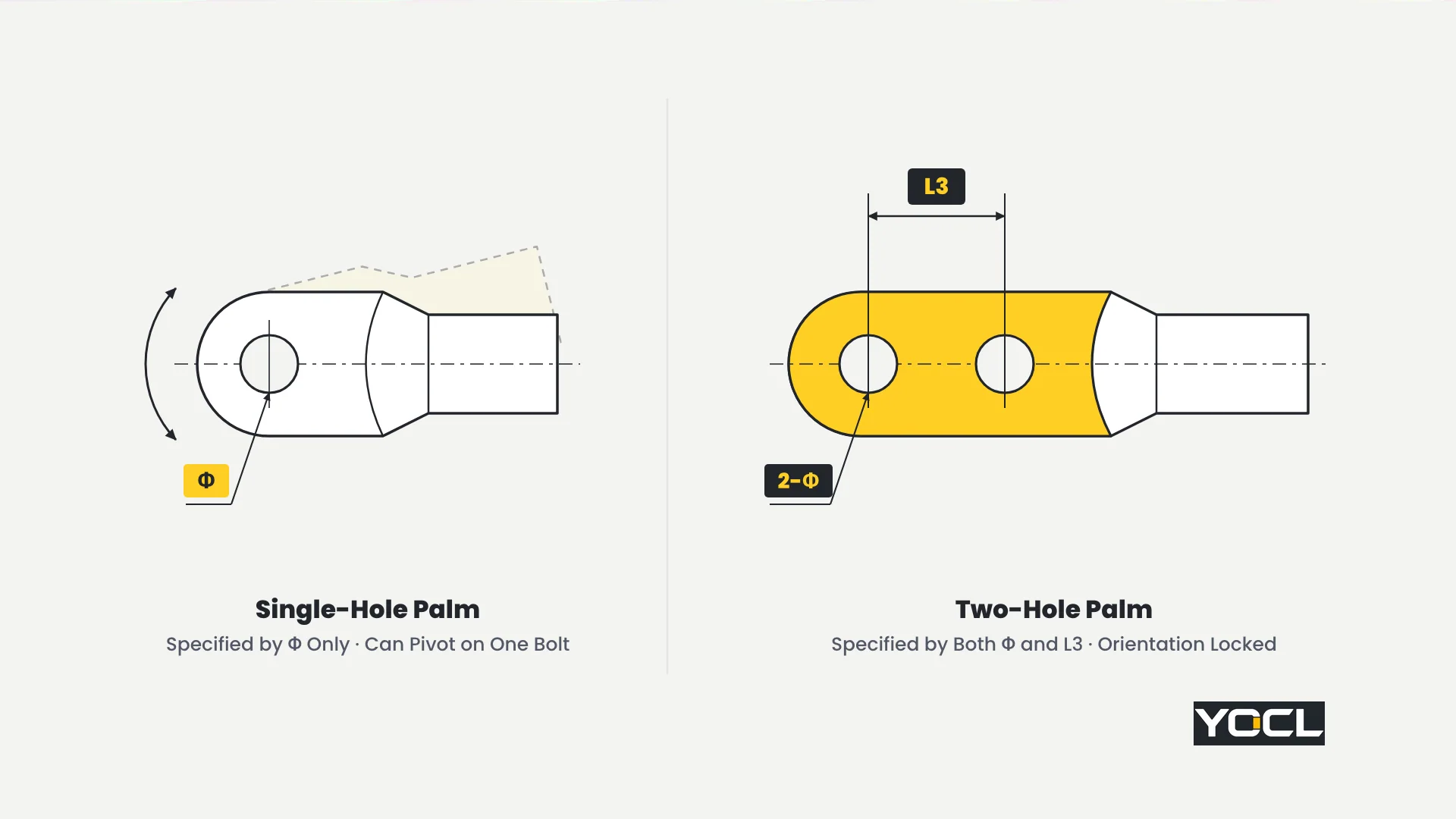
Desde un punto de vista geométrico y de instalación, comparar una pala de un solo tornillo frente a una de dos tornillos explica por qué se utilizan dos puntos de fijación en terminaciones más grandes:
- Por qué una pala de un solo tornillo puede girar: Un único orificio de montaje restringe el movimiento a través de la cara de la pala, pero deja un grado de libertad de rotación alrededor del eje del tornillo. Debido a la rigidez a la flexión de un cable de alimentación pesado, a la carga lateral durante la instalación o a un tornillo que ha perdido fuerza de apriete, una pala de un solo tornillo puede pivotar lateralmente alrededor de su espárrago.
- Cómo dos tornillos eliminan la libertad de rotación: Añadir un segundo orificio de montaje a una distancia entre centros L3 establece una restricción de línea de dos puntos. Con ambos tornillos instalados, la pala no puede girar hacia barras de fase adyacentes, paredes de envolventes o terminales vecinos.
- Solo geometría y práctica de instalación: Las páginas de producto de YOCL indican la configuración estructural (un cuerpo para el conductor, dos orificios de montaje y la conexión prevista de un conductor de cobre o aluminio a un terminal de equipo eléctrico) sin publicar datos comparativos de vibración, extracción, par de apriete o corriente. Considere la pala de dos orificios estrictamente como una geometría de fijación de orientación y adaptación de terminales.
La diferencia en la especificación: coincidencia tanto del diámetro del orificio (Φ) como de la distancia entre centros (L3)
Mientras que la pala de un terminal de un solo orificio se especifica mediante una única dimensión de ajuste (el diámetro de su orificio de montaje), la pala de un terminal de dos orificios se especifica mediante dos dimensiones de ajuste obligatorias a la vez: el diámetro de cada orificio Φ y la distancia entre centros de los orificios L3. Ambos valores deben coincidir con el patrón de orificios del terminal del equipo.
Cuatro reglas rigen toda especificación de terminal de dos orificios:
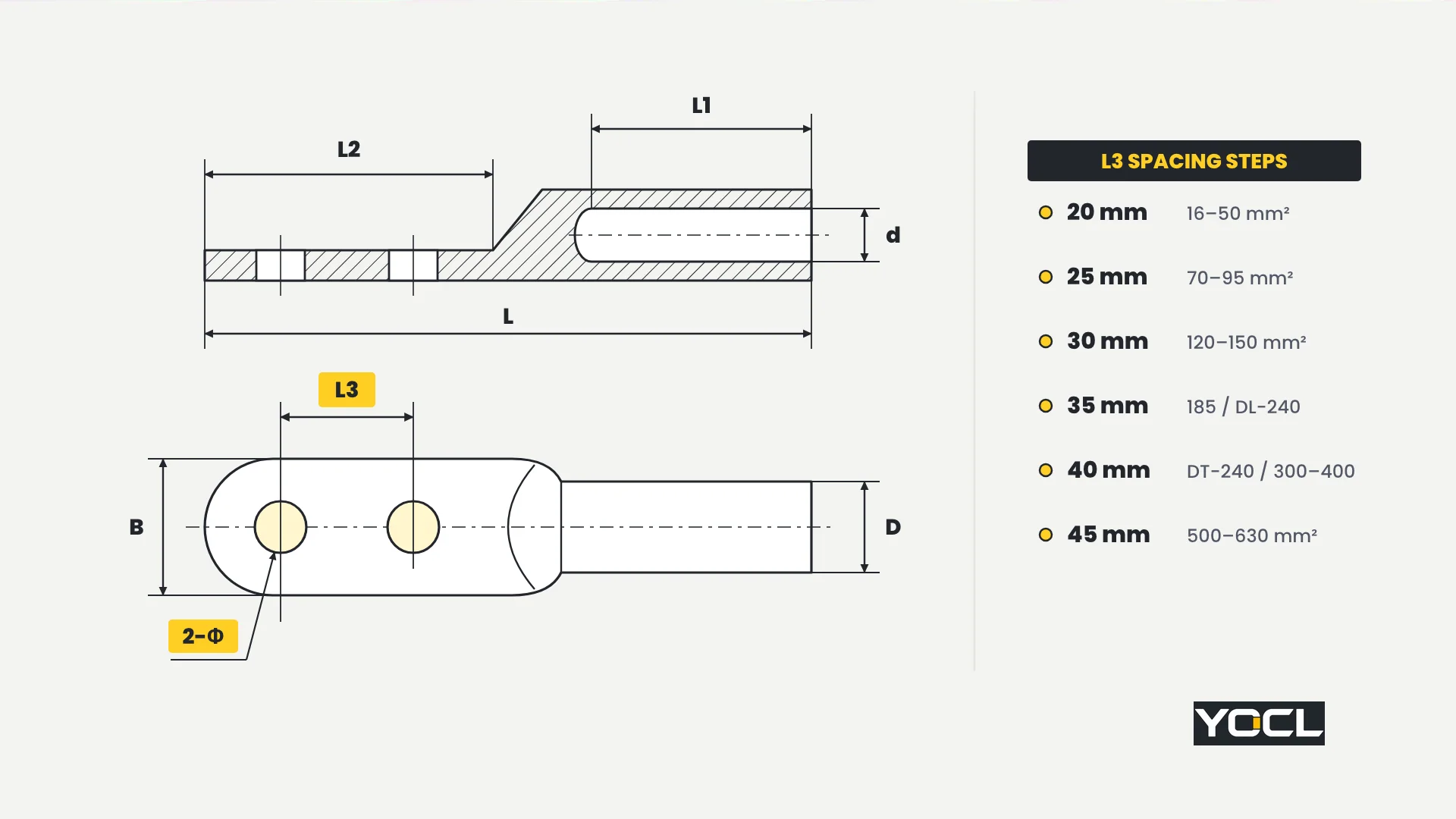
- Definiciones de campo del plano: En ambas páginas de producto de YOCL, Φ es el diámetro de cada orificio de montaje, L3 es la distancia entre centros de los dos orificios, D es el diámetro exterior del tubo, d es el diámetro interior del tubo, B es la anchura de la pala, y L, L1, y L2 follow the overall, barrel, and palm length callouts on the page drawings. Every dimension is in millimetres, and the model suffix is the conductor size in mm².
- L3 steps in six discrete increments: Across both the DT-2 and DL-2 ranges, L3 is not continuous and is not fixed at one universal pitch. As conductor cross-section grows, L3 steps through 20 mm, 25 mm, 30 mm, 35 mm, 40 mm, y 45 mm.
- A 5 mm L3 mismatch does not fit at all: If a lug’s hole diameter Φ matches the terminal studs but its centre spacing L3 is even 5 mm off—such as a 35 mm spacing palm held against a 40 mm spacing busbar—the second bolt cannot enter the hole.
- Order by the terminal pattern, not by conductor size alone: A lug with the wrong L3 cannot be “made to fit” without re-drilling or slotting the palm, which modifies the lug outside the product as supplied. Always check the equipment terminal’s hole diameter and centre-to-centre spacing before ordering.
Two-Hole Cable Lugs Size Charts: YOCL DT-2 Copper and DL-2 Aluminium Series
Especificación two-hole cable lugs from YOCL ELECTRIC requires checking the exact table for your conductor material: DT-2 for copper conductors (13 models, 25–630 mm²) and DL-2 for aluminium conductors (14 models, 16–630 mm²). Never merge the two charts or use one material’s row for the other.
Table A: DT-2 Two-Hole Copper Cable Lugs (25–630 mm², 13 Models)
de YOCL DT-2 two-hole copper cable lugs are copper compression lugs with one conductor barrel and two mounting holes, designed to connect copper conductors (25–630 mm²) to electrical equipment terminals.
Across the 13 DT-2 models, hole diameter Φ steps through 8.5, 10.5, 12.5, 14.5, 16.5, y 21 mm, while centre-to-centre spacing L3 steps through 20, 25, 30, 35, 40, y 45 mm.
| Modelo | Φ (mm) | D (mm) | d (mm) | L (mm) | L1 (mm) | L2 (mm) | L3 (mm) | B (mm) |
|---|---|---|---|---|---|---|---|---|
| DT-2-25 | 8.5 | 11 | 7.8 | 86 | 32 | 40 | 20 | 18 |
| DT-2-35 | 10.5 | 12 | 8.7 | 98 | 34 | 47 | 20 | 20 |
| DT-2-50 | 10.5 | 14 | 9.7 | 105 | 40 | 50 | 20 | 23 |
| DT-2-70 | 12.5 | 16 | 12 | 118 | 45 | 55 | 25 | 26 |
| DT-2-95 | 12.5 | 18 | 13.5 | 125 | 48 | 57 | 25 | 28 |
| DT-2-120 | 14.5 | 20 | 15.5 | 135 | 50 | 65 | 30 | 30 |
| DT-2-150 | 14.5 | 22 | 16.5 | 142 | 53 | 68 | 30 | 34 |
| DT-2-185 | 14.5 | 25 | 18.5 | 145 | 55 | 71 | 35 | 37 |
| DT-2-240 | 16.5 | 27 | 21 | 160 | 59 | 74 | 40 | 40 |
| DT-2-300 | 16.5 | 30 | 23 | 172 | 62 | 81 | 40 | 45 |
| DT-2-400 | 16.5 | 34 | 26 | 181 | 68 | 82 | 40 | 50 |
| DT-2-500 | 21 | 38 | 29.5 | 203 | 73 | 96 | 45 | 60 |
| DT-2-630 | 21 | 45 | 35 | 220 | 84 | 107 | 45 | 60 |
Regla de selección: Use Table A (DT-2) exclusively for copper conductors (25–630 mm²), confirming that Φ, L3, and palm width B match the equipment terminal drawing.
Table B: DL-2 Two-Hole Aluminium Cable Lugs (16–630 mm², 14 Models)
de YOCL DL-2 two-hole aluminium cable lugs are aluminium compression lugs with one conductor barrel and two mounting holes, designed to connect aluminium conductors (16–630 mm²) to electrical equipment terminals.
The 14-model DL-2 range begins at DL-2-16 (16 mm²) and is not interchangeable with the copper table: barrel diameters D y d, lengths L / L1 / L2, y las 240 mm² y 400 mm² palm hole patterns differ from DT-2. For joint preparation on aluminium barrels, see compuesto antioxidante para terminales de aluminio.
| Modelo | Φ (mm) | D (mm) | d (mm) | L (mm) | L1 (mm) | L2 (mm) | L3 (mm) | B (mm) |
|---|---|---|---|---|---|---|---|---|
| DL-2-16 | 8.5 | 10 | 5.5 | 93 | 32 | 44 | 20 | 18 |
| DL-2-25 | 8.5 | 12 | 7 | 94 | 33 | 45 | 20 | 18 |
| DL-2-35 | 10.5 | 14 | 8.5 | 104 | 42 | 48 | 20 | 20 |
| DL-2-50 | 10.5 | 16 | 9.5 | 112 | 47 | 50 | 20 | 23 |
| DL-2-70 | 12.5 | 18 | 12 | 125 | 48 | 59 | 25 | 26 |
| DL-2-95 | 12.5 | 21 | 13 | 136 | 53 | 60 | 25 | 28 |
| DL-2-120 | 14.5 | 23 | 15 | 145 | 55 | 69 | 30 | 30 |
| DL-2-150 | 14.5 | 25 | 16 | 150 | 57 | 70 | 30 | 34 |
| DL-2-185 | 14.5 | 27 | 18 | 162 | 63 | 76 | 35 | 37 |
| DL-2-240 | 14.5 | 30 | 20 | 170 | 66 | 77 | 35 | 40 |
| DL-2-300 | 16.5 | 34 | 23 | 180 | 73 | 78 | 40 | 45 |
| DL-2-400 | 21 | 38 | 26 | 195 | 76 | 87 | 40 | 50 |
| DL-2-500 | 21 | 42 | 30 | 205 | 80 | 91 | 45 | 60 |
| DL-2-630 | 21 | 45 | 34.5 | 210 | 85 | 95 | 45 | 60 |
Regla de selección: Use Table B (DL-2) exclusively for aluminium conductors (16–630 mm²), and read Φ y L3 directly from the DL-2 row rather than assuming parity with DT-2.
Reading the Charts: Selection Order and Worked Examples
To select the right model without palm-fit errors, follow a strict verification sequence: match conductor size and material to the model first, verify Φ y L3 against the equipment terminal drawing second, and check palm width B against the terminal face third.
Step-by-Step Selection Order
- Conductor size and material → Model: Pick DT-2 for a copper conductor or DL-2 for an aluminium conductor (never fit an aluminium lug on a copper cable or the reverse; see terminales de cobre frente a aluminio frente a bimetálicos) and locate the row matching your conductor cross-section in mm².
- Verify Φ and L3 against the terminal drawing: Check that both the hole diameter Φ como la distancia entre centros de los agujeros L3 in that row match the equipment terminal’s hole pattern.
- Check palm width B against the terminal face: Confirm that B (de 18 mm up to 60 mm) fits cleanly within the terminal pad width and phase barriers.
Worked Examples: 95 mm² Coincidence vs 240 mm² and 400 mm² Divergence
- 95 mm² Copper vs Aluminium (Coincidence of One Row):
A 95 mm² copper conductor terminating on a two-hole pad with 12.5 mm holes at 25 mm centres selects DT-2-95, which has Φ = 12.5 mm, L3 = 25 mm, y B = 28 mm (with D = 18 mm, d = 13.5 mm, L = 125 mm, L1 = 48 mm, L2 = 57 mm). For a 95 mm² aluminium conductor, DL-2-95 happens to share Φ = 12.5 mm, L3 = 25 mm, y B = 28 mm (while its barrel and length dimensions change to D = 21 mm, d = 13 mm, L = 136 mm, L1 = 53 mm, L2 = 60 mm). That palm match at 95 mm² is a coincidence of this row, not a cross-table rule. - 240 mm² Copper vs Aluminium (Both Φ and L3 Diverge):
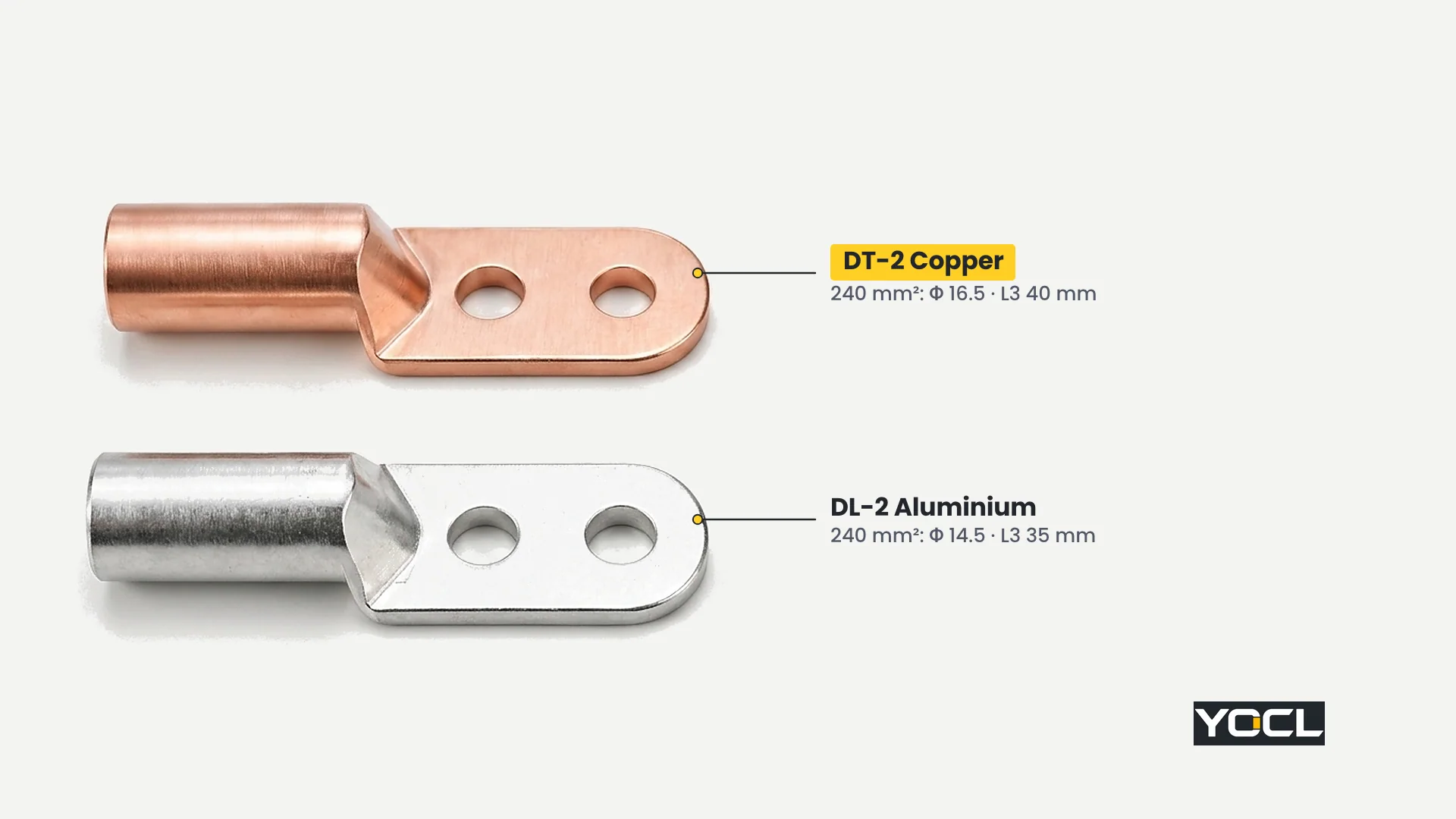
A 240 mm², the two materials diverge in both palm fit dimensions. In Table A, DT-2-240 (copper) has Φ = 16.5 mm, D = 27 mm, d = 21 mm, L = 160 mm, L1 = 59 mm, L2 = 74 mm, L3 = 40 mm, y B = 40 mm. In Table B, DL-2-240 (aluminium) has Φ = 14.5 mm, D = 30 mm, d = 20 mm, L = 170 mm, L1 = 66 mm, L2 = 77 mm, L3 = 35 mm, y B = 40 mm. A buyer terminating a 240 mm² aluminium cable must check the DL-2-240 row separately: its 14.5 mm holes at 35 mm centres will not fit a terminal drilled for 16.5 mm holes at 40 mm centres. - 400 mm² Copper vs Aluminium (Hole Diameter Φ Diverges):
A 400 mm², both rows share L3 = 40 mm y B = 50 mm, but DT-2-400 tiene Φ = 16.5 mm (D = 34, d = 26, L = 181, L1 = 68, L2 = 82 mm) whereas DL-2-400 tiene Φ = 21 mm (D = 38, d = 26, L = 195, L1 = 76, L2 = 87 mm).
When One Bolt Is Not Enough: How the Terminal and Application Decide
Answering when one bolt is not enough begins with the equipment terminal itself: the terminal as built decides first. A single-hole equipment terminal takes a single-hole lug, and no lug preference overrides the hardware pattern on the equipment.
Where termination geometry is being specified or matched on site, three rules apply:
- The equipment terminal pattern comes first: Two-hole palms belong on equipment terminals and busbar ends that provide a matching two-hole pattern (Φ y L3). Where an equipment stud or busbar pad has only one hole, specify a single-hole lug.
- Where orientation lock matters: Two-hole palms are specified where heavy feeders could twist a single-bolt palm out of alignment during installation pulling, where tight phase-to-phase spacing requires the palm to stay fixed inline with the busbar, or where the equipment manufacturer provides two inline studs to prevent palm rotation.
- Conductor size is a hint, not a current rule: YOCL’s two-hole ranges start at 25 mm² in copper (DT-2) y 16 mm² in aluminium (DL-2) and run to 630 mm², while smaller wire sizes are covered by single-hole ranges (see la tabla de tamaños de terminales de cable). Do not apply an assumed current threshold for switching to two holes—the product pages publish no current ratings for these series.
Installation Notes: Both Bolts Installed and Pre-Crimp Spacing Checks
Installing a two-hole lug requires two field habits that follow directly from the data: every two-hole palm must be fastened with both bolts, and L3 must be verified against the terminal before the barrel is crimped onto the cable.
- Both bolts belong to the joint: Fitting only one bolt of a two-hole palm into a single-hole terminal leaves the palm free to rotate around that single bolt—the exact failure mode the second hole exists to prevent—while leaving half of the palm overhanging the contact pad.
- Check L3 before crimping: Verify Φ y L3 on the terminal drawing or by measuring centre-to-centre directly on the terminal pad before crimping. After compression, a lug with the wrong hole spacing cannot be exchanged without cutting the conductor back.
- Use the matching crimp die: Match the compression die to the barrel’s series and size (D y d differ between DT-2 and DL-2); see cómo combinar terminales de cable, matrices de crimpado y conductores.
Preguntas frecuentes
Can I use a two-hole cable lug on a terminal with only one hole?
No. Both holes of a two-hole palm belong to the joint. Fastening only one bolt of a two-hole lug onto a single-hole terminal leaves the palm free to rotate on that single bolt—the exact problem the second hole exists to prevent. Always fit a single-hole lug to a single-hole terminal.
How do I measure hole spacing on a two-hole lug?
Hole spacing L3 is measured centre-to-centre between the two mounting holes in millimetres, not edge-to-edge. Measure the centre-to-centre distance and hole diameter Φ on the equipment terminal or drawing, then match both numbers to the Φ y L3 columns in the DT-2 or DL-2 table.
Is a two-hole cable lug stronger than a single-hole lug?
YOCL’s DT-2 and DL-2 product pages publish no comparative mechanical strength, torque, vibration, or current figures. The difference is fixing geometry and terminal fit: two inline bolts separated by L3 lock the palm’s orientation so it cannot rotate around a single bolt axis.
Does the hole spacing change with lug size?
Yes. Across both the DT-2 (25–630 mm²) and DL-2 (16–630 mm²) charts, centre-to-centre hole spacing L3 steps from 20 mm a 25 mm, 30 mm, 35 mm, 40 mm, y 45 mm as conductor size increases, and differs between copper and aluminium at 240 mm² (40 mm vs 35 mm).
Referencias
- YOCL ELECTRIC Product Information — DT-2 Terminales de cable de cobre de dos orificios: copper two-hole lug specifications, drawing field definitions (Φ, D, d, L, L1, L2, L3, B), and 13-model table (25–630 mm²).
- YOCL ELECTRIC Product Information — Terminales de Aluminio de DL-2 Dos Orificios: aluminium two-hole lug specifications, drawing field definitions (Φ, D, d, L, L1, L2, L3, B), and 14-model table (16–630 mm²).