
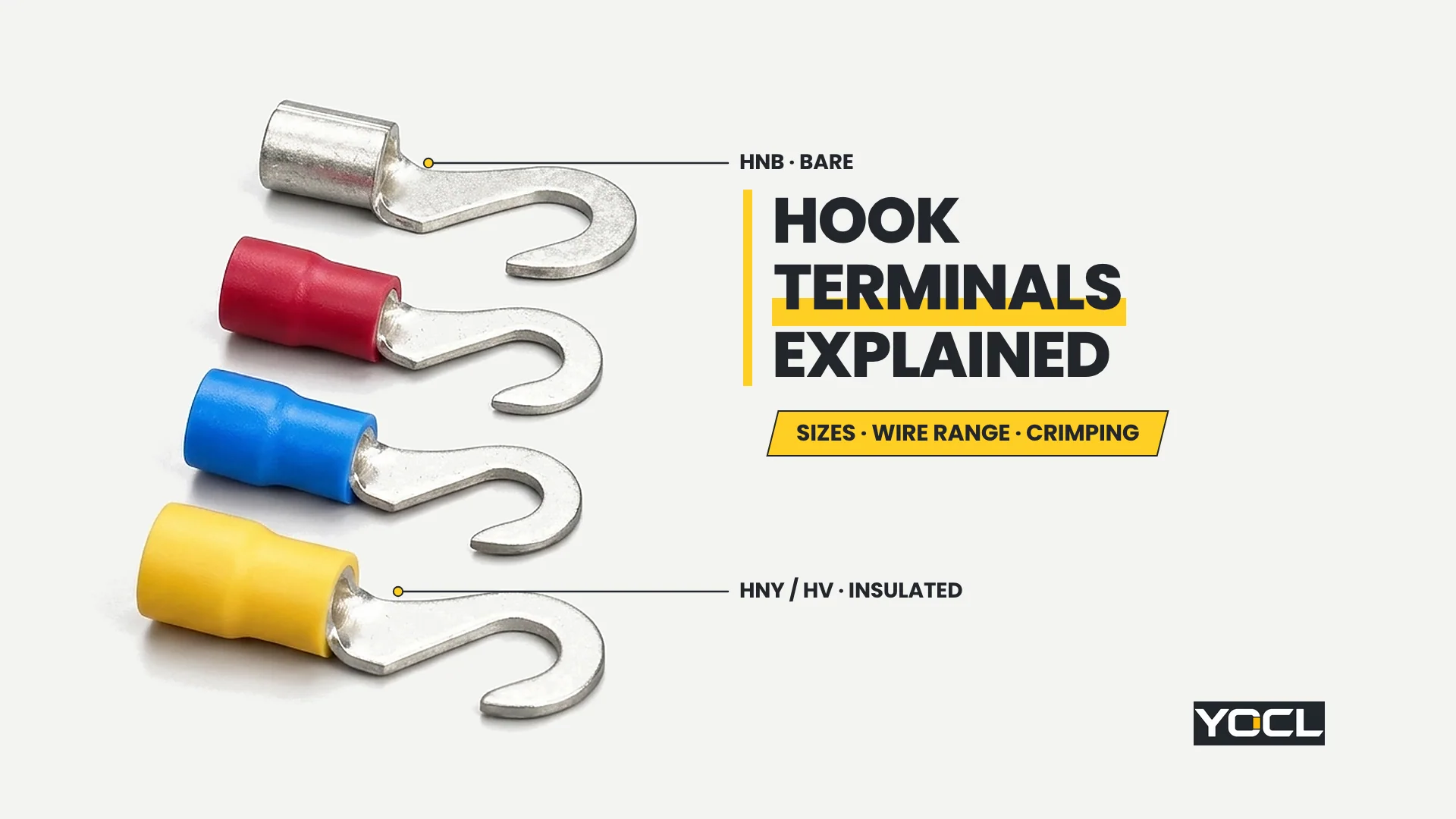
Terminais de gancho são conectores de cravação por compressão a frio cuja lâmina de contacto forma uma curva em C de entrada lateral aberta em vez de um anel fechado ou de um garfo de duas pontas, permitindo que o terminal deslize lateralmente para um parafuso ou perno desapertado e bloqueie sob a cabeça do parafuso quando apertado. Em todos os modelos 65 da YOCL ELECTRIC, três grupos de fios combinam com cinco aberturas para parafusos.
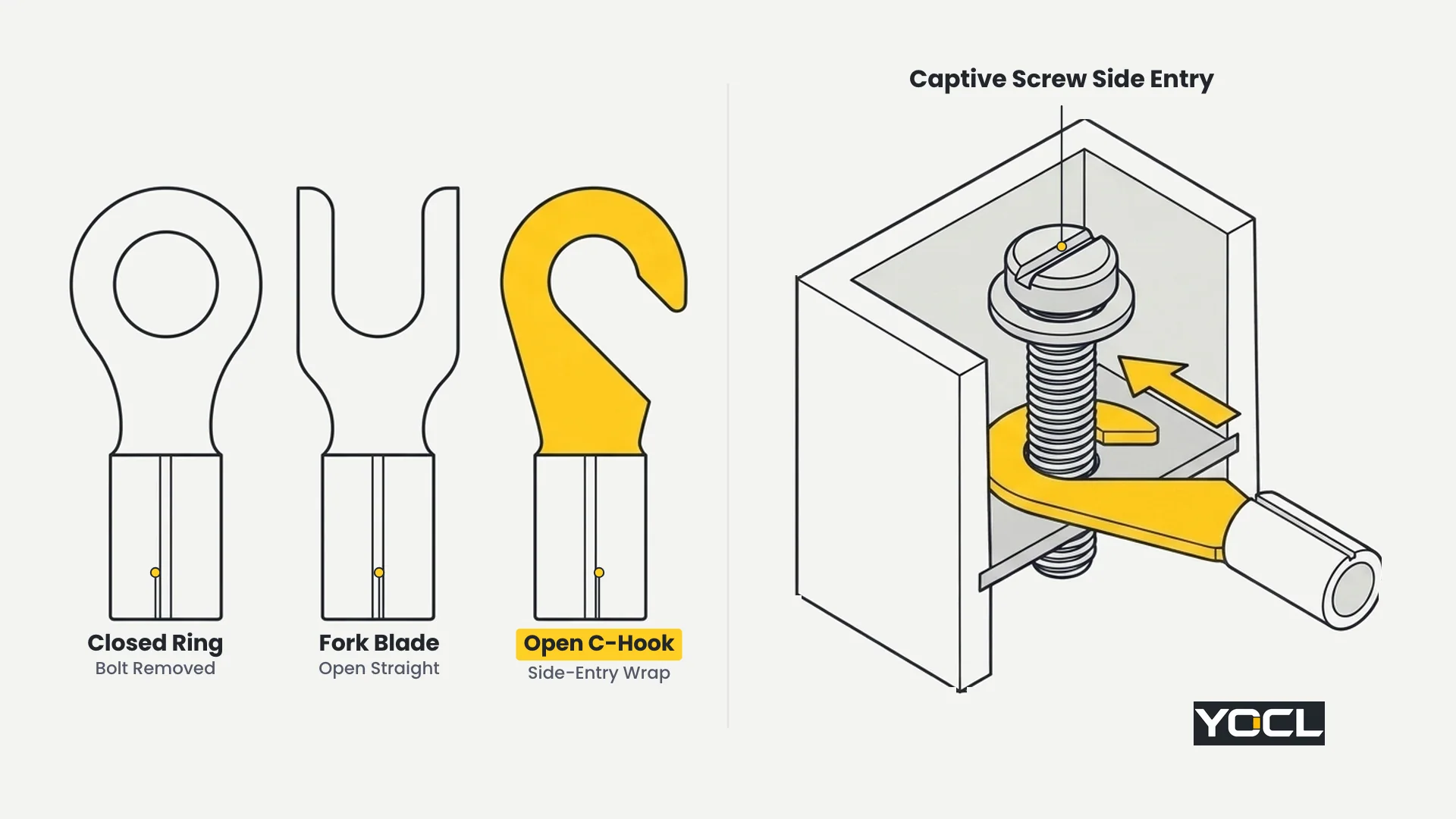
Os engenheiros especificam uma lâmina de gancho para um problema prático de instalação: um ponto de ligação aparafusado onde o parafuso pode ser desapertado algumas voltas para cablagem ou trabalhos de modernização, mas não pode — ou não deve — ser totalmente removido. Um terminal de anel fechado não pode ser instalado sem remover o parafuso completamente, enquanto um gancho em C aberto desliza para o veio a partir da lateral em filas de terminais apinhadas ou blocos de parafusos cativos. Para manter os tópicos vizinhos distintos, a estrutura geral do terminal de cravação pertence a o que é um terminal de cravação, a escolha entre anéis fechados e garfos de duas pontas pertence a terminais de anel vs. terminais de forquilha, e as propriedades do material de isolamento pertencem a PVC vs nylon vs terminais de cravação não isolados.
Geometria de Gancho Aberto vs Anéis Fechados: O Compromisso de Entrada Lateral
Uma lâmina de gancho aberto combina acesso de instalação de entrada lateral com um envolvimento parcial em torno do eixo do parafuso, situando-se mecanicamente entre um anel fechado e um garfo reto. No entanto, a mesma garganta lateral que permite que o gancho deslize sobre um parafuso solto também permite que ele escorregue lateralmente se o fixador se soltar.
Trate essa garganta aberta como uma consequência geométrica direta em vez de uma classificação de desempenho oculta:
- Por que o gancho C ajuda durante o serviço: Porque a ponta curva se encaixa na parte de trás do parafuso uma vez posicionada, puxar diretamente para trás ao longo do eixo do fio faz com que a curva interna se pressione contra o eixo do parafuso em vez de deslizar para fora como um garfo paralelo.
- Por que não é uma junta cativa: Se a ciclagem térmica ou o aperto inadequado deixarem a cabeça do parafuso solta, o movimento lateral em direção à garganta aberta ainda pode desencaixar completamente a lâmina—algo que um anel fechado impede fisicamente enquanto o parafuso permanecer no lugar.
- Regra de seleção de campo: Especifique um anel fechado sempre que o parafuso puder ser removido e o fio deve permanecer preso ao pino; especifique um terminal em gancho onde o hardware cativo ou o acesso apertado ao painel exigem entrada lateral e a firmeza do aperto do parafuso é verificada durante a montagem.
Sistema de Tamanhos de Terminais em Gancho: Códigos de Modelo, Aberturas de Parafuso e Tabelas Completas
Selecionando terminais em gancho com precisão começa com a decodificação do sistema de código de modelo compartilhado de YOCL e a escada dimensional de três grupos em todos os SKUs do catálogo 65. Cada código de modelo emparelha um prefixo de faixa de condutor com um sufixo de tamanho de parafuso nominal—e o sufixo nominal após o traço nunca é igual à abertura do gancho medida d2.
Decodificando a Escada Compartilhada de Condutores e Parafusos
Todas as três famílias YOCL—cobre nu HNB, isolado em nylon HNY/HNYD, e isolado em PVC HV/HVD—usam a mesma sintaxe de código de modelo: [Série] [Grupo]-[Código do Parafuso]. Por exemplo, HNB 2-5 identifica a série HNB, grupo de condutores 2 (1.5–2.5 mm²), e código do parafuso 5 (#10 parafuso).
- Três grupos de condutores partilhados: Grupo 1.25 cobre 0.5–1.5 mm²; Grupo 2 cobre 1.5–2.5 mm²; Grupo 5.5 cobre 4–6 mm². As páginas isoladas HNY/HNYD e HV/HVD também imprimem o equivalente AWG 22–16, AWG 16–14, e AWG 12–10 faixas e codificam por cores as mangas Vermelho (1.25), Azul (2), and Amarelo (5.5), whereas the HNB page lists mm² only. Copper contact thickness across all three families is 0.7 mm (group 1.25), 0.8 mm (group 2), and 1.0 mm (group 5.5).
- Catalogue Imax label boundary: Across all three families, the group tables list Imax = 19 A (group 1.25), 27 A (group 2), and 48 A (group 5.5). As stated on YOCL’s product pages, Imax is the catalogue’s maximum-current label for the conductor group and test or installation conditions are not provided—never treat Imax as an installed circuit ampacity.
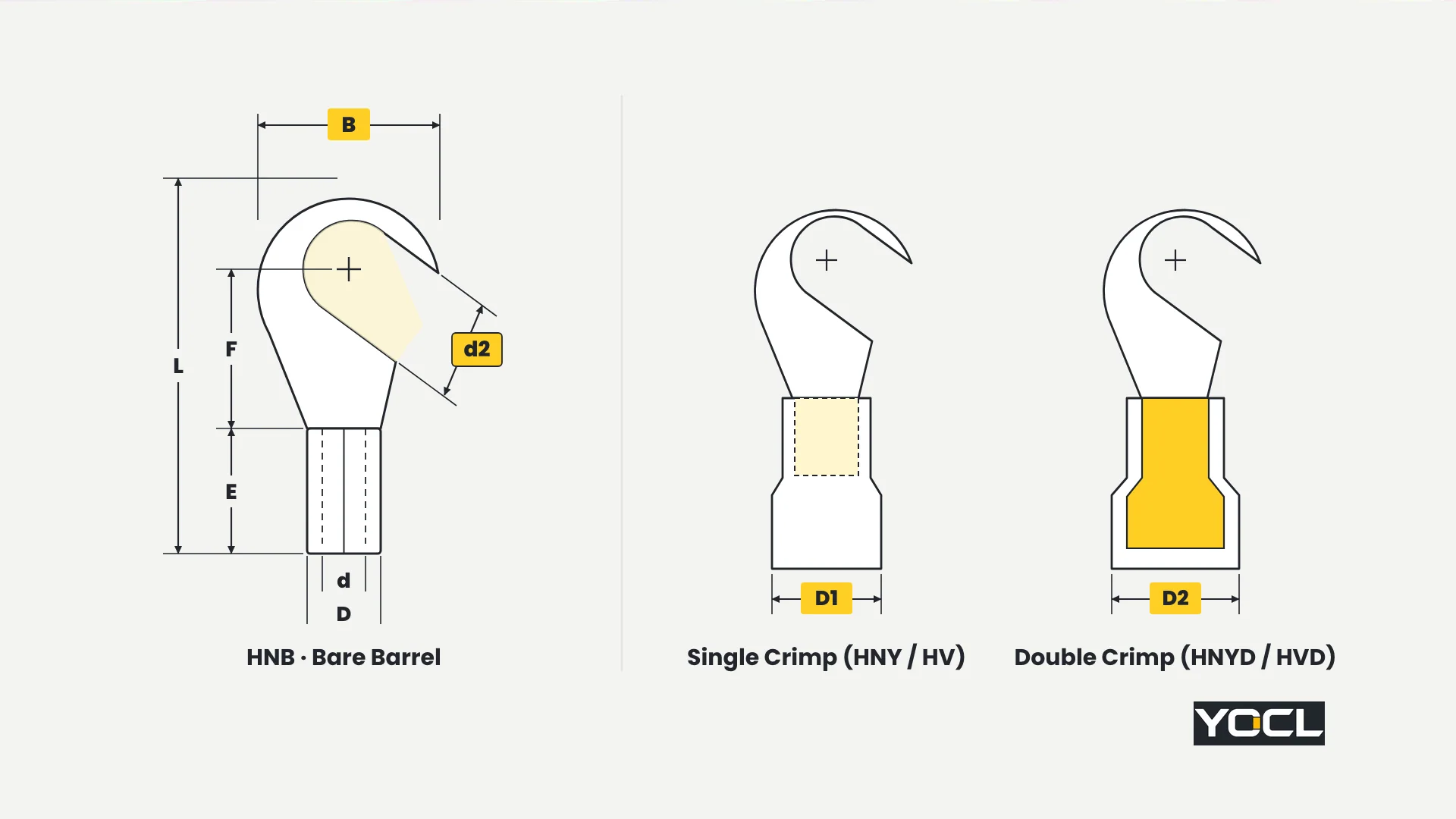
- Nominal bolt code vs actual opening d2: Each family lists 13 models per crimp style (4 in group 1.25, 4 in group 2, and 5 in group 5.5, where the 5/16 bolt size exists only in group 5.5). The number after the dash (3.5, 4, 5, 6, 8) is the nominal screw code, while d2 is the actual clearance opening in millimeters:
- Suffix -3.5 (#6 US bolt) → actual opening d2 = 3.7 mm
- Suffix -4 (#8 US bolt) → actual opening d2 = 4.3 mm
- Suffix -5 (#10 US bolt) → actual opening d2 = 5.3 mm
- Suffix -6 (1/4 US bolt) → actual opening d2 = 6.5 mm
- Suffix -8 (5/16 US bolt, group 5.5 only) → actual opening d2 = 8.5 mm
- Sequência de seleção: Match wire cross-section to the conductor group first, match the stud or screw size to d2 second, and check B (outer hook width), F (barrel top to bolt center), and L (overall length) against the barrier walls around the terminal post—because a hook slides on from the side, it requires lateral clearance beside the screw. (For tab-style disconnects that use a different sizing system, see the quick-disconnect terminal size chart.)
Family 1: HNB Non-Insulated Hook Terminals (TO Type)
YOCL’s HNB non-insulated hook terminals (TO type) are uninsulated copper terminals across 13 models, providing the shortest overall length L (15.7–27.0 mm) and bare barrels for direct visual inspection or post-crimp heat-shrink tubing.
Within each conductor group, copper thickness, barrel length E, barrel outer diameter D, and barrel inner diameter d are shared: Group 1.25 (0.5–1.5 mm², Imax 19 A without test/installation conditions stated) has thickness 0.7 mm, E = 4.8 mm, D = 3.4 mm, d = 1.7 mm; Grupo 2 (1.5–2.5 mm², Imax 27 A, no conditions stated) has thickness 0.8 mm, E = 4.8 mm, D = 4.1 mm, d = 2.3 mm; Grupo 5.5 (4–6 mm², Imax 48 A, no conditions stated) has thickness 1.0 mm, E = 6.0 mm, D = 5.6 mm, d = 3.4 mm.
| Modelo | Section (mm²) | Bolt | d2 (mm) | B (mm) | F (mm) | L (mm) | E (mm) | D (mm) | d (mm) |
|---|---|---|---|---|---|---|---|---|---|
| HNB 1.25-3.5 | 0.5–1.5 | #6 | 3.7 | 8.0 | 7.0 | 15.8 | 4.8 | 3.4 | 1.7 |
| HNB 1.25-4 | 0.5–1.5 | #8 | 4.3 | 8.0 | 7.0 | 15.8 | 4.8 | 3.4 | 1.7 |
| HNB 1.25-5 | 0.5–1.5 | #10 | 5.3 | 8.0 | 7.0 | 15.8 | 4.8 | 3.4 | 1.7 |
| HNB 1.25-6 | 0.5–1.5 | 1/4 | 6.5 | 11.6 | 11.0 | 21.8 | 4.8 | 3.4 | 1.7 |
| HNB 2-3.5 | 1.5–2.5 | #6 | 3.7 | 8.5 | 7.4 | 16.8 | 4.8 | 4.1 | 2.3 |
| HNB 2-4 | 1.5–2.5 | #8 | 4.3 | 8.5 | 7.4 | 16.8 | 4.8 | 4.1 | 2.3 |
| HNB 2-5 | 1.5–2.5 | #10 | 5.3 | 9.5 | 7.3 | 16.8 | 4.8 | 4.1 | 2.3 |
| HNB 2-6 | 1.5–2.5 | 1/4 | 6.5 | 12.0 | 11.0 | 21.8 | 4.8 | 4.1 | 2.3 |
| HNB 5.5-3.5 | 4–6 | #6 | 3.7 | 7.2 | 6.1 | 15.7 | 6.0 | 5.6 | 3.4 |
| HNB 5.5-4 | 4–6 | #8 | 4.3 | 9.5 | 9.5 | 19.8 | 6.0 | 5.6 | 3.4 |
| HNB 5.5-5 | 4–6 | #10 | 5.3 | 9.5 | 9.5 | 19.8 | 6.0 | 5.6 | 3.4 |
| HNB 5.5-6 | 4–6 | 1/4 | 6.5 | 12.0 | 10.3 | 22.5 | 6.0 | 5.6 | 3.4 |
| HNB 5.5-8 | 4–6 | 5/16 | 8.5 | 15.0 | 13.5 | 27.0 | 6.0 | 5.6 | 3.4 |
Regra de Seleção: Choose HNB bare copper models when minimal overall length L (15.7–27.0 mm) is required in tight spaces or when external heat-shrink tubing will be applied after crimping; switch to HNY/HNYD or HV/HVD whenever pre-insulated color-coded barrels are required.
Family 2: HNY (Single Crimp) and HNYD (Double Crimp) Nylon Hook Terminals
YOCL’s HNY/HNYD nylon hook terminals pair a copper contact with a nylon insulating sleeve across 13 matched single-crimp (HNY) and double-crimp (HNYD) rows (26 models). For this nylon family—and this family only—the product page states 600 V e 105 °C across all three size groups.
Group parameters pair Vermelho (group 1.25: 0.5–1.5 mm² / AWG 22–16, thickness 0.7 mm, catalogue Imax 19 A without test/installation conditions), Azul (group 2: 1.5–2.5 mm² / AWG 16–14, thickness 0.8 mm, Imax 27 A, no conditions stated), and Amarelo (group 5.5: 4–6 mm² / AWG 12–10, thickness 1.0 mm, Imax 48 A, no conditions stated).
| HNY (Single) | HNYD (Double) | Cor | Bolt | d2 (mm) | B (mm) | F (mm) | L (mm) | E (mm) | D1 (mm) | D2 (mm) |
|---|---|---|---|---|---|---|---|---|---|---|
| HNY 1.25-3.5 | HNYD 1.25-3.5 | Vermelho | #6 | 3.7 | 8.0 | 7.0 | 22.0 | 11.0 | 4.3 | 4.8 |
| HNY 1.25-4 | HNYD 1.25-4 | Vermelho | #8 | 4.3 | 8.0 | 7.0 | 22.0 | 11.0 | 4.3 | 4.8 |
| HNY 1.25-5 | HNYD 1.25-5 | Vermelho | #10 | 5.3 | 8.0 | 7.0 | 22.0 | 11.0 | 4.3 | 4.8 |
| HNY 1.25-6 | HNYD 1.25-6 | Vermelho | 1/4 | 6.5 | 11.6 | 11.0 | 28.0 | 11.0 | 4.3 | 4.8 |
| HNY 2-3.5 | HNYD 2-3.5 | Azul | #6 | 3.7 | 8.5 | 7.4 | 23.0 | 11.0 | 4.9 | 5.2 |
| HNY 2-4 | HNYD 2-4 | Azul | #8 | 4.3 | 8.5 | 7.4 | 23.0 | 11.0 | 4.9 | 5.2 |
| HNY 2-5 | HNYD 2-5 | Azul | #10 | 5.3 | 9.5 | 7.3 | 23.0 | 11.0 | 4.9 | 5.2 |
| HNY 2-6 | HNYD 2-6 | Azul | 1/4 | 6.5 | 12.0 | 11.0 | 28.0 | 11.0 | 4.9 | 5.2 |
| HNY 5.5-3.5 | HNYD 5.5-3.5 | Amarelo | #6 | 3.7 | 7.2 | 6.1 | 23.7 | 14.0 | 6.9 | 7.2 |
| HNY 5.5-4 | HNYD 5.5-4 | Amarelo | #8 | 4.3 | 9.5 | 9.5 | 27.8 | 14.0 | 6.9 | 7.2 |
| HNY 5.5-5 | HNYD 5.5-5 | Amarelo | #10 | 5.3 | 9.5 | 9.5 | 27.8 | 14.0 | 6.9 | 7.2 |
| HNY 5.5-6 | HNYD 5.5-6 | Amarelo | 1/4 | 6.5 | 12.0 | 10.3 | 30.5 | 14.0 | 6.9 | 7.2 |
| HNY 5.5-8 | HNYD 5.5-8 | Amarelo | 5/16 | 8.5 | 15.0 | 13.5 | 35.0 | 14.0 | 6.9 | 7.2 |
Regra de Seleção: Choose HNY/HNYD when the specification requires nylon insulation with stated 600 V and 105 °C group parameters; select HNYD (D2 = 4.8 / 5.2 / 7.2 mm) over HNY (D1 = 4.3 / 4.9 / 6.9 mm) when a double-crimp barrel over the wire insulation is needed.
Family 3: HV (Single Crimp) and HVD (Double Crimp) PVC Pre-Insulated Hook Terminals
YOCL’s HV/HVD pre-insulated hook terminals pair a copper contact with a PVC sleeve across 13 matched pairs (26 models), where HVD incorporates an additional copper tube with sleeve described on the source page as double pressure.
Group wire ranges (Vermelho 0.5–1.5 mm² / AWG 22–16; Azul 1.5–2.5 mm² / AWG 16–14; Amarelo 4–6 mm² / AWG 12–10), copper thicknesses (0.7 / 0.8 / 1.0 mm), and catalogue Imax labels (19 A / 27 A / 48 A, without test or installation conditions stated) match the shared ladder, while the HV/HVD page states não voltage or temperature rating.
| HV (Single) | HVD (Double) | Cor | Bolt | d2 (mm) | B (mm) | F (mm) | L (mm) | E (mm) | D1 (mm) | D2 (mm) |
|---|---|---|---|---|---|---|---|---|---|---|
| HV 1.25-3.5 | HVD 1.25-3.5 | Vermelho | #6 | 3.7 | 8.0 | 7.0 | 21.0 | 10.0 | 4.3 | 4.5 |
| HV 1.25-4 | HVD 1.25-4 | Vermelho | #8 | 4.3 | 8.0 | 7.0 | 21.0 | 10.0 | 4.3 | 4.5 |
| HV 1.25-5 | HVD 1.25-5 | Vermelho | #10 | 5.3 | 8.0 | 7.0 | 21.0 | 10.0 | 4.3 | 4.5 |
| HV 1.25-6 | HVD 1.25-6 | Vermelho | 1/4 | 6.5 | 11.6 | 11.0 | 27.0 | 10.0 | 4.3 | 4.5 |
| HV 2-3.5 | HVD 2-3.5 | Azul | #6 | 3.7 | 8.5 | 7.4 | 22.0 | 10.0 | 4.9 | 5.2 |
| HV 2-4 | HVD 2-4 | Azul | #8 | 4.3 | 8.5 | 7.4 | 22.0 | 10.0 | 4.9 | 5.2 |
| HV 2-5 | HVD 2-5 | Azul | #10 | 5.3 | 9.5 | 7.3 | 22.0 | 10.0 | 4.9 | 5.2 |
| HV 2-6 | HVD 2-6 | Azul | 1/4 | 6.5 | 12.0 | 11.0 | 27.0 | 10.0 | 4.9 | 5.2 |
| HV 5.5-3.5 | HVD 5.5-3.5 | Amarelo | #6 | 3.7 | 7.2 | 6.1 | 22.7 | 13.0 | 6.7 | 7.0 |
| HV 5.5-4 | HVD 5.5-4 | Amarelo | #8 | 4.3 | 9.5 | 9.5 | 26.8 | 13.0 | 6.7 | 7.0 |
| HV 5.5-5 | HVD 5.5-5 | Amarelo | #10 | 5.3 | 9.5 | 9.5 | 26.8 | 13.0 | 6.7 | 7.0 |
| HV 5.5-6 | HVD 5.5-6 | Amarelo | 1/4 | 6.5 | 12.0 | 10.3 | 29.5 | 13.0 | 6.7 | 7.0 |
| HV 5.5-8 | HVD 5.5-8 | Amarelo | 5/16 | 8.5 | 15.0 | 13.5 | 34.0 | 13.0 | 6.7 | 7.0 |
Regra de Seleção: Choose HV (single crimp, D1 = 4.3 / 4.9 / 6.7 mm) or HVD (double-pressure copper tube + PVC sleeve, D2 = 4.5 / 5.2 / 7.0 mm) when standard PVC pre-insulated hook terminals with 1.0 mm shorter sleeve lengths E (10.0 / 10.0 / 13.0 mm) and overall lengths L (21.0–34.0 mm) fit the panel layout.
Three Hook-Terminal Families on One Shared Dimensional Ladder
Comparing HNB, HNY/HNYD, and HV/HVD side by side shows that all 65 models share one identical contact-blade ladder—every matching suffix has the exact same d2 opening, outer hook width B, neck length F, and copper thickness. Only the barrel insulation, sleeve length E, and overall length L change.
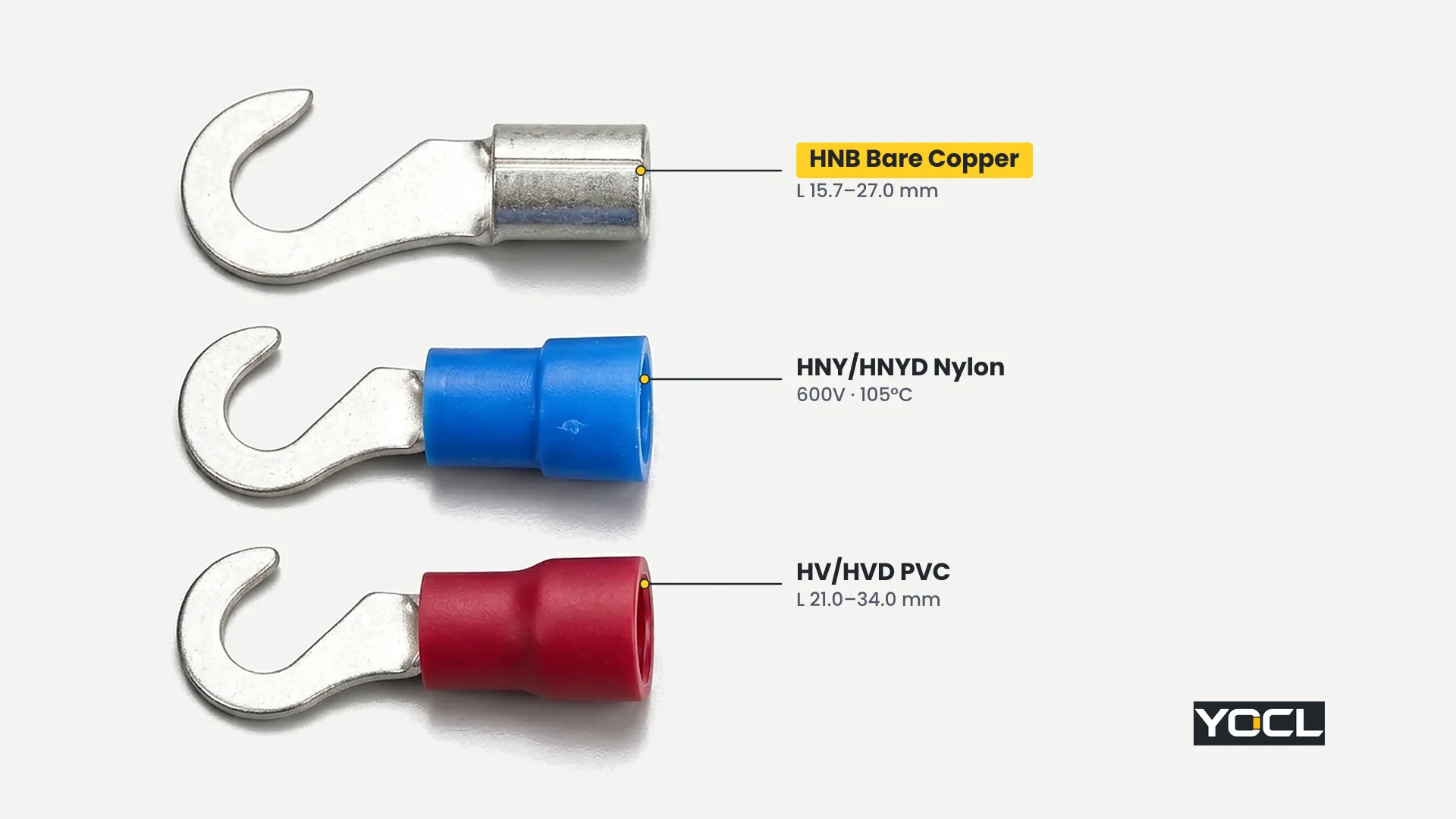
Because the hook blade itself never changes between families for a given model suffix, switching between bare, nylon, and PVC versions affects only the wire-entry barrel:
- HNB (TO type): Uninsulated copper barrel with E = 4.8 / 4.8 / 6.0 mm and the shortest overall lengths (L = 15.7–27.0 mm).
- HNY and HNYD: Nylon-insulated single-crimp and double-crimp barrels with E = 11.0 / 11.0 / 14.0 mm, L = 22.0–35.0 mm, and stated 600 V / 105 °C group ratings.
- HV and HVD: PVC pre-insulated single-crimp and double-pressure barrels with E = 10.0 / 10.0 / 13.0 mm e L = 21.0–34.0 mm (each 1.0 mm shorter in E and L than the corresponding HNY/HNYD row). For how PVC, nylon, and non-insulated sleeves compare in application, see PVC vs nylon vs terminais de cravação não isolados.
Single Crimp vs Double Crimp Barrels: D1, D2, and Die Matching
In both insulated families, the single-crimp versions (HNY, HV) and double-crimp versions (HNYD, HVD) differ in barrel construction and outer entry diameter: every double-crimp model carries a larger barrel diameter D2 > D1, providing a second compression zone over the wire insulation alongside the conductor crimp.
Look at how the published barrel diameters step up from D1 (single crimp) to D2 (double crimp) across all three wire groups:
- Group 1.25 (Red, 0.5–1.5 mm²): HNY D1 = 4.3 mm vs HNYD D2 = 4.8 mm; HV D1 = 4.3 mm vs HVD D2 = 4.5 mm.
- Group 2 (Blue, 1.5–2.5 mm²): HNY D1 = 4.9 mm vs HNYD D2 = 5.2 mm; HV D1 = 4.9 mm vs HVD D2 = 5.2 mm.
- Group 5.5 (Yellow, 4–6 mm²): HNY D1 = 6.9 mm vs HNYD D2 = 7.2 mm; HV D1 = 6.7 mm vs HVD D2 = 7.0 mm.
As the HV/HVD specification page notes, the HVD double-crimp barrel contains an additional internal copper tube inside the sleeve—referred to as a double-pressure construction—so closing the crimping tool compresses the primary copper barrel onto the stripped conductor strands while the rear section grips the wire insulation jacket. Match the crimping die cavity strictly to the chosen construction (D1 vs D2): crimping a larger D2 double-crimp barrel in a narrow single-crimp die setting crushes the sleeve unevenly and damages the insulation entry.
Frequently Asked Questions
Should I choose a hook terminal or a ring terminal?
Access to the fastener decides. Choose a closed ring terminal whenever the screw or nut can be removed completely and the wire must remain captive on the stud. Choose a hook terminal when captive hardware or tight spacing allows loosening the screw only a few turns and clamp tightness is verified; see terminais de anel vs. terminais de forquilha.
What does the number after the dash mean in a hook terminal code?
The number after the dash (3.5, 4, 5, 6, ou 8) is the nominal screw code, not the measured hook opening. Always read the actual clearance opening d2 from the table: code 3.5 (#6 bolt) has d2 = 3.7 mm, 4 (#8) has 4.3 mm, 5 (#10) has 5.3 mm, 6 (1/4) has 6.5 mm, e 8 (5/16) has 8.5 mm.
Can a hook terminal go on a bolt one size larger than its chart row?
No. The hook opening d2 is sized to clear its designated bolt shaft (#6 through 5/16) and seat around the stud center. Forcing a smaller hook onto the next bolt size up prevents the C-curve from seating around the shaft, while using an oversized hook leaves minimal contact area under the screw head and lets the blade slip off easily.
Should I specify single crimp (HNY / HV) or double crimp (HNYD / HVD)?
Specify single crimp (HNY ou HV, barrel diameter D1) when standard conductor-only compression in a flared insulating skirt fits your crimping tool; specify double crimp (HNYD ou HVD, larger barrel diameter D2 > D1 with an inner copper sleeve on HVD) when you need a second grip section over the wire insulation and have a matching double-crimp die.
Referências
- YOCL ELECTRIC Product Information — Terminais de Gancho Não Isolados HNB (Tipo TO): bare copper specifications, group Imax labels, and 13-model dimensional table.
- YOCL ELECTRIC Product Information — Terminais Gancho em Nylon HNY/HNYD (Crimpagem Simples e Dupla): nylon-insulated single-crimp (D1) and double-crimp (D2) specifications, 600 V and 105 °C group ratings, and 13 paired model rows.
- YOCL ELECTRIC Product Information — HV/HVD Terminais de Gancho Pré-Isolados: PVC-insulated single-crimp (HV) and double-pressure additional-copper-tube (HVD) specifications and 13 paired model rows.