
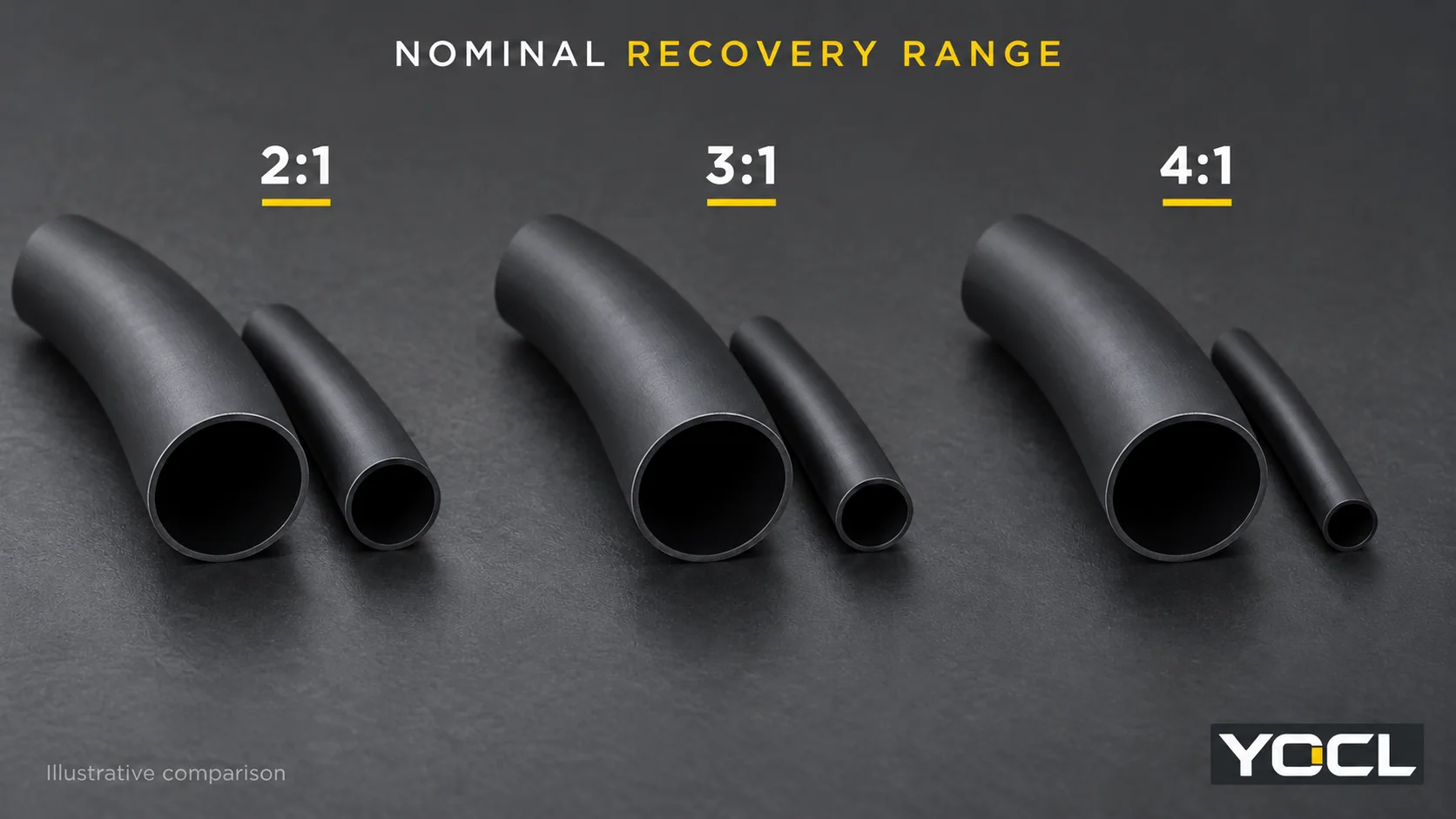
Chọn tỷ lệ co ngót từ đường kính chuyển đổi mà ống phải bắc qua. Đường kính bên trong ban đầu phải đủ lớn để bao phủ bộ phận lớn nhất, và đường kính bên trong sau khi co lại phải nhỏ hơn bề mặt hẹp nhất mà nó cần bám vào. Một kích thước 2:1 phù hợp có thể hoàn thành công việc đó. Hãy xem xét 3:1 hoặc 4:1 khi kích thước thực tế yêu cầu phạm vi co ngót rộng hơn.
Tỷ lệ co ngót cao hơn một mình không cung cấp chất kết dính, kết nối kín hoặc định mức điện cao hơn. So sánh trước tiên về hình dạng, sau đó kiểm tra cấu tạo và chức năng của sản phẩm cụ thể.
So sánh 2:1, 3:1 và 4:1 trên cùng một hình dạng
Tỷ lệ co ngót mô tả mối quan hệ danh nghĩa giữa đường kính bên trong (ID) khi được mở rộng và ID khi co lại tự do. Đối với phép tính số học lý tưởng:
ID phục hồi tự do = ID đã mở rộng ÷ số tỷ lệ
Với cùng một 15 mm lỗ mở đã mở rộng giả định, 2:1 cho 7.5 mm, 3:1 cho 5 mm, và 4:1 cho 3.75 mm. Đây là các điểm cuối minh họa không có vật thể bên trong hạn chế sự phục hồi, thay vì kích thước được đảm bảo của ba sản phẩm trong danh mục. Tỷ lệ mô tả sự phục hồi đường kính; nó không chia chiều dài cắt hoặc xác định số lượng thành. hướng dẫn thuật ngữ ống co nhiệt giải thích các trường riêng biệt đó.
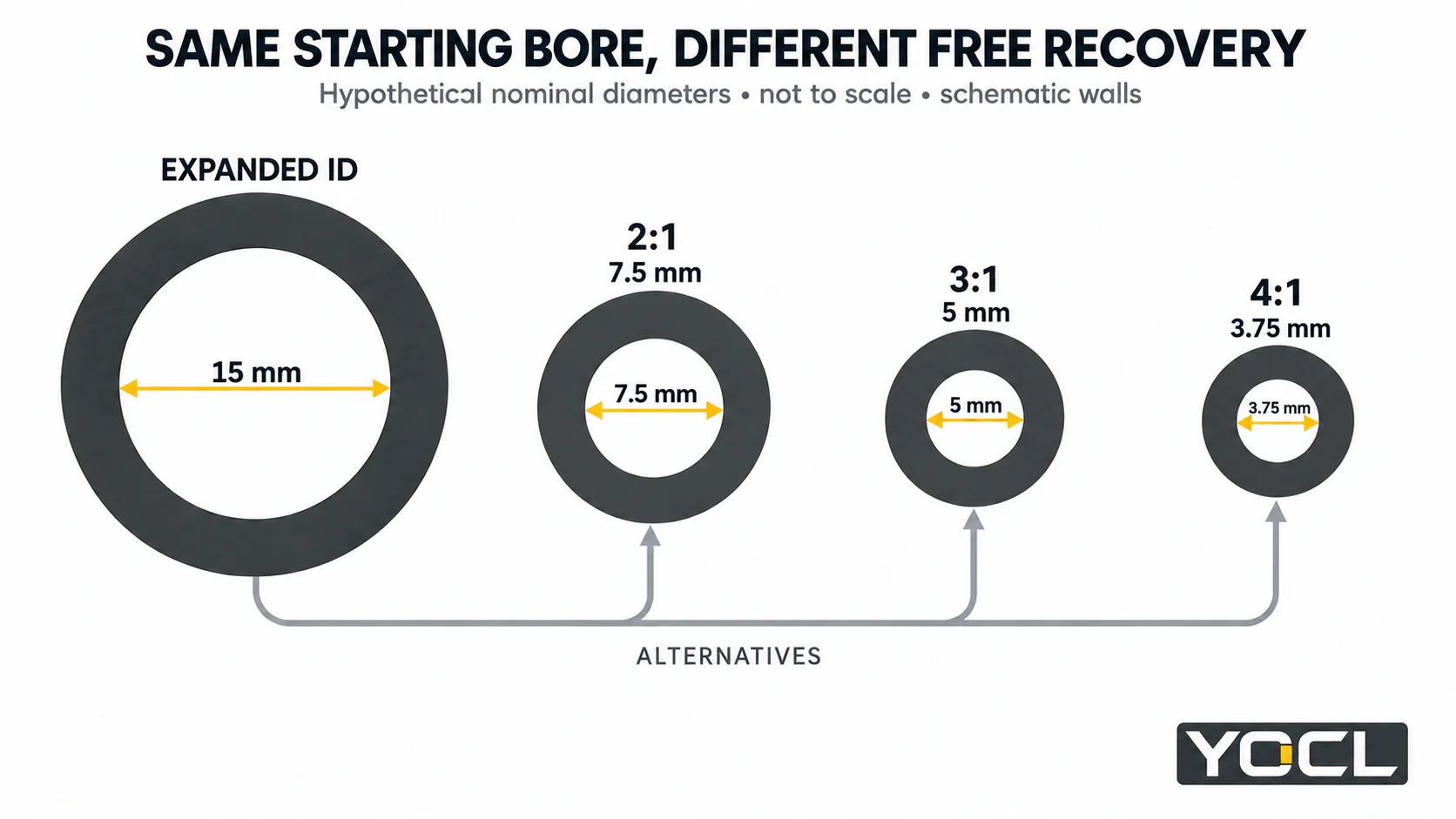
Bây giờ giữ chi tiết tròn lớn nhất mà ống phải đi qua ở 13 mm đường kính ngoài (OD). Chỉ thay đổi bề mặt tròn nhỏ nhất nơi nó phải tiếp đất. Cả ba ống lót giả định đều bắt đầu với cùng một 15 mm lỗ khoan, vì vậy sự so sánh này cô lập phạm vi phục hồi của chúng.
| Đường kính ngoài nhỏ nhất | 2:1: ID miễn phí 7.5 mm | 3:1: ID miễn phí 5 mm | 4:1: ID miễn phí 3.75 mm | Tỷ lệ đủ dưới các giả định này |
|---|---|---|---|---|
| 9 mm | Dưới đường kính ngoài | Dưới đường kính ngoài | Dưới đường kính ngoài | Cả ba; 2:1 đã đủ về mặt hình học |
| 6 mm | Quá lớn | Dưới đường kính ngoài | Dưới đường kính ngoài | 3:1 hoặc 4:1; 3:1 đã đủ về mặt hình học |
| 4.5 mm | Quá lớn | Quá lớn | Dưới đường kính ngoài | 4:1 thôi |
| 3 mm | Quá lớn | Quá lớn | Quá lớn | Không có ba ứng cử viên này |
Đây là một phép so sánh giả định có kiểm soát, không phải là danh sách kích thước đã được phê duyệt. Khoảng cách 2 mm giữa lỗ mở rộng giả định và đường kính ngoài đi qua là một khoảng trống ví dụ, không phải là khoảng hở được khuyến nghị. Dung sai thực tế, khoảng lắp đặt và phạm vi ứng dụng cho phép vẫn cần được kiểm tra.
Hàng cuối cùng quan trọng: ngay cả 4:1 cũng có thể không đủ. Tỷ lệ cao hơn mở rộng phạm vi danh nghĩa, nhưng không có nhãn nào đảm bảo sự phù hợp trên mọi chuyển đổi. Ngược lại, hàng đầu tiên không đưa ra lý do kích thước nào để loại bỏ 2:1 chỉ vì 4:1 có sẵn.
Chuyển đổi ứng viên tỷ lệ thành kích thước ống chính xác
Đối với các bộ phận tròn và ống hở, hãy kiểm tra cả hai giới hạn từ một kích thước chính xác:
- Minimum supplied ID > largest pass-over OD
- Maximum freely recovered ID < smallest landing OD
NASA KSC-E-165 Bản sửa đổi F, §3.8.1.1.1(a) uses this expanded-larger/recovered-smaller principle within Kennedy Space Center electrical ground-support-equipment fabrication. It supports the dimensional relationship, without approving a YOCL product or assembly.
Retain the table’s minimum, maximum and ± signs, component tolerances and specified application allowance. Equality supplies no assured margin. A model’s stated application range may further restrict the usable diameters, even where the preliminary inequalities pass.
If you increase the supplied size to clear a connector, recheck the recovered limit of that larger row. Changing the first diameter can also change the second. Use the kích thước ống co nhiệt for the full lookup and limit conventions.
Free recovery is different from installed fit
A sleeve installed over a cable stops contracting against the surface inside it. In the hypothetical 4:1 example, a 4.5 mm jacket prevents the bore reaching its empty 3.75 mm endpoint. The endpoint therefore does not specify installed ID, outside diameter or wall thickness.
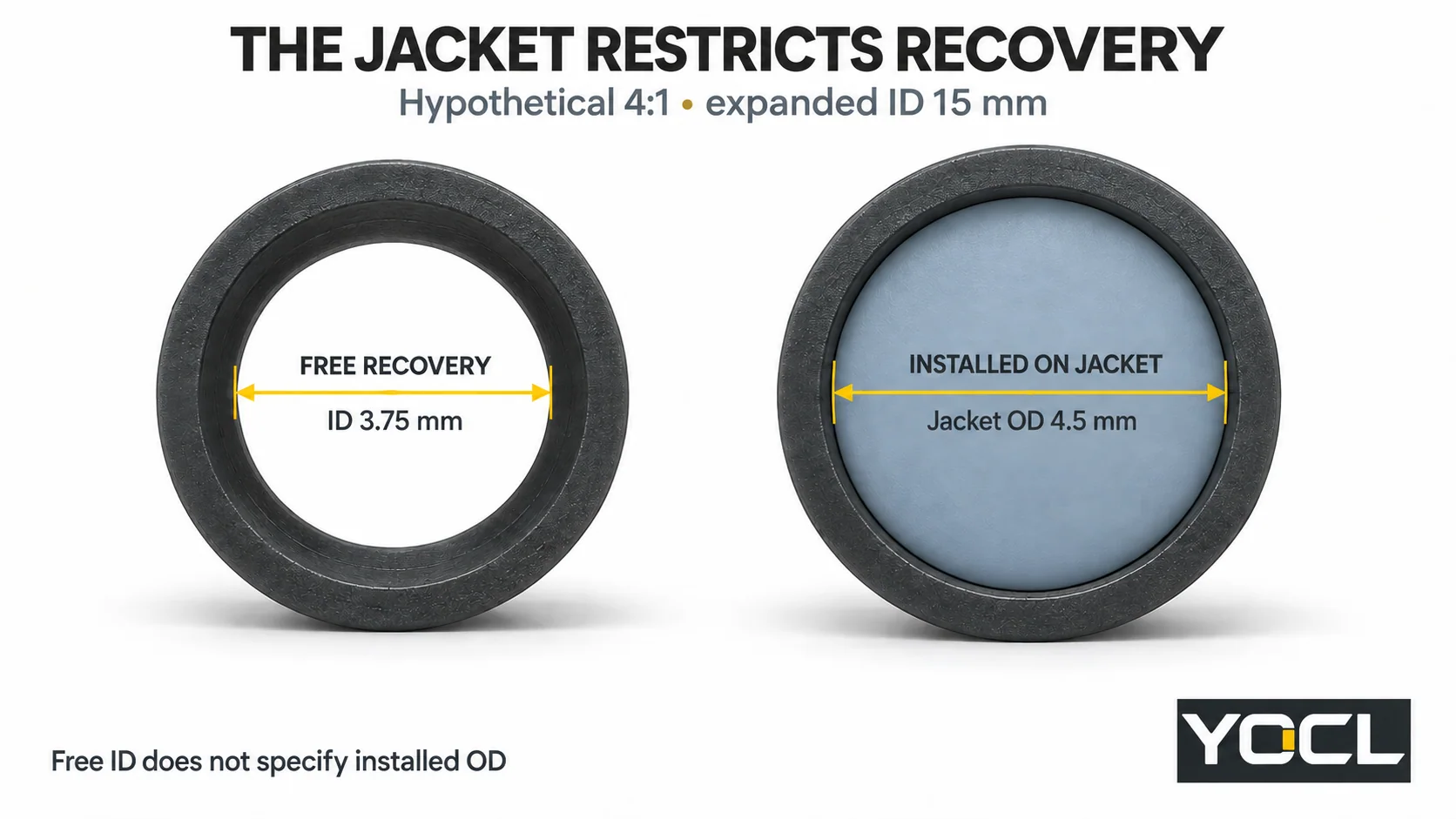
For a sleeve spanning several surfaces, check the smallest required landing as well as the largest feature it crosses. Irregular connectors, flat busbars, bundles and branches need their actual envelope and contact geometry reviewed; one round OD cannot describe every gap or valley.
A real YOCL 3:1 vs 4:1 comparison
Tỷ lệ 3:1 Zero-Halogen single-wall product và 4:1 Zero-Halogen single-wall product offer a useful same-construction comparison. Both declare no internal adhesive. Their 20 mm supplied-bore entries have different recovered limits:
| Trường đã xuất bản | 3:1 single wall | 4:1 single wall |
|---|---|---|
| Size entry | 20.0/6.7 mm | 20.0/5.0 mm |
| Minimum supplied ID | 20.0 mm | ≥20.0 mm |
| Maximum ID after recovery | 6.7 mm | ≤5.0 mm |
| Chất kết dính bên trong | Không có | Không có |
These are manufacturer declarations from the respective dimension tables, checked 9 October 2026. The 3:1 page establishes minimum and maximum through its column headings; the 4:1 page also prints the inequalities in each row.
For hypothetical 18 mm pass-over and 6 mm landing dimensions, both supplied minima clear the large feature. The 3:1 row’s 6.7 mm recovered maximum does not establish contraction below 6 mm; the 4:1 row’s 5.0 mm maximum does. That makes the latter a dimensional candidate, still subject to allowance and application review. It does not prove a sealed joint.
Keep the published 6.7 mm limit. Replacing it with 20 ÷ 3 would substitute nominal arithmetic for the actual declaration.
Check construction and duty alongside the ratio
The unlined 4:1 example shows why ratio cannot identify adhesive. Where a bonded interface is required, select an appropriate lined product and assess compatibility, contact geometry and sealing evidence. Use the so sánh ống một lớp với ống hai lớp for that decision.
Compare actual wall fields and their measurement states rather than assuming 4:1 is thicker or stronger. Also check coverage and declared longitudinal change, permitted recovery conditions, service temperature, electrical duty and required environmental evidence for the exact grade. Diameter ratio supplies none of those values.
A tight exterior or visible adhesive at an end cannot by itself verify the complete sealing interface. If an installed sleeve is already loose, damaged or has an unverified seal, the heat-shrink failure guide addresses that separate investigation.
Make the final choice from the products that pass
Keep 2:1 in consideration when its exact size meets both fit checks and the required function. Move to 3:1 or 4:1 when their documented recovery range solves a transition the lower-ratio candidate cannot cover. If several products pass, compare their construction, installed space, process and duty. If none passes, revise the exact size or connection arrangement instead of assuming extra heat will deliver extra recovery.
For a YOCL size review, provide the largest pass-over dimension, smallest landing dimension, required coverage, jacket material and intended duty through the dòng sản phẩm ống co nhiệt. Request the matching size limits, permitted application range and installation information so the final selection identifies a product and size, not just “4:1 heat shrink.”
Tài liệu tham khảo
- Trung tâm Vũ trụ Kennedy của NASA — KSC-E-165 Revision F, 20 December 2021, Electrical Ground Support Equipment Fabrication, Specification for. §3.8.1.1.1(a), printed page 59; scoped expanded/recovered size principle.
- Thông tin sản phẩm YOCL — 3:1 Ống co nhiệt thành đơn không halogen. 20.0/6.7 mm row, dimension headings and absence of adhesive; checked 9 October 2026.
- Thông tin sản phẩm YOCL — 4:1 Ống co nhiệt thành đơn không halogen. 20.0/5.0 mm row, supplied/recovered bounds and absence of adhesive; checked 9 October 2026.