
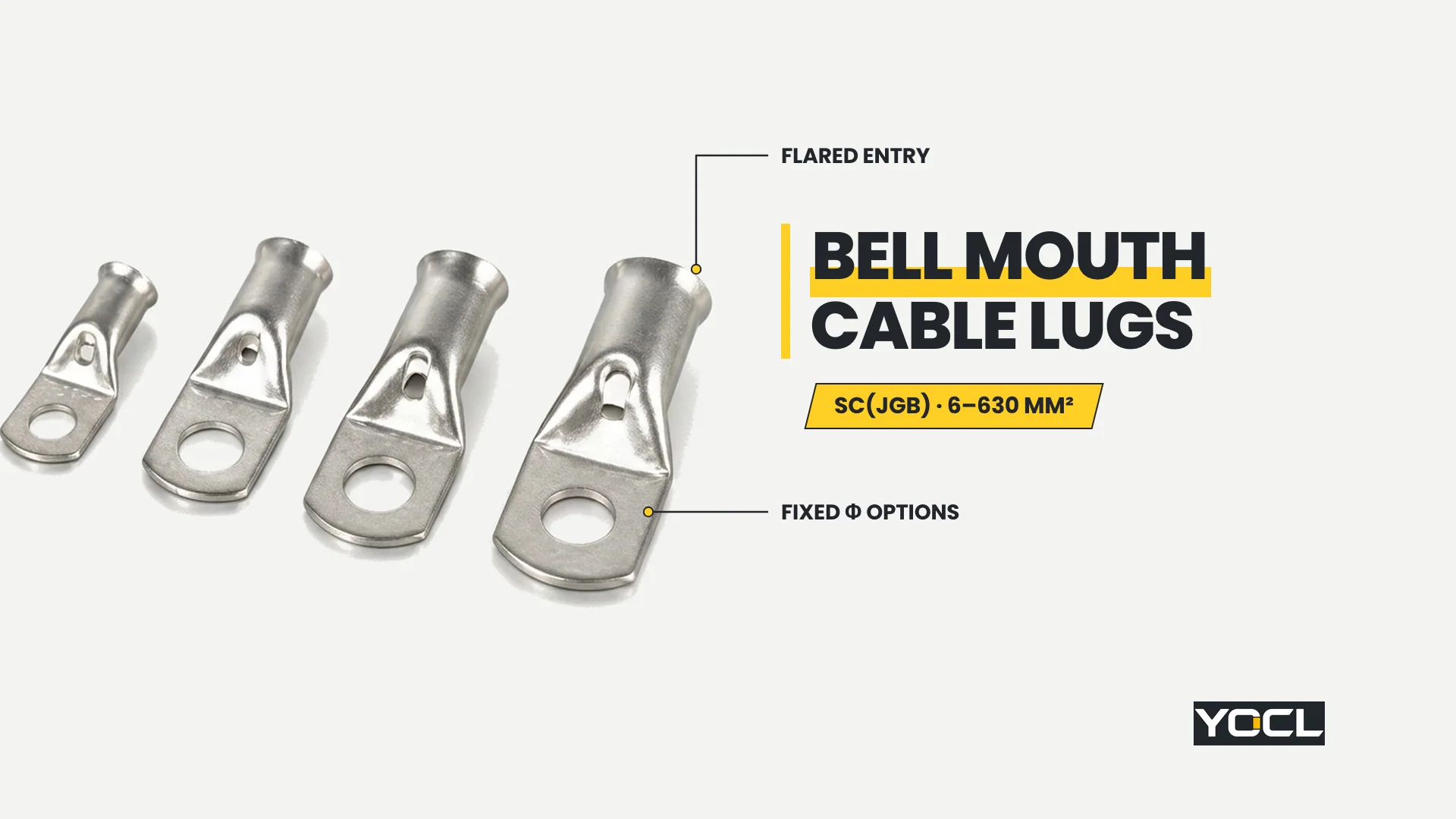
Terminales de cable con entrada abocardada son terminales tubulares de compresión de cobre formados con una abertura ensanchada en forma de embudo en la parte posterior del barril del conductor para recoger y guiar los hilos de cobre trenzados limpiamente hacia el interior. En la serie SC(JGB de YOCL ELECTRIC, los modelos 16 cubren conductores de 6 a 630 mm².
La mayoría de las especificaciones de los terminales de cable se centran en el orificio del perno de la pala y en el calibre del barril, tratando la boca posterior del barril como un corte cuadrado simple. Sin embargo, en cables trenzados de múltiples hilos, ese borde de entrada determina si cada hilo de cobre entra en la zona de crimpado o si se engancha en el borde durante el montaje. Para mantener distintos los temas relacionados, el procedimiento de crimpado (longitud de pelado, profundidad de inserción, colocación del crimpado y comprobaciones posteriores al crimpado) pertenece a cómo crimpar terminales de cable, la selección de herramientas pertenece a cómo combinar terminales de cable, matrices de crimpado y conductores, y el dimensionamiento general del calibre respecto al conductor pertenece a la tabla de tamaños de terminales de cable. Las familias de terminales con mirilla o ventana de inspección (como las series YOCL SC(JGK) y JM/JGY) abordan la verificación visual de la profundidad en lugar de la geometría de entrada del conductor y son una característica distinta del cuerpo del terminal.
El problema de inserción de conductores trenzados en una boca de terminal recta
Un conductor de cobre trenzado se comporta como un haz elástico de hilos individuales en lugar de una varilla rígida. Al empujarlo contra una boca de terminal de 90 grados de corte recto, los hilos exteriores se enganchan fácilmente en el borde del terminal, se abren hacia afuera o se doblan a lo largo de la pared exterior en lugar de entrar en el orificio.
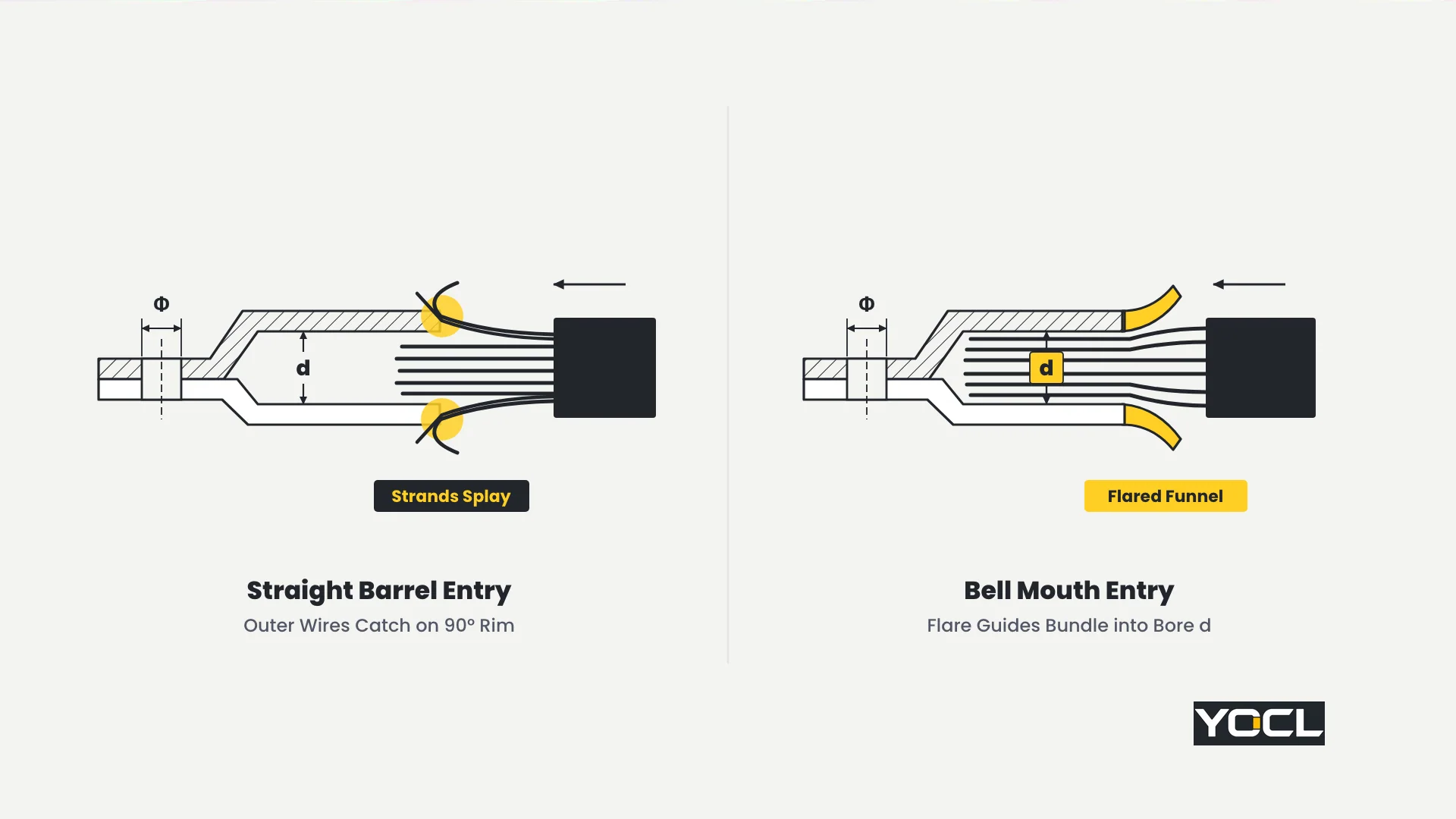
En el taller o dentro de un armario de aparamenta, el enganche de los hilos en una entrada de terminal recta crea dos defectos mecánicos inmediatos antes incluso de que la herramienta de crimpado toque el terminal:
- Hilos atrapados fuera del terminal: Una vez que se retira el aislamiento de un cable trenzado, la capa exterior de hilos se relaja ligeramente hacia afuera. Si el diámetro interior del terminal d se ajusta estrechamente al haz del conductor, incluso una entrada ligeramente descentrada contra un borde de corte cuadrado engancha uno o más hilos exteriores. Esos hilos escapados se doblan hacia atrás fuera de la pared del terminal, lo que reduce la sección transversal del conductor capturada dentro de la unión y deja hilos de cobre expuestos que pueden desviarse hacia terminales de fase adyacentes o partes metálicas conectadas a tierra.
- Profundidad de inserción incompleta: Incluso cuando un hilo atrapado no se desprende completamente por el exterior del tubo, el amontonamiento en el borde del cuerpo del terminal bloquea el haz e impide que el conductor alcance la profundidad de asiento completa dentro del cuerpo.
- Por qué las secciones transversales más grandes ofrecen mayor resistencia: A 6 mm², un cable de cobre de pocos hilos es fácil de retorcer entre dos dedos e introducir en un tubo recto. A partir de 95 mm² y superiores, pasando por 185 mm², 300 mm², y 630 mm²—la rigidez de los cables gruesos, los radios de curvatura estrechos en las envolventes y un mayor número de hilos hacen que sea mucho más difícil mantener una alineación perfectamente coaxial manualmente, por lo que los bordes cuadrados del terminal atrapan los hilos con mucha más facilidad durante el montaje.
Qué cambia la entrada abocardada del terminal y qué no
Una boca de campana es un embudo cónico suave formado en el extremo de entrada del terminal de cobre: como indica la especificación del producto YOCL SC(JGB), la abertura abocardada ayuda a guiar los conductores, incluidos los conductores de cobre trenzado, hacia el terminal. Más allá de ese borde de entrada, la estructura de la unión mecánica y eléctrica del terminal permanece inalterada.

Separar lo que cambia el abocardado de lo que permanece idéntico evita una interpretación excesiva de la geometría del catálogo:
- Lo que cambia el abocardado (entrada de montaje): En lugar de presentar un resalte anular plano al extremo del cable pelado, la boca abocardada ensancha la abertura objetivo y se estrecha suavemente hacia el interior del orificio cilíndrico. Los hilos exteriores ligeramente relajados entran en contacto con una rampa inclinada que vuelve a agrupar el cable y guía el haz de forma coaxial hacia el interior del tubo.
- Lo que permanece idéntico a continuación: Más allá del ensanchamiento de entrada corto, el calibre cilíndrico del cuerpo (d en la tabla a continuación), el diámetro exterior del cuerpo (D), la zona de compresión por crimpado, la selección de la matriz y la pala de montaje plana de un solo orificio funcionan exactamente de la misma manera que en los terminales de entrada recta estándar de YOCL SC(JGA) terminales de cobre.
- Una característica de inserción, nunca una mejora eléctrica: YOCL no publica ninguna clasificación de corriente, valor de tracción o clasificación de temperatura para la serie SC(JGB, y la boca ensanchada nunca debe considerarse como un factor que proporcione mayor ampacidad, menor resistencia de contacto o temperaturas de funcionamiento más bajas. La calidad de la unión eléctrica proviene de un ajuste adecuado entre el conductor y el calibre y de la compresión en frío del cuerpo; la boca acampanada simplemente ayuda a garantizar que todos los hilos entren realmente en ese cuerpo antes del crimpado.
Tabla de tamaños de terminales de cable con boca acampanada: YOCL Serie SC(JGB (6–630 mm²)
Especificación terminales de cable con boca acampanada en YOCL de ELECTRIC SC(JGB) terminales de cable de cobre con boca de campana range covers 16 copper models from SC(JGB)-6 a SC(JGB)-630, where each model suffix identifies nominal copper conductor cross-section in mm² and every dimensional column is given in millimetres.
Understanding the Mounting-Hole Φ-Range Rule Before Ordering
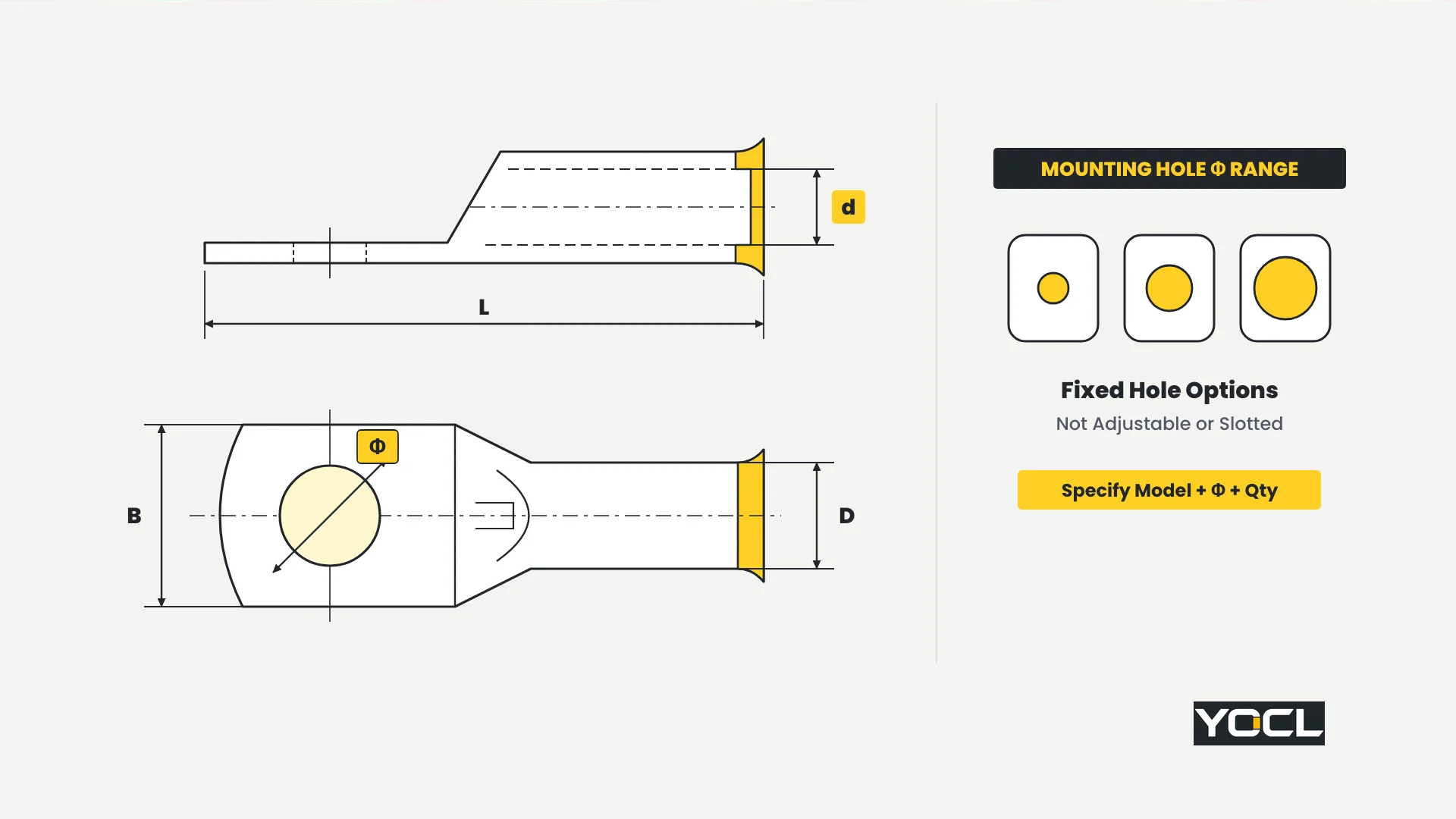
Look carefully at the Mounting-Hole Φ Range (mm) column in the SC(JGB) table below. Each row prints a millimetre range—such as 6.4–8.4 mm on SC(JGB)-6 o 10.5–18.5 mm on SC(JGB)-240—because each conductor model is manufactured in multiple fixed stud-hole diameters within that span.
As stated on YOCL’s SC(JGB) product page, that range represents the available hole sizes for the model, not an adjustable, slotted, or one-size-fits-all hole. Every supplied lug has a single round mounting hole punched to one specific diameter. When requesting a quotation or placing an order, specify three items together:
- Complete model code (for example, SC(JGB)-95 o SC(JGB)-240);
- Required mounting-hole diameter (chosen from that model’s published Φ range to match your equipment bolt or stud);
- Order quantity.
Complete YOCL SC(JGB) Dimensional Specification Table (16 Models)
| Modelo | Mounting-Hole Φ Range — Available Hole Sizes (mm) | D Barrel Outer (mm) | d Barrel Inner (mm) | L Overall (mm) | B Palm Width (mm) |
|---|---|---|---|---|---|
| SC(JGB)-6 | 6.4–8.4 | 5.5 | 4.5 | 23 | 10 |
| SC(JGB)-10 | 6.4–8.4 | 6.5 | 5.5 | 27 | 11 |
| SC(JGB)-16 | 6.4–12.5 | 8 | 6.6 | 33 | 12 |
| SC(JGB)-25 | 6.4–12.5 | 9 | 7.2 | 36 | 14 |
| SC(JGB)-35 | 6.4–12.5 | 10.5 | 8.7 | 42 | 16 |
| SC(JGB)-50 | 8.4–12.5 | 12 | 10 | 49 | 18 |
| SC(JGB)-70 | 8.4–12.5 | 14.5 | 12.1 | 55 | 21 |
| SC(JGB)-95 | 8.4–16.5 | 16 | 13.2 | 59 | 24 |
| SC(JGB)-120 | 10.5–16.5 | 19 | 15.6 | 67 | 29 |
| SC(JGB)-150 | 10.5–16.5 | 20.5 | 16.9 | 72 | 30 |
| SC(JGB)-185 | 10.5–16.5 | 23.5 | 19.5 | 78 | 34 |
| SC(JGB)-240 | 10.5–18.5 | 26 | 21.4 | 90 | 38 |
| SC(JGB)-300 | 10.5–18.5 | 30 | 24.4 | 100 | 42 |
| SC(JGB)-400 | 10.5–20.5 | 34 | 28.2 | 113 | 48 |
| SC(JGB)-500 | 12.5–22.5 | 38 | 32 | 126 | 54 |
| SC(JGB)-630 | 12.5–22.5 | 45 | 37.8 | 145 | 65 |
Regla de selección: Match nominal copper conductor cross-section to the SC(JGB model suffix first, verify stripped conductor clearance against barrel inner diameter d (de 4.5 mm at 6 mm² up to 37.8 mm at 630 mm²), specify the exact fixed mounting-hole diameter from the row’s Φ range for your terminal bolt, and check overall length L (23–145 mm) and palm width B (10–65 mm) against terminal compartment barriers. For the general bore-and-stud sizing method across lug families, see la tabla de tamaños de terminales de cable.
For example, terminating a 95 mm² stranded copper feeder selects SC(JGB)-95 (d = 13.2 mm, D = 16 mm, L = 59 mm, B = 24 mm), and the buyer specifies the exact required bolt-hole diameter within 8.4–16.5 mm at order time; stepping up to a 240 mm² feeder selects SC(JGB)-240 (d = 21.4 mm, D = 26 mm, L = 90 mm, B = 38 mm) with its fixed hole chosen within 10.5–18.5 mm.
When Bell Mouth Lugs Earn Their Place — and When Straight Entry Is Fine
Flared-entry lugs are the practical answer to a specific wire-insertion problem rather than an automatic replacement for every straight-entry lug on a bill of materials. Matching the barrel mouth to conductor construction and assembly workflow keeps selection grounded:
- Where bell mouth lugs earn their place:
- Stranded and flexible multi-wire copper conductors: The higher the wire count and the finer the individual copper strands, the more readily the stripped end mushrooms or catches on a square tube edge.
- Larger cable cross-sections: On heavy feeders—such as 95 mm² (d = 13.2 mm), 185 mm² (d = 19.5 mm), 300 mm² (d = 24.4 mm), and 630 mm² (d = 37.8 mm)—guiding a stiff cable end onto a lug inside a tight termination box benefits directly from a funnelled entry.
- Repetitive panel and harness production: When an assembly line terminates hundreds of cable ends per shift, every snagged strand forces the operator to pull the cable out, re-lay the wires, and repeat the insertion. A flared entry cuts down that repetitive assembly rework.
- When a standard straight entry is completely adequate:
- Solid copper conductors: A single solid wire has no individual strands to splay or fold back at the mouth.
- Small stranded conductors that seat cleanly: On compact sizes such as 6 mm² o 10 mm² where a neatly stripped conductor slips straight into bore d without catching, a standard straight-entry lug performs the termination without difficulty.
- Undisturbed bench terminations verified by trial fit: If the stripped conductor will not be bent or handled roughly between stripping and crimping, and a dry trial fit confirms the wire bundle enters the barrel cleanly to full depth, barrel entry geometry is not your bottleneck.
Insertion Practice with a Flared Barrel Entry
A flared mouth guides strands inward, but it does not excuse careless wire preparation or blind crimping. Follow three assembly habits whenever terminating stranded copper conductors into an SC(JGB) lug:
- Re-twist the strand lay by hand after stripping: Pulling off tough cable insulation often untwists or ruffles the outer copper layer. Before presenting the wire to the lug, gently twist the stripped strands in the natural direction of their lay so the bundle enters the bell mouth as a single coherent cylinder.
- Seat the conductor fully home before compressing: Push the cable smoothly through the flare until the conductor reaches full insertion depth inside the barrel; for strip-length matching, seating depth criteria, and crimp placement along the barrel, follow cómo crimpar terminales de cable.
- Inspect the bell mouth rim before closing the crimping tool: Pause and look all the way around the flared entry lip before applying pressure. Zero strands may sit outside the flare. Any wire resting outside the bell mouth is outside the crimp barrel—closing the die over it locks a reduced-section joint and a loose external copper whisker permanently in place. If even one strand escapes, withdraw the cable, re-form the lay, and insert again before crimping.
Preguntas frecuentes
Does a bell mouth cable lug carry more current than a standard lug?
No. YOCL publishes no current rating, tensile figure, or temperature rating for the SC(JGB) series, and the flared mouth provides no ampacity, resistance, or thermal advantage over a straight-entry lug. Electrical joint quality is determined by proper bore fit (d) and barrel compression, which match standard copper tube lugs in form.
Is the mounting hole on an SC(JGB) lug adjustable?
No. The Mounting-Hole Φ Range in the SC(JGB) chart (6.4–8.4 mm through 12.5–22.5 mm) lists the range of fixed circular hole diameters manufactured for each model—never a slotted or adjustable hole. Specify the model code, the exact required mounting-hole diameter, and quantity when ordering.
Do I need different crimp dies for bell mouth cable lugs?
The crimp is made on the cylindrical barrel body downstream of the flared mouth, just as on straight-entry copper cable lugs (D desde 5.5 mm a 45 mm y d desde 4.5 mm a 37.8 mm across 6–630 mm²). Do not assume a special bell-mouth die; follow cómo combinar terminales de cable, matrices de crimpado y conductores.
Should I choose a bell mouth lug or a peephole lug?
They solve two different assembly tasks. A bell mouth lug (SC(JGB) flares the rear barrel entry to guide multi-wire stranded conductors smoothly into the bore without splaying strands, whereas a peephole lug (such as YOCL’s SC(JGK o JM/JGY series) provides an inspection hole to check conductor seating depth before crimping.
Referencias
- Información del producto ELECTRIC YOCL — SC(JGB) Terminales de cobre con boca de campana: flared-entry copper lug specifications, mounting-hole Φ-range ordering rules, and 16-model dimensional table (6–630 mm²).
- Información del producto ELECTRIC YOCL — SC(JGA) Terminales de cobre: standard straight-entry copper tube cable lug counterpart series (6–630 mm²).