
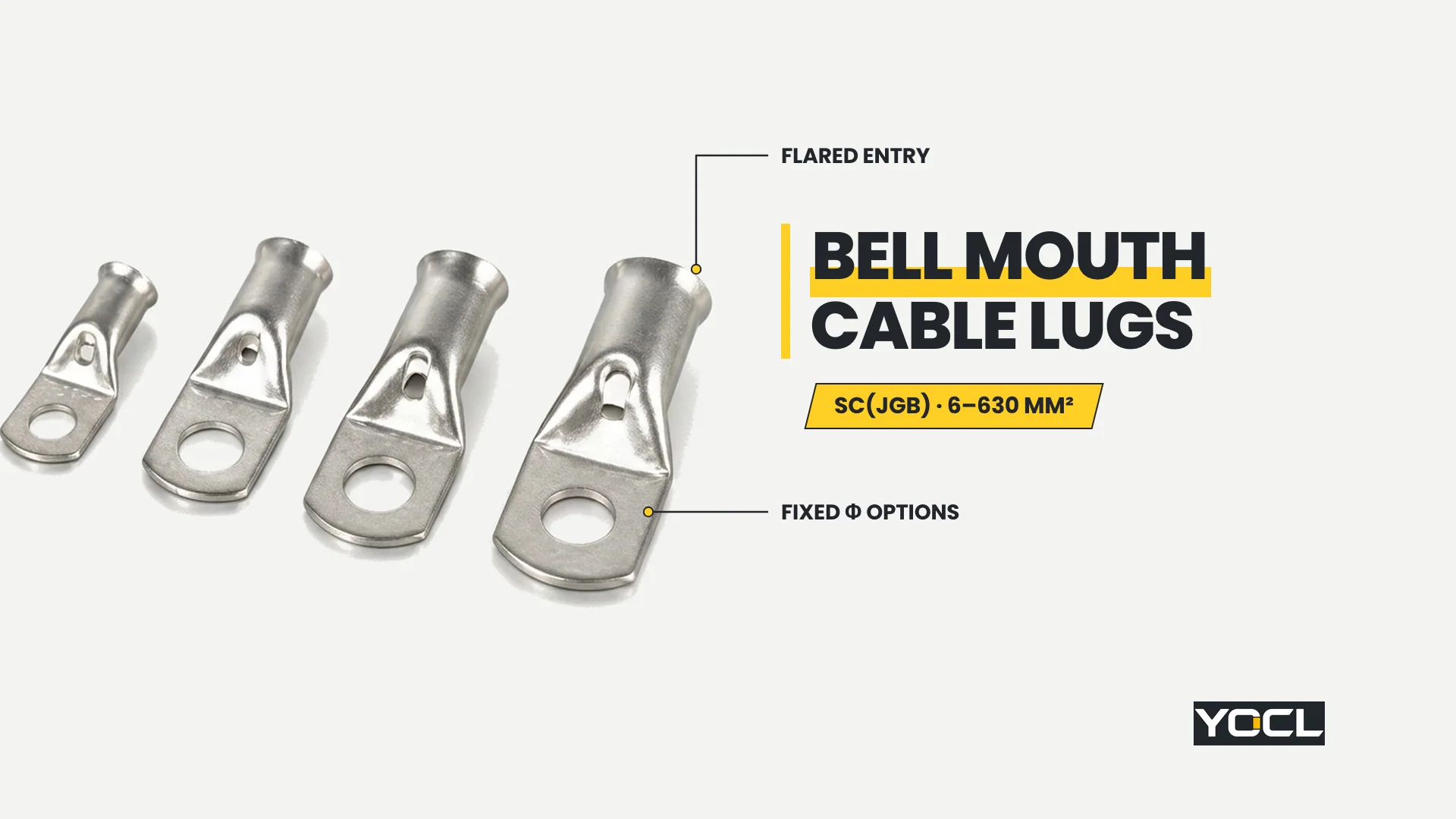
Bell mouth cable lugs are copper compression tube terminals formed with a funnel-shaped, flared opening at the rear of the conductor barrel to gather and guide multi-wire copper strands cleanly into the bore. Across YOCL ELECTRIC’s SC(JGB) series, 16 models cover 6–630 mm² conductors.
Most cable-lug specifications focus on the palm bolt hole and barrel bore while treating the rear mouth of the barrel as a plain square cut. On multi-wire stranded cables, however, that entry edge decides whether every copper wire enters the crimp zone or catches on the lip during assembly. To keep neighbouring topics distinct, crimping procedure (strip length, insertion depth, crimp placement, and post-crimp checks) belongs to how to crimp cable lugs, tooling selection belongs to how to match cable lugs, crimp dies and conductors, and general bore-to-conductor sizing belongs to the cable lug size chart. Inspection-window or peephole lug families—such as YOCL’s SC(JGK) and JM/JGY series—address visual depth verification rather than conductor entry geometry and are a separate barrel feature.
The Stranded-Conductor Insertion Problem at a Straight Barrel Mouth
A stranded copper conductor behaves like a springy bundle of individual wires rather than a rigid rod. When pushed against a straight-cut, 90-degree barrel mouth, outer strands readily catch on the barrel rim, splay outward, or fold back along the outside wall instead of entering the bore.
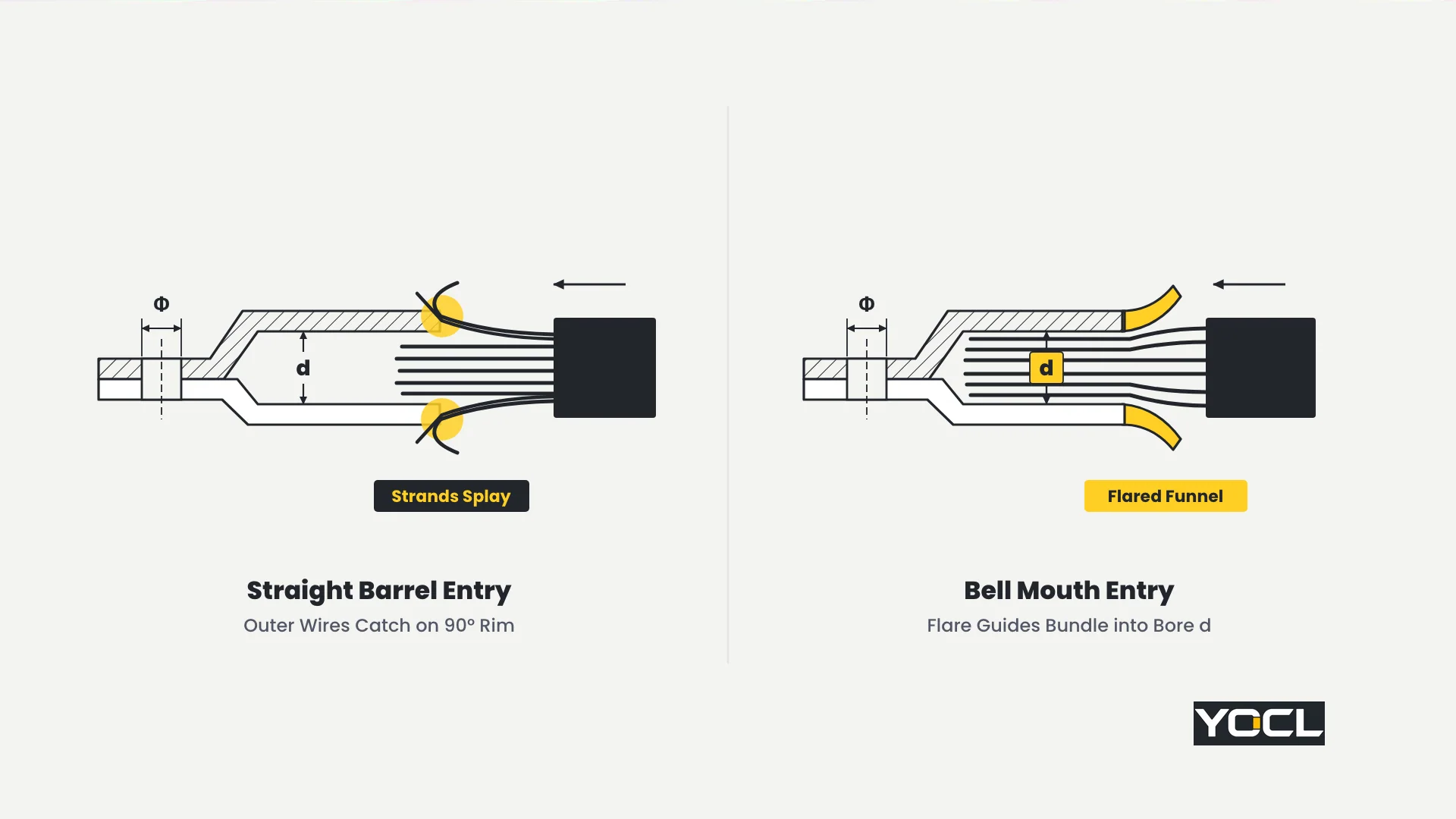
On the shop floor or inside a switchgear cabinet, strand snagging at a straight barrel entry creates two immediate mechanical defects before the crimping tool even touches the lug:
- Strands trapped outside the barrel: Once insulation is stripped from a stranded cable, the outer wire layer relaxes slightly outward. If barrel inner diameter d is closely matched to the conductor bundle, even slight off-angle entry against a square-cut rim hooks one or more outer wires. Those escaped wires fold back outside the barrel wall—reducing the conductor cross-section captured inside the joint and leaving exposed copper whiskers that can stray toward adjacent phase terminals or earthed metalwork.
- Incomplete insertion depth: Even when a caught strand does not peel fully down the outside of the tube, bunching at the barrel lip binds the bundle and stops the conductor short of full seating depth inside the barrel.
- Why larger cross-sections fight back harder: At 6 mm², a low-strand copper wire is easy to twist between two fingers and slip into a straight tube. By 95 mm² and upward—through 185 mm², 300 mm², and 630 mm²—heavy cable stiffness, tight enclosure bending radii, and higher strand counts make perfectly coaxial alignment much harder to hold by hand, so square barrel edges catch strands far more readily during assembly.
What the Flared Barrel Entry Changes — and What It Does Not
A bell mouth is a smooth, conical funnel formed at the entry end of the copper barrel: as YOCL’s SC(JGB) product specification states, the flared opening helps guide conductors—including stranded copper conductors—into the lug. Downstream of that entry lip, the lug’s mechanical and electrical joint structure is unchanged.

Separating what the flare changes from what stays identical prevents over-reading catalogue geometry:
- What the flare changes (assembly entry): Instead of presenting a flat annular shoulder to the stripped wire end, the flared mouth widens the target opening and tapers smoothly inward into the cylindrical bore. Slightly relaxed outer strands contact an inclined ramp that gathers the wire lay back together and guides the bundle coaxially into the tube.
- What stays identical downstream: Past the short entry flare, the cylindrical barrel bore (d in the chart below), outer barrel diameter (D), compression crimping zone, die selection, and single-hole flat mounting palm work exactly the same way as on YOCL’s standard straight-entry SC(JGA) copper cable lugs.
- An insertion feature, never an electrical upgrade: YOCL publishes no current rating, tensile value, or temperature rating for the SC(JGB) series, and the flared mouth must never be credited with higher ampacity, lower contact resistance, or cooler running temperatures. Electrical joint quality comes from proper conductor-to-bore fit and cold compression of the barrel—the bell mouth simply helps ensure all strands actually enter that barrel before crimping.
Bell Mouth Cable Lugs Size Chart: YOCL SC(JGB) Series (6–630 mm²)
Specifying bell mouth cable lugs in YOCL ELECTRIC’s SC(JGB) bell mouth copper cable lugs range covers 16 copper models from SC(JGB)-6 to SC(JGB)-630, where each model suffix identifies nominal copper conductor cross-section in mm² and every dimensional column is given in millimetres.
Understanding the Mounting-Hole Φ-Range Rule Before Ordering
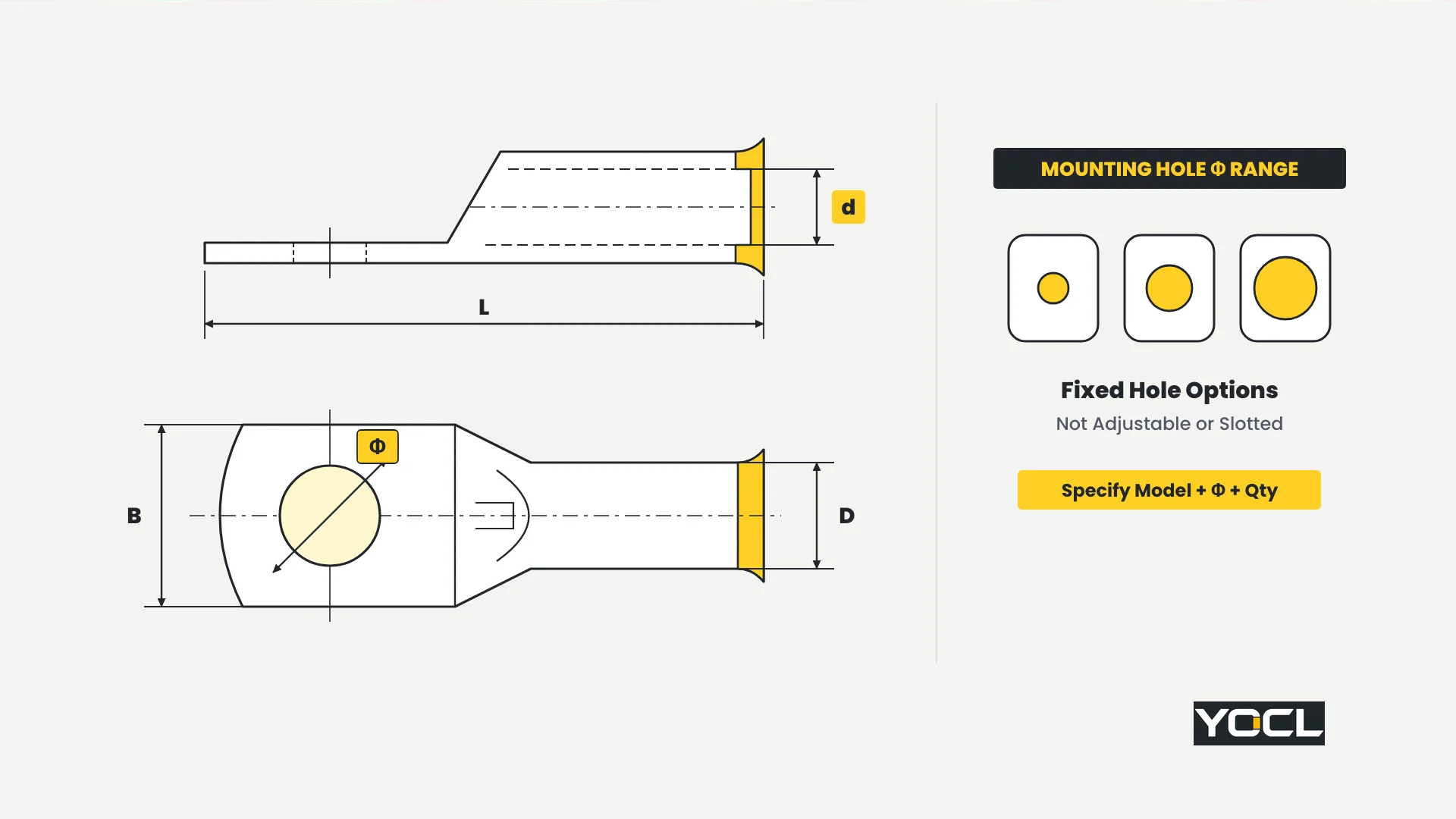
Look carefully at the Mounting-Hole Φ Range (mm) column in the SC(JGB) table below. Each row prints a millimetre range—such as 6.4–8.4 mm on SC(JGB)-6 or 10.5–18.5 mm on SC(JGB)-240—because each conductor model is manufactured in multiple fixed stud-hole diameters within that span.
As stated on YOCL’s SC(JGB) product page, that range represents the available hole sizes for the model, not an adjustable, slotted, or one-size-fits-all hole. Every supplied lug has a single round mounting hole punched to one specific diameter. When requesting a quotation or placing an order, specify three items together:
- Complete model code (for example, SC(JGB)-95 or SC(JGB)-240);
- Required mounting-hole diameter (chosen from that model’s published Φ range to match your equipment bolt or stud);
- Order quantity.
Complete YOCL SC(JGB) Dimensional Specification Table (16 Models)
| Model | Mounting-Hole Φ Range — Available Hole Sizes (mm) | D Barrel Outer (mm) | d Barrel Inner (mm) | L Overall (mm) | B Palm Width (mm) |
|---|---|---|---|---|---|
| SC(JGB)-6 | 6.4–8.4 | 5.5 | 4.5 | 23 | 10 |
| SC(JGB)-10 | 6.4–8.4 | 6.5 | 5.5 | 27 | 11 |
| SC(JGB)-16 | 6.4–12.5 | 8 | 6.6 | 33 | 12 |
| SC(JGB)-25 | 6.4–12.5 | 9 | 7.2 | 36 | 14 |
| SC(JGB)-35 | 6.4–12.5 | 10.5 | 8.7 | 42 | 16 |
| SC(JGB)-50 | 8.4–12.5 | 12 | 10 | 49 | 18 |
| SC(JGB)-70 | 8.4–12.5 | 14.5 | 12.1 | 55 | 21 |
| SC(JGB)-95 | 8.4–16.5 | 16 | 13.2 | 59 | 24 |
| SC(JGB)-120 | 10.5–16.5 | 19 | 15.6 | 67 | 29 |
| SC(JGB)-150 | 10.5–16.5 | 20.5 | 16.9 | 72 | 30 |
| SC(JGB)-185 | 10.5–16.5 | 23.5 | 19.5 | 78 | 34 |
| SC(JGB)-240 | 10.5–18.5 | 26 | 21.4 | 90 | 38 |
| SC(JGB)-300 | 10.5–18.5 | 30 | 24.4 | 100 | 42 |
| SC(JGB)-400 | 10.5–20.5 | 34 | 28.2 | 113 | 48 |
| SC(JGB)-500 | 12.5–22.5 | 38 | 32 | 126 | 54 |
| SC(JGB)-630 | 12.5–22.5 | 45 | 37.8 | 145 | 65 |
Selection Rule: Match nominal copper conductor cross-section to the SC(JGB) model suffix first, verify stripped conductor clearance against barrel inner diameter d (from 4.5 mm at 6 mm² up to 37.8 mm at 630 mm²), specify the exact fixed mounting-hole diameter from the row’s Φ range for your terminal bolt, and check overall length L (23–145 mm) and palm width B (10–65 mm) against terminal compartment barriers. For the general bore-and-stud sizing method across lug families, see the cable lug size chart.
For example, terminating a 95 mm² stranded copper feeder selects SC(JGB)-95 (d = 13.2 mm, D = 16 mm, L = 59 mm, B = 24 mm), and the buyer specifies the exact required bolt-hole diameter within 8.4–16.5 mm at order time; stepping up to a 240 mm² feeder selects SC(JGB)-240 (d = 21.4 mm, D = 26 mm, L = 90 mm, B = 38 mm) with its fixed hole chosen within 10.5–18.5 mm.
When Bell Mouth Lugs Earn Their Place — and When Straight Entry Is Fine
Flared-entry lugs are the practical answer to a specific wire-insertion problem rather than an automatic replacement for every straight-entry lug on a bill of materials. Matching the barrel mouth to conductor construction and assembly workflow keeps selection grounded:
- Where bell mouth lugs earn their place:
- Stranded and flexible multi-wire copper conductors: The higher the wire count and the finer the individual copper strands, the more readily the stripped end mushrooms or catches on a square tube edge.
- Larger cable cross-sections: On heavy feeders—such as 95 mm² (d = 13.2 mm), 185 mm² (d = 19.5 mm), 300 mm² (d = 24.4 mm), and 630 mm² (d = 37.8 mm)—guiding a stiff cable end onto a lug inside a tight termination box benefits directly from a funnelled entry.
- Repetitive panel and harness production: When an assembly line terminates hundreds of cable ends per shift, every snagged strand forces the operator to pull the cable out, re-lay the wires, and repeat the insertion. A flared entry cuts down that repetitive assembly rework.
- When a standard straight entry is completely adequate:
- Solid copper conductors: A single solid wire has no individual strands to splay or fold back at the mouth.
- Small stranded conductors that seat cleanly: On compact sizes such as 6 mm² or 10 mm² where a neatly stripped conductor slips straight into bore d without catching, a standard straight-entry lug performs the termination without difficulty.
- Undisturbed bench terminations verified by trial fit: If the stripped conductor will not be bent or handled roughly between stripping and crimping, and a dry trial fit confirms the wire bundle enters the barrel cleanly to full depth, barrel entry geometry is not your bottleneck.
Insertion Practice with a Flared Barrel Entry
A flared mouth guides strands inward, but it does not excuse careless wire preparation or blind crimping. Follow three assembly habits whenever terminating stranded copper conductors into an SC(JGB) lug:
- Re-twist the strand lay by hand after stripping: Pulling off tough cable insulation often untwists or ruffles the outer copper layer. Before presenting the wire to the lug, gently twist the stripped strands in the natural direction of their lay so the bundle enters the bell mouth as a single coherent cylinder.
- Seat the conductor fully home before compressing: Push the cable smoothly through the flare until the conductor reaches full insertion depth inside the barrel; for strip-length matching, seating depth criteria, and crimp placement along the barrel, follow how to crimp cable lugs.
- Inspect the bell mouth rim before closing the crimping tool: Pause and look all the way around the flared entry lip before applying pressure. Zero strands may sit outside the flare. Any wire resting outside the bell mouth is outside the crimp barrel—closing the die over it locks a reduced-section joint and a loose external copper whisker permanently in place. If even one strand escapes, withdraw the cable, re-form the lay, and insert again before crimping.
Frequently Asked Questions
Does a bell mouth cable lug carry more current than a standard lug?
No. YOCL publishes no current rating, tensile figure, or temperature rating for the SC(JGB) series, and the flared mouth provides no ampacity, resistance, or thermal advantage over a straight-entry lug. Electrical joint quality is determined by proper bore fit (d) and barrel compression, which match standard copper tube lugs in form.
Is the mounting hole on an SC(JGB) lug adjustable?
No. The Mounting-Hole Φ Range in the SC(JGB) chart (6.4–8.4 mm through 12.5–22.5 mm) lists the range of fixed circular hole diameters manufactured for each model—never a slotted or adjustable hole. Specify the model code, the exact required mounting-hole diameter, and quantity when ordering.
Do I need different crimp dies for bell mouth cable lugs?
The crimp is made on the cylindrical barrel body downstream of the flared mouth, just as on straight-entry copper cable lugs (D from 5.5 mm to 45 mm and d from 4.5 mm to 37.8 mm across 6–630 mm²). Do not assume a special bell-mouth die; follow how to match cable lugs, crimp dies and conductors.
Should I choose a bell mouth lug or a peephole lug?
They solve two different assembly tasks. A bell mouth lug (SC(JGB)) flares the rear barrel entry to guide multi-wire stranded conductors smoothly into the bore without splaying strands, whereas a peephole lug (such as YOCL’s SC(JGK) or JM/JGY series) provides an inspection hole to check conductor seating depth before crimping.
References
- YOCL ELECTRIC Product Information — SC(JGB) Bell Mouth Copper Cable Lugs: flared-entry copper lug specifications, mounting-hole Φ-range ordering rules, and 16-model dimensional table (6–630 mm²).
- YOCL ELECTRIC Product Information — SC(JGA) Copper Cable Lugs: standard straight-entry copper tube cable lug counterpart series (6–630 mm²).