
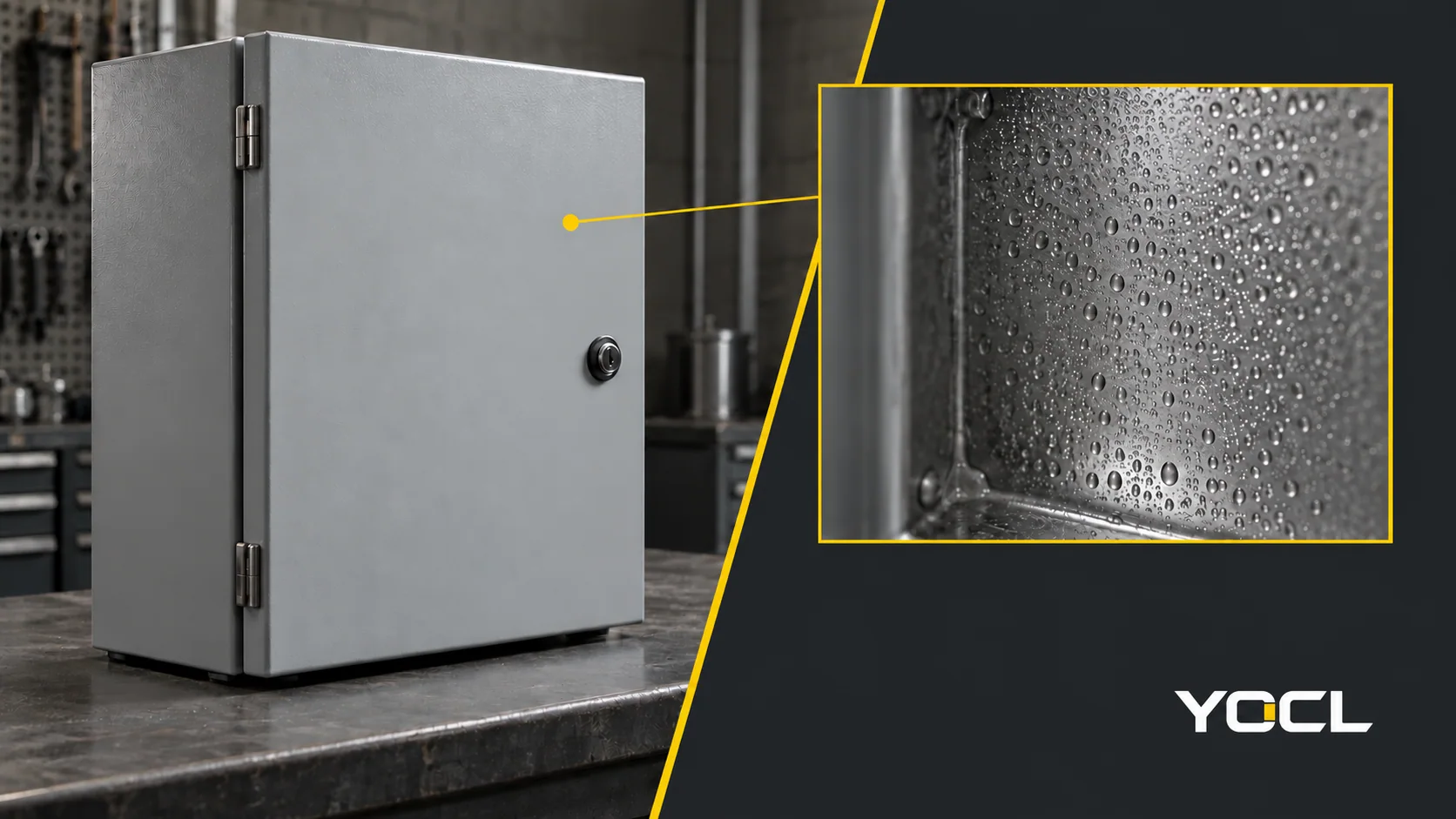
Condensation in sealed electrical enclosures can occur when water vapor already inside meets an internal surface below the local dew point. Closing the lid limits entry paths; it does not remove the moisture enclosed at assembly. The National Weather Service’s cold-surface explanation describes the same physical rule.
The causal chain is enclosed water vapor → a sufficiently cold internal surface → liquid droplets. A new liquid-water leak is not required for that chain to occur.
Closing the enclosure does not make its contents dry
Air trapped when a lid is closed can contain water vapor even when no droplets are visible. A liquid-resistant boundary and a dry internal atmosphere are separate properties. Even a genuinely vapor-tight enclosure can contain moisture from its initial contents.
An instructive physical analogue is NASA’s sealed-glass encasement humidity measurement. Researchers chilled part of a glass panel until water condensed on its inner face while the encasement remained at its normal operating temperature. This was document-conservation work, not an electrical-enclosure or YOCL product test, but it demonstrates the localized cold-surface mechanism in a sealed enclosure.
Some previously exposed polymers may release stored moisture. The National Physical Laboratory (NPL) material-moisture guide describes absorption, diffusion and moisture release from samples. The quantity depends on the material and its exposure history, so enclosure contents can contribute water beyond that initially in the air.
For a closed water inventory, cooling redistributes moisture rather than creating it. Vapor can become droplets and later evaporate. Repeated temperature cycles alone do not continually add new water; real exchange paths and internal moisture reservoirs must be considered separately.
A cold wall can condense water while the bulk air remains warm
A sensor in the middle of a cabinet measures the air around that sensor. It does not establish the temperature of every inner wall, cover or mounting surface. Air adjacent to a colder surface can reach saturation there while the bulk air remains unsaturated.
Calculated snapshot: 25°C bulk air, 60% relative humidity (RH) → dew point ≈16.7°C.
| Inner-wall temperature | Surface minus calculated dew point | Interpretation |
|---|---|---|
| 20°C | +3.3°C | Above the calculated dew point |
| 15°C | −1.7°C | Below it; surface condensation is possible |
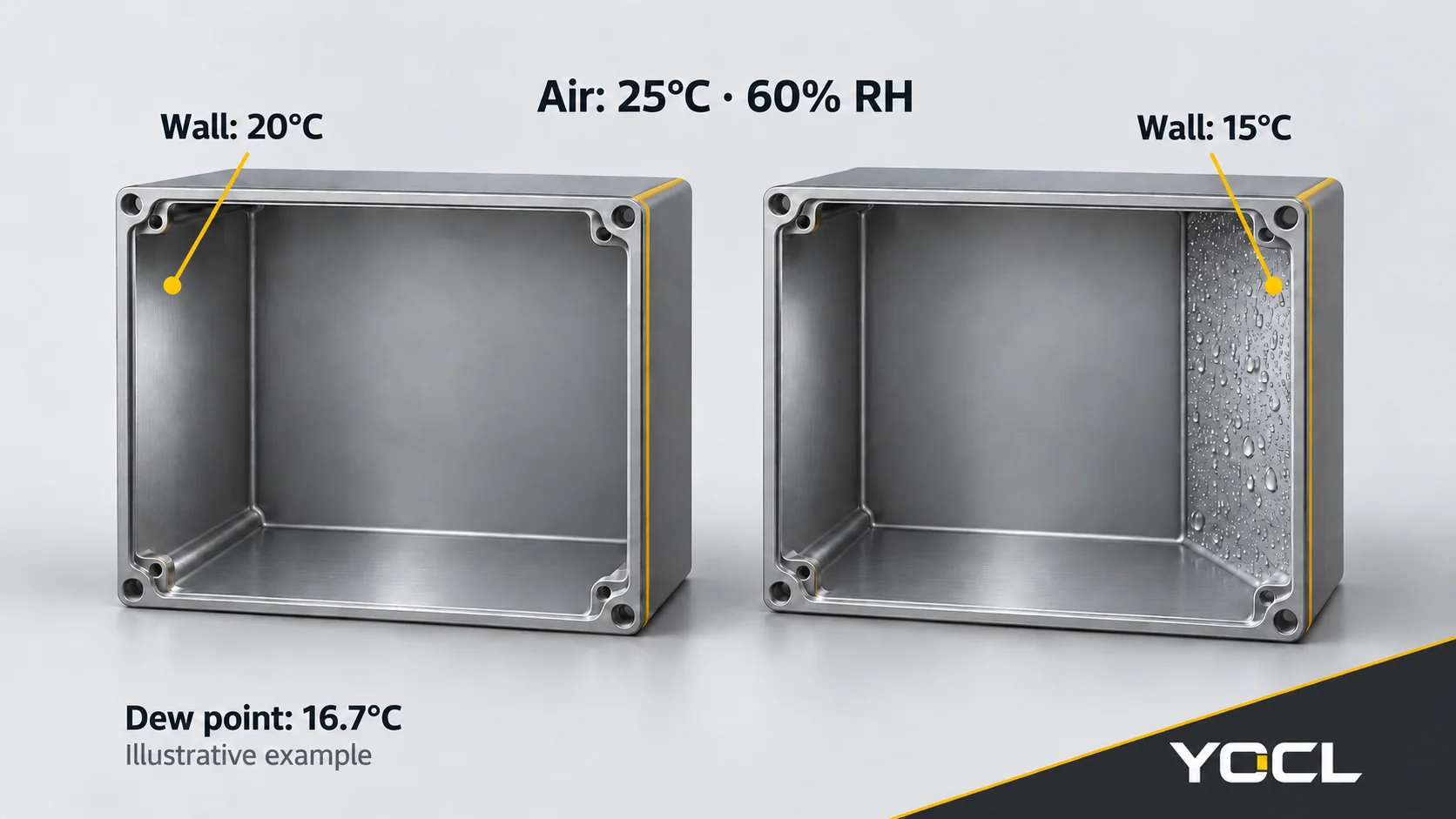
The calculation rearranges the Magnus equation in NPL’s dew-point conversion guidance:
g = ln(RH/100) + 17.62T/(243.12 + T)Td = 243.12g/(17.62 − g)
Here T and dew point Td are in °C, RH is a percentage and ln is the natural logarithm. This approximation uses liquid-water saturation near room temperature and atmospheric pressure. It predicts neither droplet quantity nor drying time. It is not a uniform-cooling model for a rigid sealed volume; changing gas conditions require a new calculation.
Temperature cycles affect pressure and moisture differently
Equipment operation, shutdown and environmental cooling can change the internal air and surface temperatures at different rates. That makes the coldest relevant surface over the cycle more informative than a single warm-state air reading.
A second effect is pressure. For fixed gas amount and volume, the NASA ideal-gas state relationship makes pressure rise with absolute temperature and fall as the gas cools. This simplified model explains a tendency toward outward flow during warming and inward flow during cooling if a gas-exchange path exists. A perfectly closed boundary does not breathe merely because a pressure difference develops.
Real enclosures may exchange air through an intended vent, imperfect interfaces or opening for service. Incoming air can carry water vapor; liquid ingress is another, distinct source. A thermal cycle can thus change the water inventory when exchange occurs, but it does not necessarily add moisture on every cycle.
Pressure balance describes a mechanical condition. Dew-point margin describes a temperature-and-moisture condition. Equal inside/outside pressure gives no assurance that the inner wall is warm enough to remain dry.
An IP declaration does not establish a condensation-free interior
The International Electrotechnical Commission’s IEC 60529 classifies protection provided by electrical-equipment enclosures using the IP Code. In the original edition-2.2 preview, clause 1, protection against moisture produced by condensation is identified as a matter for the relevant product standard.
An ingress declaration therefore cannot replace the moisture and surface-temperature assessment above. It also does not by itself prove hermetic vapor sealing. A vent component’s declaration is evidence for its documented configuration; the finished enclosure still includes the mounting interface, cable entries and cover joints.
Droplets inside a closed box are not, by themselves, proof that rain penetrated it. Conversely, assuming every wet box is suffering only from condensation can conceal a real liquid-entry path. These mechanisms can coexist.
What a passive breather vent changes
A membrane breather provides a controlled gas path across the enclosure boundary. Pressure-driven exchange and water-vapor diffusion are different transport processes; neither makes the outside atmosphere automatically dry.
Independent near-isothermal two-chamber experiments by Khakpour and colleagues linked diffusion to membrane area and the concentration difference; wetting could impede transport. These findings establish no YOCL drying rate.
Net diffusion can favor outward transfer when conditions favor it and reverse when the gradient reverses. Pressure-driven incoming air may carry vapor too. A passive breather therefore provides no fixed humidity setpoint, and it is not a liquid drain. A cold internal wall can still cross the local dew point.
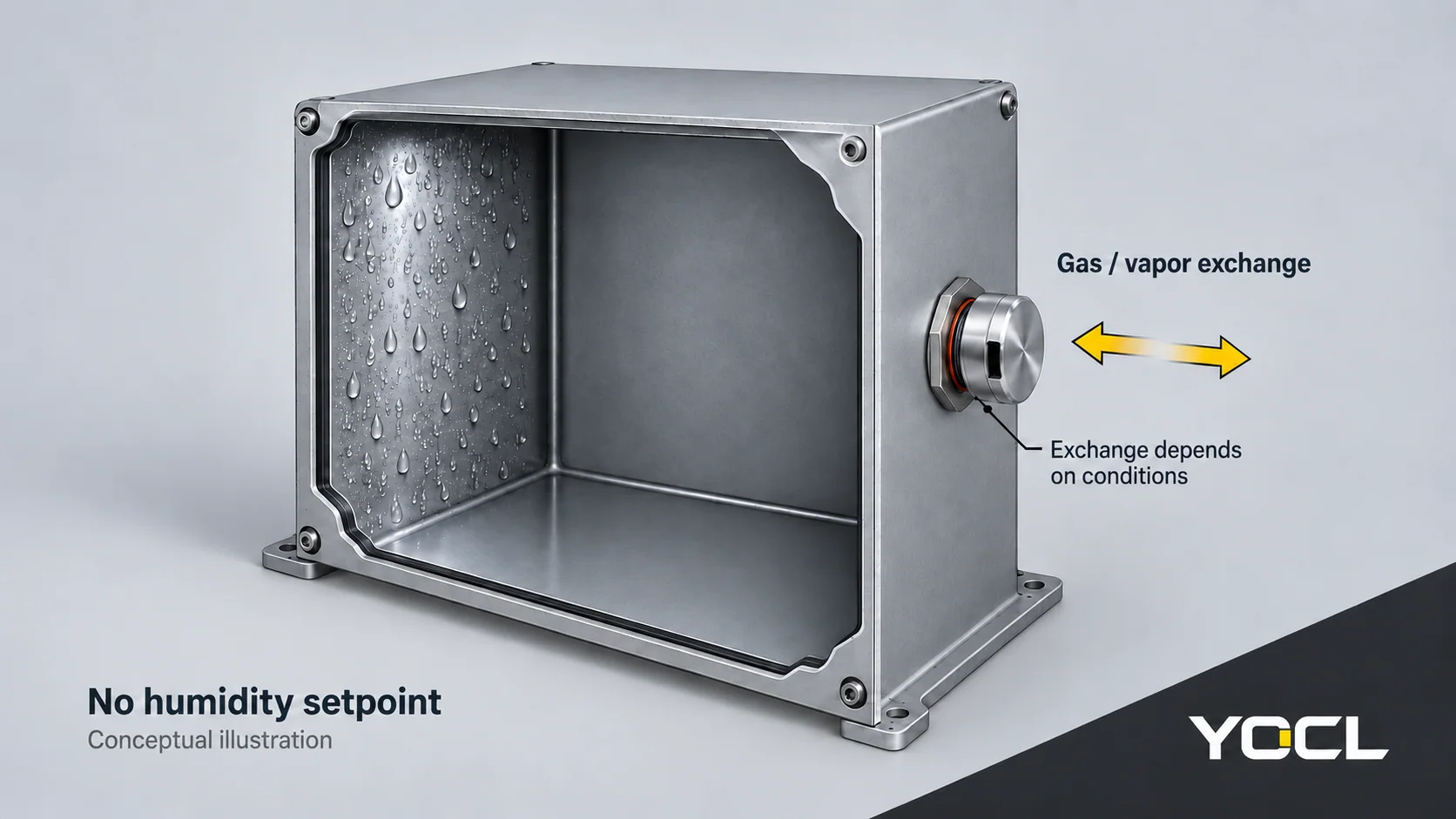
For a construction example, YOCL’s K-series snap-on vent information declares expanded polytetrafluoroethylene (ePTFE) membrane options, a polyamide 66 (PA66) body and cover, and a silicone-rubber O-ring. These are catalogue declarations, not a condensation-free enclosure result. The enclosure vent-plug overview explains the separate breathing, relief and mounting questions.
Keep the design variables separate
The causal model gives three distinct questions for a moisture review:
| Variable | What it changes | What still needs establishing |
|---|---|---|
| Internal water inventory | The vapor state and potential dew point | Initial moisture, material history and later sources |
| Internal surface temperature | Whether a local surface crosses the dew point | Cold spots and their temperatures through powered and unpowered states |
| Boundary transport | Pressure response and possible moisture exchange | Ambient conditions, actual flow paths and the exact vent’s behavior |
Each variable needs evidence for the expected operating cycle. One favorable reading or one component declaration cannot resolve all three.
For a component review, start with the YOCL breather vent plug range and provide the enclosure drawing, expected temperature/humidity cycle, intended breathing function and assembled ingress requirements. Those inputs frame the next model-specific discussion; they do not replace verification of the enclosure’s moisture behavior.
References
- NOAA/National Weather Service — Dry Bulb, Wet Bulb and Dew Point Temperatures, “Dew Point Temperature” section; cold-surface condensation.
- NASA Langley Research Center — Measuring Humidity in Sealed Glass Encasements, NASA Tech Briefs, June 2005, pp. 6–7, LAR-16422-1; sealed-encasement physical analogue, not an electrical enclosure test.
- NPL — Absorption and Diffusion of Moisture in Polymeric Materials, Good Practice Guide 102, issue 2, June 2023, pp. 2–3 and 36; material moisture and desorption.
- NPL — How Do I Convert Between Dew Point and Relative Humidity?, equation 2; Magnus calculation and approximation limits.
- NASA Glenn Research Center — Equation of State; ideal-gas pressure/temperature relationship.
- IEC — IEC 60529 edition-2.2 preview, August 2013, clause 1; original IEC preview hosted by VDE Verlag. Full standard not consulted.
- Khakpour, A., Gibbons, M. and Chandra, S. — Effect of Moisture Condensation on Vapour Transmission Through Porous Membranes, Journal of Industrial Textiles, first published May 9, 2021; original membrane-transport experiments.
- YOCL product information — K-series Snap-on Waterproof Breathable Valve; declared construction only.