
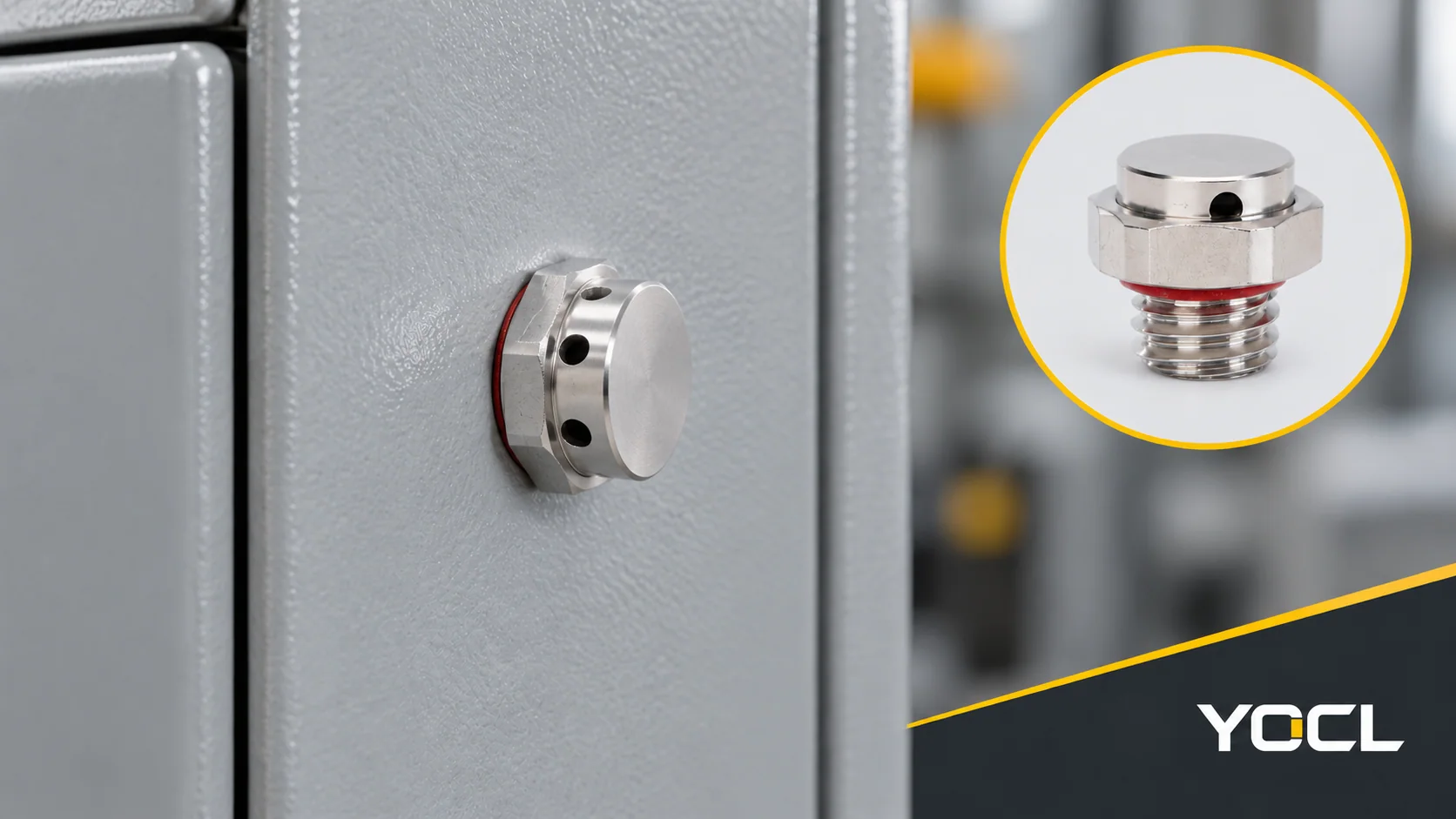
An enclosure vent plug is a fitting that provides a controlled gas path through an enclosure wall. A protective membrane vent allows pressure-driven air exchange while resisting liquid-water entry under specified conditions. It helps an enclosure breathe, but it does not make incoming air dry or guarantee that condensation will disappear.
The terms breather vent plug and pressure equalization vent usually describe this breathing function. Check the actual construction and function, however: a routine membrane vent, a one-way pressure relief valve and a combined breathing/relief device have different operating requirements.
For an OEM or panel builder, the first decision is which problem needs attention: a pressure difference, a liquid-water entry path, humid air inside the box, or pressure that must be released at a defined threshold. These problems need different evidence.
Where the vent plug sits in an enclosure
A vent plug occupies its own enclosure opening. Its mounting arrangement holds the fitting in the wall, and its gas path connects the internal airspace with the surrounding atmosphere. A threaded version needs a matching entry and sealing interface; a snap-on version needs the specified opening and panel geometry.
This separates it from two neighboring fittings:
- A cable gland seals around a cable that passes through the wall and provides the required cable-entry interface.
- A blanking plug closes an unused entry. Its intended job is closure, rather than controlled gas exchange.
The distinction matters when reviewing an enclosure drawing. Adding a breathing opening does not correct an unsuitable cable seal, a loose panel joint or another unintended leak path. The vent and each existing entry still need to work within the assembled enclosure’s requirements.
Small fittings can also have similar-looking heads while using different internal arrangements. Identify the part from its drawing and product specification, rather than from the words “waterproof valve” or its appearance alone.
Why temperature changes create a pressure difference
Consider a closed, rigid enclosure containing a fixed amount of air, with external pressure initially unchanged. As the air warms, its pressure rises; as it cools, its pressure falls. This is a simplified application of the ideal-gas relationship described in NASA Glenn’s Equation of State.
With a suitable breathing path, gas can flow outward when internal pressure is higher, or inward when external pressure is higher. Equipment heating, changes in sunlight and cooling after shutdown can therefore produce different flow directions over time. The vent is responding to the pressure difference, rather than continually blowing air in one direction.
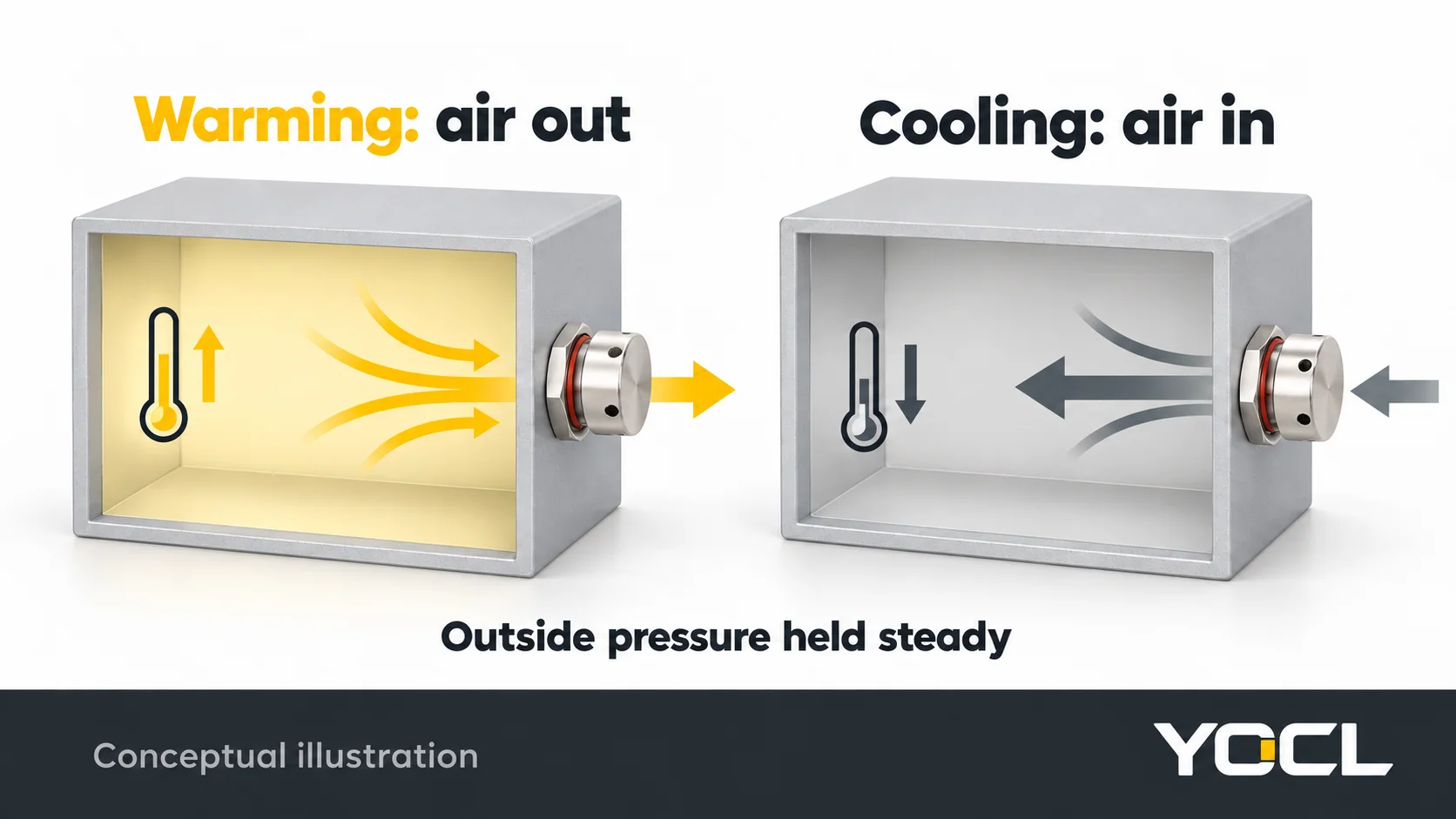
Real enclosures exchange gas, may flex and may have other leakage paths. Consequently, the sealed-air model explains the cause of breathing; it does not predict the pressure reached by a particular enclosure or specify the required vent size. Equalization also takes time, governed by the actual flow path and conditions.
How a membrane passes gas while resisting liquid water
A hydrophobic porous membrane resists liquid wetting while providing paths for gas and water vapor. Liquid water and water vapor are the same molecule in different phases; their behavior here depends on the membrane’s surface and pore structure.
Original research by Hou and colleagues in Nature Communications demonstrates these material properties. The study concerns membrane distillation, so its results do not establish an enclosure vent’s airflow, ingress rating or condensation performance.
Liquid resistance is finite and depends on the membrane, liquid and conditions. Request the exact vent’s exposure limits for washdown, chemicals or immersion.
For a concrete product example, YOCL’s K-series snap-on vent information lists a black PA66 body and cover, a silicone rubber O-ring, and either expanded polytetrafluoroethylene (ePTFE) or non-woven PET combined with ePTFE membrane construction. These are first-party catalogue declarations for that series. Confirm the supplied construction; do not transfer it to every product called a vent plug.
Pressure balance and moisture follow different rules
“Moisture” can mean liquid water entering from outside, water vapor already in the internal air, or droplets forming on a cold surface. Keeping those meanings separate makes a vent specification more useful.
Water-vapor exchange can occur in either direction
Net vapor transfer depends on conditions on both sides, including the water-vapor pressure difference. Vapor can leave under favorable conditions, but the gradient can reverse. Pressure-driven incoming air can also contain vapor. A passive path therefore does not establish a humidity setpoint; this is a transport inference, rather than a measured vent result.
A protective vent therefore belongs in the enclosure’s moisture strategy as a breathing component. It is not an active dehumidifier, a desiccant cartridge or a drain for accumulated liquid. If one of those functions is required, assess it separately instead of expecting the membrane to perform it.
Condensation depends on the cold surface
Condensation can form when a surface cools below the dew point of the surrounding local air. The National Weather Service’s dew-point explanation illustrates this with water forming on a cold bottle.
The same principle explains why a pressure-balanced enclosure can still develop droplets. Imagine a cabinet closed in warm, humid conditions, then cooling overnight. An internal wall can become cold enough for the adjacent air’s vapor to condense even while inside and outside pressures are nearly equal. Equal pressure is not evidence of a safe margin above dew point.
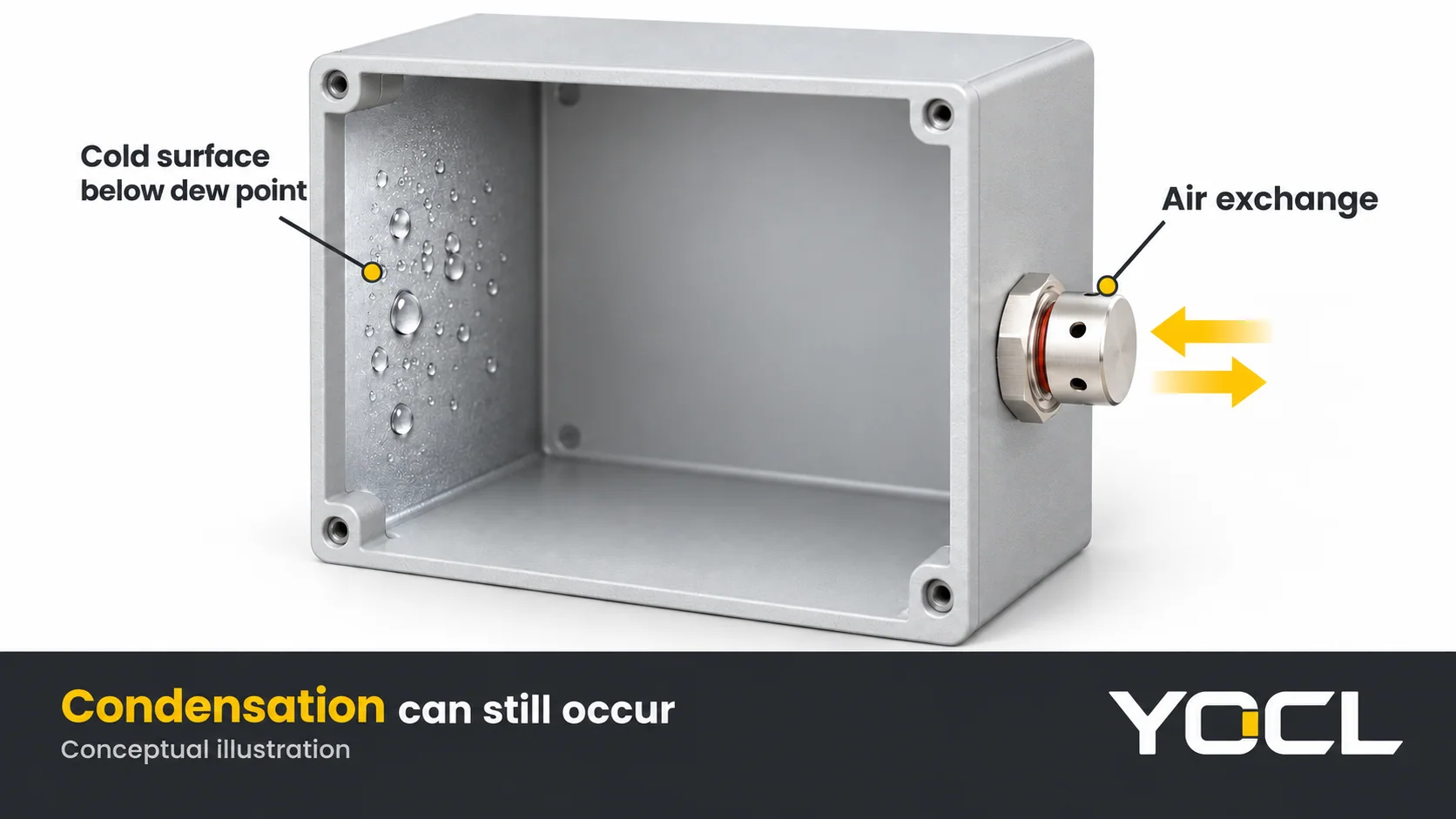
To assess this issue, the useful information includes internal moisture sources, local humidity and surface temperatures over the operating cycle. A vent’s air permeability or component ingress declaration cannot replace that assessment. Measures intended to control moisture content or surface temperature need their own design review.
Choose the next resource by function
Use this map to identify the relevant design question before comparing thread sizes. The rows describe different tasks; a product name alone does not demonstrate that the task is satisfied.
| Your main question | Function to investigate | Next resource or evidence |
|---|---|---|
| How can the enclosure exchange gas during normal pressure changes? | Routine breather vent | Review the vent’s airflow characteristics and mounting form; the K-series snap-on page is one configuration example. |
| Must internal pressure be released at a defined threshold? | One-way pressure relief | Review opening pressure, tolerance and release behavior for the exact device; YOCL’s one-way relief valve information separates these model requirements. |
| Does the design require both ordinary breathing and pressure-actuated release? | Combined breather and relief device | Compare the two functions separately in the YOCL function overview, then obtain the exact model data. |
| Does a cable pass through the opening? | Cable-entry sealing | Use the cable gland selection guide to check cable fit and the enclosure entry. |
| Is there persistent condensation or accumulated liquid? | Moisture-source, thermal or liquid-management assessment | Establish whether water is entering as liquid or forming internally; routine venting alone does not identify or resolve the cause. |
A one-way relief specification should not be assumed to provide bidirectional routine breathing. Likewise, normal membrane airflow does not establish a defined opening pressure for a relief function. Where both are needed, confirm both behaviors in the proposed assembly.
Pressure release also does not establish explosion-proof certification or a complete enclosure’s safety rating. Those questions require evidence for the actual equipment and application, beyond a catalogue family name.
Read airflow and ingress data at their stated conditions
Once you have identified the breathing function, the model data should answer three separate questions.
What does the airflow value describe?
An airflow figure needs its pressure differential and test conditions. YOCL’s current vent range information states that its displayed catalogue airflow figures use 70 mbar. That is the stated test differential, not a universal enclosure operating pressure or an equalization-time promise.
For a design expected to operate at another differential, request relevant flow characteristics. A single published point does not tell you how rapidly the enclosure will follow a temperature cycle. Enclosure volume alone also leaves out the rate of temperature change, other flow paths and the acceptable pressure difference.
What seals the fitting into the wall?
There are two paths to consider: the intended gas path through the vent and the perimeter where the fitting meets the enclosure. A suitable membrane does not compensate for an unsuitable mounting seal.
Read the drawing for the exact thread form and pitch, engagement and clearance, or the snap-on opening, panel thickness and retention requirements. Body dimensions are useful for checking space; they do not automatically establish a permitted hole tolerance or panel thickness. Obtain installation requirements for the actual configuration.
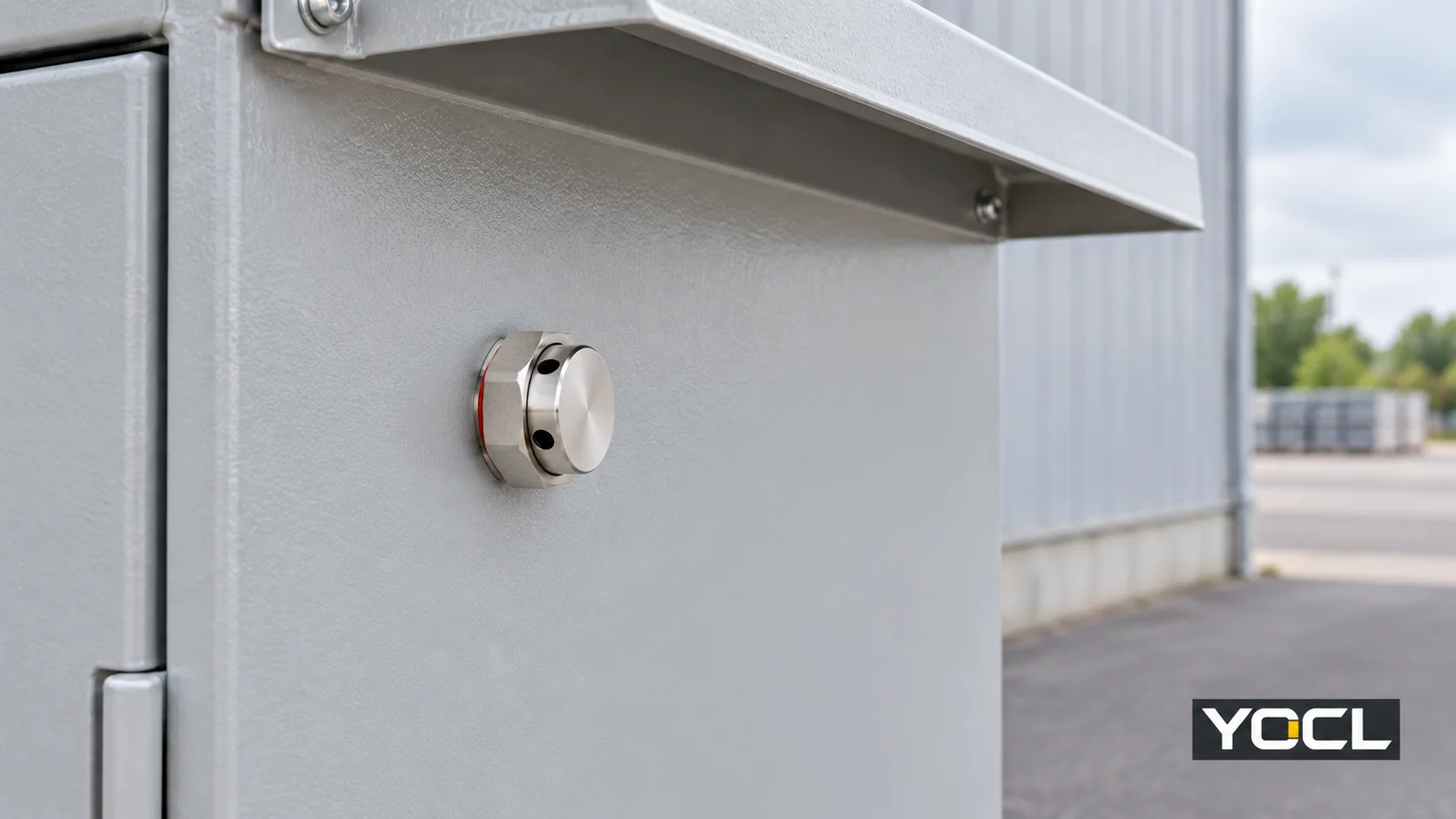
A cover, bracket, coating or the surrounding installation can affect access to the vent path. Review the assembled layout and exposure, including liquids and contamination, rather than evaluating only the loose fitting. Use the manufacturer’s requirements for orientation and protection where supplied.
What does the ingress declaration apply to?
The International Electrotechnical Commission’s official IEC 60529 abstract identifies its scope as classification of protection provided by electrical-equipment enclosures. That scope is distinct from pressure equalization or humidity control.
A vent’s declared IP rating applies to its documented configuration and conditions. It does not by itself establish the rating of a finished enclosure with a new opening, mounting seal, cable entries and cover joints. Request model-specific evidence and verify the assembled enclosure’s applicable ingress requirements.
For available threaded, snap-on and relief configurations, start with the YOCL breather vent plug and pressure relief range. Identify the required function, enclosure interface and operating conditions so the next discussion can focus on the appropriate model documentation.
Related reading: See condensation checks after fitting a vent plug.
Related reading: breathable cable glands for cable entries.
References
- NASA Glenn Research Center, Equation of State, updated May 13, 2021—gas pressure, temperature, amount and volume relationships.
- Hou, Y. et al., A super liquid-repellent hierarchical porous membrane for enhanced membrane distillation, Nature Communications 14, 6886, October 28, 2023—original membrane research; material physics only.
- YOCL, K-series Snap-on Waterproof Breathable Valve—YOCL product information, including declared membrane and seal construction.
- NOAA/National Weather Service, Dry Bulb, Wet Bulb and Dew Point Temperatures, “Dew Point Temperature” section.
- YOCL, Safety One-Way Pressure Relief Valves—YOCL product information on model-specific relief requirements.
- YOCL, Breather Vent Plug & Pressure Relief Valve Manufacturer—YOCL product information and function overview, reviewed October 5, 2026.
- IEC, IEC 60529:1989+AMD1:1999+AMD2:2013 CSV, edition 2.2, August 29, 2013—official catalogue abstract and scope only.