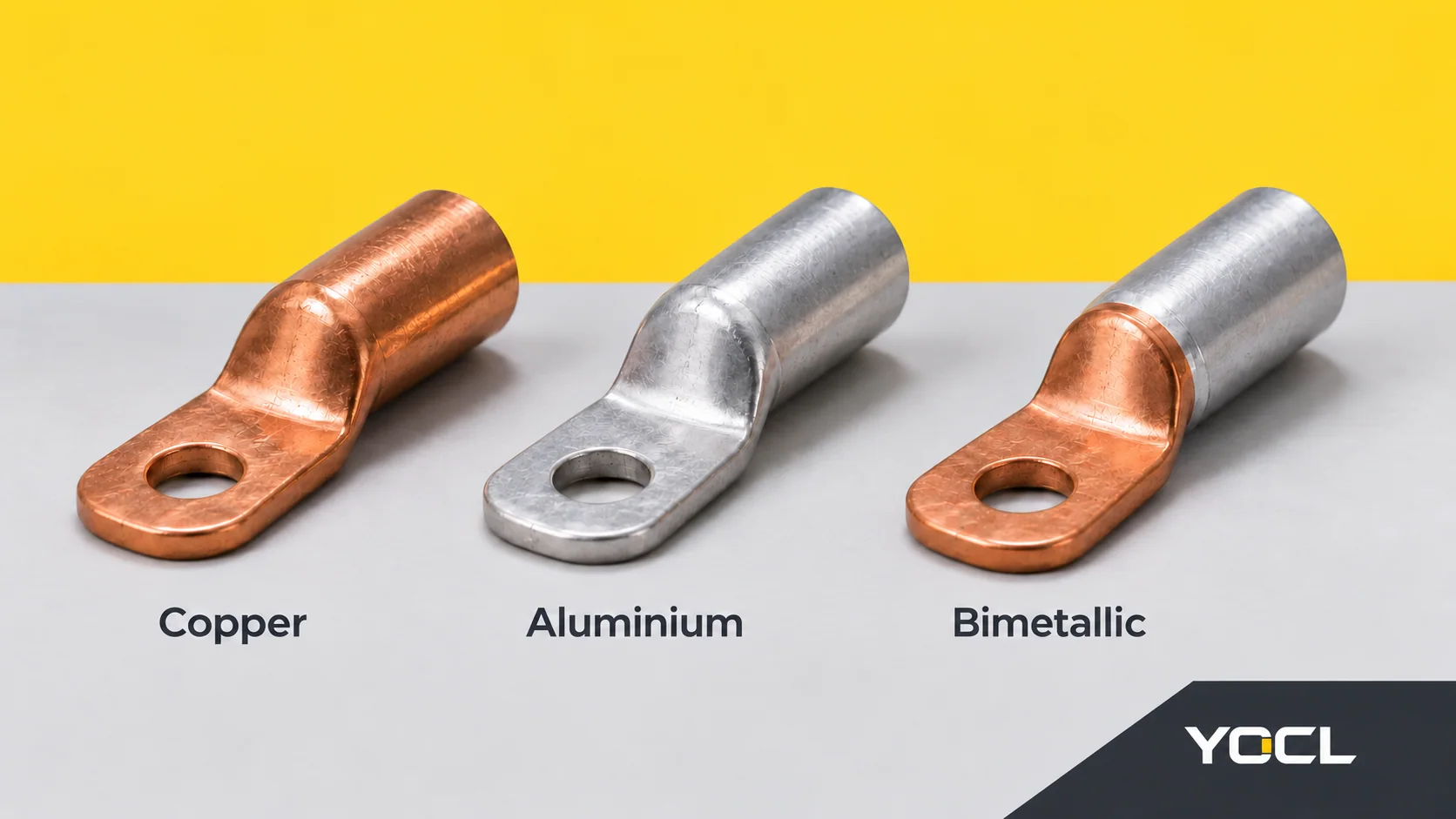
Start with copper lugs for copper conductors, aluminium lugs for aluminium conductors, and an aluminium-barrel/copper-palm bimetallic lug for an aluminium conductor connecting to a compatible copper interface. These are candidate choices: the exact lug and equipment documentation must approve the connection. Aluminium and aluminum describe the same material.
The decisive question is whether the lug fits both sides of the connection: the conductor inside its barrel and the equipment surface under its palm.
Compare the three lug materials on the same basis
This table describes common constructions, not a universal compatibility approval.
| Comparison point | Copper cable lug | Aluminium cable lug | Bimetallic cable lug, Al barrel/Cu palm type |
|---|---|---|---|
| Body construction | Copper; may have a surface coating such as tin | Aluminium body | Aluminium conductor barrel joined to a copper palm |
| Bulk-material tradeoff | Higher conductivity and density than aluminium | Lower conductivity and density than copper | Combines both metals; performance depends on the design |
| Starting conductor choice | Copper | Aluminium | Aluminium |
| Equipment-side contact | Copper or plated-copper palm; check the accepted interface | Aluminium palm; check the accepted interface | Copper palm; check the accepted interface |
| Main decision advantage | Straightforward candidate for a copper conductor and compatible equipment contact | Candidate for an aluminium conductor and compatible aluminium contact | Places a defined material transition within the lug for an Al-to-Cu connection |
| Important exception | A copper-only rating excludes aluminium conductors | Some connectors are rated for both Cu and Al; verify the exact model | This construction does not automatically accept copper conductors or work in reverse |
| What the material name cannot establish | Conductor class, tooling, current or equipment acceptance | Conductor class, tooling, current or equipment acceptance | Conductor class, tooling, current or equipment acceptance |
These conductivity and density differences concern bulk electrical-grade metals. Finished-lug geometry and the approved connection still govern suitability; a material comparison cannot establish an ampere rating or justify changing conductor size. Copper for Busbars, sections 1.2.2–1.2.2.1.
In the U.S. certification context, UL Solutions explains copper-only CU markings and copper/aluminium CU-AL or AL-CU ratings. It also distinguishes equipment markings from connector markings. These examples support checking the actual rating, rather than inferring compatibility from the connector’s base metal. UL Solutions, Copper Clad Aluminum Terminations.
YOCL’s copper cable lug range and aluminium cable lug range provide model families for comparison. Confirm the selected model’s documentation before treating either range as a replacement specification.
Choose against both sides of the connection
Separate the conductor-to-barrel connection from the palm-to-equipment connection. A conductor rating does not, by itself, approve every busbar material, surface finish or equipment terminal.
| Conductor → equipment interface | Starting candidate | Approval still required |
|---|---|---|
| Copper → copper | Copper lug | Conductor size/construction, palm finish, mounting geometry and equipment acceptance |
| Aluminium → aluminium | Aluminium lug | Aluminium conductor compatibility and the specified aluminium contact arrangement |
| Aluminium → copper | Al-barrel/Cu-palm bimetallic lug | Aluminium barrel rating plus acceptance of the copper palm at the equipment; another documented connector arrangement may also be acceptable |
| Copper → aluminium | Connector or transition arrangement explicitly approved for this direction | Copper conductor rating and the aluminium equipment interface; do not reverse an Al-barrel/Cu-palm lug by assumption |
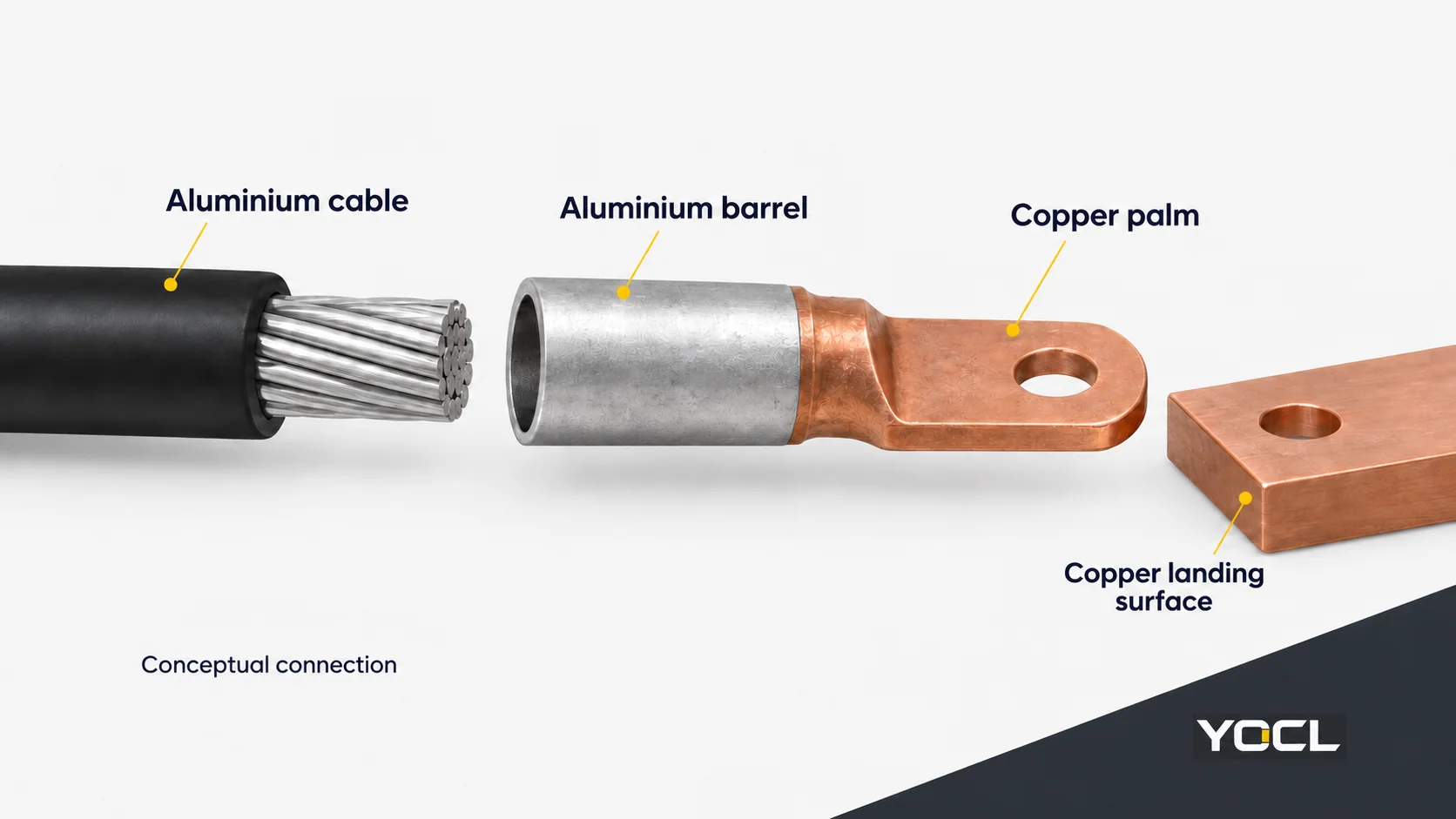
For a concrete structural example, YOCL’s DTL-2 copper-aluminium connecting terminal declares an aluminium crimp barrel and a copper bolted palm. Its catalogue describes the material arrangement and dimensional fields. It does not establish an installation torque, approved die or certification merely by showing that construction.
Compare the bimetallic cable lug range when that transition matches the project. Specify which metal belongs at each end; “bimetallic” alone is an incomplete purchasing requirement.
Plating and corrosion do not replace compatibility evidence
Tinned copper is still a copper-body lug
A silver finish is an unreliable material identifier. A tinned copper lug has a copper body with a surface coating; it is different from a lug with an aluminium barrel and copper palm. Do not interpret the coating as an aluminium-conductor rating. Check the model’s declared base material and conductor approval.
Likewise, dual conductor rating does not automatically permit mixing copper and aluminium wires in direct contact inside one connector. UL Solutions identifies additional intermixing and location restrictions in its connector-marking explanation. The published explanation concerns U.S. certification practice; the applicable project rules and exact instructions remain controlling. UL Solutions marking guidance.
The environment and contact design matter
Galvanic corrosion requires an electrochemical path involving dissimilar metals and an electrolyte, commonly water. That makes moisture exposure part of the material decision. A bimetallic lug does not, by itself, prove that the completed termination is suitable for a wet or corrosive location. NASA, MSFC-HDBK-3697, section 5.3.6.1.
Aluminium also forms a hard, electrically insulating oxide. The Copper Development Association’s busbar guide discusses oxide and the effects of stress relaxation and thermal movement on bolted-contact pressure. These mechanisms explain why the contact arrangement and preparation instructions matter; they do not provide a universal lug preparation or retightening recipe. Copper for Busbars, sections 1.2.2.3 and 6.6.4–6.6.5.
Request the specified surface preparation, compound if required, sealing and hardware instructions for the actual connector and equipment. Do not substitute a generic corrosion treatment for those instructions.
A matching cable size and bolt hole are separate checks
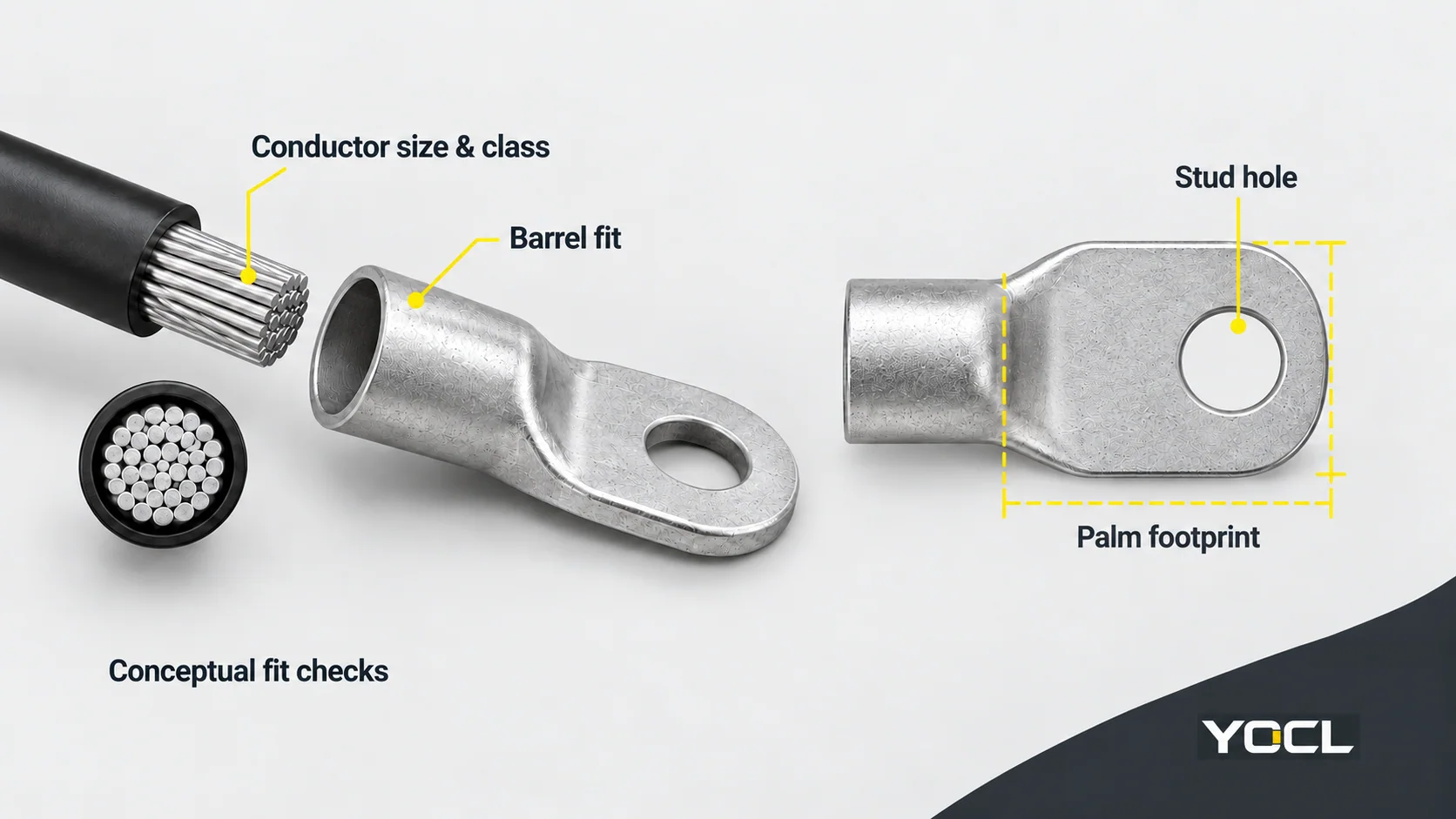
The conductor’s nominal cross-section is not the palm’s stud-hole diameter. Two lugs with the same bolt hole can have different barrel bores, palm widths and overall lengths. Conversely, two lugs intended for the same conductor size may have different mounting geometry.
Include conductor construction in the comparison: solid, stranded, compacted or fine-stranded. A nominal area match does not establish every strand configuration. The visible scope of UL 486A-486B, fourth edition (2025) distinguishes conductor constructions and includes other class/strand configurations as indicated by marking. This is a scope reference, not evidence that a particular YOCL model is certified. UL Standards & Engagement, public scope.
Approve a substitute only when the evidence follows it
For an IEC-based specification, identify the relevant standard part and application. IEC 61238-1-1:2018 concerns compression and mechanical connectors for power cables up to 1 kV, tested on non-insulated conductors. Its public abstract establishes that scope; a generic “IEC 61238” sales claim does not identify the exact model’s evaluated configuration. IEC official abstract.
Use this acceptance checklist before approving a copper, aluminium or bimetallic substitute:
- Conductor: material, nominal area and strand construction are explicitly covered.
- Equipment: the palm material/finish and connector arrangement are accepted by the equipment documentation.
- Geometry: barrel, stud hole, palm footprint and clearance match the drawing.
- Installation: the actual connector instructions identify the applicable tooling, crimp requirements and contact preparation; equipment instructions establish the mounting requirements.
- Service conditions: temperature and environmental suitability are documented for the intended use.
- Evidence: any required certificate or test report identifies the exact model, configuration and relevant standard scope.
Compare the complete installed connection when assessing price: lug, compatible tooling, hardware, environmental protection and documentation. A cheaper part that cannot satisfy these checks is not an approved substitute.
Use YOCL’s cable lug catalogue to shortlist a family. For an enquiry, send the conductor material, area and construction; equipment contact material; mounting drawing; environment; target-market requirements; and quantity. Those inputs make the material comparison actionable.
Related reading: investigating overheating at lug connections.
References
- Copper Development Association / European Copper Institute — Copper for Busbars, revised May 2014, sections 1.2.2–1.2.2.3 and 6.6.4–6.6.5; bulk properties, oxide and bolted-joint contact mechanisms.
- UL Solutions — Copper Clad Aluminum Terminations, IAEI Magazine, March 1, 2021; connector and equipment marking distinctions.
- YOCL ELECTRIC — DTL-2 Series Copper-Aluminium Connecting Terminal; first-party product information on declared construction and dimensions.
- NASA — Electrical Bonding Design Guide Handbook — MSFC-HDBK-3697, section 5.3.6.1; galvanic corrosion mechanism.
- UL Standards & Engagement — UL 486A-486B: Wire Connectors, fourth edition, March 14, 2025; public scope only.
- IEC — IEC 61238-1-1:2018; public abstract only.