
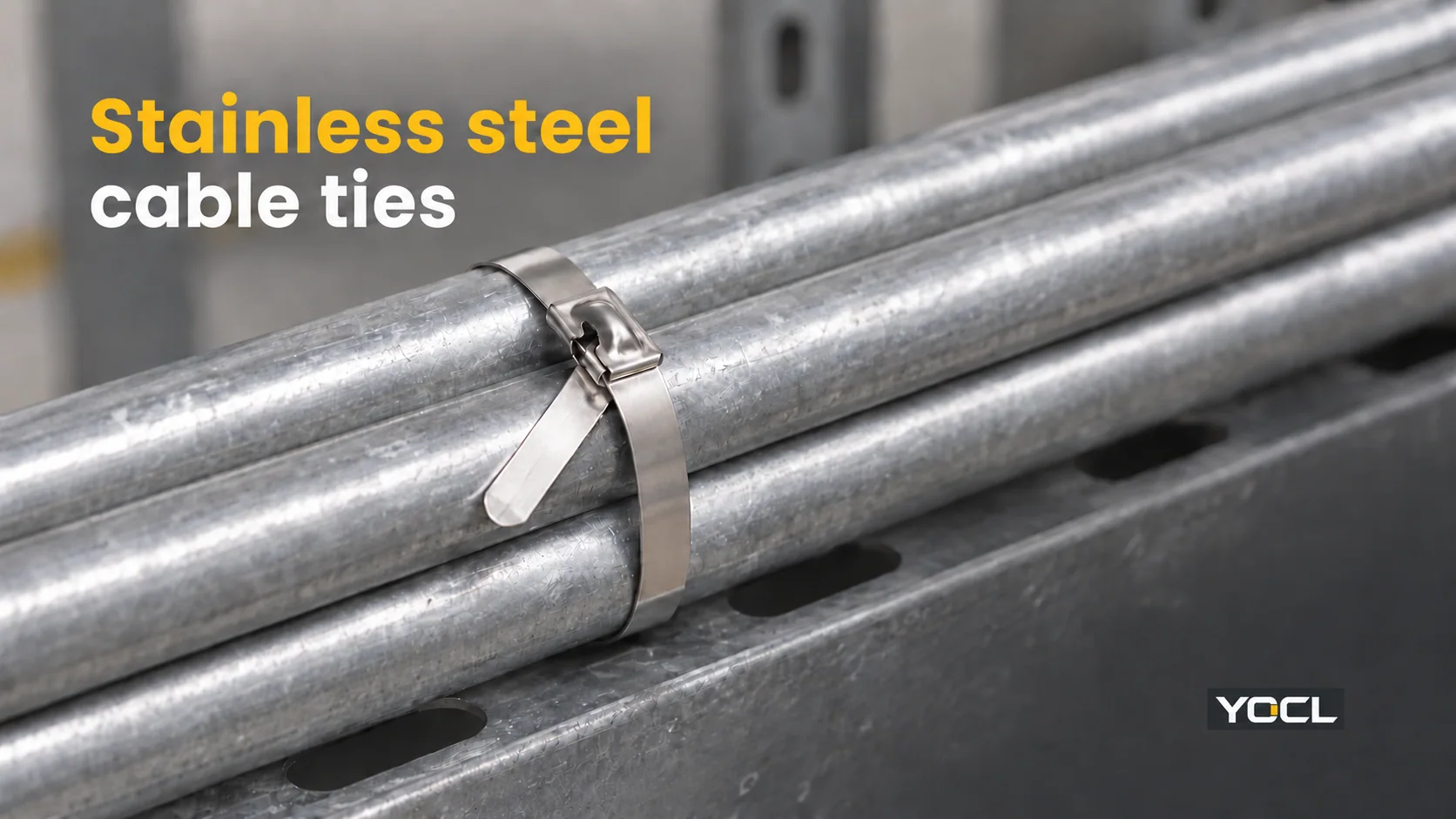
Stainless steel cable ties secure a bundle using a metal band and a locking head. Their locking construction, steel grade and surface coating are separate attributes. The lock retains the band, the alloy affects corrosion suitability, and the coating changes the surfaces in contact with the bundle.
Names such as “316 ball-lock tie” or “black coated steel tie” describe only part of the product. They do not establish its complete strength, temperature, release or installation specification. Understanding those three attributes makes it easier to recognize a design and find the right model data.
Read the Lock, Grade and Coating as Separate Attributes
Two ties may look similar but use different alloys or coatings. Conversely, several locking constructions may be offered in the same steel grade. Keep the three questions separate when comparing a description or photograph.
| Attribute | What it tells you | What still needs confirmation |
|---|---|---|
| Locking construction | How the band is retained; whether the design uses a ball lock or ladder-style hooks | Exact band routing, installation tool, release provisions and declared performance |
| Stainless steel grade | The specified alloy, such as 304 or 316 | Suitability for the actual exposure and confirmation of the supplied material |
| Coating and coverage | The polymer or finish applied over the metal, and which surfaces it covers | Contact protection, exposed metal, temperature limits and any tested environmental or electrical properties |
The photograph can help identify a slotted band, a spring section or an exposed locking head. It cannot establish the steel grade, coating chemistry or a test rating. Those details belong in the exact product specification.
Locks: Ball-Lock and Ladder Designs
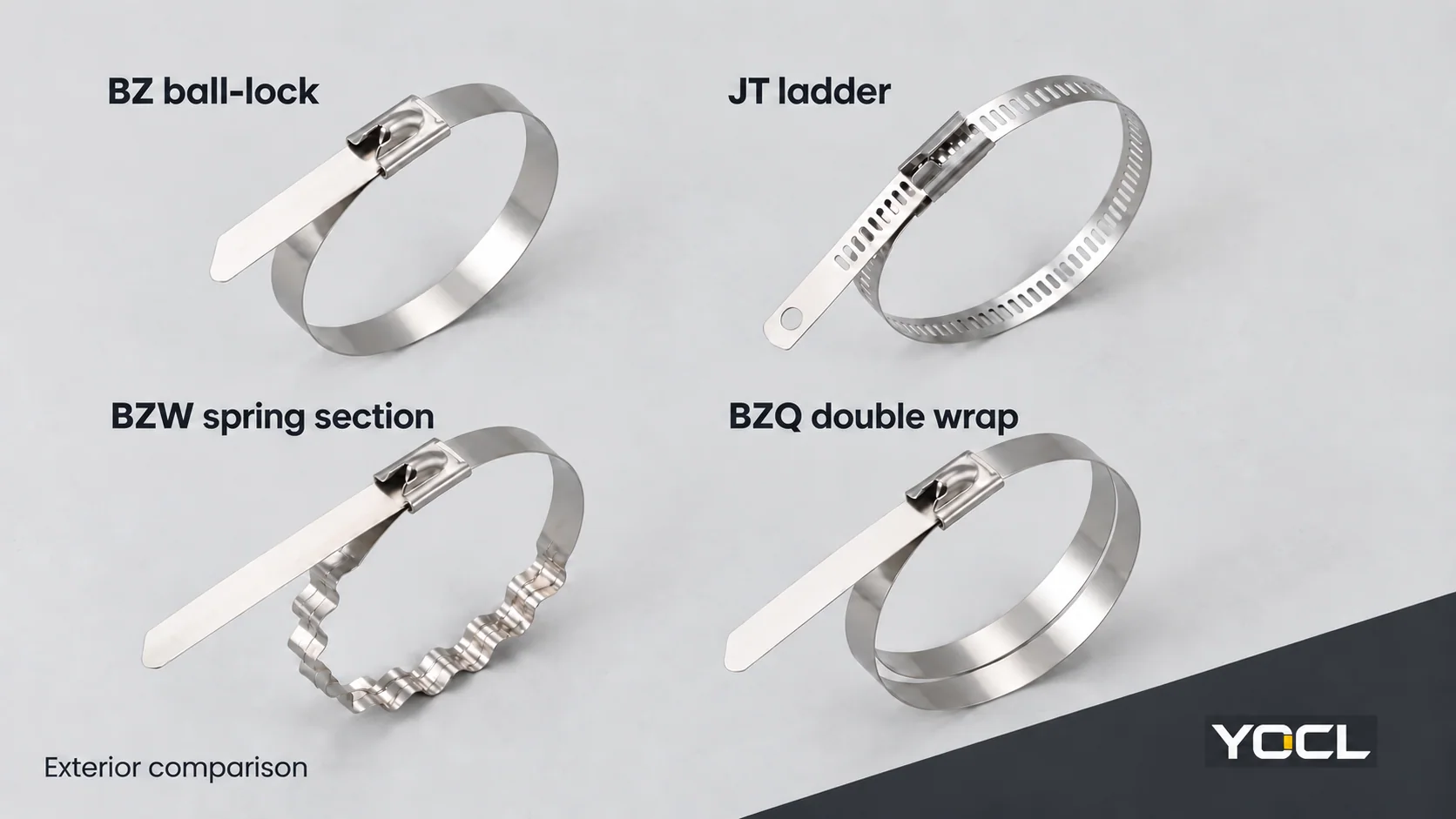
A ball-lock tie uses a ball mechanism to retain the band in its locking head. A ladder tie uses a slotted band and hook-style locking construction. These are different fastening arrangements; a slotted worm-drive hose clamp with a screw is a different device again.
YOCL’s documented series show how the lock and band construction can vary:
| Construction | Visible or documented feature | What the series name does not establish |
|---|---|---|
| BZ ball-lock ties | Self-locking ball mechanism; uncoated BZ, coated BZP and fully coated BZPM variants where listed | One shared finish, temperature limit or strength across every width and variant |
| JT ladder ties | Ladder-style band with multiple-hook locking; JT and coated JTP versions | Equivalence to a ball-lock head, or automatic reuse capability |
| BZW spring ball-lock ties | Ball lock plus a wavy band section that provides compliance around the bundle | A quantified spring force or a demonstrated vibration rating |
| BZQ double-wrap ties | Ball-lock construction with a specified two-pass route through the buckle | A universal doubling of strength or the bundle capacity of a single-wrap tie of the same length |
Spring and double-wrap designs modify the band or its routing. They do not identify a new steel grade. Their series-specific length and installation requirements remain relevant even when the locking principle is shared.
Self-Locking Does Not Mean Reusable
Self-locking describes how the fitting retains the inserted band. It does not tell you whether the tie can be released, adjusted after installation or installed repeatedly.
Even a release feature needs a separate reuse assessment. The UL Solutions cable-tie application guide, updated in July 2026, notes that a releasable locking mechanism may be investigated for a single installation. Use the exact model’s instructions for any release or repeat-use requirement.
Grades: What Changes Between 304 and 316?
The grade describes the stainless steel alloy, not the locking head’s operating principle or the colour of the band. It is an important input to corrosion assessment, but it is not a complete environmental rating for the finished tie.
316 contains molybdenum, which improves corrosion resistance. The British Stainless Steel Association’s 316/L overview identifies 316/L as a grade to consider where 304 is inadequate, including chloride-rich conditions. This explains why a 316 requirement may arise in saline or coastal exposure. It does not establish that every application needs 316, or that a 316 tie will have a higher loop-strength rating than a 304 tie.
316 still has limits in seawater. BSSA’s seawater grade-selection guidance describes susceptibility to pitting and crevice corrosion. Temperature, water conditions and crevice geometry influence suitability; evaporation can concentrate chlorides in damp splash areas. “Marine grade” should therefore lead to an exposure assessment rather than an assumption of indefinite corrosion resistance.
For a tie, the relevant question is the environment at the band, buckle and contact surfaces. A sheltered, dry location is a different exposure from sustained wetting, trapped deposits or seawater contact. The grade should be evaluated alongside those conditions and the complete tie configuration.
The YOCL BZ catalogue also lists 201, alongside 304 and 316. These are catalogue material options, not a declaration that every grade is available under every order code or suitable for the same environment. Confirm the steel grade for the supplied configuration rather than inferring it from a family photograph.
Coatings: A Surface Layer Over a Steel Band
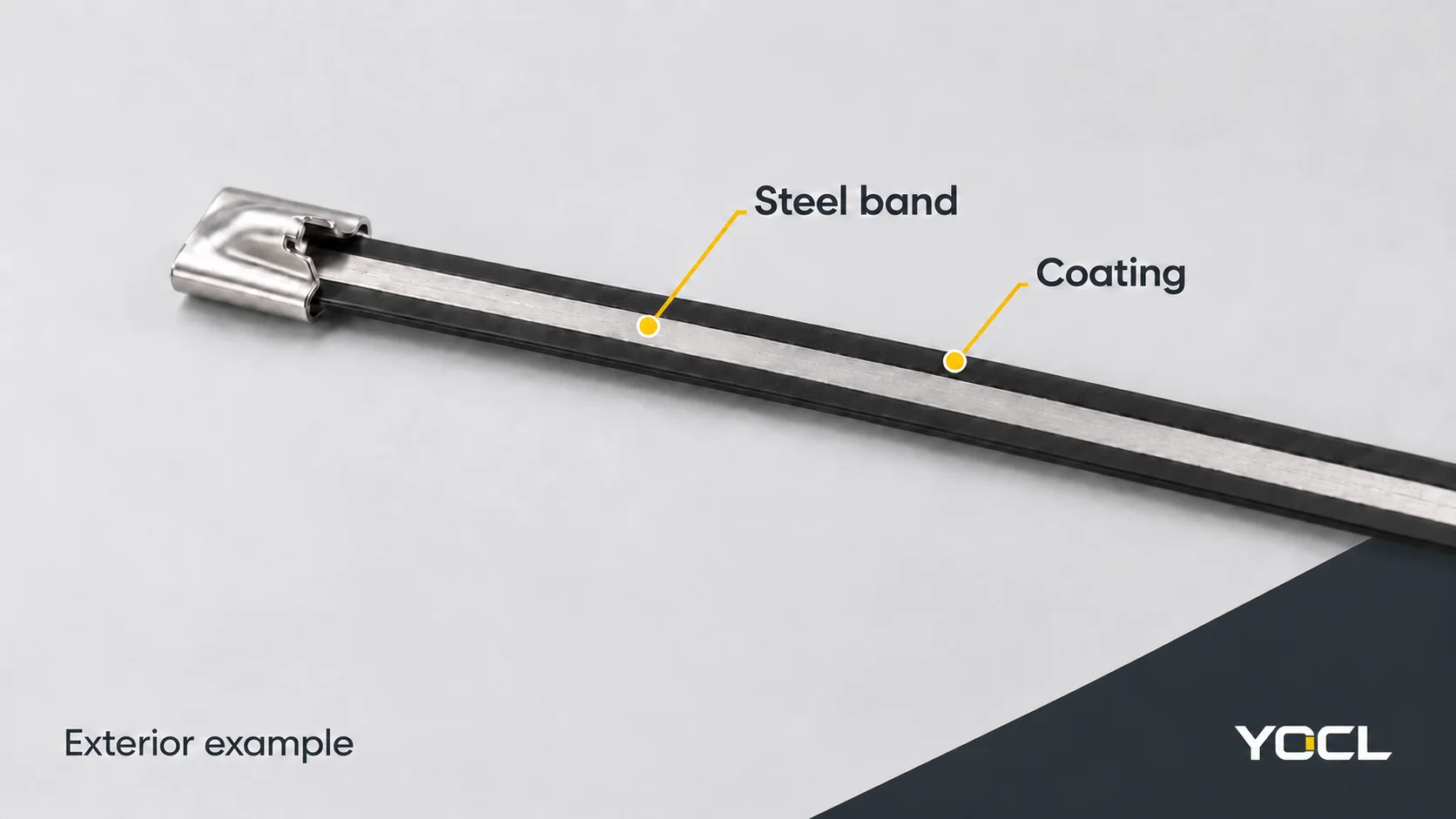
An uncoated tie presents its metal surface at the band contact. A coated tie adds a layer over some or all of that surface. The steel core remains part of the fastening construction: a Nylon 11-coated stainless steel tie is still a metal-band tie, rather than an all-nylon cable tie.
The YOCL BZ product description describes coated bands as providing an additional barrier at band edges and between the metal and bundled materials. The coverage matters as much as the word “coated.” A coated band with an exposed head or metallic stripe does not enclose every metal surface.
PVC and Nylon 11 Examples Have Their Own Specifications
The YOCL BZB PVC-coated tie and BZNP Nylon 11-coated tie illustrate why coated products need model-specific data.
| Declared characteristic | BZB | BZNP |
|---|---|---|
| Coating | Polyvinyl chloride (PVC) | Nylon 11 |
| Described appearance/coverage | Black coated band with a metallic locking head | Semi-coated band with a metallic line and exposed metallic head |
| Declared working temperature | −40 °C to +70 °C | −80 °C to +150 °C |
These are YOCL catalogue declarations for two different product series, not universal temperature limits for PVC or Nylon 11 and not results from an independent comparison test. The series also have different dimensions and strength declarations. Their tables cannot isolate coating chemistry as the cause of a performance difference.
The BZ product document also lists polyester and epoxy coating options. For BZP and BZPM, it does not map each coating chemistry to a separate order code. Specify the required material and coverage explicitly; a black finish alone cannot resolve them.
A contact barrier also does not establish a tested electrical insulation rating. Review the required property separately, along with the condition and coverage of the coating. The bare-metal temperature declaration of another variant cannot be transferred to the coated tie.
Read Ratings for the Complete Tie
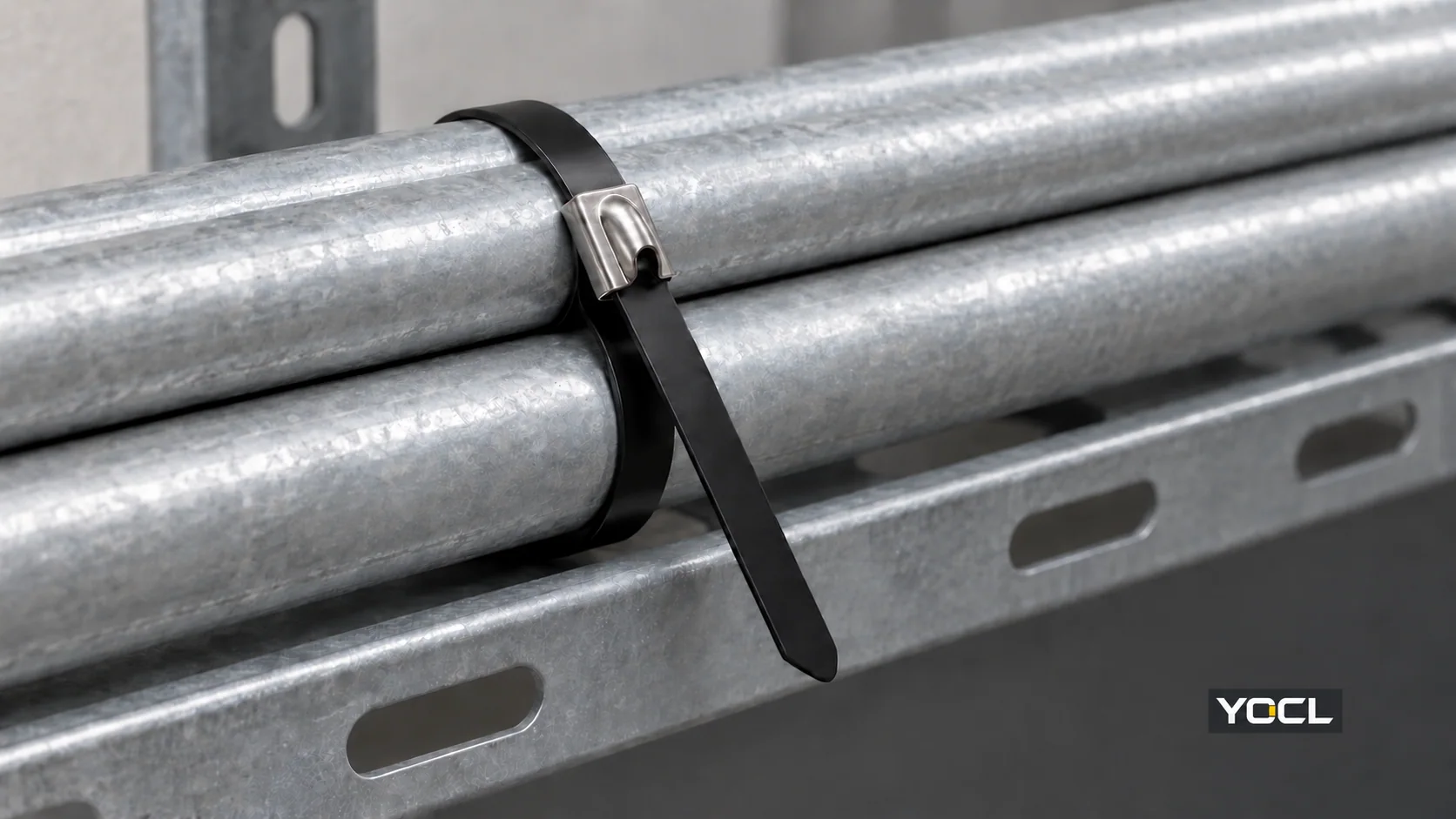
Lock, grade and coating describe the construction. Performance evidence must cover the complete candidate configuration, including its band dimensions and installation conditions.
The UL guide’s loop-strength explanation states that loop tensile strength loads the strap and engaged locking mechanism together. It is a reference characteristic for bundling, not the strength of the alloy alone and not a long-term static load-bearing rating. A catalogue pull-strength figure therefore cannot by itself establish a lifting load or approval for primary cable support.
Temperature descriptions also need their intended meaning. The same guide distinguishes the minimum installation temperature from minimum and maximum operating temperatures. A working-temperature range should not be silently treated as permission to install the tie at every temperature within that range.
For outdoor or vibrating equipment, look for the relevant model evidence rather than deriving suitability from “stainless,” “316,” a dark coating or a spring section. These attributes help describe the candidate; the required performance still has to be established for the intended service.
A description such as ball-lock / 316 / Nylon 11-coated is a useful start, but it still needs an exact series, band size and confirmed supplied specification. Review the YOCL stainless steel cable tie range to identify that series, then use its own drawings and documented limits for the next decision.
Related reading: 304 and 316 stainless steel grades.
References
- YOCL — BZ Ball-Lock Stainless Steel Cable Ties. First-party product information: variants, listed grades and coating options; accessed October 6, 2026.
- YOCL — JT Ladder Self-Locking Stainless Steel Cable Ties. First-party product information: ladder and hook construction; accessed October 6, 2026.
- YOCL — BZW Spring Ball-Lock Stainless Steel Cable Ties. First-party product information: wavy spring section; accessed October 6, 2026.
- YOCL — BZQ Double-Wrap Ball-Lock Stainless Steel Cable Ties. First-party product information: two-pass routing; accessed October 6, 2026.
- UL Solutions — Positioning Devices: Cable Ties for Cable Management of Electrical Installations, Application Guide, updated July 2026. Release, loop-strength and temperature boundaries.
- British Stainless Steel Association — Stainless Steels to Behold: 316/L. Association grade overview; qualitative molybdenum and corrosion explanation.
- British Stainless Steel Association — Selection of 316, 304 and 303 Types of Stainless Steels for Seawater Applications. Seawater, pitting and crevice-corrosion limits.
- YOCL — BZB PVC Coated Stainless Steel Cable Ties. First-party coating and working-temperature declarations; accessed October 6, 2026.
- YOCL — BZNP Nylon 11 Coated Stainless Steel Cable Ties. First-party coverage and working-temperature declarations; accessed October 6, 2026.