
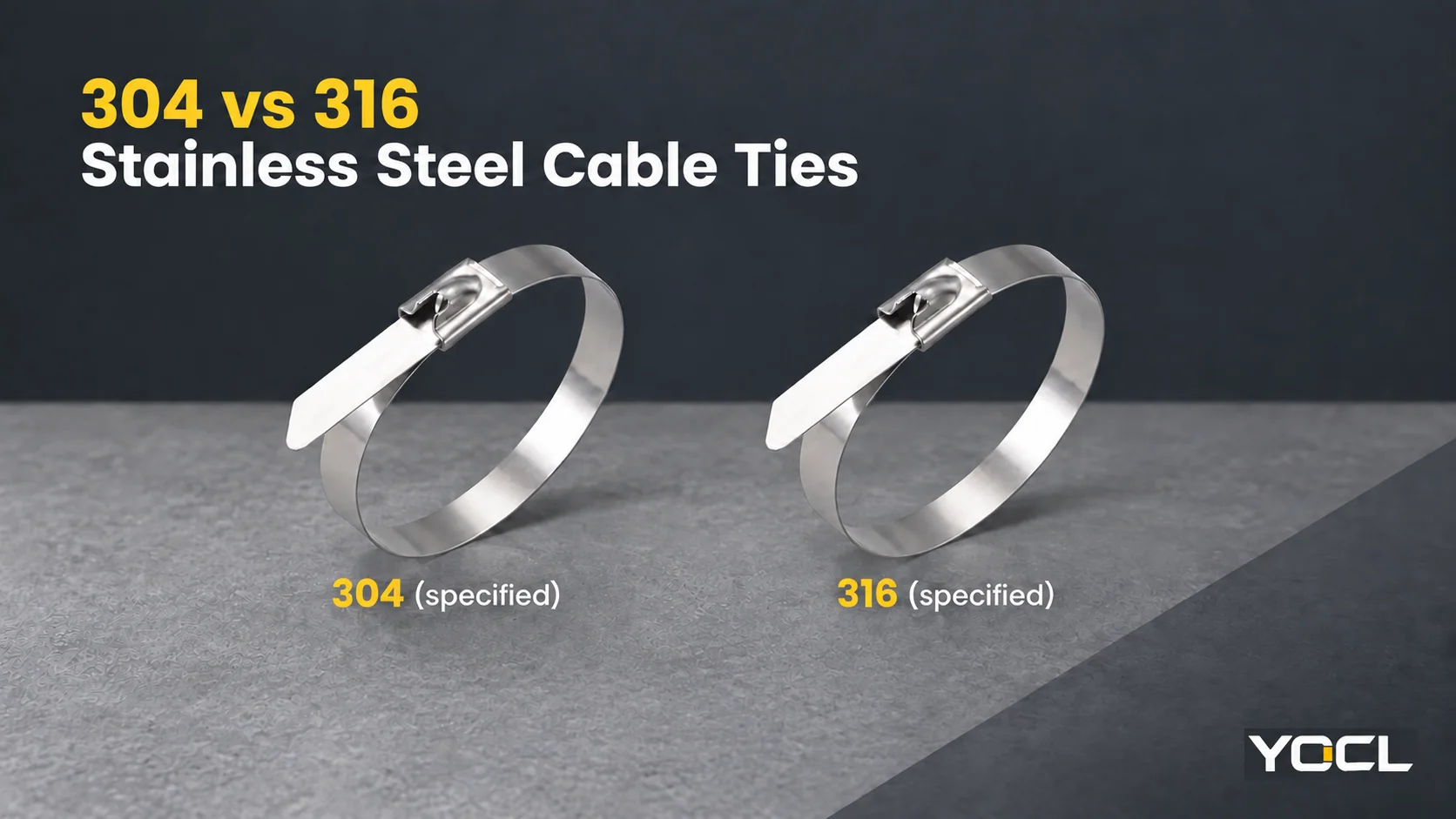
316 is the more corrosion-resistant candidate where chloride exposure makes 304 inadequate. Its molybdenum addition is the key reason to consider it, as described in the British Stainless Steel Association’s 316/L overview. A documented 304 tie can remain a candidate for mild service where its suitability is adequate. The decision starts with exposure at the installed band and locking head.
Choose the material candidate first, then verify the finished tie. A change from 304 to 316 does not establish a higher loop-strength rating, a different working-temperature range or permission to substitute one model for another.
Start With Exposure, Using the Same Tie Configuration
For a grade-only comparison, identify the same locking design, band dimensions and coating. Otherwise, a difference in the finished products may come from several changed variables.
| Defined service condition | 304 candidate | 316 candidate | Decision to make |
|---|---|---|---|
| Documented mild, low-chloride exposure; contact areas stay clean and dry | Retain for consideration where the exact product is suitable | May also qualify; a grade change needs a stated corrosion requirement | Check the exposure assumptions and complete-tie requirements before choosing |
| Chloride-bearing wetting, splash or deposits at the band and head | Requires evidence that 304 is adequate for that exposure | Prioritize for assessment because of its greater corrosion resistance | Review wetting, retained deposits, contact geometry and the supplied configuration |
| Direct seawater contact, especially with warmth, stagnation or sheltered wet areas | Do not treat as a suitable seawater choice | Requires a specific corrosion assessment | Neither grade label alone approves the assembly for service |
| Unidentified cleaning chemicals or liquid exposure | Selection is unresolved | Selection is unresolved | Identify the exposure before choosing between the grades |
This is a candidate-selection framework, not a test comparison of two YOCL models. Its seawater boundary follows BSSA’s seawater guidance: 304 should not be considered suitable for seawater service, while 316 also has limits.
Why the Contact Area Can Change the Grade Decision
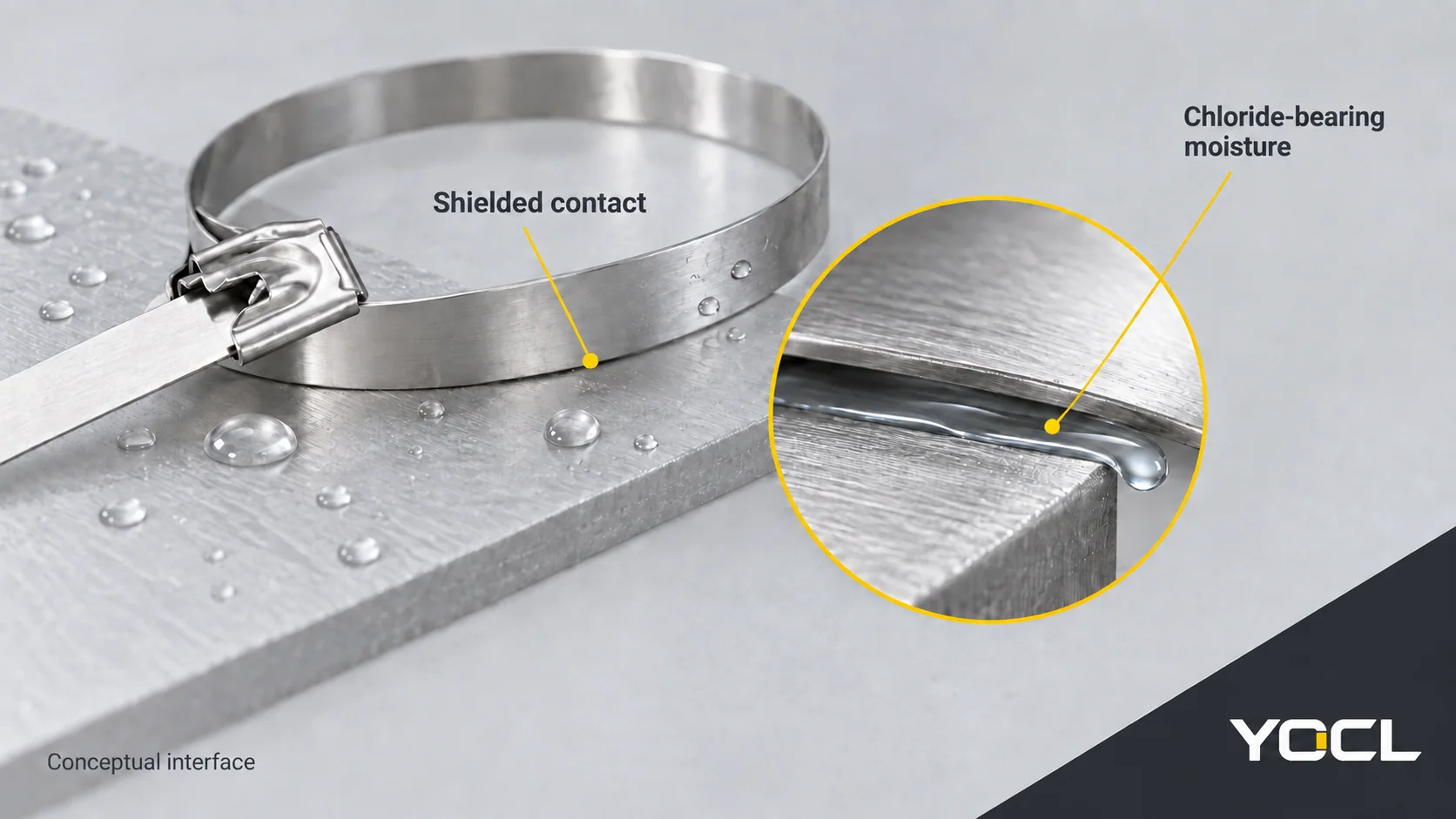
The exposed band is only part of the corrosion environment. Moisture and deposits can also sit beneath a band or beside a locking head, creating a sheltered contact area.
BSSA’s crevice-corrosion explanation describes local breakdown of stainless steel’s passive surface protection in crevices or beneath deposits. Stagnant conditions restrict oxygen replenishment; chloride-bearing liquid can become more aggressive within the crevice. The guidance identifies molybdenum as beneficial to resistance, but supplies no universal safe crevice dimension.
Apply that mechanism to the actual tie contact. A chloride-free, dry contact and a wet contact retaining salt-bearing deposits are different comparison cases. A product described as being “indoors” can still encounter cleaning liquid or condensation at the band. Record what reaches the tie and what remains there, rather than using the location label alone to decide the grade.
Where the 316 Advantage Stops
316 provides a reason to consider greater corrosion resistance when 304 is inadequate. It does not provide a service-life number for an installed tie. The BSSA overview discusses 316/L; that source is not evidence that a particular supplied tie is 316L.
For seawater, BSSA’s guidance describes 316’s susceptibility to pitting and crevice corrosion. Temperature, water conditions and fastening geometry affect suitability; evaporation can concentrate chlorides in damp splash areas. A coastal equipment description therefore needs more detail: occasional exposure on an accessible surface is a different case from retained salt-bearing moisture in a sheltered contact. Neither description creates an automatic approval.
Where the exposure is severe or poorly defined, pause the grade selection for a materials assessment. Replacing the label “304” with “316” does not resolve an unknown corrosive environment.
Can a 316 Tie Replace a 304 Tie?
A replacement is a finished-product decision. Use a shared comparison basis, then review the evidence for the proposed replacement.
| Field to compare | What to hold comparable or confirm | Why a grade change is insufficient |
|---|---|---|
| Material declaration | Stated grade and which metallic parts it covers: band, head and other locking parts as applicable | A family material list does not identify every component in the supplied tie |
| Lock and routing | Same documented locking construction and band route | Grade does not define retention geometry, tool compatibility or release/reuse capability |
| Band dimensions | Width, steel-core thickness and length | Changing geometry changes the comparison; a coated product’s overall thickness may include its surface layer |
| Finish | Same coating chemistry, coverage and supplied condition where a grade-only comparison is intended | A bare 304 tie and coated 316 tie differ in both alloy and contact surface |
| Strength evidence | Rating for the exact supplied configuration and applicable investigation | Grade alone does not establish the loop-strength result |
| Temperature and environment | Installation and operating requirements, plus relevant model evidence | The alloy name does not establish the finished tie’s service limits |
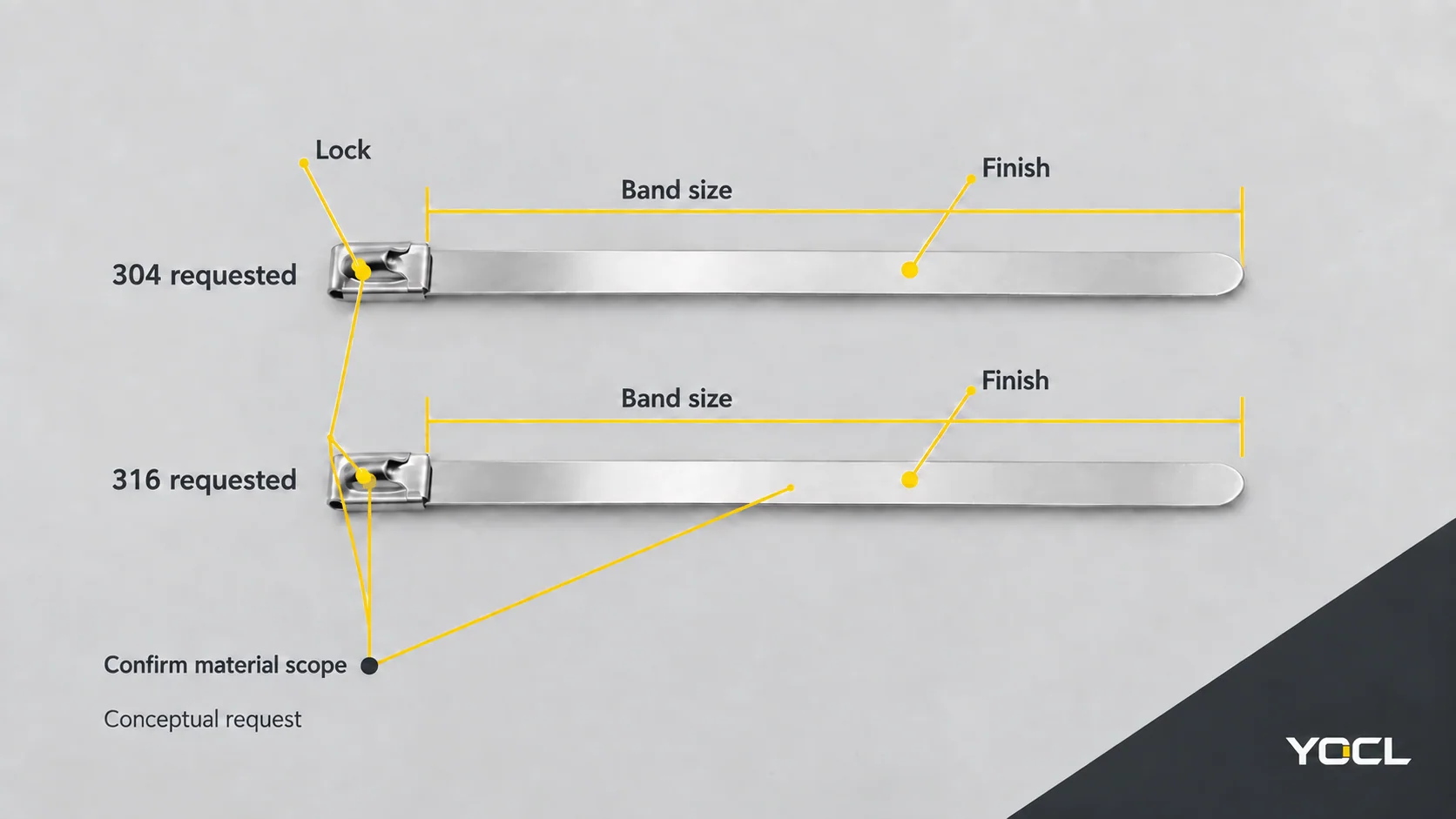
The material declaration should identify its scope clearly. Asking which parts it covers is a verification step; it is not a claim that YOCL uses different alloys for those parts. A photograph of two silver ties cannot replace that declaration.
The UL Solutions cable-tie application guide, updated July 2026, explains that loop tensile strength loads the strap and engaged lock together. It is not bulk alloy strength or a long-term static load-bearing rating. The guide also distinguishes installation temperature from operating temperatures. Check those fields for the proposed product; a 316 label cannot establish them or approve primary cable support.
What the YOCL BZ Catalogue Establishes
The YOCL BZ ball-lock catalogue lists 201, 304 and 316, along with band sizes, finishes and width-based strength declarations. It does not assign each steel grade to a separate order code or strength-test configuration.
For example, BZ, uncoated, 7.9 × 300 mm, 0.25 mm nominal band thickness can form a proposed comparison request for 304 and 316. These dimensions are listed in the catalogue. This is a shared basis to ask about, not proof that two grade-specific items have been supplied or independently tested.
Request confirmation of the offered material, declaration scope and configuration-specific values for each candidate. Do not treat the family table as evidence that both grades have identical performance, or that one is stronger. For recognition of the different locks and finishes, use the stainless steel cable tie overview.
Compare Quotations After Matching the Specification
Obtain actual quotations for the same construction, dimensions, finish, quantity and required documentation. If the quoted candidates differ in those fields, the price difference is not a grade-only comparison.
Assess any quoted difference against the corrosion requirement that led you to consider 316. An unsupported lifespan estimate cannot turn a higher purchase price into a verified lifecycle saving. Likewise, a lower-priced 304 offer is useful only where its documented suitability meets the service requirements.
Keep 304 as a candidate when its suitability for the defined exposure is adequate. Prioritize assessment of 316 where chloride-bearing conditions justify the added corrosion resistance. For direct seawater or unresolved aggressive exposure, obtain the corrosion assessment needed to select a material. In every case, accept the finished tie only after its supplied configuration and required ratings are confirmed. The YOCL stainless steel cable tie range is the next resource for identifying that configuration.
Related reading: See coating choice for stainless cable ties.
References
- British Stainless Steel Association — Stainless Steels to Behold: 316/L. Association material overview; molybdenum and qualitative corrosion resistance.
- British Stainless Steel Association — Selection of 316, 304 and 303 Types of Stainless Steels for Seawater Applications. Finite seawater suitability, localized corrosion and exposure conditions.
- British Stainless Steel Association — Principles and Prevention of Crevice Corrosion. Shielded contacts, passive-film breakdown and alloy-selection principles.
- UL Solutions — Positioning Devices: Cable Ties for Cable Management of Electrical Installations, Application Guide, updated July 2026. Finished-loop strength and temperature boundaries.
- YOCL — BZ Ball-Lock Stainless Steel Cable Ties. First-party catalogue: nominal dimensions, listed grades and unresolved grade-to-code/test mapping; accessed October 6, 2026.