
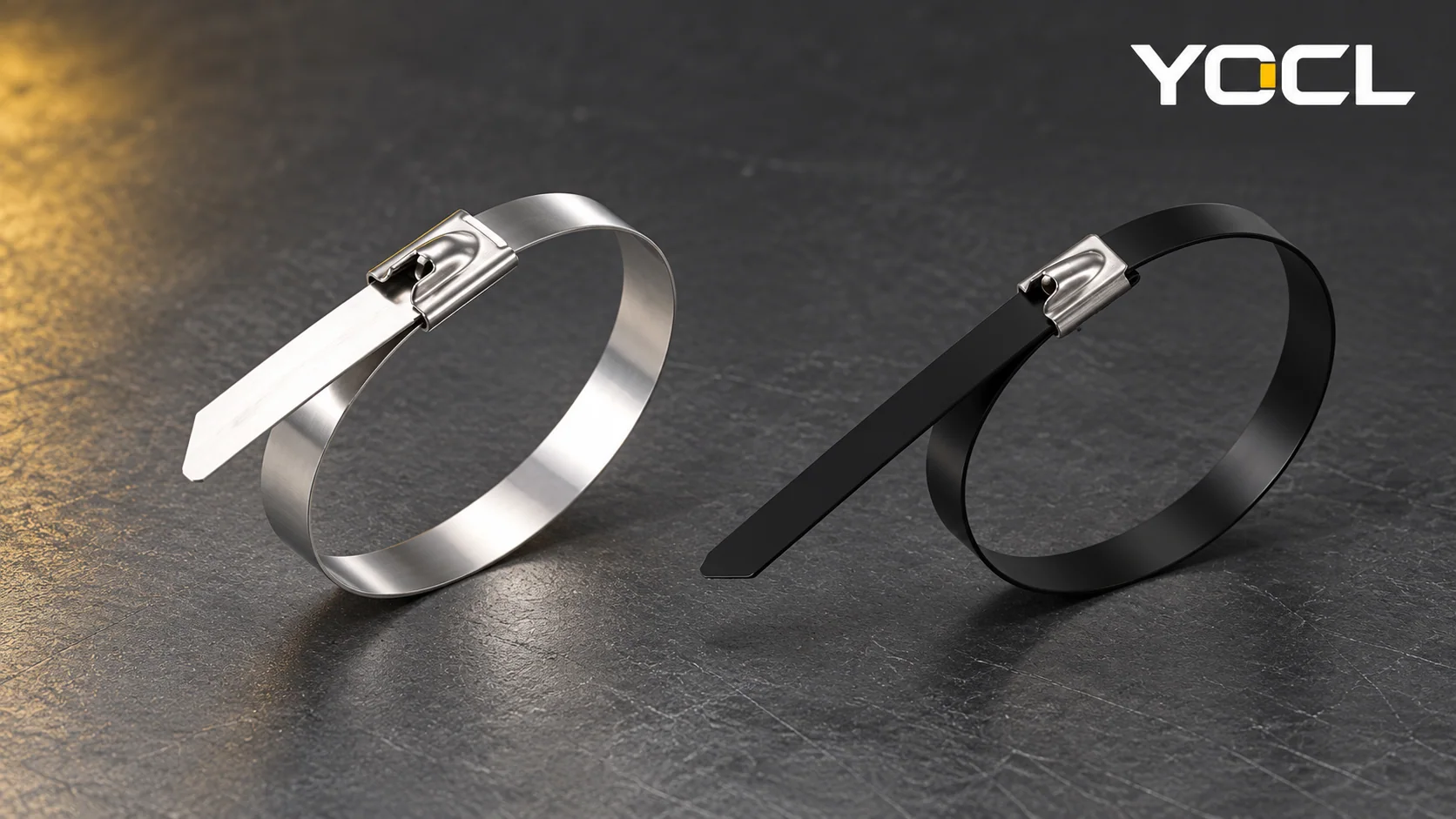
Consider coated stainless steel cable ties when a suitable covering is needed at the band’s contact surface. Consider uncoated ties when direct metal contact is acceptable and the selected steel tie meets the installation requirements. In either case, the exact tie must suit the environment, temperature and mechanical duty. A coating on the band does not necessarily cover the locking head, edges or cut end.
The practical choice starts with one question: what does the coating need to do in this installation? Protecting a contact surface, meeting an environmental requirement and providing electrical insulation are different tasks. Identify the task before comparing finishes.
For product-family background, see the stainless steel cable tie overview. This guide compares the two finishes for the same installation; it does not rank brands or claim that one finish always lasts longer.
Coated vs Uncoated: Which Should You Consider First?
| Your installation requirement | Starting choice | What decides whether it works? |
|---|---|---|
| A covering is required between the metal band and a cable jacket or finished surface | Consider a coated tie | The covering must suit the contact material and be present at the actual contact point, including after installation. |
| Direct metal contact is acceptable | Consider an uncoated tie | The exact steel grade, tie construction and documented ratings must meet the duty. Coating is unnecessary unless it addresses another requirement. |
| The head or cut end will touch a surface that must be separated from metal | A coated band alone does not resolve the requirement | Review the contact geometry and a documented protective arrangement; changing band finish may leave the problem unchanged. |
| Chemical exposure or temperature determines suitability | Screen exact products before choosing a finish | Exclude candidates whose documented limits do not cover the application. Review both coating and exposed metal on coated ties. |
| Electrical insulation is required | Neither finish is established as suitable by appearance alone | Require evidence for the intended insulation function and complete installed arrangement. |
| Both candidates satisfy all requirements | Either may be suitable | Compare verified dimensions, tooling, availability and quotations for those exact configurations. |
This is a selection framework, not comparative test data. It helps identify which requirement controls the choice and which candidate needs further evidence.
Check Where the Coating Actually Covers the Tie
“Coated” describes a construction feature, not a guarantee that every metal surface is covered. YOCL’s product descriptions provide three useful examples:
- The BZ uncoated ball-lock tie has an exposed metallic band.
- The BZB PVC-coated tie is described with a black PVC-coated band and a metallic locking head.
- The BZNP Nylon 11-coated tie is described as semi-coated, with a metallic line and an exposed metallic locking head.
These catalogue descriptions establish the illustrated construction differences, not independently tested protection or electrical-insulation performance.
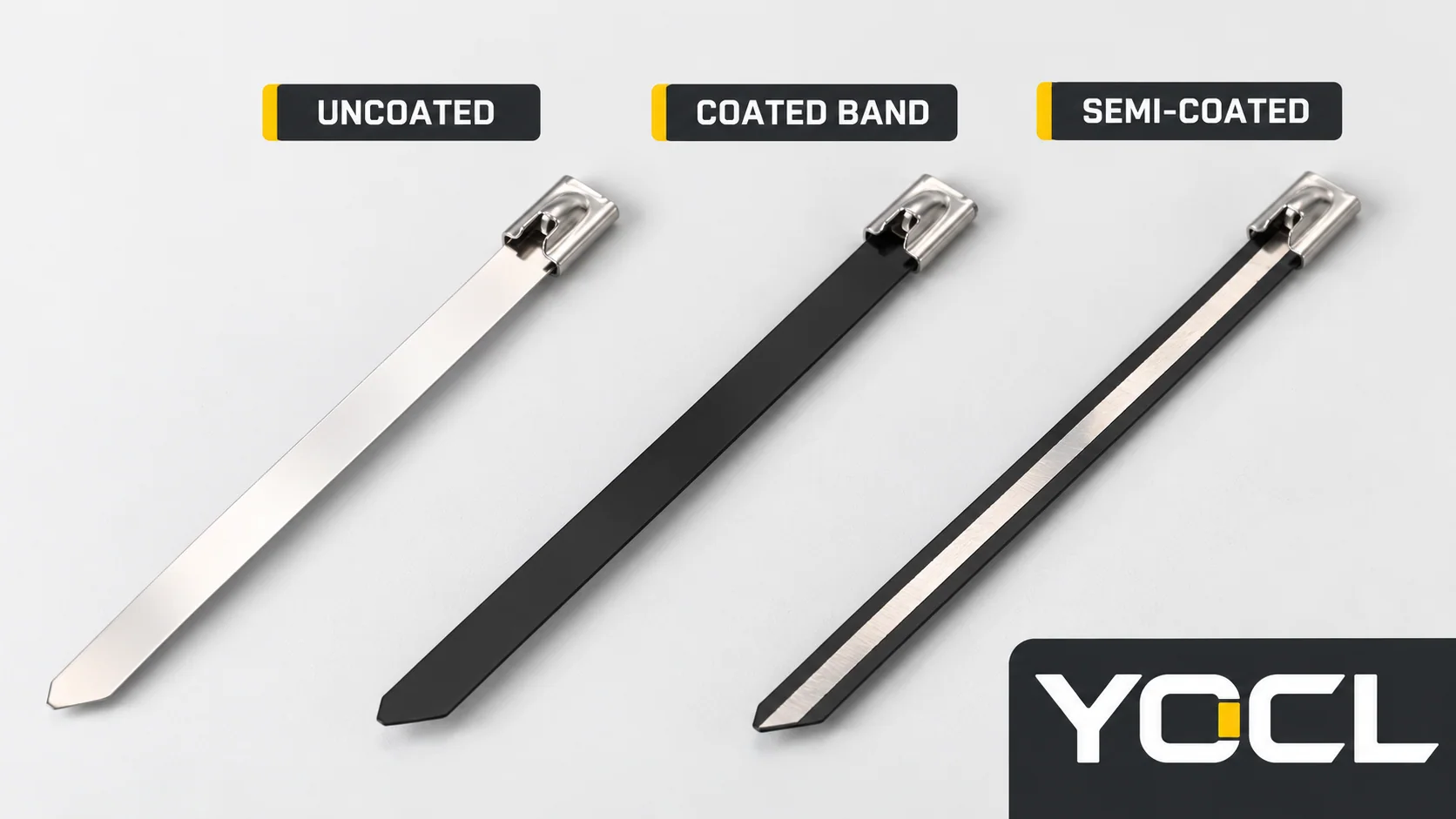
To use this distinction, mark where the band, locking head and trimmed end will contact the bundle or support. Then compare those locations with the specified coverage. If the required separation is at an exposed head, selecting a coated band does not address that location.
The next question is material suitability. A covered contact point is useful only when the covering is appropriate for that cable jacket, hose or finish under the intended duty. For a sensitive surface, request the contact-compatibility information for the actual combination—not simply confirmation that the tie is black or coated.
When Does a Coated Tie Address the Contact Problem?
Consider a coated candidate when the design calls for a barrier at the band-to-bundle interface and the documented covering can provide it. YOCL’s BZB and BZNP descriptions identify an additional barrier at band contact surfaces and edges. Whether that barrier meets a particular installation requirement still depends on the contact arrangement and product evidence.
For an uncoated candidate, establish whether the cable or equipment instructions permit the proposed direct metal contact. If they do, and the remaining requirements are satisfied, an uncoated tie remains a valid option. If they require separation, the bare band does not provide it by itself.
Use the installed arrangement for this assessment. A product photograph cannot show where your lock head will sit, what the trimmed end will touch, or whether movement will bring an exposed area into contact. Where those details defeat the required separation, revise the arrangement or consider a suitable protective component rather than treating a different finish as an automatic cure.
Let Environment and Temperature Eliminate Unsuitable Candidates
Compare both finishes against the same exposure: moisture, chemicals, sunlight and installation/service temperatures. For a coated tie, include the covering and exposed metal in that assessment; for an uncoated tie, assess the selected steel and complete construction.
The UL Solutions application guide treats environmental and temperature suitability as product/application considerations. Its evaluation context does not establish certification of a YOCL model.
Ask for evidence that matches the condition which matters. If a cleaning chemical is the concern, a general “corrosion-resistant” description does not answer the compatibility question. If temperature is the concern, obtain the exact product’s installation and operating limits. A candidate outside a documented limit should be excluded; missing limits leave that candidate unresolved rather than qualified.
Steel grade and coating are separate selection variables. A coating label does not identify the steel beneath it. Keep the grade constant when assessing the coating difference, or record the grade change as a separate difference. Use the 304 vs 316 stainless steel cable tie comparison when grade selection is the main question.
No universal PVC, Nylon 11 or bare-steel temperature range is assigned here: a material name alone does not establish the complete tie’s usable range.
Do Not Use Coating as a Shortcut for Strength or Support
Compare the actual band dimensions, lock and reported test basis. If a coated and uncoated candidate differ in width, thickness or locking construction, any reported strength difference cannot be attributed to coating alone.
UL’s guide distinguishes cable-tie loop tensile strength from fixing-device mechanical strength and states that a loop-strength rating does not establish long-term static load-bearing capability. The IEC 62275:2022 public abstract also notes that additional requirements can apply when ties and fixing devices support wiring systems.
Therefore, decide whether the tie is bundling cables, securing their position or providing required support before accepting a strength figure. Obtain the evidence for that duty; neither finish turns a bundling specification into a support approval.
Tooling belongs in the comparison too. Confirm that each candidate can be installed using its specified tool and process while retaining the contact arrangement you selected. The stainless steel tie tensioning and cutting guide covers that separate installation task.
Compare Quotations Against One Shared Requirement
A useful enquiry lets the supplier answer the deciding question. Specify:
- Contact: bundle/support material, points that must be separated from metal, and the intended head/end position. Include a drawing or photograph where helpful.
- Exposure: chemicals, moisture, sunlight, installation temperature and service conditions.
- Mechanical duty: bundling, securing or required support, together with the applicable project requirements.
- Candidate configuration: model, steel grade, width, length, listed thickness, lock, coating material and coverage.
- Installation and procurement: intended tooling, quantity and required delivery date; request documents for the quoted configuration.
For example, asking whether a specified covering reaches a marked contact point is more actionable than asking for a “better coated tie.” This is an illustrative enquiry approach, not a reported customer case.
Choose a coated candidate when its documented covering solves the identified requirement and the complete tie passes the remaining checks. Choose an uncoated candidate when direct metal contact is acceptable and it passes those checks. If both qualify, compare the actual quotations and installation requirements. If neither qualifies, change the candidate or securing arrangement.
Use the YOCL stainless steel cable tie range to identify candidates, and send the shared requirements when requesting configuration-specific documents and a quotation.
Related reading: See adhesive versus screw-mounted tie-base comparison.
References
- YOCL ELECTRIC, BZ Ball-Lock Stainless Steel Cable Ties, product information, reviewed November 4, 2026—uncoated construction example.
- YOCL ELECTRIC, BZB PVC-Coated Stainless Steel Cable Ties, product information, reviewed November 4, 2026—coating material, contact barrier and exposed locking head.
- YOCL ELECTRIC, BZNP Nylon 11-Coated Stainless Steel Cable Ties, product information, reviewed November 4, 2026—semi-coated construction and contact barrier.
- UL Solutions, Positioning Devices: Cable Ties for Cable Management of Electrical Installations — Application Guide, linked guide—temperature/environment considerations, loop strength and support distinctions.
- International Electrotechnical Commission, IEC 62275:2022, Cable Management Systems — Cable Ties for Electrical Installations, public abstract—scope and additional requirements for support applications; full standard not consulted.