
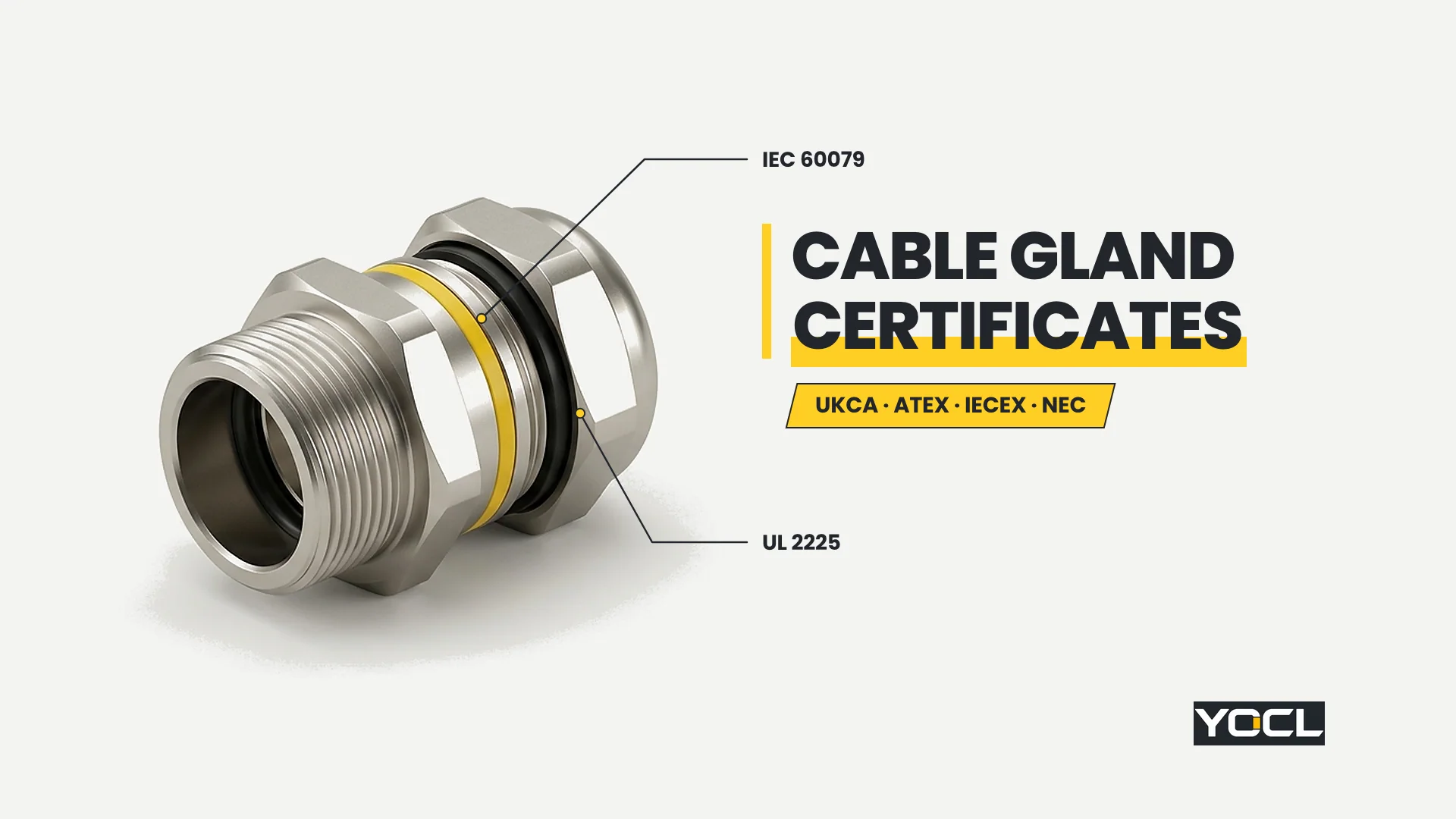
Hazardous-area cable gland certificates UKCA, ATEX, IECEx, and NEC (UL 2225) are not interchangeable across borders even when the brass body and internal seal geometry are identical. Legal market access depends on which jurisdiction enforces the site: Great Britain governs Ex fittings under UK SI 2016/1107, the European Union mandates ATEX Directive 2014/34/EU, international projects rely on the voluntary IECEx 02 scheme, and United States sites require an OSHA-recognized NRTL listing under NEC Articles 500–506.
Specifying an Ex d or Ex e cable gland by product name alone leads directly to failed site inspections, customs holds, or forced panel rework. An EU ATEX certificate without an active manufacturing audit (QAN) cannot legally place new stock on the European market, an IECEx Certificate of Conformity alone does not satisfy a US Authority Having Jurisdiction (AHJ) inspecting a Class I Division 1 enclosure, and ignoring an X suffix on a certificate can void the flameproof barrier rating the moment the cable is clamped.
Cable Gland Certificates UKCA, ATEX, IECEx and NEC: Market-by-Market Matrix
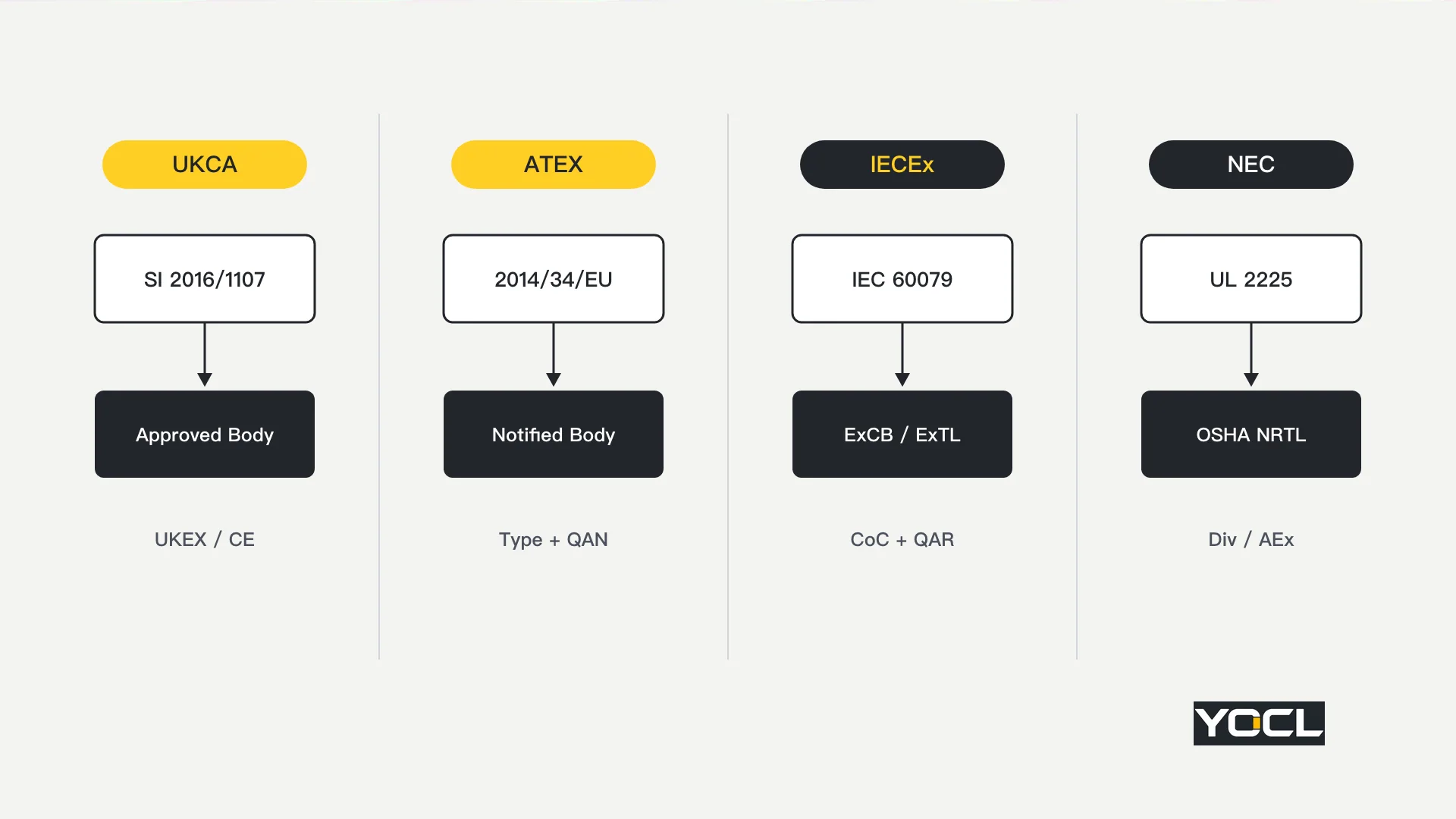
Each hazardous-location market ties cable gland compliance to a specific legal instrument, an accredited certification body, and a paired document chain covering both product design and ongoing factory quality control. Treating these four regimes as equivalent labels is the single most common procurement error on export skids and international EPC packages.
| Target Market | Governing Law or Scheme | Certifying Authority | Mandatory Document Pair | Required Body Marking | Cross-Acceptance Trap |
|---|---|---|---|---|---|
| Great Britain (England, Scotland, Wales) | UK SI 2016 No. 1107 (UKEX) + GB CE recognition rules | UK Approved Body (or EU Notified Body under GB CE recognition) | UK-Type Examination Certificate + UK QAN (or valid EU ATEX file) + DoC | UKCA + UKEX code (or CE + Ex hexagon under GB recognition) | Northern Ireland does not accept standalone UKCA; NI requires CE or CE + UKNI |
| European Union & EEA | ATEX Directive 2014/34/EU | EU Notified Body (4-digit NB ID) | EU Type Examination Certificate + active ATEX QAN + EU DoC | CE + 4-digit NB ID + Ex hexagon + Group/Category | Standalone IECEx CoC does not legally authorize placing goods on the EU market |
| International / Offshore / ANZ / Middle East | IECEx 02 Certified Equipment Scheme | IECEx Certification Body (ExCB) & Test Lab (ExTL) | IECEx CoC + ExTR (Test Report) + active QAR | IECEx certificate number + IEC 60079 Ex marking | Voluntary international scheme; local law in EU or US still overrides IECEx alone |
| United States (Hazardous Locations) | NFPA 70 (NEC) Articles 500–506; UL 2225 | OSHA-recognized NRTL (e.g., UL, CSA, Intertek) | Active NRTL Listing / Certificate of Compliance + Control Drawing | NRTL mark + Class/Division or AEx Zone rating | ATEX and IECEx certificates alone fail NEC inspection without an NRTL listing |
Before issuing a purchase order for an export panel or skid, lock the destination jurisdiction first and require the exact market-matched certificate pair—never accept an ATEX PDF as proof of US NEC compliance or an IECEx CoC as a legal substitute for EU CE marking.
EU ATEX (2014/34/EU) vs UKCA / UKEX (SI 2016/1107): Great Britain vs Northern Ireland
EU ATEX Directive 2014/34/EU and Great Britain UK SI 2016 No. 1107 share the same technical safety baseline—EN IEC 60079-0 for general requirements, EN IEC 60079-1 for flameproof Ex d, EN IEC 60079-7 for increased safety Ex e, and EN IEC 60079-31 for dust Ex t—but diverge in legal jurisdiction and conformity markings.
Buyers shipping into the United Kingdom must separate two distinct legal territories on the same packing list:
- Great Britain (England, Scotland, Wales): Regulated under UK SI 2016/1107. Products assessed by a UK Approved Body carry a UK-Type Examination Certificate (commonly referred to as UKEX) and the UKCA mark. Under UK government indefinite CE recognition measures aligned with EU product safety frameworks, compliant CE-marked ATEX cable glands backed by valid EU Notified Body files also retain an accepted market route in Great Britain—though end-user project specifications in oil, gas, and utilities may still contractually request UKCA/UKEX paperwork.
- Northern Ireland: Continues to operate under the Windsor Framework aligned with EU ATEX Directive 2014/34/EU. Cable glands placed on the Northern Ireland market require CE marking (via an EU Notified Body) or CE + UKNI marking (when assessed by a UK body for the NI market); standalone UKCA marking is not valid in Northern Ireland.
In both the EU and UK, third-party Type Examination is mandatory for Category 1 and Category 2 (Zone 0/1/20/21) cable glands—including virtually all Ex db flameproof and Ex eb increased-safety cable glands—and must be accompanied by the manufacturer Declaration of Conformity (DoC) citing the exact product series and standard editions.
IECEx Certified Equipment Scheme: CoC, ExTR and QAR Explained
The IECEx 02 Certified Equipment Scheme is an international conformity system administered by the International Electrotechnical Commission to eliminate redundant hazardous-area testing across participating countries such as Australia, New Zealand, Singapore, Middle East oil and gas operators, and global offshore projects. Unlike ATEX, which is a regional European law, IECEx is a standardized global certificate system built on three publicly traceable records:
- Certificate of Conformity (CoC): The headline electronic certificate issued by an IECEx Certification Body (ExCB), published live in the official IECEx online database so any buyer or inspector can verify its status (Current, Suspended, or Cancelled) by certificate number in seconds.
- IECEx Test Report (ExTR): The underlying laboratory evidence issued by an accepted IECEx Testing Laboratory (ExTL) documenting impact, thermal endurance, clamping pull-out, explosion pressure, and ingress protection tests under the IEC 60079 series.
- Quality Assessment Report (QAR): The ongoing factory surveillance audit confirming that the manufacturing plant maintains a hazardous-location quality management system compliant with ISO/IEC 80079-34.
Because IECEx CoCs are publicly searchable online, many EPC buyers use an active IECEx number as their fastest technical sanity check—yet an IECEx CoC alone does not confer legal CE marking inside the EU or replace OSHA NRTL listing on a United States jobsite.
North American NEC (Articles 500–506) and UL 2225: Why ATEX/IECEx Alone Fails Inspection
In the United States, hazardous-location cable fittings are governed by NFPA 70 (the National Electrical Code, NEC) and evaluated primarily to UL 2225 (Cables and Cable-Fittings for Use in Hazardous (Classified) Locations) by an OSHA-recognized Nationally Recognized Testing Laboratory (NRTL) such as UL, CSA, or Intertek. Submitting an ATEX or IECEx certificate without an NRTL listing mark routinely triggers an immediate red-tag rejection from the local Authority Having Jurisdiction (AHJ).
North American approvals also introduce two physical engineering differences that catch European panel builders off guard:
- Class/Division (Articles 500–503) vs Zone (AEx, Articles 505–506): Traditional US industrial plants classify hazardous areas by Class (I gas, II dust, III fibers) and Division (1 continuous/intermittent, 2 abnormal), whereas NEC Articles 505 and 506 adopt the Zone framework using AEx markings (AEx db, AEx eb). A gland listed only for Class I Division 2 cannot be installed in a Class I Division 1 flameproof entry.
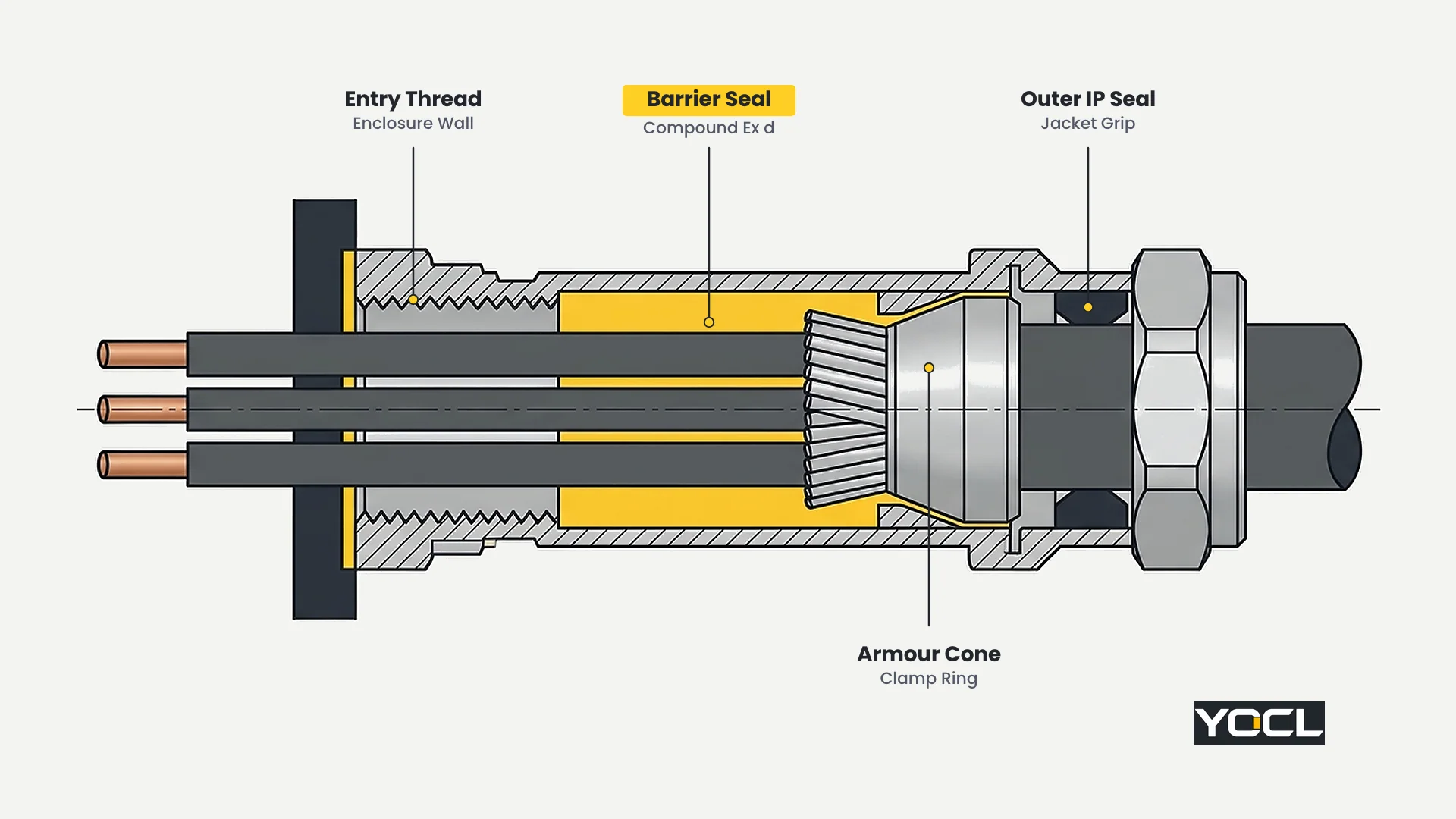
- Barrier sealing and thread engagement divergence: In Class I Division 1 installations using armored or tray cables (such as MC-HL or TC-ER-HL), NEC Article 501 and UL 2225 frequently require compound-filled barrier glands to block gas migration through cable interstices, paired with tapered NPT entry threads meeting minimum engaged-thread rules. By contrast, IEC 60079-14 allows non-barrier Ex d displacement-seal glands in Zone 1/2 only when specific cable-construction, length, and enclosure-volume criteria are met.
For entry thread geometry differences between parallel Metric threads and tapered NPT threads, see Metric vs PG vs NPT cable gland threads. For how IP66/IP68 ingress testing interacts with hazardous-area enclosure seals, see cable gland IP ratings explained.
The Two-Document Trap: QAN/QAR Validity and Certificate Suffixes (X vs U)
Even when a supplier emails a genuine Type Examination Certificate or IECEx CoC, two hidden documentation traps routinely invalidate the installation at commissioning: an expired factory quality audit and an unread certificate suffix.
- Trap 1 — Type Certificate without an active QAN or QAR: An EU Type Examination Certificate (ATEX) or IECEx CoC proves only that the laboratory prototype passed design testing. To legally manufacture and ship compliant Ex cable glands today, the factory must simultaneously hold a current ATEX Quality Assessment Notification (QAN) or current IECEx Quality Assessment Report (QAR) audited to ISO/IEC 80079-34. If the QAN/QAR has lapsed or been suspended, newly manufactured glands cannot legally carry the Ex mark.
- Trap 2 — Ignoring the X vs U certificate suffix:
- Suffix X (Specific Conditions of Use): Signals mandatory installation constraints written inside the certificate schedule—for example, restricting an unarmoured Ex cable gland to fixed installations with additional external clamping, limiting service temperature to a specific elastomeric seal range, or mandating a specific sealing washer to maintain IP66/IP68 on thin enclosure walls.
- Suffix U (Component Certificate): Identifies an incomplete Ex component that cannot be placed into hazardous-area service as standalone equipment; it must be incorporated into a separately certified Ex enclosure assembly whose final equipment certificate evaluates the combined thermal and flameproof boundary.
Pre-Order and Incoming Certificate Verification Checklist for Buyers
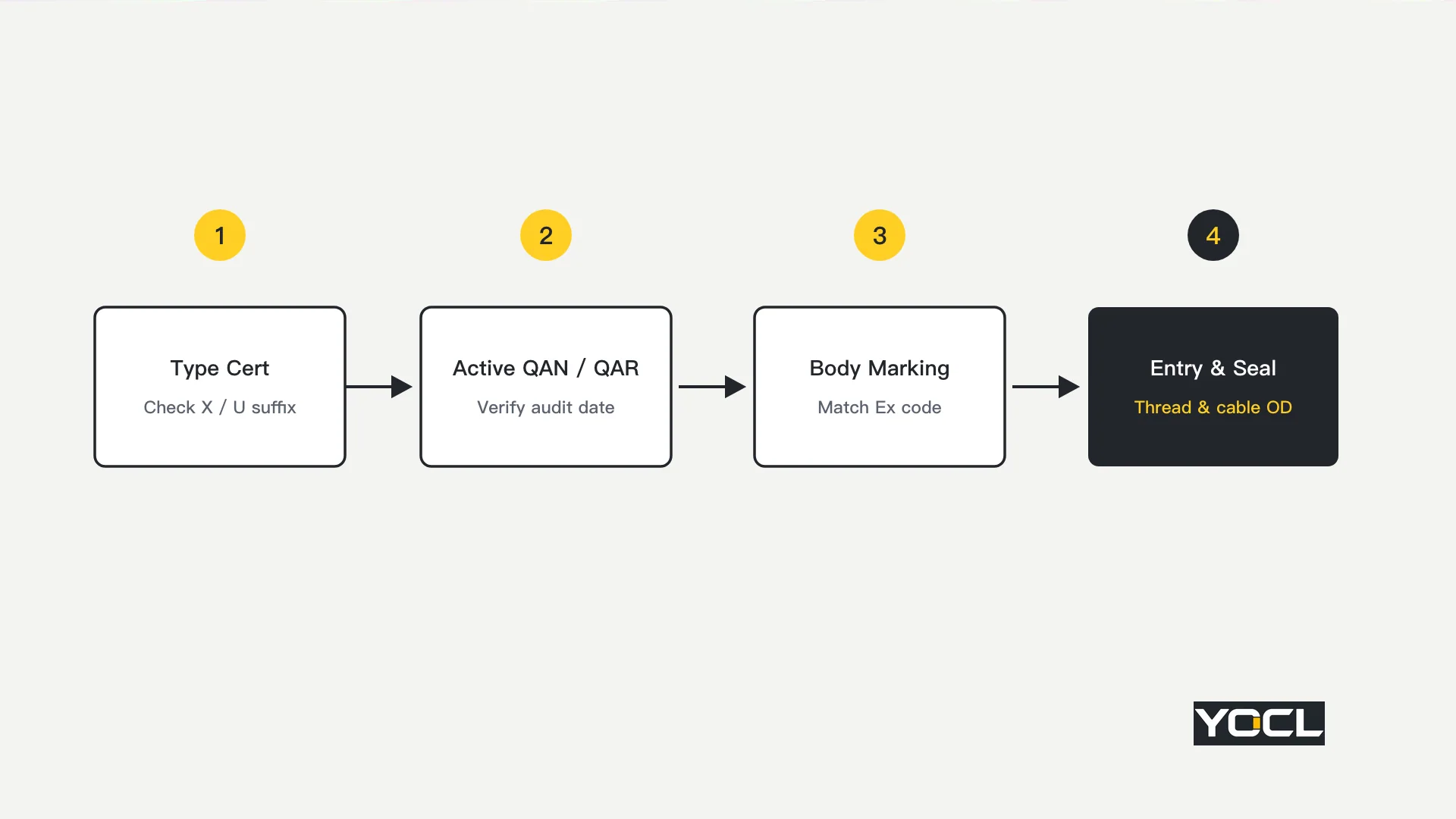
Treating hazardous-area compliance as a structured incoming inspection prevents mismatched shipments before cables are stripped and glands are torqued into enclosures. Check all six items below against both the PDF paperwork and the laser-etched or stamped marking on the physical gland body:
| Verification Point | What to Inspect on Paperwork | What to Match on Physical Gland Body | Reject / Hold Condition |
|---|---|---|---|
| 1. Certificate number & suffix | Exact ATEX, UKEX, IECEx, or NRTL file number including any X or U suffix | Laser-etched or stamped certificate reference matching the delivered model code | Missing suffix X conditions sheet, or U component supplied where an equipment cert is required |
| 2. Certifying body ID / mark | 4-digit EU Notified Body / UK Approved Body ID, ExCB name, or OSHA NRTL listing | Matching 4-digit ID beside CE/UKCA mark, or matching NRTL mark | Unverified body number, or ATEX/IECEx supplied for a US NEC site requiring NRTL |
| 3. Protection concept | Exact concept (Ex db, Ex eb, Ex tb, AEx db, or Class/Div) matching enclosure | Identical protection concept marked on the hex body | Ex e gland installed into an Ex d flameproof enclosure entry |
| 4. Gas / dust group & zone | Group IIC / IIB (gas), Group IIIC (dust), EPL Gb/Db, or Class I/II Div 1/2 | Matching gas/dust group and EPL on body and box label | Group IIB gland installed in a Group IIC hydrogen/acetylene zone |
| 5. Service temperature & IP rating | Certified seal elastomer temperature window (e.g., -40 °C to +100 °C) and IP66/IP68 | Model code and seal material match certificate schedule | Missing thread sealing washer or wrong cable OD clamping range |
| 6. Active QAN / QAR & DoC | Current QAN/QAR expiry date covering the manufacturing date + signed DoC | Batch or date code traceable to valid surveillance audit period | Expired QAN/QAR or missing manufacturer Declaration of Conformity |
Hold incoming stock at QC receiving if any single gate fails—especially a lapsed QAN/QAR date, an unread X condition, or a protection-concept mismatch between an Ex e gland and an Ex d flameproof enclosure.
For general non-hazardous gland sizing and material selection, see how to choose a cable gland, and for troubleshooting ingress failure after installation, see why is my cable gland leaking. When sourcing hazardous-area or armoured entries from YOCL ELECTRIC—such as explosion-proof cable glands, armoured cable glands, or specific series like BDM-17 single-compression armored Ex d cable glands, BDM-3 barrier armored cable glands, and BDM-1 Ex e unarmoured cable glands—always specify your target market (GB, EU, IECEx, or US NEC), cable construction, and entry thread so exact model-level certificates and installation conditions are verified before order confirmation.
Frequently Asked Questions
Does an IECEx certificate automatically allow selling or installing a cable gland in the EU?
No, an IECEx Certificate of Conformity is a voluntary international scheme and does not legally replace EU ATEX Directive 2014/34/EU compliance. To place a hazardous-area cable gland on the European Union market, the manufacturer must hold an EU Type Examination Certificate (where required), an active ATEX QAN, an EU Declaration of Conformity, and apply CE plus Ex marking.
Can an ATEX or IECEx cable gland be used in a US NEC Class I Division 1 area?
No, an ATEX or IECEx certificate alone does not satisfy United States OSHA and NEC Article 500–506 inspection requirements. Hazardous-location cable glands installed in the United States require an active listing from an OSHA-recognized NRTL—typically evaluated to UL 2225—matching the site Class/Division or AEx Zone classification and barrier-sealing rules.
What is the difference between an ATEX QAN and an IECEx QAR?
Both documents verify that the cable gland factory operates an audited hazardous-location quality management system aligned with ISO/IEC 80079-34. A QAN (Quality Assessment Notification) is issued by an EU Notified Body (or UK Approved Body for UKEX) to maintain ATEX/UKEX production approval, whereas a QAR (Quality Assessment Report) is issued by an ExCB under the international IECEx scheme.
What does the letter X at the end of an ATEX or IECEx cable gland certificate number mean?
The suffix X indicates Specific Conditions of Use listed inside the certificate schedule. For cable glands, X conditions commonly restrict unarmoured glands to fixed installations requiring additional external cable clamping, define exact elastomeric service temperature limits, or mandate specific entry sealing washers to preserve enclosure ingress protection.
References
- EU Directive 2014/34/EU (ATEX) — Equipment and protective systems intended for use in potentially explosive atmospheres (Official Journal of the European Union).
- UK SI 2016 No. 1107 — The Equipment and Protective Systems Intended for Use in Potentially Explosive Atmospheres Regulations 2016 (UK Legislation).
- IECEx Certified Equipment Scheme (IECEx 02) — International Electrotechnical Commission System for Certification to Standards Relating to Equipment for Use in Explosive Atmospheres (IECEx).
- OSHA Nationally Recognized Testing Laboratory (NRTL) Program & UL 2225 Scope — US Occupational Safety and Health Administration and NFPA 70 (NEC) Articles 500–506.
- YOCL ELECTRIC — Explosion-Proof Cable Glands Manufacturer
- YOCL ELECTRIC — How to Choose a Cable Gland
- YOCL ELECTRIC — Cable Gland IP Ratings Explained: IP65 vs IP66 vs IP68 (and IP69K)
- YOCL ELECTRIC — Metric vs PG vs NPT Cable Gland Threads
- YOCL ELECTRIC — Why Is My Cable Gland Leaking? A Seal-by-Seal Checklist