
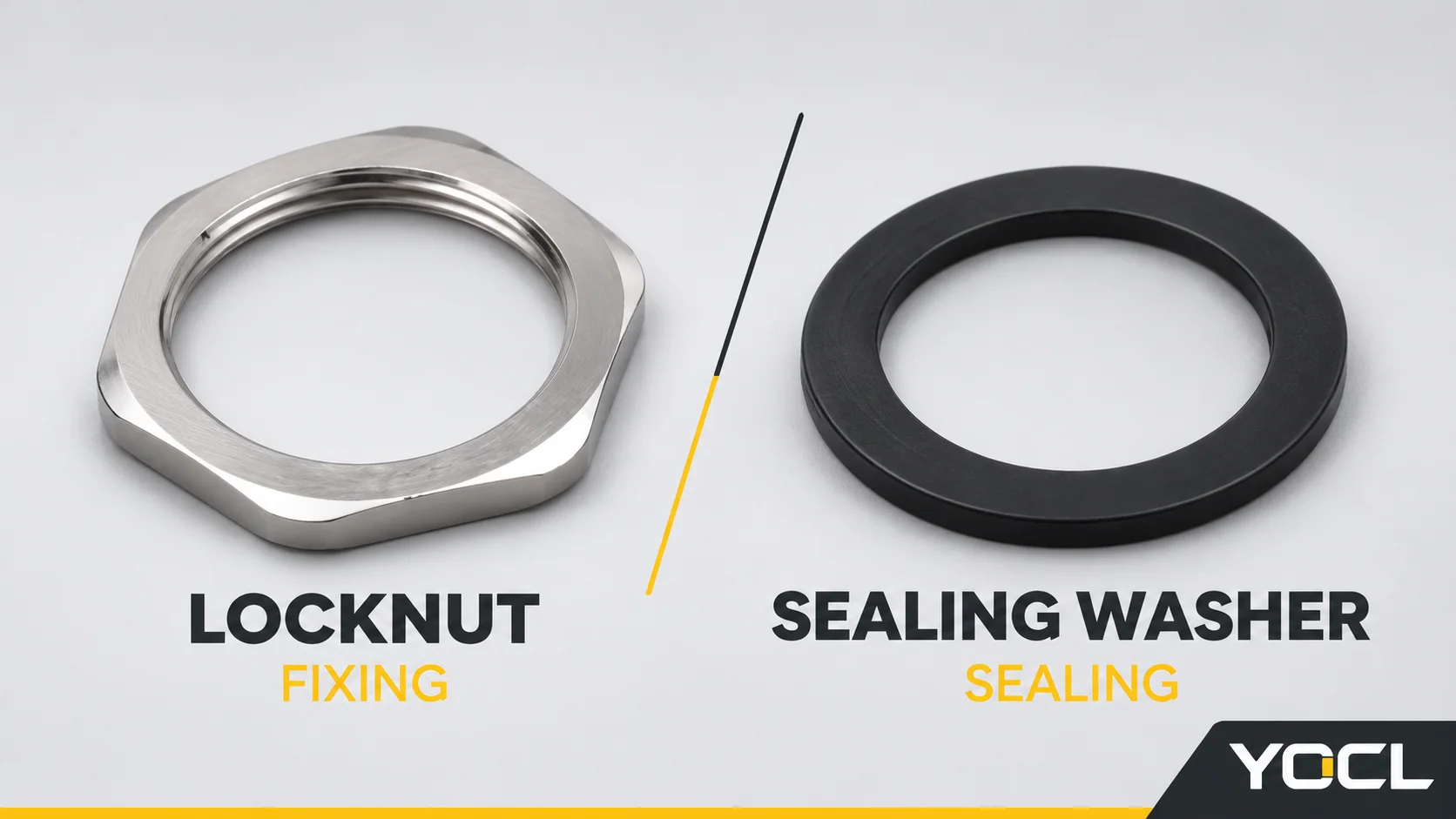
A cable gland locknut secures the fitting at the enclosure opening; a sealing washer seals the mounting interface for which it is designed. They solve different problems. A clearance-hole mounting may need both. A suitable threaded entry may provide fixing without a separate locknut, while still requiring the specified entry-sealing arrangement.
Do not replace one with the other. A tight locknut is not evidence of a watertight joint, and a sealing washer cannot provide the missing threaded fixing. The decision starts with the gland drawing and enclosure entry, rather than with a bag of accessories bearing the same nominal size.
Compare the functions at the same enclosure entry
| Question | Locknut | Sealing washer |
|---|---|---|
| What is its primary job? | Mechanically retain a compatible threaded fitting at the mounting opening | Seal the intended joint between mating surfaces |
| What makes it work? | Matching thread and a suitable bearing/fixing arrangement | The specified seal geometry, material, seating surfaces and compression |
| What must match? | Thread system, size and pitch; available thread and tool space | Gland/seal interface, opening, contact footprint and service conditions |
| Does it replace the other part? | No: fixing does not establish sealing | No: a seal does not establish mechanical retention |
| What does a nominal size leave unresolved? | Pitch, actual engagement and installation requirements | Inner/outer fit, section, material and the supported sealing arrangement |
| Does its presence establish the finished entry’s IP rating? | No | No |
YOCL describes its VO-ML standard locknuts as fixing accessories for threaded electrical fittings. Its divided-structure metric nylon gland identifies a separate locknut and washer. These are first-party product descriptions; they do not establish that any loose nut and washer form an approved kit.
For the larger product map, use the cable gland overview. The comparison here concerns the mounting-side accessories, rather than the gland’s full cable-selection task.
Identify which nut and which seal the drawing means
“Nut” and “seal” can refer to more than one part of a gland. Confusing the cable-side compression components with the mounting-side parts creates a misleading parts list.
The original YOCL divided-structure nylon drawing identifies:
- A — Lock Nut: the separate mounting locknut.
- B — Washer: the separate washer associated with the mounting interface.
- C — Body: the fitting body with its mounting thread.
- D — Seal: the cable-side sealing component.
- E — Claw: the cable clamping component.
- F — Sealing Nut: the cable-side nut acting on the gland’s internal arrangement.
The same product page lists the locknut, body, claw and sealing nut as PA66, and the washer and seal as NBR. That material list helps distinguish components; it does not make the two NBR parts interchangeable. Their shapes, locations and mating features remain different.
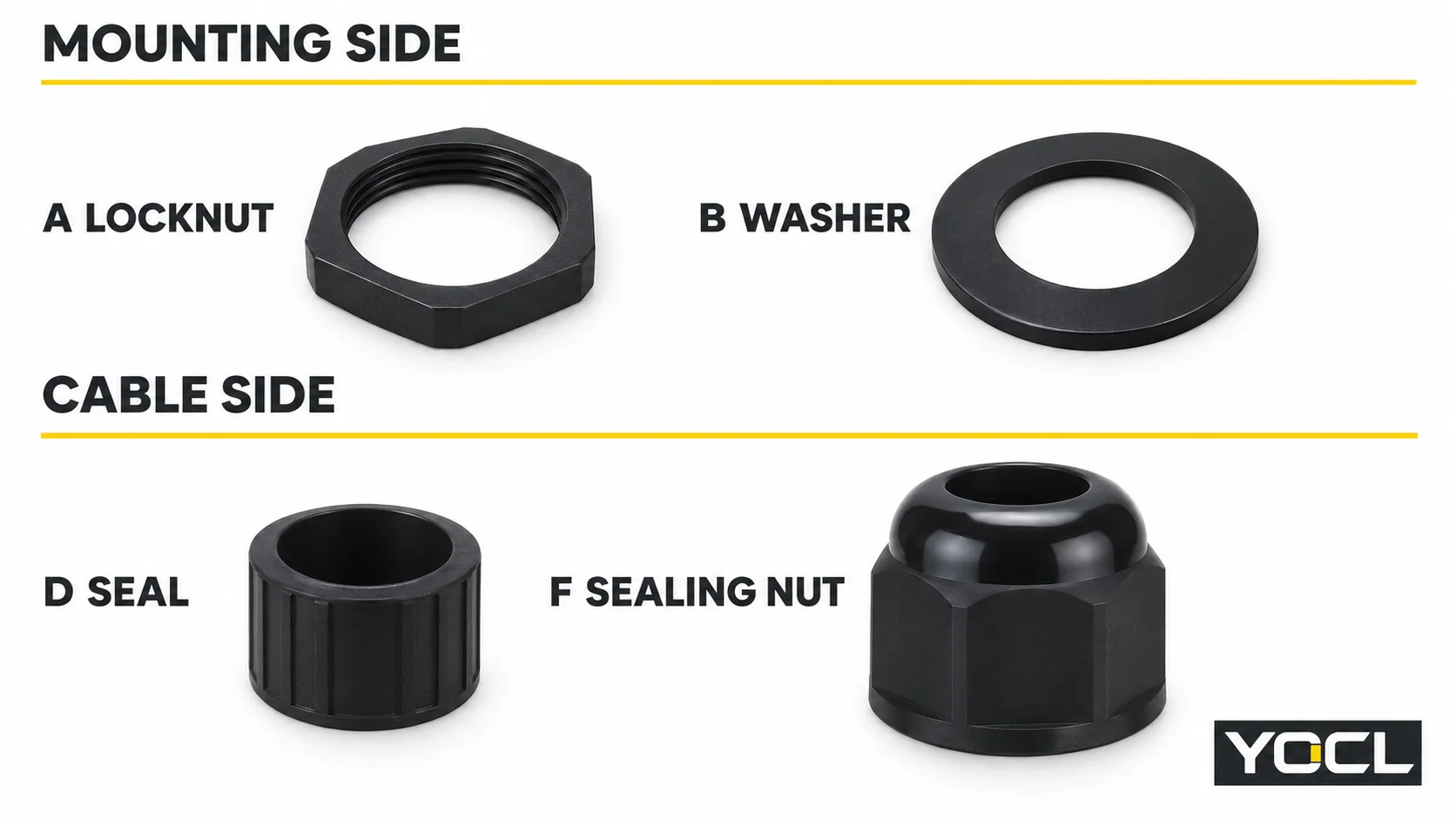
Tightening the cable-side sealing nut does not establish that the gland-to-enclosure interface is sealed. Likewise, fitting the mounting locknut does not confirm the cable’s retention or its seal. Keep the cable interface and the mounting interface as separate acceptance checks.
When do you need a locknut, a washer or both?
Use the same gland and enclosure requirements for each comparison. The opening’s construction changes how fixing is achieved; the sealing method must still be established for that construction.
| Entry arrangement | Fixing question | Sealing question | Decision boundary |
|---|---|---|---|
| Unthreaded clearance hole | What retains the threaded gland through the panel? | What specified seal closes the gland-to-panel joint? | Both a locknut and an entry seal may be required; verify the actual parts and drawing |
| Compatible tapped entry | Does the entry provide the required thread engagement and fixing? | What sealing arrangement is specified for this thread and gland? | A separate locknut may be unnecessary; entry sealing remains a separate requirement |
| Gland with a supplied or retained entry seal | How is the gland fixed in the chosen opening? | Is the supplied seal intended for this mounting arrangement? | Retain the documented configuration rather than automatically adding another washer |
| Entry incorporating an adapter or reducer | How are both threaded interfaces secured? | How is each new interface sealed? | A washer at one joint does not establish the other joint’s performance |
These are layout decisions, not universal assembly instructions. Obtain the manufacturer’s arrangement for seal position, mounting surfaces and tightening. A catalogue exploded view without an enclosure wall does not determine which side of every possible panel receives each accessory.
A sealing washer and an O-ring are also not automatic substitutes. A washer generally presents an annular face-sealing form; an O-ring has its own section and seating requirements. Use the actual gland drawing to identify the supplied part. Do not stack an extra flat washer over an existing seal merely because both fit over the thread: the changed stack must be assessed as a different arrangement.
Check four interfaces before ordering accessories
1. The locknut thread must match the fitting
Record the thread system, nominal size and pitch where applicable. Matching a printed number does not establish matching threads. Use the metric, PG and NPT thread comparison when identifying the system; then verify the actual parts against their drawings.
For a concrete catalogue example, the nylon gland VO-NLM20B-DS is listed as M20 × 1.5, with a 10 mm mounting-thread length, C2. The VO-NLM20C-DS lists the same thread and cable range but a 15 mm C2. Those are alternative gland configurations, not permission to choose solely by available thread length.
The separate metal VO-M20-ML locknut is listed as M20, 3 mm thick, with a 22 mm spanner size. Its current product page does not specify pitch. Before proposing it as a replacement for the nylon gland’s own PA66 locknut, obtain confirmation of the thread and complete mounting arrangement. “M20” alone does not finish that substitution check.
These values illustrate distinct specification fields; they are not a verified cross-product kit or a tightening instruction.
2. The mounting stack must leave a workable fixing arrangement
The panel, specified seal and any approved intermediate parts occupy space along the entry. Check the gland’s available mounting-thread length against that complete stack and the required locknut engagement. Do not equate the nut’s thickness with a universal minimum engagement, or assume that the entire catalogue thread length remains available after installation.
There must also be room to position and operate the relevant tool. A locknut that can be placed over the thread may still be inaccessible beside a wall, another entry or internal equipment. The two nylon C2 options above show why mounting-thread length belongs in this review, independently of cable range.
3. The washer must meet its intended seating surfaces
Check the opening, the gland’s sealing seat and the washer’s contact footprint together. Confirm the specified inner and outer geometry and section. An oversized, irregular or damaged opening is not made acceptable simply by finding a larger loose washer.
The enclosure surface also belongs in the review. Paint condition, surface irregularity and the available contact area can change the intended seating arrangement. Follow the selected part’s instructions rather than inventing a universal amount of compression or tightening until the seal visibly deforms.
4. The seal material must suit the declared service
The nylon product’s NBR declaration identifies the supplied material family. It does not establish resistance to every chemical, temperature or exposure. Specify the actual conditions and obtain suitability evidence for the selected compound and assembly.
Similarly, changing from a polymer locknut to a metal one does not upgrade the entry seal by itself. It changes a fixing component and may affect the surrounding mounting design. Keep material substitution, fixing and sealing as separately verified requirements.
Keep ingress protection and bonding claims separate
Neither a standard metal locknut nor a generic sealing washer proves the installed entry’s ingress protection. If protection is required, the evidence must cover the chosen gland, cable, enclosure entry and specified accessories under their applicable assembly conditions. Do not transfer a gland’s catalogue rating to a revised accessory stack without confirmation.
The public GSO adoption preview of IEC 62444:2010, Clause 1, describes a scope covering complete cable glands as supplied by the responsible manufacturer or supplier. That scope is useful context; it does not certify this YOCL combination or supply installation instructions for it.
Bonding is another function. Do not assume that an ordinary metal locknut creates a documented earth or shield-contact path, or add an insulating seal to a designed conductive interface without reviewing that design. The YOCL cable gland accessory range separates standard locknuts, EMC locknuts and earth tags by function. A fitting that needs both sealing and bonding must satisfy both through its specified arrangement.
Turn the comparison into a clear accessory request
For the mounting-side decision, record:
- Exact gland model and the parts already supplied with it.
- Clearance-hole or tapped-entry drawing, panel material and thickness.
- Required fixing thread, available thread length and tool access.
- Specified entry seal, its seating geometry and the service conditions.
- Any required ingress or bonding evidence for the complete arrangement.
Mark missing fields for supplier confirmation. Request the actual mounting drawing and accessory part numbers rather than a generic “M20 nut and rubber washer.” The complete cable gland selection guide covers the separate cable, construction and exposure inputs that also govern the gland itself.
For a YOCL accessory review, send this entry record with the required quantities. Specify whether you need the original kit, a separate fixing part or a proposed replacement; that distinction determines what must be checked before the parts are treated as compatible.
References
- YOCL product information, VO-ML Standard Locknuts — fixing function, VO-M20-ML dimensions and missing pitch specification; checked November 3, 2026.
- YOCL product information, Divided Structure Nylon Cable Gland — Metric Thread — A–F component drawing, declared materials and VO-NLM20B/C-DS data; checked November 3, 2026.
- GCC Standardization Organization, GSO IEC 62444:2025 public preview, adopting IEC 62444:2010 — Clause 1 scope only; not a full-standard review or model approval.
- YOCL product information, Cable Gland Accessories — separate fixing, screening, earthing and thread-conversion functions; checked November 3, 2026.