
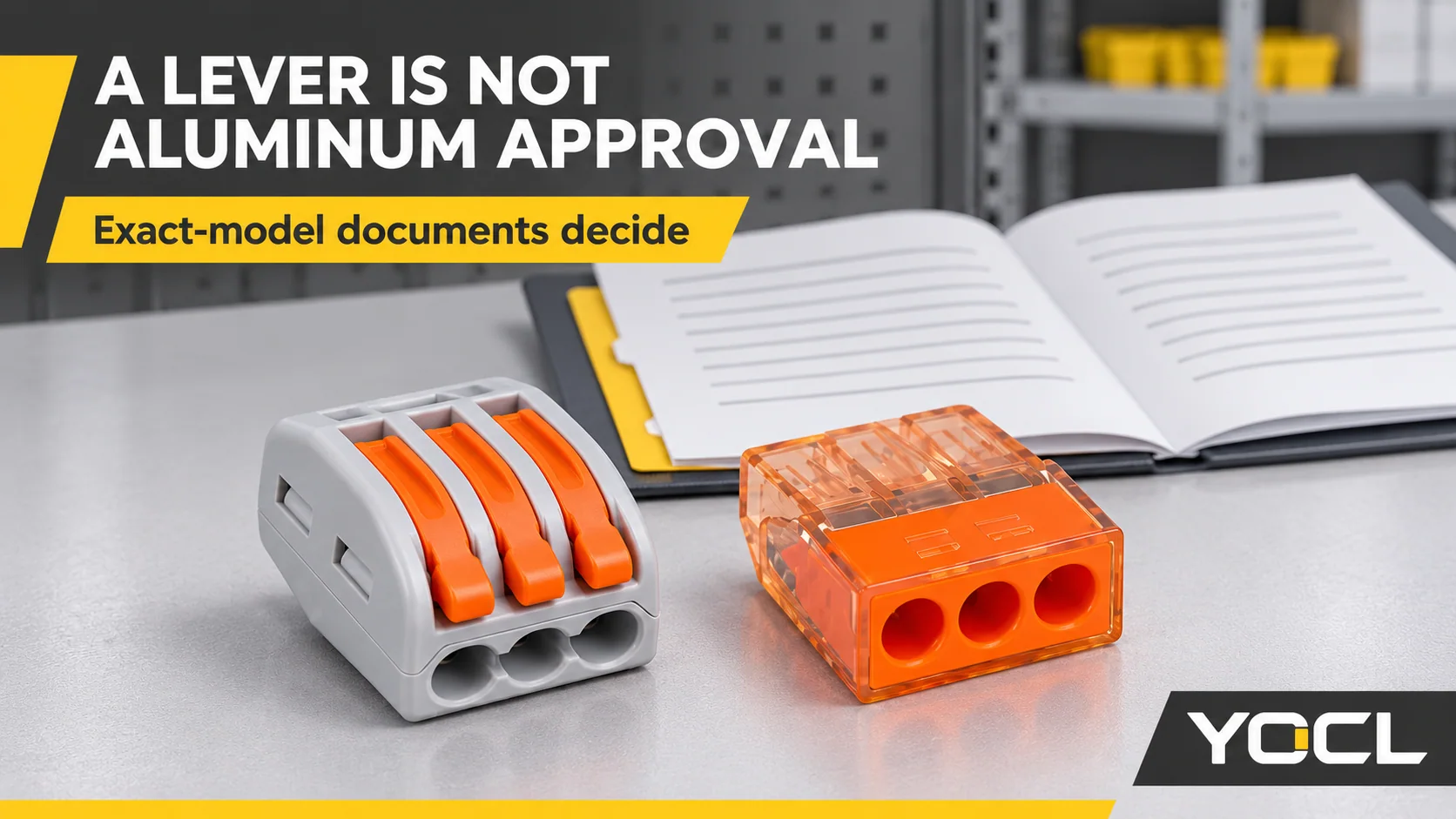
Only if the exact connector is documented for the aluminum conductor and application. A lever operates a clamp; it does not establish conductor-metal acceptance. Contact paste cannot convert a copper-only or unidentified connector into an aluminum-approved product. Start with the product documents, not its appearance.
| What the product documents establish | Aluminum use | What to do |
|---|---|---|
| Copper only | Not permitted on that basis | Select a separately documented connection system |
| Conductor metal not stated | Unconfirmed | Obtain exact-model confirmation before use |
| Aluminum explicitly accepted | Conditional | Match conductor construction, size, treatment and applicable ratings |
| Similar-looking connector or matching family number | No transferable permission | Check the actual manufacturer and complete item number |
The decision is a chain: exact product, permitted conductor, contact treatment, electrical limits and local acceptance. A missing link cannot be supplied by adding paste or borrowing another manufacturer’s instructions.
Why aluminum needs its own acceptance check
Aluminum’s oxide film can impede contact; creep under pressure and thermal expansion or contraction can affect a connection; and mixed aluminum/copper interfaces can suffer galvanic corrosion when an electrolyte is present. These are different mechanisms, so an antioxidant alone is not evidence that the complete connection is suitable. CPSC’s archival technical discussion describes oxide, creep and thermal movement. The Bureau of Reclamation also explains galvanic action between conductor metals in its electrical-connections manual; only that general mechanism is used here, not its power-circuit installation procedures. Copper, aluminum and copper-clad aluminum remain separate acceptance cases; see What Is a Wire Connector?.
For US workplaces covered by the rule, OSHA’s electrical-connection requirements require connecting devices to be identified for the conductor material and used properly. They also address mixed-metal contact and suitable connection compounds. This is workplace regulation, not a worldwide approval of a connector or a residential repair method.
For a buyer, the practical question is specific: does the documentation cover this metal, this conductor construction and this connection arrangement? A current number or a statement about flexible wire answers a different question unless its material scope is also clear.
The lever-series trap: appearance is not approval
Two connectors can both have levers and still have different material permissions. Their operating motion may be similar while their exact designs, tests and approved applications differ. Likewise, a generic technology name does not override a model-specific exclusion.
A documented example makes the distinction concrete: WAGO excludes its 221 Series from the aluminum route described in its official FAQ, while identifying its 222 Series as a conditional alternative with specified contact treatment. That is a manufacturer-specific example, not a rule for every connector carrying similar digits. The official FAQ is listed in Sources for verification. Check the exact product rather than treating that example as a rule for another brand.
A “221-style” description therefore cannot establish aluminum acceptance for another product. Nor does a different manufacturer’s “222” label inherit a permission. The identity must include the manufacturer and complete model, with documents that actually belong to it.
Keep the mechanism question separate. The lever-versus-push-in guide explains the operating and conductor-construction comparison. Neither operating method alone answers whether aluminum is allowed.
This distinction also prevents an unsafe substitution: a connector that physically grips a wire has demonstrated grip, not the full electrical and environmental suitability of the joint. A closed lever or a successful continuity check cannot replace the acceptance documents.
Which connector types accept contact paste?
Only the types and exact models whose instructions permit the proposed treatment. There is no universal rule that every lever, push-in or screw connector should receive antioxidant compound.
| Connector or supplied condition | How to decide about paste | What cannot be assumed |
|---|---|---|
| Copper-only connector | Follow its copper-use instructions; paste does not authorize aluminum | An inhibitor changes the permitted conductor metal |
| Aluminum-rated connector requiring a named compound | Use the documented compound and preparation method | A similar-purpose product is interchangeable |
| Factory-prefilled connector | Follow the supplied configuration and installation instructions | Additional compound is necessary or permitted |
| Aluminum-rated connector with another documented preparation method | Use that exact method | Every aluminum connection needs syringe filling |
| Missing treatment instructions | Seek clarification before adding a compound | A general antioxidant recommendation approves that connector |
UL’s wire-connector guide information, in the dated White Book edition identified in Sources, distinguishes factory-prefilled connectors from products where compound may be used when recommended by the connector manufacturer. It also treats preparation as part of the product instructions. The guide supplies a useful distinction, not a current listing for a particular item.
Paste and connector suitability must be checked together. If a product requires a specified treatment, omitting it leaves the installation outside those instructions. If a product has no aluminum acceptance, supplying the treatment does not fix that absence. Those are separate failure paths.
Check preparation without inventing a procedure
Ask what the selected product requires for oxide removal, wire-end preparation and filling. Some systems prescribe cleaning and immediate protection of the contact surface; others arrive prefilled or prescribe a different process. Do not move one connector’s cleaning or filling sequence onto another.
The applicable documents must also settle strip length, permitted conductor count per entry, insertion or tightening method, and any tooling requirement. This guide intentionally provides no universal strip length, amount of paste or tightening value: each belongs to the identified product.
Any compound temperature or environmental limit applies alongside the connector and conductor limits. A high temperature figure for the housing does not establish suitability of an added compound. A prefilled variant’s specification also cannot be transferred to a separately treated version merely because the housings resemble each other.
These checks are for selection and document review. They are not instructions to prepare conductors in an energized installation. Electrical work should follow the applicable isolation and professional-work requirements.
Read aluminum, conductor construction and current together
An aluminum statement must be read with the wire construction and cross-section it covers. Acceptance of stranded copper does not establish acceptance of stranded aluminum. A solid-aluminum instruction does not extend to fine-stranded wire because the wire fits through the opening.
The same discipline applies to size. A general statement about a connection family cannot enlarge the exact item’s conductor range. Where a connector has different connection sides, check the entry that will actually receive the aluminum conductor. Do not combine a size from one side with a preparation method from another.
Next establish which electrical limits apply to that aluminum arrangement. Request the documented basis rather than using a headline copper rating or inventing a reduction factor. Another manufacturer’s reduced-current table cannot fill a missing rating in the selected product’s documents.
A connector rating is also not the complete circuit design. The conductor, connected equipment, termination arrangement and installation requirements remain relevant. Do not treat a compatibility note as permission to change circuit protection or increase load.
For mixed-metal joints, check the exact combination. UL’s guide information distinguishes conductor-material markings from permission for conductors of different metals to be intermixed in direct contact. Its discussion shows why “accepts copper and aluminum” should not be read as “accepts every copper/aluminum combination in every entry.”
Keep that distinction in the application record: separate connection points, direct intermixing and multiple conductors under one clamp are different arrangements. The relevant documentation must identify the one proposed.
What YOCL’s public product pages establish
Use four checks before selecting any connector for aluminum. They organize the evidence; they are not a new universal certification scheme.
- Explicit aluminum acceptance. Match the manufacturer and complete item number to an aluminum statement. Include conductor construction, cross-section, connection side and permitted wire combination. A similar family name or product photo does not establish any of these fields.
- Contact-treatment instructions. Establish whether the product requires, permits or excludes an added compound, or is supplied prefilled. If treatment is specified, identify it and its applicable conditions. Do not assume an ordinary antioxidant is an approved substitute.
- Applicable electrical limits. Confirm that the documented ratings apply to the proposed aluminum connection. Resolve any aluminum-specific limits or required adjustment with the manufacturer. Do not create a value from copper data or another supplier’s example.
- Marking and local acceptance. Verify the applicable marking, certification or other required recognition for the exact product and use. Match the record to the item and intended market; a general logo does not establish the scope.
If necessary evidence is absent, aluminum acceptance is unconfirmed: do not use the connector for aluminum on that evidence. This does not automatically prove copper suitability either. Each material follows the product’s own permitted-use documentation.
YOCL’s public product pages reviewed for this article do not declare aluminum-conductor acceptance. The 222-41x lever connector page and 773-60x connector page are linked here to identify the exact product documents, not as an aluminum-wiring purchase recommendation.
Before a proposed aluminum application, obtain written manufacturer confirmation and the applicable technical and compliance evidence for the exact model. Another manufacturer’s approval, paste specification or current table cannot be applied to a YOCL product. Written clarification also cannot replace any required local recognition.
Ask for a response that identifies the item and the aluminum termination it covers, rather than an informal yes to an entire family. Keep the datasheet revision and its conditions with that response. If a certificate is cited, check its product identity and conductor scope. A seller message that only repeats the catalogue’s current figure does not resolve a missing aluminum declaration.
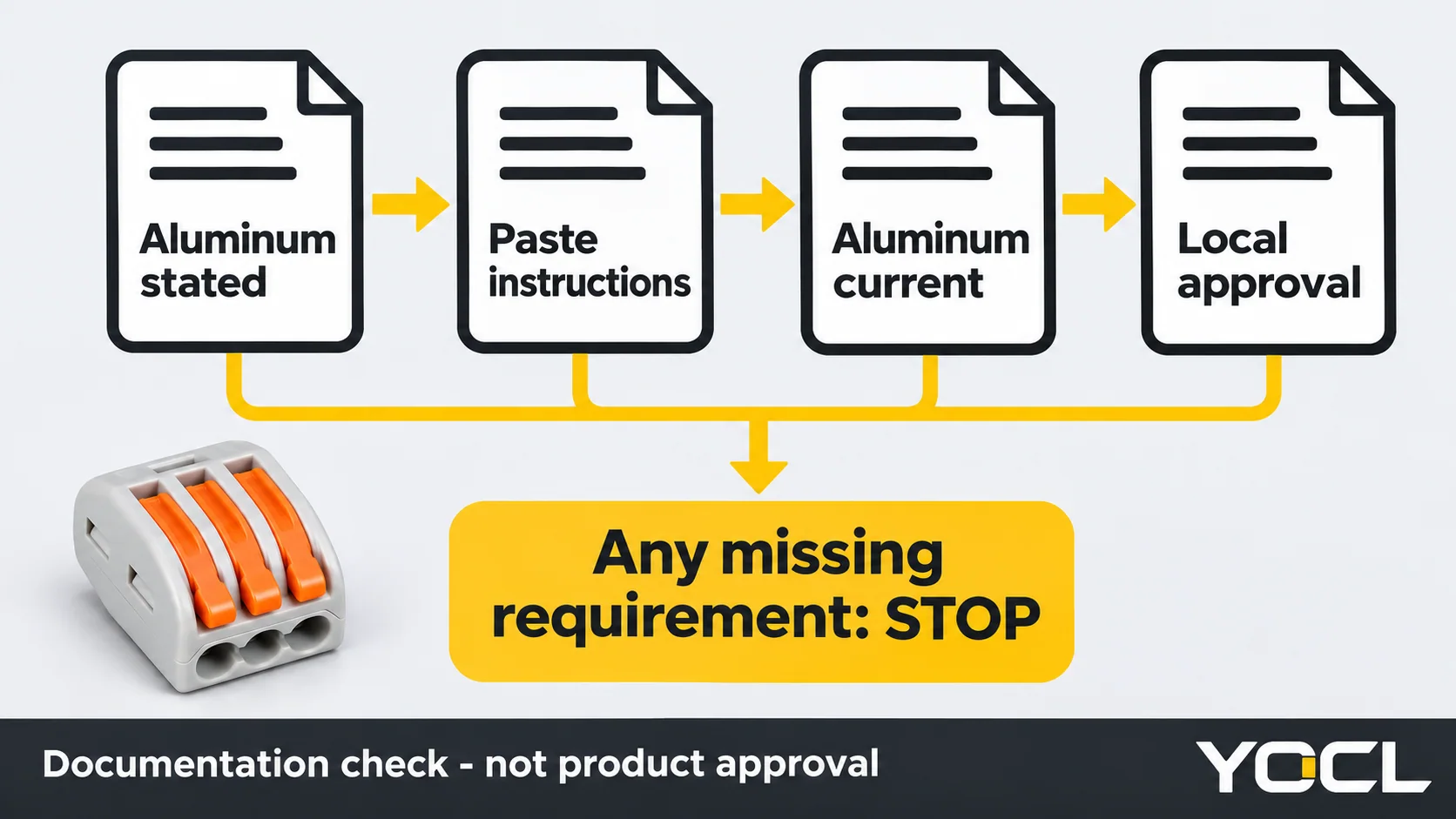
For an enquiry, use the wire connectors category to identify the item. Provide the conductor metal and construction, size, proposed combination, environment and destination market. Ask for the documents that resolve those fields, rather than a general statement that the connector is “universal.”
If the connector is copper-only or its acceptance is unconfirmed
Use a separately documented route. Depending on the installation, this may mean a purpose-designed aluminum-to-copper transition or replacement of affected wiring. Adding paste to the existing connector is not a substitute for either option.
For a copper pigtail, the transition connector must permit the actual aluminum and copper conductors, their arrangement and preparation. The downstream copper-only connector then needs its own compatible copper entry. This preserves a documented interface at both ends instead of assuming that the word “pigtail” makes the assembly acceptable.
A product marking and a permanent residential repair recommendation are also different matters. For US aluminum branch wiring, CPSC’s Repairing Aluminum Wiring discusses specific replacement and permanent-repair approaches and their limitations. It does not treat every AL/CU-marked connector as an equivalent remedy. Have a qualified electrician experienced with aluminum wiring assess the circuit and the locally accepted repair.
That assessment should resolve the actual wiring condition and application, not just whether a new connector can close around the conductor. This article does not provide a panel-work or whole-house remediation procedure.
Decision summary
| Your situation | Supported decision |
|---|---|
| Product explicitly restricted to copper | Do not use it for aluminum; choose another documented route |
| Only the lever style or a copied series name is known | Identify the actual product and obtain its own documents |
| Aluminum accepted, but treatment or applicable limits unresolved | Stop until those required conditions are settled |
| Exact aluminum conductor and all required conditions are documented | Check the proposed arrangement and local acceptance before installation |
| Copper and aluminum proposed in one connector | Verify the specific mixed-metal arrangement and permitted entry use |
| Old residential aluminum wiring needs repair | Use qualified assessment and the applicable remediation guidance |
Keep the decision record with the selected item: product identity, conductor details, preparation, applicable limits and recognition. A future substitution should trigger the same check instead of inheriting permission from the original connector.
FAQ
Can I use a 221-style lever connector on aluminum wire?
A “221-style” shape does not establish aluminum acceptance. WAGO explicitly excludes its genuine 221 Series from the direct-aluminum route discussed in its official guidance. That exclusion does not prove the status of another manufacturer’s look-alike. For another product, use only its own exact-model aluminum statement, conditions and applicable local acceptance.
Can lever or push-in connectors take stranded aluminum wire?
Only if the exact product documents permit that aluminum conductor construction and size. A solid-aluminum instruction does not cover stranded or fine-stranded aluminum, and acceptance of stranded copper proves nothing about aluminum. Neither a lever nor direct-insertion operation can supply the missing conductor approval.
Can I use ordinary antioxidant compound instead of the specified contact paste?
Do not substitute it without the connector manufacturer’s permission. Follow the exact product’s treatment instructions, including any specified compound, factory-filled condition or other preparation method. Some products do not call for added paste. A compound’s general antioxidant purpose does not establish compatibility or authorize aluminum in a copper-only connector.
Can copper and aluminum go into the same connector?
Only when the exact product permits the proposed mixed-metal arrangement and all applicable conductor, preparation and installation conditions are satisfied. Permission to accept either material is not automatically permission to intermix them in direct contact or place several wires in one entry. See the material-acceptance principle in What Is a Wire Connector?.
How do I check whether my connector is approved for aluminum?
Verify the exact-model aluminum statement, contact-treatment instructions, applicable electrical limits and marking or local recognition. Include conductor construction, size, connection side and wire combination. If required evidence is missing, aluminum use remains unconfirmed. Obtain written clarification and supporting documents rather than applying another product’s permission.
Sources
- CPSC, archival aluminum-wire systems technical notice, 1975; qualitative mechanism background, not current law.
- Bureau of Reclamation, Electrical Connections for Power Circuits, FIST 3-3, November 1991, conductor characteristics and galvanic action; mechanism background only.
- OSHA, 1910.303: General electrical requirements, conductor material, mixed metals and suitable compounds; US workplace scope.
- WAGO, Interconnection Technology Product FAQ, the narrowly attributed 221/222 example only.
- UL, 2015-16 White Book, Wire Connectors and Soldering Lugs (ZMVV), markings, conductor combinations and preparation; dated guide information, not a current item certification.
- YOCL ELECTRIC, 222-41x product information and 773-60x product information, first-party pages reviewed for an aluminum declaration.
- CPSC, Repairing Aluminum Wiring, Publication 516, June 2011; US residential repair scope.