
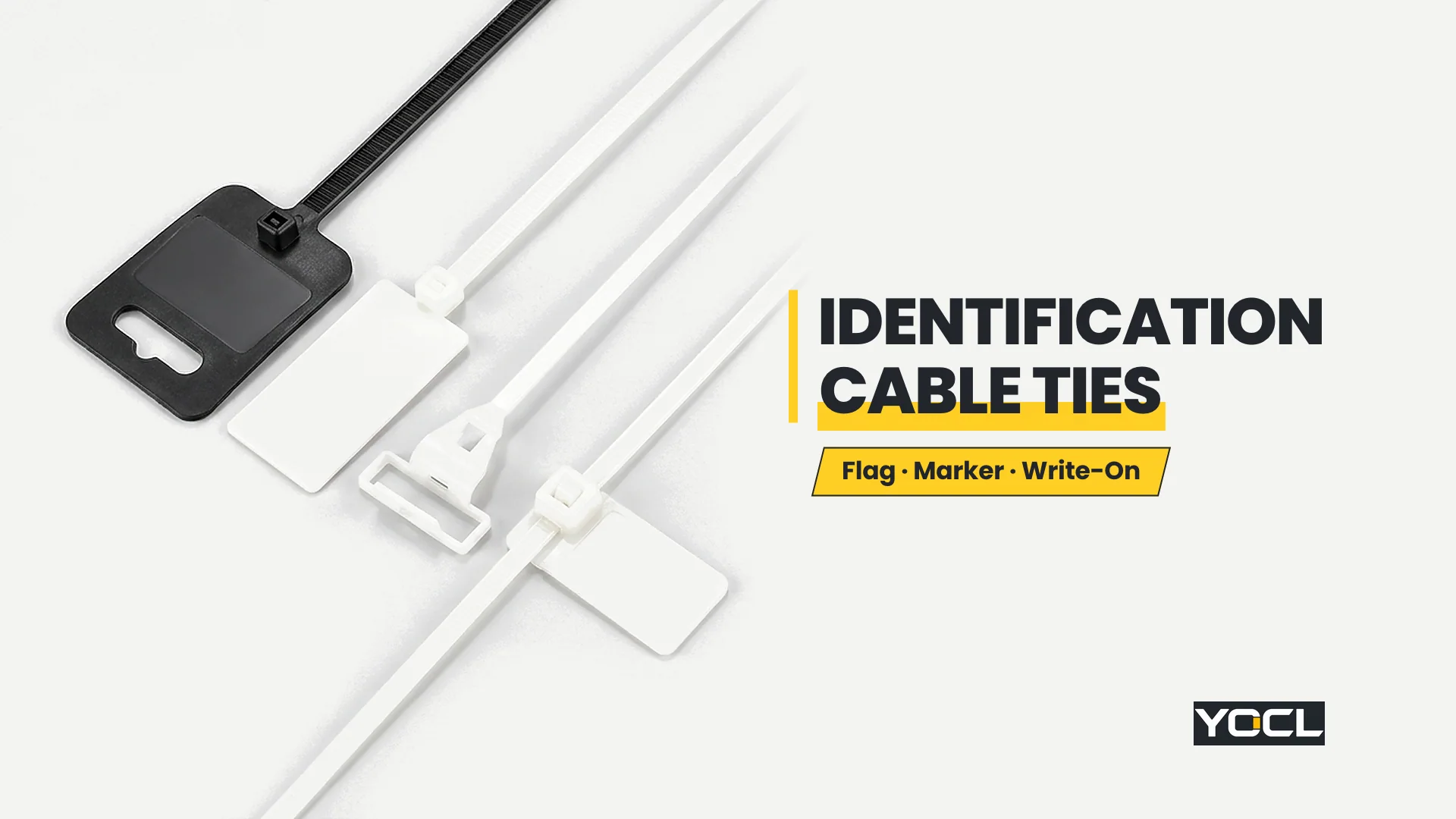
Identification cable ties are one-piece polyamide straps moulded with an integral flat tag or marker plate, fastening and labelling a cable bundle in a single step without separate tie-on tags or adhesive wraps. Because the strap mechanics are ordinary, the real procurement question is whether the identifier can be written clearly, read in position, and retained in service.
Integrating the writing surface into the fastening strap eliminates secondary label hardware across control panels, harness looms, and structured cabling. Keep the product boundary distinct from single-wire markers: markers that slide, clip, or shrink onto individual wires belong to cable markers explained and clip-on vs slide-on vs heat-shrink cable markers, whereas marker and flag ties label whole bundles. Across YOCL ELECTRIC’s four PA66 families, published tag dimensions and strap ranges govern fit.
Four Identification Cable Tie Geometries and What Each One Solves
Choosing between head-end tags, shaped inline plates, box markers, and extended flag ties depends on how much text must fit and where the tag sits once tightened around the bundle. YOCL’s four PA66 marker-tie families separate compact code tags from multi-strap plates reaching 47 × 55 mm.
Head-End Blank Tag Ties (HSS-MT)
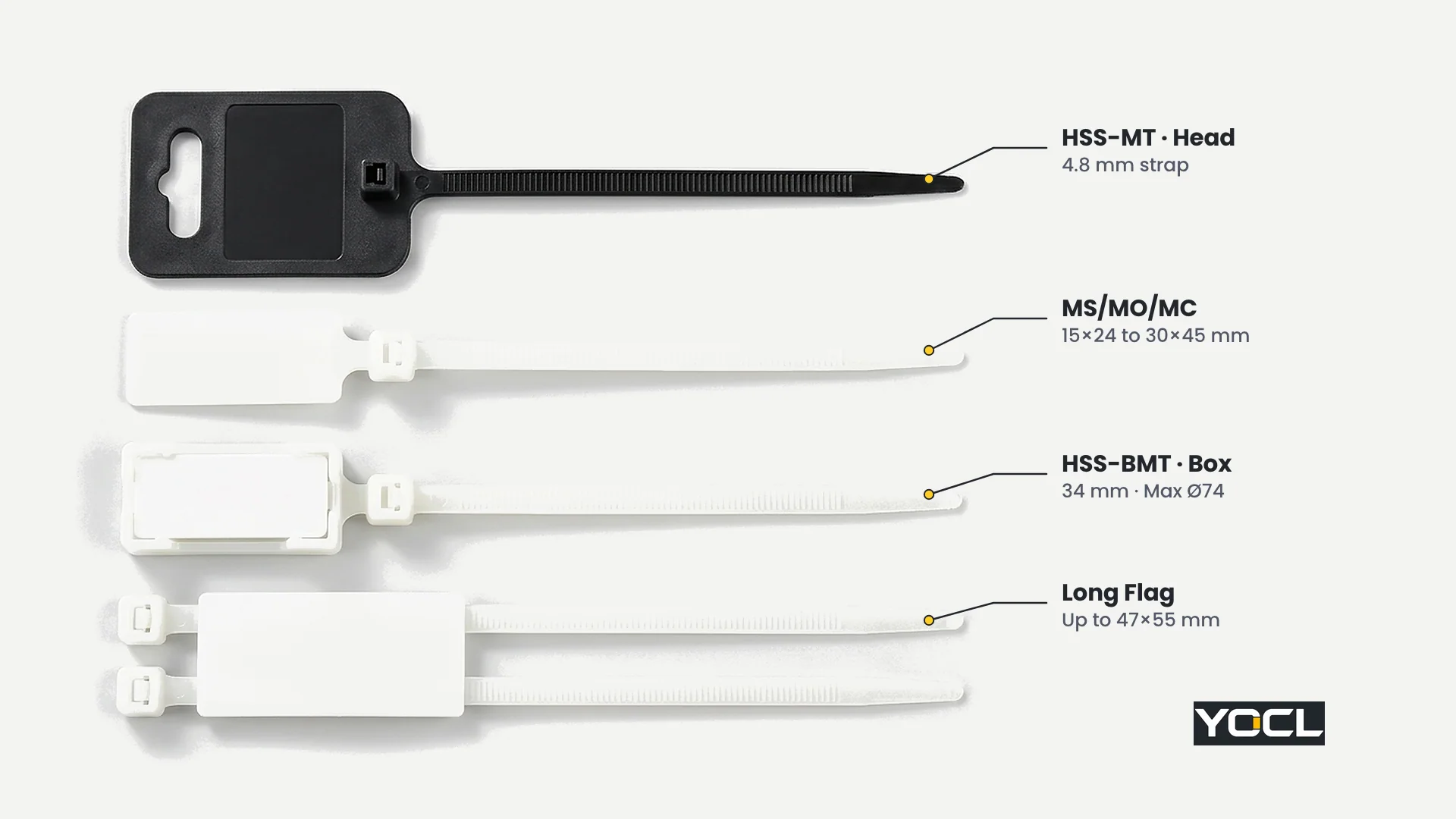
Head-end marker ties place a blank write-on paddle directly behind the self-locking head so bundle fastening and code marking happen on one 4.8 mm Nylon 66 strap. YOCL’s HSS-MT marker cable ties cover 3–40 mm and 3–65 mm bundles with a stated UL 94 V-2 material flammability classification.
Two models make up the line: HSS-200MT (200 mm length, 4.8 mm width, 3–40 mm bundle diameter) and HSS-250MT (250 mm length, 4.8 mm width, 3–65 mm bundle diameter). Both list 50 lb / 22 kgf tensile strength, which is a test value rather than a working-load rating (see the cable tie size and tensile strength chart). Because the HSS-MT page does not publish tag dimensions, check physical tag fit on a sample when character space is tight.
In-Line Shaped Marker Ties: Rectangular, Oval, and Round (HSS MS/MO/MC)
Shaped marker ties mould rectangular, oval, or round blank identification plates onto narrow 2.5 mm and 3 mm straps for compact harness coding and shape-grouped bundle sorting. YOCL’s HSS MS/MO/MC marker ties publish exact marker dimensions across nine models without assigning tensile strength figures.
| Model | Length (mm) | Width (mm) | Shape | Marker Size (mm) |
|---|---|---|---|---|
| HSS-100MS | 100 | 2.5 | Rectangular | 16 × 20 |
| HSS-120MS | 120 | 3 | Rectangular | 20 × 26 |
| HSS-130MS | 130 | 3 | Rectangular | 21 × 27 |
| HSS-150MS | 150 | 3 | Rectangular | 15 × 24 |
| HSS-200MS | 200 | 3 | Rectangular | 15 × 24 |
| HSS-120MO | 120 | 3 | Oval | 30 × 20 |
| HSS-200MO | 200 | 3 | Oval | 30 × 45 |
| HSS-090MC | 90 | 3 | Round | Ø20 |
| HSS-150MC | 150 | 3 | Round | Ø25 |
Selection Rule: Choose round MC models (Ø20 mm or Ø25 mm) for short zone codes on light looms; switch to rectangular MS models (up to 21 × 27 mm) or oval HSS-200MO (30 × 45 mm) when multi-character labels need wider space.
Notice that longer straps do not guarantee larger tags: HSS-150MS and HSS-200MS carry a 15 × 24 mm marker, smaller than the 21 × 27 mm plate on HSS-130MS. No tensile values are published for this family.
Box Marker Cable Ties (HSS-BMT)
Box marker cable ties pair a 5 mm Nylon 66 strap with a structured blank box-marker head sized for larger cable bundles up to 74 mm in diameter. YOCL’s HSS-BMT box marker cable ties publish two models with a 34 mm marker figure and a stated UL 94 V-2 material flammability classification.
Both HSS-180BMT (180 mm length, 5 mm width, 55 mm maximum bundle diameter) and HSS-240BMT (240 mm length, 5 mm width, 74 mm maximum bundle diameter) specify 50 lb / 22 kgf tensile strength—not a working-load rating—and print the marker size as a single 34 mm figure.
Extended Flag Layouts: End, Side, and Multi-Strap Plates (Long Flag)
Extended flag ties separate the writing plate into transverse end or side flags for narrow spaces and multi-strap inline plates for multi-line circuit legends. YOCL’s PA66 Long Flag marker cable ties span eight layouts whose writing area reaches 47 × 55 mm by multiplying parallel straps across the plate.
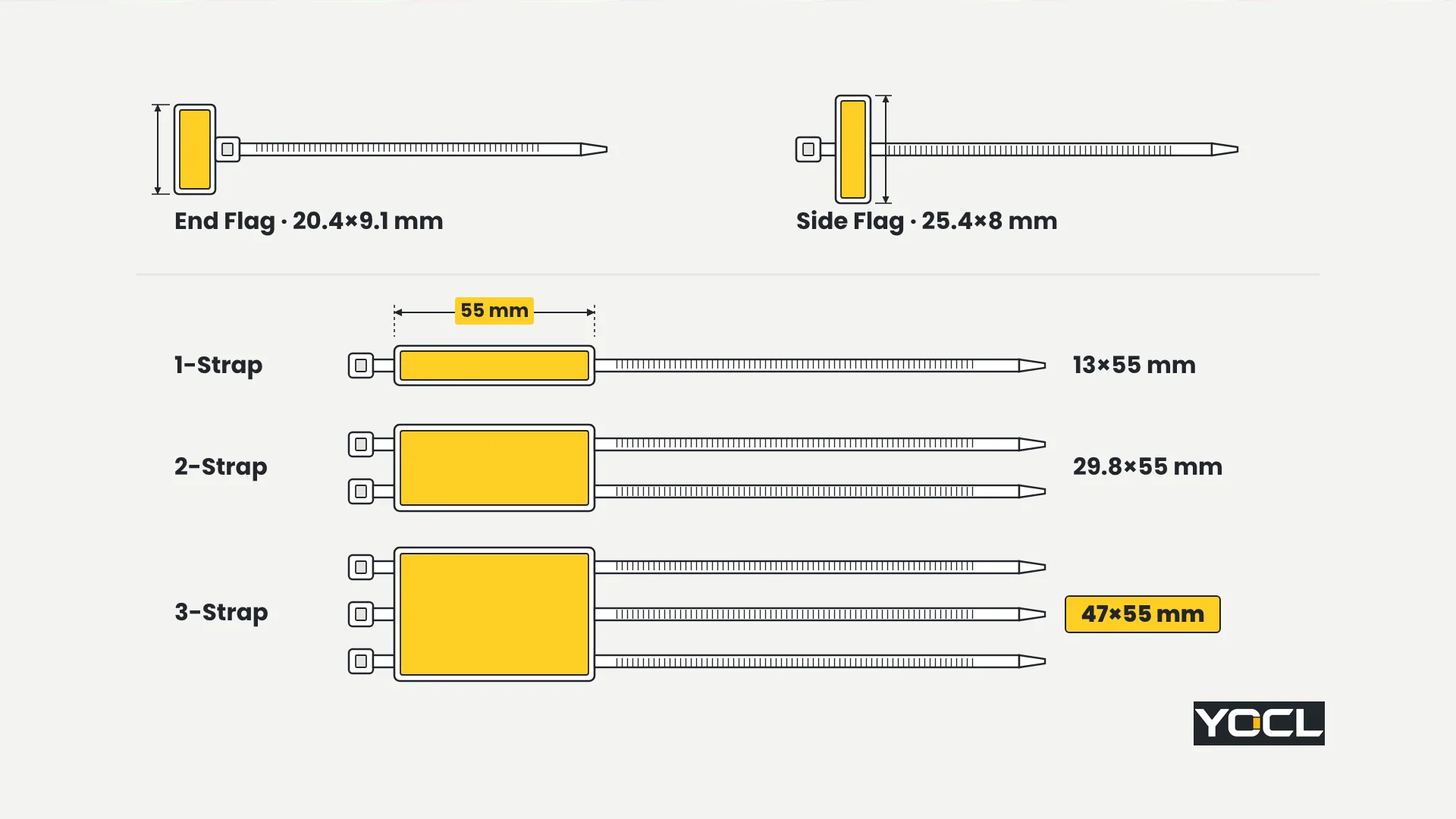
Two geometric features govern these eight layouts:
- End flag vs side flag position: A single strap, end flag (20.4 × 9.1 mm) sits behind the outer end of the locking head like a T-bar so the tag stands clear of crowded ducts, whereas a single strap, side flag (25.4 × 8 mm) sits between the projecting locking head and the serrated strap.
- Multi-strap width scaling: Bridging two parallel straps widens the plate from 13 mm to 29.8 mm or 30 mm, and bridging three parallel straps widens it to 47 mm—forming a stable saddle that resists twisting on curved trunks. No tensile values are published for Long Flag ties.
| Layout | Straps | Marker Size (mm) | Geometry Role |
|---|---|---|---|
| Single strap, end flag | 1 | 20.4 × 9.1 | T-end tag behind locking head |
| Single strap, side flag | 1 | 25.4 × 8 | Transverse bar between head and strap |
| Single strap, short flag | 1 | 13 × 28 | Compact single-strap inline plate |
| Single strap, long flag | 1 | 13 × 55 | Extended 55 mm single-line plate |
| Double strap, short flag | 2 | 30 × 28 | Dual-strap two-line saddle |
| Double strap, long flag | 2 | 29.8 × 55 | Wide 55 mm saddle plate |
| Triple strap, short flag | 3 | 47 × 28 | Three-strap broad multi-line plate |
| Triple strap, long flag | 3 | 47 × 55 | Maximum writing area in range |
Selection Rule: Choose single-strap end or side flags (20.4 × 9.1 mm or 25.4 × 8 mm) when the tag must project off a tight bundle; switch to double-strap (29.8 × 55 mm) or triple-strap (47 × 55 mm) plates when multi-line identifiers need a wide saddle.
Why Marker Area Comes Before Strap Length When Sizing Bundle Labels
Sizing bundle-labelling ties by bundle diameter first is the primary specification mistake: buyers pick a long strap that wraps the harness easily, only to discover its marker pad cannot fit the required circuit string. Always match marker dimensions to your longest identifier before selecting strap length and bundle capacity.
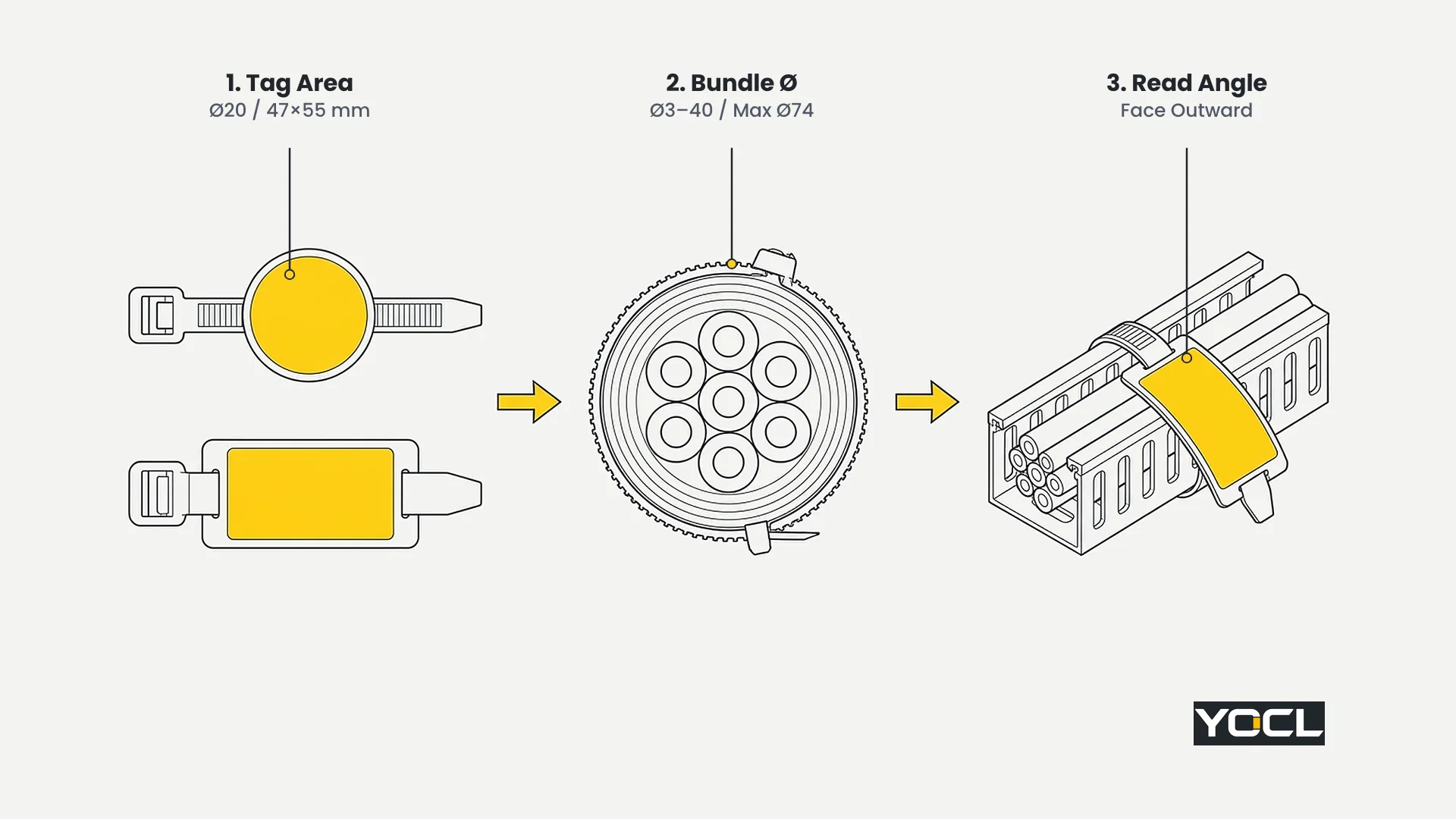
Two worked selections using only published dimensions show why tag area leads:
- Short code on a compact bundle: A two-character port or bay code on a small sensor loom needs minimal writing space without snagging adjacent wires—pointing to HSS-090MC (Ø20 mm round marker on a 90 mm strap).
- Full written circuit designation: A multi-part panel and feeder identifier requires multi-line legibility—pointing directly to the Long Flag triple-strap long flag (47 × 55 mm).
Where both bundle-diameter limits and tensile test data are needed alongside a blank tag, compare the HSS-MT and HSS-BMT models:
| Model | Length (mm) | Width (mm) | Bundle Ø (mm) | Tensile (Not Working Load) | Marker Size |
|---|---|---|---|---|---|
| HSS-200MT | 200 | 4.8 | 3–40 | 50 lb / 22 kgf | Not published |
| HSS-250MT | 250 | 4.8 | 3–65 | 50 lb / 22 kgf | Not published |
| HSS-180BMT | 180 | 5 | Max 55 | 50 lb / 22 kgf | 34 mm |
| HSS-240BMT | 240 | 5 | Max 74 | 50 lb / 22 kgf | 34 mm |
Selection Rule: Choose HSS-200MT or HSS-250MT for 3–65 mm bundles using a 4.8 mm head-tag strap; switch to HSS-180BMT or HSS-240BMT when you need a published 34 mm box-marker figure or up to 74 mm bundle capacity.
Marking Methods and Surface Durability Boundaries on Blank PA66 Tags
Blank Nylon 66 marker ties accept handwriting at installation, while broader harness markets also use pre-installation thermal-transfer or hot-stamp printing and factory pre-numbering. Across every method, durability follows one qualitative rule: marks printed or stamped during manufacture outlast surface handwritten ink exposed to abrasion, solvents, or UV light.
YOCL’s four product pages specify blank identification surfaces for writing and state no printing, hot-stamping, or numbering services. As general industry context, blank or market-supplied tags are marked in three ways:
- Handwriting at installation: Technicians write directly on the blank PA66 pad with a permanent marker. Longevity depends qualitatively on pen chemistry and exposure to UV light, rubbing, or cleaning solvents.
- Pre-installation printing: Harness shops mark compatible flat tags before installation using thermal-transfer or hot-stamp equipment.
- Factory pre-printing or numbering as a market option: Some market suppliers offer pre-numbered ties to order. Because YOCL’s pages list blank write-on tags only, never assume a marking service—select the exact blank model and enquire directly if custom marking is needed.
Four-Step Selection Checklist for Identification Cable Ties
Specifying identification cable ties without panel rework requires verifying four practical parameters in strict order—identifier character space, bundle diameter capacity, tightened viewing angle, and published PA66 material boundaries—so every installed tag fits the circuit string and remains legible inside the enclosure before releasing purchase orders:
- Identifier length → marker size and shape: Pick round (Ø20 mm, Ø25 mm), rectangular (15 × 24 mm to 21 × 27 mm), oval (30 × 20 mm, 30 × 45 mm), box (34 mm), or Long Flag layouts (up to 47 × 55 mm) first.
- Bundle diameter → strap model: Stay within 3–40 mm (HSS-200MT), 3–65 mm (HSS-250MT), 55 mm max (HSS-180BMT), or 74 mm max (HSS-240BMT); check wrap fit on a sample for MS/MO/MC and Long Flag ties.
- Read position after tightening: Orient the strap before locking so end flags, side flags, or inline plates face outward rather than rotating against a tray wall.
- Environment honesty: Tags are moulded PA66, yet the four pages publish no temperature or UV ratings—only the UL 94 V-2 material flammability classification on HSS-MT and HSS-BMT (a material classification, not a product certification). Assign no unstated thermal or UV ratings.
Frequently Asked Questions
Can I write on any cable tie’s strap instead of using an identification tie?
No. An ordinary strap is narrow, curved around the bundle, and ribbed with locking teeth on one face, leaving no flat plane for legible text. Identification ties exist because their integral paddle, shaped plate, box, or flag provides a flat writing surface.
What is the difference between a marker tie and a cable marker?
A marker tie fastens around a multi-wire bundle and carries an integral tag to label the group as one unit. A cable marker is a sleeve, clip-on ring, or shrink tube fitted onto a single wire; see cable markers explained.
How much can I write on an identification cable tie?
Capacity follows the published marker size: round or rectangular MS/MO/MC tags (Ø20 mm or 15 × 24 mm) fit short codes, HSS-BMT provides a 34 mm box area, and long designations require Long Flag double-strap (29.8 × 55 mm) or triple-strap (47 × 55 mm) layouts.
Are numbered or pre-printed identification cable ties available?
Pre-printing and numbering exist as custom options in the wider market, while YOCL’s four pages list blank write-on tags only and state no printing service. Select your blank model code first and ask the supplier directly regarding custom orders.
References
- YOCL ELECTRIC Product Information — HSS-MT Marker Cable Ties: PA66 construction, UL 94 V-2 material classification, and HSS-200MT / HSS-250MT specifications.
- YOCL ELECTRIC Product Information — HSS MS/MO/MC Marker Ties: nine rectangular, oval, and round marker tie models and dimensions.
- YOCL ELECTRIC Product Information — Long Flag Marker Cable Ties: PA66 end-flag, side-flag, and single-, double-, and triple-strap flag dimensions.
- YOCL ELECTRIC Product Information — HSS-BMT Box Marker Cable Ties: PA66 construction, UL 94 V-2 material classification, 34 mm marker size, and HSS-180BMT / HSS-240BMT specifications.