
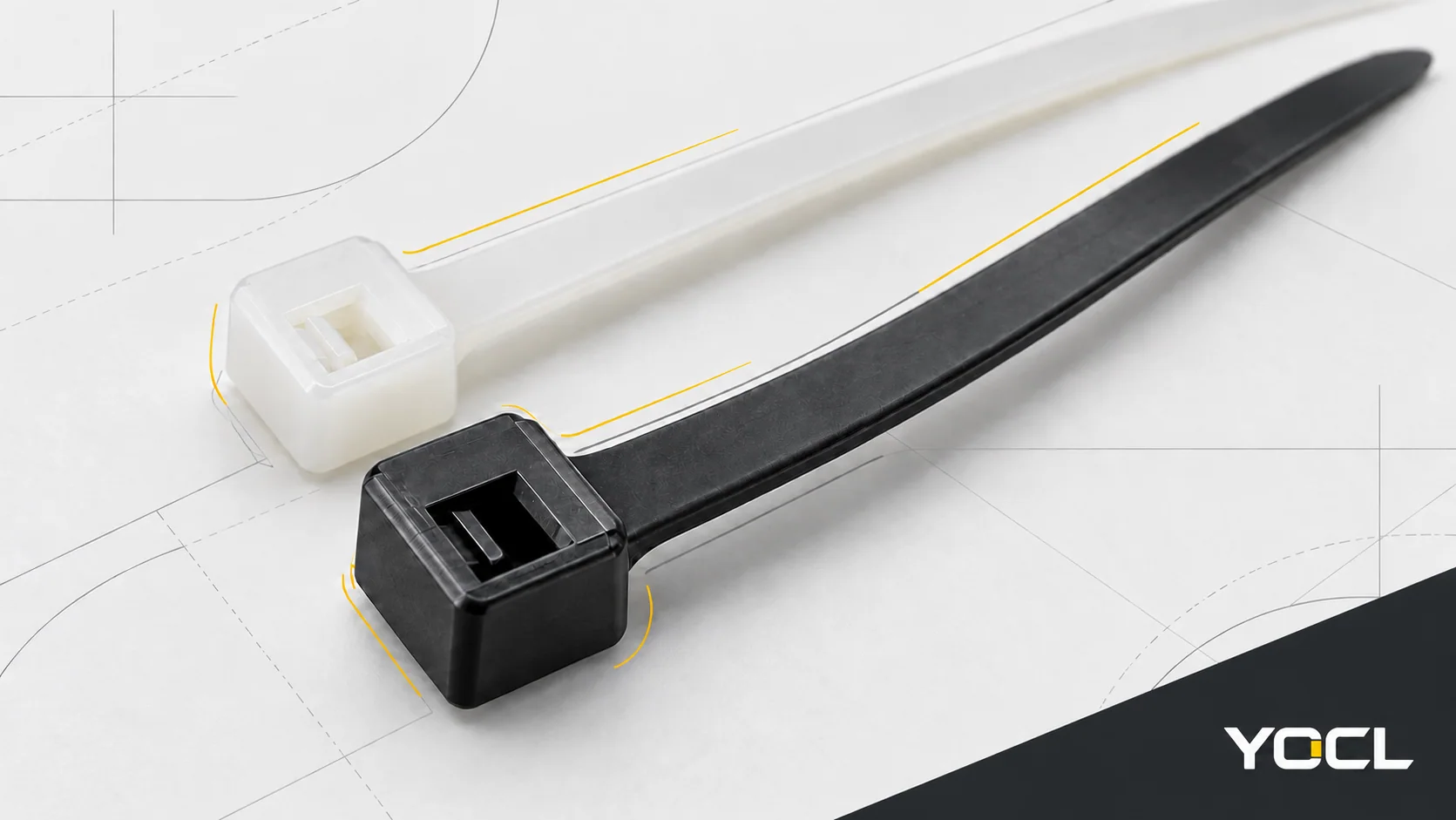
Read each cable tie row as four separate specifications: length, actual strap width, maximum bundle diameter and declared tensile force. The model code alone cannot establish fit or load capacity.
YOCL YC cable tie size and tensile strength chart
Selected YC standard nylon rows; force columns show rounded catalogue equivalents, not working-load ratings.
| YC model | Length (mm) | Actual width (mm) | Max. bundle diameter (mm) | Declared tensile (lbf) | Listed equivalent (kgf) |
|---|---|---|---|---|---|
| YC-3×200 | 200 | 2.4 | 50 | 18 | 8 |
| YC-4×200 | 200 | 3.4 | 50 | 40 | 18 |
| YC-5×200 | 200 | 4.8 | 50 | 50 | 22 |
| YC-5×300 | 300 | 4.8 | 82 | 50 | 22 |
| YC-8×300 | 300 | 7.6 | 82 | 120 | 55 |
| YC-12×300 | 300 | 12 | 80 | 200 | 91 |
YC-5 is a family code; actual width here is 4.8 mm.
Read the four fields in order
Length is the listed overall tie length. Width is the actual strap width, read from its own column. Maximum bundle diameter is the largest bundle diameter declared for that model. Use this diameter field to check fit; do not calculate it from length alone. Tensile strength is a force figure with its stated unit, not a bundle size or sustained support capacity.
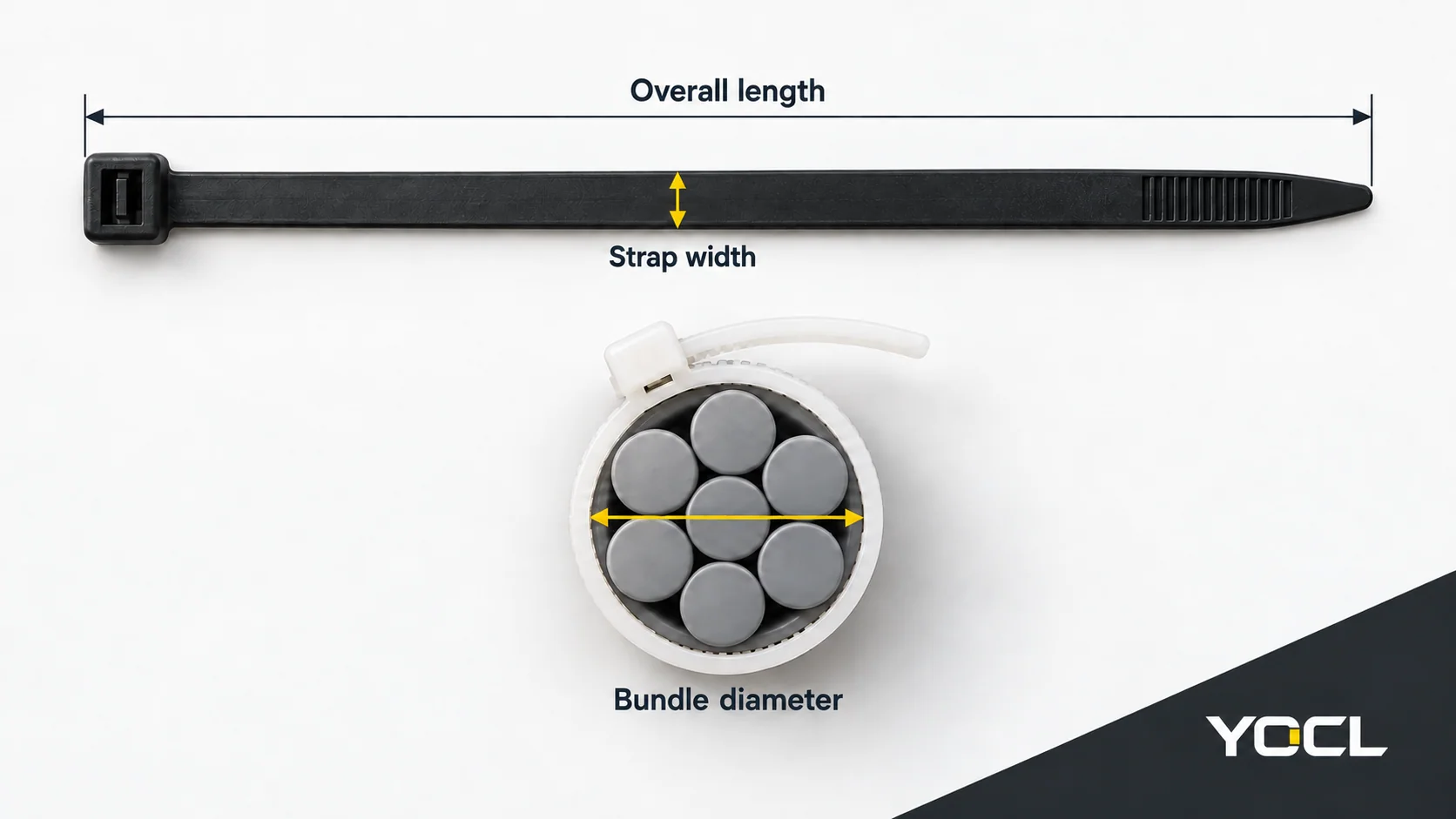
There is no universal length-to-bundle calculation: use the model’s declared diameter field. UL Solutions’ cable-tie guidance treats bundling diameter as a manufacturer-recommended selection limit.
Take a measured 60 mm bundle as a reading exercise. A row with a 50 mm maximum fails that diameter check; an 82 mm maximum clears that one check. Passing it does not establish how much continuous load the tie can support, whether its material suits the surroundings, or how much room is available to feed the tail through its head. Keep your measured diameter separate from the manufacturer’s declared limit; the chart is not a measurement of your installation.
Two comparisons that make the chart useful
YC-5×200 → YC-5×300: width and force remain 4.8 mm / 50 lbf; bundle limit rises 50 → 82 mm.
YC-5×300 → YC-8×300: both are 300 mm long with an 82 mm bundle limit; width rises 4.8 → 7.6 mm and declared force 50 → 120 lbf. These catalogue pairs do not establish a width-to-strength formula.
For any new comparison, copy the entire row for each exact model and mark what stayed the same, what changed and what the table leaves unknown. Taking length from one row, width from another and force from a third can create a specification that no listed model actually has.
Read lbf, kgf and N without mixing force with mass
lbf means pound-force; kgf means kilogram-force. Both are force units. A kilogram (kg) alone is a unit of mass, so replacing “kgf” with “kg” changes the meaning of the column. The US National Institute of Standards and Technology (NIST) lists 1 lbf ≈ 4.448222 N and 1 kgf = 9.80665 N. NIST SP 811 force conversion factors.
For example, 50 lbf × 4.448222 ≈ 222 N. For a controlled specification, request the exact-model test basis.
The unit also matters when the printed numbers look identical. An illustrative 10 lbf ≈ 44.5 N, while 10 kgf ≈ 98.1 N: the two values called “10” are not the same force. Convert to a common unit before comparing tables, but keep the original entry and its unit beside your calculation. Extra digits in the converted value do not increase the precision of the original product declaration. A conversion standardizes the unit only; it cannot recover a missing test method or turn a tensile entry into an allowable continuous load. NIST force conversion factors.
Force is not material stress
A value in lbf or kgf describes force; a material datasheet may instead describe tensile stress in megapascals (MPa). These are different quantities: NIST’s SI table gives the newton (N) for force and the pascal (Pa), equivalent to N/m², for stress. Strap width by itself is not a cross-sectional area. Dividing a listed tie force by width, or multiplying a material-stress value by width, therefore cannot produce a valid rating for a different tie. Keep the complete-tie declaration and any material property in separate fields until the relevant test basis is known.
What the tensile entry establishes
“Tensile strength” needs a defined specimen and test condition. The International Electrotechnical Commission (IEC) defines loop tensile strength for a cable tie with its lock engaged. Its IEC 62275:2022 public preview also says a loop tensile value does not indicate long-term static load-bearing capability. IEC 62275:2022 public preview, Sections 3.7 and 6.2.1.
YC lists “Tensile strength” without a row-specific test method; the table alone cannot establish IEC testing. UL Solutions also distinguishes a locked tie’s loop result from material strength and long-term support. UL cable-tie guidance.
The distinction is practical when two suppliers print similar force figures. The public IEC preview describes type-test specimens installed according to the manufacturer’s instructions; it also addresses stabilization of non-metallic samples, ambient conditions and a mandrel arrangement for mechanical tests. Those details show why the specimen, conditioning and test method matter to a comparison. They are requirements of the IEC method, not evidence that YOCL’s YC entries were obtained by that method. Ask whether a reported figure is a declared minimum loop result, another statistic or simply a catalogue heading before treating two numbers as comparable. IEC 62275:2022 public preview, Section 5.
The table also cannot decide exposure suitability. Material, operating temperature, installation conditions and ultraviolet exposure require their own exact product information. For those separate choices, see nylon versus stainless steel cable ties and UV-resistant versus standard cable ties.
Keep the exact-model record intact
When copying a chart entry into a drawing or purchase specification, keep the full model code, original units, listed dimensions, source page and retrieval date together. If a field is blank, write “not stated”; a neighboring length or width does not fill it. Record your measured bundle diameter separately from the manufacturer’s maximum and from the evidence still needed for the application. For a force-sensitive use, that missing evidence may include the test method, specimen condition and approved service limits. This record makes an enquiry precise and prevents a later unit conversion or catalogue revision from hiding the original claim.
Use the YOCL cable-tie range to compare the selected material and construction. Include the measured bundle diameter, intended environment and exact model when requesting its complete strength and test documentation.
Related reading: troubleshooting broken nylon ties.
References
- YOCL ELECTRIC, YC Standard Nylon Cable Ties, model table, checked 12 October 2026.
- UL Solutions, Cable Ties and Cable Management, bundling diameter, loop strength and application limits.
- National Institute of Standards and Technology, Guide for the Use of the International System of Units (SI), SP 811, Appendix B.9: Force, lbf and kgf conversion factors.
- National Institute of Standards and Technology, The International System of Units (SI), SP 330, Section 2, SI units for force and stress.
- IEC, IEC 62275:2022 — public preview, Sections 3.7, 5.1–5.3, 5.9 and 6.2.1; consulted preview sections only.