
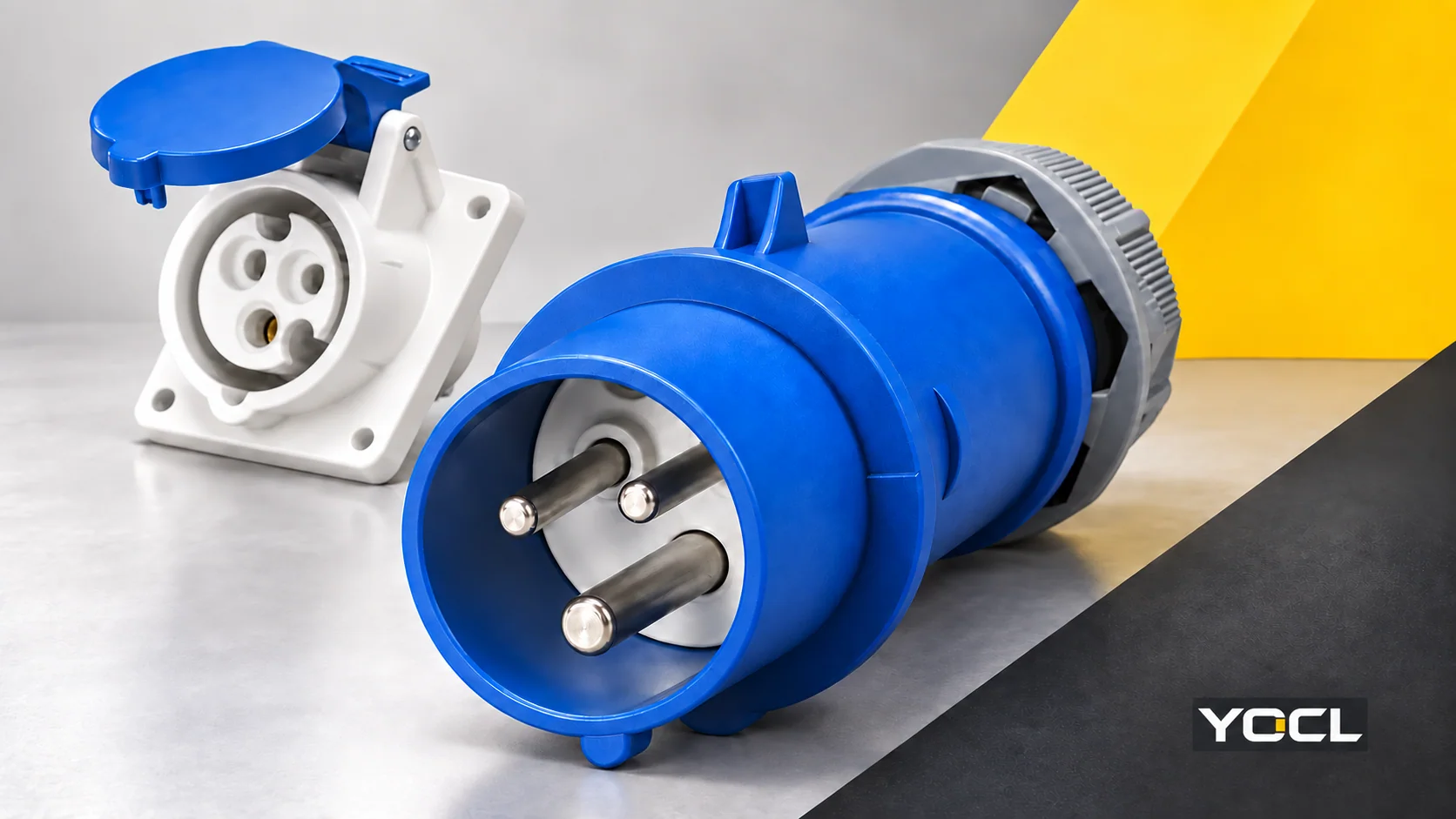
Industrial plugs and sockets provide a detachable power connection between a supply and equipment. A matching pair is defined by its physical interface and electrical configuration: pole arrangement, voltage and frequency, current rating, keying and the declared protection conditions. Colour or amperage alone leaves important parts of that specification unresolved.
The IEC 60309 family distinguishes general requirements in Part 1 from dimensional compatibility requirements for pin and contact-tube accessories in Part 2. Those are product-standard scopes; naming them does not establish that a particular connector is certified or suitable for every installation. IEC 60309-1 catalogue abstract, IEC 60309-2 catalogue abstract.
The useful starting point is to separate three questions: What physical component is it? Which circuit contacts does it provide? What do its markings actually establish?
Plug, cable connector and fixed socket
The contact interface and the mounting format describe different features. A female interface can be part of a movable cable connector or a fixed socket on equipment.
| Component | Physical role | YOCL product example |
|---|---|---|
| Cable plug | Male contact interface on a cable-mounted body | IP44 industrial plugs |
| Cable connector or cable coupler | Female contact interface on a cable-mounted body | IP44 industrial cable couplers |
| Fixed socket-outlet | Female interface installed at a fixed supply point; panel and surface mounting are separate formats | IP44 angled panel sockets |
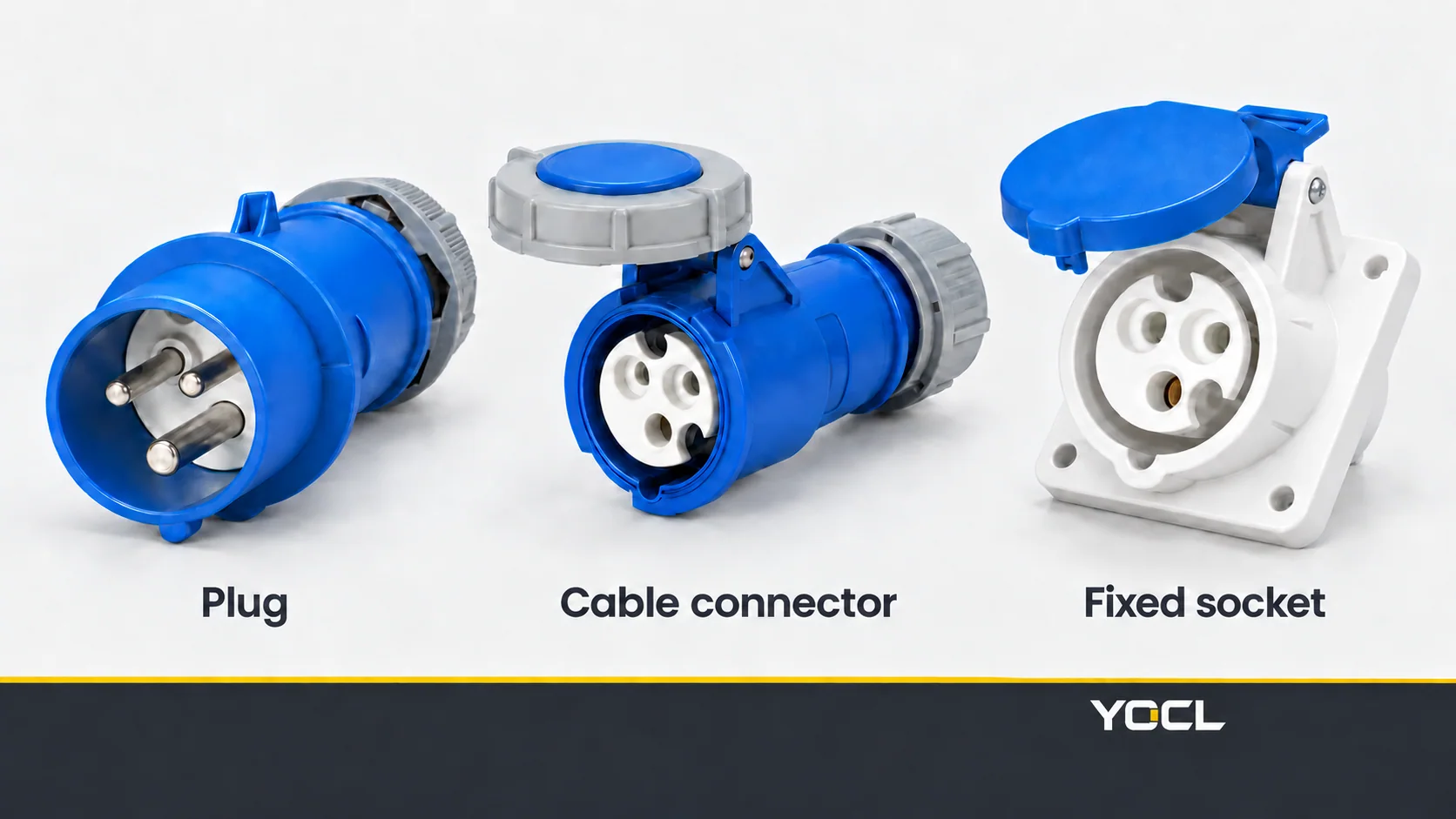
An appliance inlet is an equipment-mounted input interface. It has a different mounting role from a cable plug, even when both use male contacts. Identify the component’s place in the connection before comparing catalogue codes.
Single-pole Cam-Lock connectors are a separate branch in the YOCL industrial connection range. They should be evaluated through their own product information, rather than through a multipole clock-position reference.
What 2P+E, 3P+E and 3P+N+E mean
These designations describe contact functions. E is protective earth; N is neutral. The additional neutral contact in 3P+N+E changes the circuit connection available to the equipment.
| Arrangement | Total contacts | Interpretation |
|---|---|---|
| 2P+E | 3 | Two current-carrying poles plus protective earth. In a line-to-neutral application these serve line, neutral and earth; the supply configuration must still be confirmed. |
| 3P+E | 4 | Three phase contacts plus protective earth, with no dedicated neutral contact. |
| 3P+N+E | 5 | Three phase contacts, a separate neutral contact and protective earth. |
YOCL’s industrial plug catalogue lists these three arrangements. The contact-count explanation above interprets their notation; it is not a terminal-position or wiring map. YOCL product information.
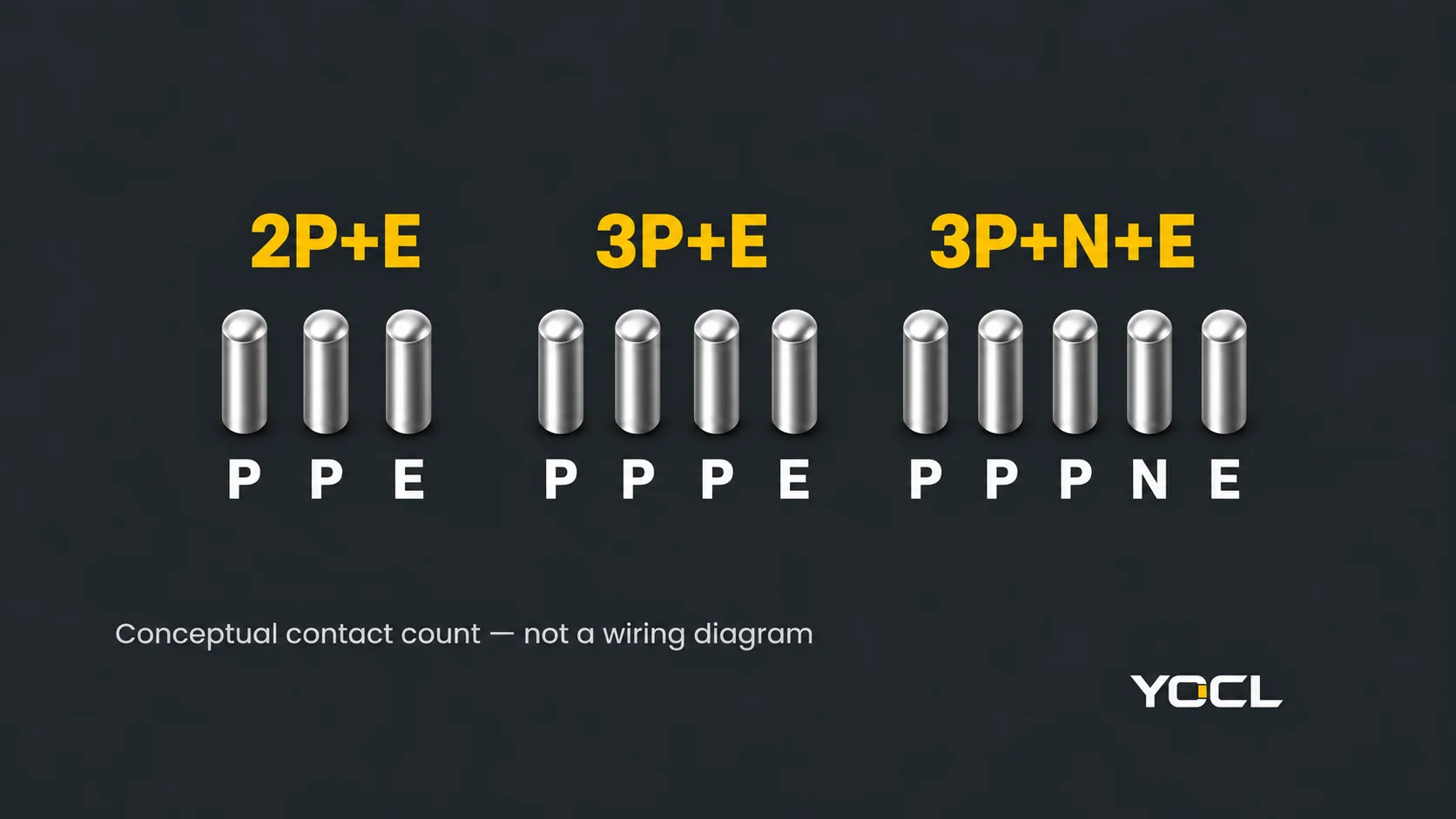
A three-phase load that requires a neutral needs that function considered explicitly. A four-contact 3P+E designation does not provide a separate neutral contact. Protective earth and neutral remain different functions; the earth contact must not be repurposed to make up a missing neutral.
Keying and colour describe different parts of the interface
Keying is the physical pattern that makes mating selective. The contact arrangement, reference features and connector size need to be checked as a complete interface. A housing colour is a visible identification cue; it is not a complete mating specification.
YOCL’s model tables include a clock-position field, with entries such as 6h. Its supplied clock-position reference is labelled as a socket front view and uses earth-contact position as an interface identifier. Read that view and the selected model’s markings together. It is not a rear terminal diagram.
Two catalogue entries can share a clock marking while differing in poles, voltage or current size. Before treating parts as a pair, confirm both complete model references, their contact arrangement, rated voltage and frequency, current rating and documented mating geometry. An appearance match leaves those checks open.
Read the rating fields as separate evidence
Each rating answers a particular question. Combining unrelated values from different catalogue rows creates a specification that may describe no actual product.
| Field | What it tells you | What still needs checking |
|---|---|---|
| Rated current, in amperes (A) | The current rating declared for that accessory | Load, cable and circuit protection requirements; a connector rating is not a circuit-design calculation |
| Rated voltage and frequency | The stated electrical operating configuration | The actual supply and equipment requirements; frequency cannot be filled in from colour alone |
| Poles and clock marking | The listed contact configuration and interface identifier | The complete mating pair and the correct drawing/view |
| Ingress protection (IP) code | A classification of protection against solid-object access/ingress and water ingress | The documented assembly state, seals, entries and exposure conditions |
| Conductor capacity | The conductor sizes accepted by the specified terminals | Conductor type, termination instructions and the separate cable-jacket diameter |
IP44 and IP67 identify different protection categories
The IP code has separate solid/access and water numerals. UL’s explanatory IP table gives the following limited meanings. UL White Book, 2015–16, p. 52.
| Code | Solid/access category | Water category |
|---|---|---|
| IP44 | Protection against objects of 1.0 mm diameter and greater | Splashing water |
| IP67 | Dust-tight category | Temporary immersion |
These are code meanings, not evidence that a particular YOCL model has been independently certified. An immersion category also does not, by itself, establish a water-jet rating.
For an actual plug/socket assembly, ask which state carries the declared rating: connected, disconnected with a cover, or another documented condition. The current catalogue summary alone does not resolve every state. A protection code also does not establish chemical resistance, operating temperature or hazardous-area suitability.
Two YOCL catalogue examples
The following entries come from the current YOCL IP44 industrial plug table. They are declared product information, not independently verified test results.
| Catalogue model | Current | Arrangement | Listed voltage | Clock marking | Listed protection |
|---|---|---|---|---|---|
| NM-013H | 16 A | 2P+E | 220–240 V | 6h | IP44 |
| NM-024H | 32 A | 3P+E | 380–415 V | 6h | IP44 |
Both entries show 6h and IP44, yet they describe different current ratings, contact arrangements and voltages. Neither shared field makes them substitutes. Their exact frequency and mating counterpart still need confirmation; the public selector explicitly leaves frequency to quotation confirmation.
The illustrations in this article show product families. They do not identify either complete NM model or establish an approved mating combination.
Find the resource that answers your next question
| Your remaining question | Where to continue | What to obtain |
|---|---|---|
| Which complete model matches the required electrical fields? | YOCL industrial model selector | A candidate model, then confirmation of its frequency and mating counterpart |
| How should the clock-position view be read? | Supplied socket-front-view reference | The applicable configuration and matching model documentation |
| Which cable entry dimension matters? | Cable diameter and entry selection | The distinction between jacket outside diameter and conductor area; use the connector’s own entry instructions |
| Does a panel socket fit the equipment face? | Angled panel-socket drawings | The selected housing’s mounting dimensions and enclosure-interface requirements |
| Which parts and product documents belong to the family? | YOCL industrial plugs and sockets range | The correct plug, inlet, fixed socket or cable-connector branch |
Start with the complete connection requirement and both sides of the interface. For catalogue evaluation, record the component format, supply voltage and frequency, required contact functions, current rating, environment and existing mating-part reference. Those inputs make the model discussion specific without turning a product overview into an installation procedure.
References
- IEC. IEC 60309-1:2021 — Part 1: General requirements, Edition 5.0; official catalogue abstract and public preview, including the May 2023 corrigendum. Used for standard scope.
- IEC. IEC 60309-2:2021 — Part 2: Dimensional compatibility requirements for pin and contact-tube accessories, Edition 5.0, corrected version 2026-08; official catalogue abstract and public preview. Used for standard scope.
- YOCL ELECTRIC. IP44 industrial plugs. First-party product information, model table and exterior-image reference; accessed 8 October 2026.
- YOCL ELECTRIC. IP44 industrial cable couplers. First-party product information and exterior-image reference; accessed 8 October 2026.
- YOCL ELECTRIC. IP44 angled panel sockets. First-party product information, drawings and exterior-image reference; accessed 8 October 2026.
- YOCL ELECTRIC. Industrial plugs and sockets manufacturer page, supplied clock-position reference, product branches and public model selector. First-party product information; accessed 8 October 2026.
- UL. 2015–16 Guide Information for Electrical Equipment — The White Book, p. 52, IP-code explanatory table. Used for code meanings, not current installation law or YOCL certification.