
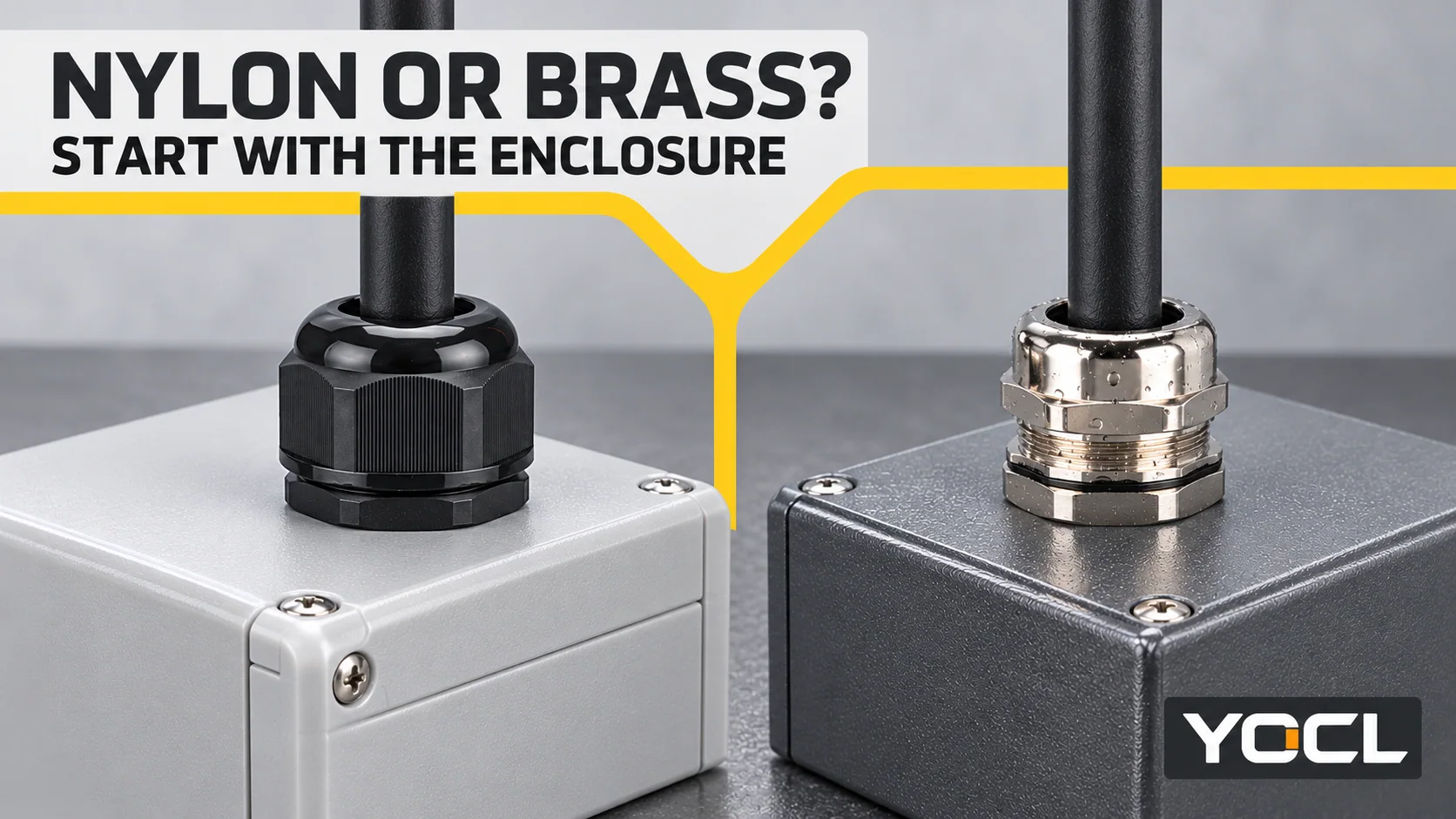
Start with the enclosure and the job the cable entry must perform. A nylon gland is often the simpler starting point for a plastic enclosure with an ordinary fixed cable and no bonding or electromagnetic compatibility (EMC) function. A nickel-plated brass gland is often the stronger starting point where a metal body, armour or shield bonding, or heavier mechanical duty is part of the requirement.
Material alone does not settle the choice. The sealing range, enclosure thread, cable construction, washer or locknut, installation method and exact product evidence determine whether the complete cable entry works. That is why “nylon or brass?” should be answered first as a boundary decision, then released by the exact model and assembly data.
The first decision is the interface, not the catalogue heading
A useful comparison starts with five inputs: the enclosure material, the cable construction, the mechanical duty, the environment and the electrical function of the entry. Use the table as a first filter, then verify the exact product.
| Decision input | Nylon is often the first candidate when | Nickel-plated brass is often the first candidate when | Evidence that releases the choice |
|---|---|---|---|
| Enclosure | A plastic enclosure and a compatible plastic thread or entry are used | A metal enclosure or a metal-bodied entry is used and the interface is designed for it | Enclosure drawing, thread designation, plate thickness and permitted accessories |
| Cable function | The cable is unarmoured and no shield or armour bonding is required through the gland | The cable is screened or armoured, or the gland is part of a designed bonding path | Cable construction, gland contact arrangement and continuity check |
| Mechanical duty | The cable is fixed, lightly loaded and protected from impact | The entry must resist heavier pull, vibration, impact or repeated service | Published impact, retention or assembly evidence for the exact model |
| Environment | The location is dry or the exact nylon grade is documented for the exposure | The alloy, plating and seal are documented for the exposure | Temperature, UV, chemical, washdown and coastal conditions |
| Electrical function | The body must remain non-conductive and no conductive path is required through it | A conductive body is needed as part of the intended design | Assembly drawing, protective-bonding design and test method |
| Ingress protection | The complete entry can meet the required IP condition | The complete entry can meet the required IP condition | Product data and the tested thread, seal and cable combination |
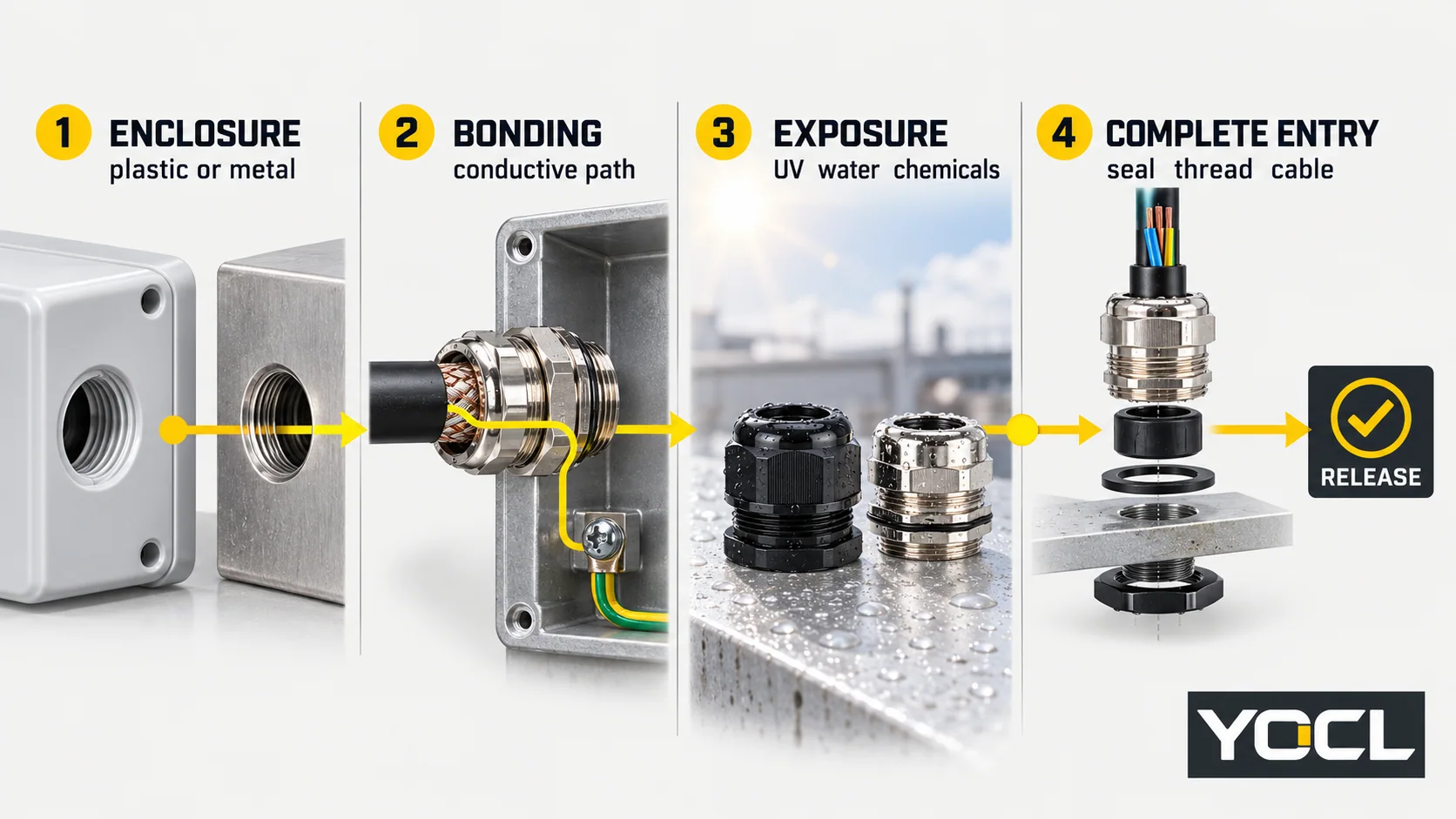
The material column answers “where should I begin?”. The final column answers “can I release this design?”. Do not skip the second question because the first answer looks familiar.
Where nylon is the better starting point
Nylon, or polyamide, is a useful body material where the enclosure is plastic, the cable is unarmoured and the entry does not need to provide a conductive path. Its lower mass can also make it easier to support on a plastic wall or a small enclosure. YOCL’s nylon range includes one-piece, divided-structure and angled bodies in several thread families, so the body format can follow the cable route rather than the material choice alone.
The case for nylon becomes weaker when the entry is expected to carry impact, resist repeated pulling, survive strong ultraviolet (UV) exposure or resist an aggressive chemical. “Nylon” is a material family, not a complete environmental specification. Ask for the compound, UV stabilisation where relevant, operating range and any applicable product evidence for the exact model. A nylon gland that is suitable indoors should not be approved for a sun-exposed façade merely because another nylon gland is described as outdoor-rated.
For a light-duty indoor panel, the practical checks are usually straightforward: the cable outside diameter (OD) must sit inside the published clamping range, the thread must match the enclosure entry, and the installed assembly must preserve the required seal. The general procedure for those checks is covered in the cable gland selection guide.
Where nickel-plated brass is the better starting point
A brass body is electrically conductive and mechanically robust, and a nickel-plated finish provides a separate surface layer over the brass substrate. That makes nickel-plated brass a natural candidate where the cable entry is part of a metal assembly, where a screened or armoured cable needs a designed bonding interface, or where the gland will face heavier mechanical duty.
Those advantages do not come from the words “brass” or “nickel-plated” alone. The exact alloy, plating quality, seal material and contact geometry matter. A metal body can only participate in protective bonding or EMC continuity when the gland and installation are designed and verified for that function. The standard’s scope and descriptors cover earthing and impact-resistance subjects, which is why the assembly evidence matters as much as the material name (BS EN 62444; IEC 62444:2010).
YOCL’s MG nickel-plated brass cable glands illustrate how a catalogue series can make the construction explicit. The product page identifies nickel-plated brass metal parts, PA66 claws and EPDM sealing components. It also states IP68 at 10 bar, a static operating range of −40 to +100 °C with short exposure to +120 °C, and a dynamic range of −20 to +80 °C with short exposure to +100 °C for that series. Those values belong to the MG series. They do not transfer automatically to another brass gland or to a nylon model.
What the body material cannot decide
IP protection belongs to the complete entry
The IP Code classifies degrees of protection provided by enclosures (IEC 60529). A cable gland is one part of an enclosure entry, not a substitute for the enclosure’s own rating. The sealing result depends on the gland’s seal, the enclosure thread, the sealing washer or O-ring, the cable jacket and the installed cable diameter.
A brass gland with an IP rating does not make a nylon gland waterproof in the same enclosure, and a nylon gland does not become unsuitable simply because another model lacks a published IP value. Check the exact product’s declared condition and the complete assembled entry. For sizing and sealing checks, use the parent cable gland selection guide rather than assuming that a larger thread or tighter nut improves protection.
Bonding and EMC need a designed conductive path
A metal gland is not automatically a bonding device. Its value depends on how it contacts the cable shield, armour, enclosure or a separate bonding conductor. The assembly must have a defined path, suitable contact surfaces and a way to verify continuity. IEC 62444 covers cable-gland construction and performance, while the BSI scope descriptors include earthing; neither fact removes the need to approve the actual assembly (IEC 62444:2010; BS EN 62444).
If the enclosure is plastic and the design needs a protective bonding path, a nylon body cannot supply that path by itself. A separate bonding arrangement or a different cable-entry design may be required. If the enclosure is metal, a brass body may be mechanically compatible, but the designer still has to address plating, contact surfaces, dissimilar metals and the method used to prove continuity.
Retention comes from the clamping design
The force that holds the cable comes from the gland’s clamping fingers, seal geometry and the fit between the cable OD and the published range. The body material affects stiffness and durability, but it does not prove retention by itself. A nylon gland with a suitable clamping design can be more appropriate than a poorly matched metal gland, and a brass gland outside its cable range is still the wrong gland.
Before approving either material, compare the cable’s minimum and maximum OD with the model’s published clamping range. Do not use the thread size as a cable-size guide. The metric, PG and NPT thread comparison explains why an entry designation and a cable diameter are separate dimensions.
Corrosion and UV are different failure mechanisms
Nylon does not rust in the way a ferrous part does, but it can age under UV, heat and chemical exposure. The relevant question is whether the exact compound and product are intended for the service condition, not whether the material is generically called nylon.
Nickel-plated brass can corrode as well. The Copper Development Association notes that high-zinc brasses can be susceptible to dezincification, particularly in seawater or stagnant conditions, and that alloy selection and inhibitors affect that risk (Copper Development Association marine guidance). Nickel plating can provide a surface barrier, but damaged or incomplete plating changes the exposed surface. A coastal washdown installation therefore needs a material and finish decision supported by the actual exposure, not a choice between “plastic” and “metal” labels.
This is also where a third option can become relevant. If the environment is strongly corrosive or repeatedly washed down, a stainless-steel or specially finished gland may be a better engineering starting point after the exposure and enclosure requirements are defined. The nylon-versus-brass question remains useful because it forces the designer to separate the body material from the seal, plating and installation.
Match temperature and chemical exposure to the exact product
Temperature limits are product declarations, not properties of the words “nylon” or “brass”. The YOCL MG page distinguishes static and dynamic operating ranges for the named series, which is a reminder that a cable under movement may have a narrower permissible condition than a fixed cable. A nylon product page may list only the body construction and dimensions; if the temperature or chemical data is not available for the exact model, obtain it before approving the application.
Use the same rule for chemicals. A generic acid or oil resistance statement is not enough when the concentration, temperature, contact time and seal material all affect the result. Check the body, seal and any washer or O-ring as a system. If the application is outside the published data, treat the selection as unresolved and ask the supplier to confirm the exact model.
A practical selection rule for four enclosure conditions
| Enclosure condition | Start with | Approve only after checking |
|---|---|---|
| Plastic control box, fixed unarmoured indoor cable, no bonding or EMC function | Nylon | Exact cable range, thread fit, enclosure wall strength and required IP condition |
| Metal panel or machine frame with a screened or armoured cable | Nickel-plated brass | Shield or armour contact design, bonding continuity, plating and the complete entry seal |
| Outdoor, coastal, chemical or frequent washdown exposure | Neither material by name alone | UV or weathering evidence, alloy and plating, seal compatibility and a defined IP test condition |
| High vibration, repeated pull or frequent re-termination | Nickel-plated brass, subject to model data | Published impact or retention evidence, thread engagement, accessory stack and installation instructions |
The decision is not a loyalty test for one material. It is a sequence of checks. For a plastic enclosure with a simple cable route, nylon may be the shortest path to a workable design. For a metal assembly with a screening or armour function, a nylon body may create more problems than it solves. For an exposed coastal entry, both standard choices may need to give way to a more suitable alloy or finish.
Procurement checks before approving either material
Send the supplier more than a material name. A cable gland quotation should be checked against the complete entry:
| Check | What to record |
|---|---|
| Enclosure | Material, thread type and size, plate thickness, available tool access and mounting space |
| Cable | Cable construction, jacket material and minimum/maximum outside diameter |
| Function | Unarmoured, screened or armoured; EMC or protective-bonding requirement; cable movement |
| Environment | Indoor or outdoor, UV, water, washdown, chemicals, coastal atmosphere and ambient temperature |
| Temperature | Static or dynamic condition and the exact model’s declared range |
| IP requirement | Required IP condition and the thread, washer, seal and cable combination used to support it |
| Mechanical duty | Pull, vibration, impact and expected number of assembly or service cycles |
| Accessories | Locknut, sealing washer, O-ring, earth tag or other components required by the exact assembly |
This checklist also makes the material decision easier to audit. A nylon gland and a brass gland are not interchangeable merely because their threads match. The assembly drawing, the cable range and the environmental evidence have to line up.
YOCL cable-gland starting points
YOCL’s nylon cable-gland category includes one-piece, divided-structure and angled formats. The one-piece metric nylon gland uses an integrated body and clamping-finger construction; select the model by its published cable range, thread dimensions and spanner access rather than by thread size alone.
YOCL’s metal cable-gland category includes the MG nickel-plated brass series described above. For a screened or armoured application, check the exact gland configuration and the enclosure bonding arrangement before treating the metal body as a functional path.
When requesting a match, provide the enclosure material and thread, cable OD range and construction, environmental exposure, required IP condition and whether the entry must provide bonding or EMC continuity. Those inputs let a nylon or brass candidate be checked against the same technical brief.
References
- International Electrotechnical Commission, IEC 62444:2010 — Cable glands for electrical installations, scope and publication details.
- British Standards Institution, BS EN 62444:2013 — Cable glands for electrical installations, standard scope and descriptors.
- International Electrotechnical Commission, IEC 60529:1989+AMD1:1999+AMD2:2013 — Degrees of protection provided by enclosures (IP Code), scope.
- Copper Development Association, Marine: Guidelines for the Use of Copper Alloys in Seawater, dezincification discussion.
- Copper Development Association, Innovations: Introduction to Brasses (Part I), electrical conductivity and corrosion notes.
- YOCL ELECTRIC, One-Piece Nylon Cable Gland — Metric Thread, YOCL product information.
- YOCL ELECTRIC, MG Nickel-Plated Brass Cable Glands, YOCL product information.