

Short Answer
Before ordering private label cable ties, approve five linked details:
- Logo: exact artwork, marking method, location, visibility after installation and agreed durability checks.
- Custom colour: a named colour reference and physical approval sample, with UV suitability confirmed separately.
- Labels and barcodes: the correct product identity, pack quantity, encoded data and print layout for each saleable unit.
- Packaging: retail or bulk format, quantities at each packing level and the approved assembled-box artwork.
- Private-label sample sign-off: the actual branded tie and finished pack together, including any differences from the approved unbranded product.
A satisfactory plain tie does not establish that the branded version and its retail pack are ready to order. This checklist covers the extra decisions created by private labelling. Use the factory audit checklist for cable accessories manufacturers for supplier qualification, specification freeze and the general sample process. For product construction and rating terminology, use the nylon cable tie types, materials and ratings guide.
The process and packaging options below are questions to resolve with a supplier, not a list of services confirmed for every YOCL cable tie. YOCL’s OEM and ODM page invites discussion of logo positions, printing, labels and box artwork; feasibility and commercial terms require project confirmation.
1. Logo: approve the process, position and durability
First distinguish a logo on the tie from a logo on its bag or box. Packaging-only branding may meet a distributor’s shelf requirement. It will not leave the brand visible on a tie once the pack is discarded.
Ask which marking method is feasible on the selected tie and material. If the supplier proposes printing, laser marking or a moulded mark, request a representative result and identify any tooling or process change. Do not approve a method from its name alone or assume the same process works on every size and colour.
| Buyer input | Put into the approval record | Hold approval when |
|---|---|---|
| Brand artwork | Exact file revision, permitted colour version, proportions and smallest acceptable details | The proof substitutes a font, redraws the mark or drops a required detail |
| Tie marking area | Dimensioned location on the head, smooth strap area or marking flag, with orientation and allowable placement variation | The supplier has approved only an enlarged logo image, not the location on the actual tie |
| Visibility in use | Whether the mark must remain readable after the tie is looped, tightened and its excess tail trimmed | The proposed position falls on discarded tail material or becomes hidden by the bundle |
| Functional clearance | Agreement that marking must not interfere with strap serrations, the locking entry or the required product identification | The marked sample changes engagement or requires removal of necessary markings |
| Marking durability | Relevant exposure, agreed test method, acceptance criterion and evidence for the marked sample | “Permanent” is offered without a defined check or a result tied to the proposed process |
For durability, specify what the mark must survive in your channel: packing and handling abrasion, installation handling, or exposure to the cleaning agents and environment actually expected. Ask the supplier to propose suitable checks, then agree the rubbing medium, exposure conditions and acceptance rule before testing. Inspect legibility, adhesion where relevant and damage to the tie itself. A satisfactory appearance immediately after marking does not answer those questions.
Keep branding durability and cable-tie performance separate. If the proposed marking or tooling changes the tie, ask how the supplier will establish that the finished version still meets its agreed mechanical and environmental requirements. Do not accept a readable logo as evidence of locking performance.
2. Custom colour: define the reference without implying a UV rating
“Match our yellow” is not an acceptance specification. Name the colour system and exact reference, such as an agreed Pantone or RAL reference where suitable, and identify whether the reference is a printed swatch or a physical plastic sample. If a digital file starts the discussion, require a physical approval reference for the finished tie rather than treating a screen image as the final colour standard.
Confirm these items together:
- Approval surface: the actual tie, not only a flat colour chip. Review the head and strap, including the effect of their different thicknesses and surface finishes.
- Viewing conditions: the lighting and background used for comparison, and who decides acceptance. If instrumental measurement is required, agree the measurement method and tolerance; do not insert an arbitrary colour-difference limit.
- Reference hierarchy: which approved physical sample or agreed measurement governs if a screen, printed swatch and production tie appear different.
- Batch consistency: how repeat batches will be compared with the retained colour reference, and which changes require renewed colour approval.
- Product identity: the material and colour formulation proposed for the order, plus evidence covering any required performance claims for that version.
Colour is not a UV grade. A black tie is not automatically UV resistant, and a custom brand colour does not establish an outdoor rating. UL Solutions explains that polymers with UV stabilizers can be supplied in different colours; suitability still depends on the relevant product evaluation and declared use. See its cable-management guidance.
Approve visual colour and ultraviolet (UV) suitability as separate items. If the tie will see sunlight, require evidence covering the proposed finished colour/material version before allowing an outdoor claim on its label. Use UV-resistant vs standard cable ties for the exposure-evidence decision; a colour approval must not replace it.
3. Labels and barcodes: connect the brand SKU to the contents
Create a label data sheet for each stock-keeping unit (SKU) and packing level. It should connect your customer-facing reference to the supplier’s exact tie and the quantity actually inside the pack. For mixed-size packs, specify the contents by size rather than using an undifferentiated total.
| Label or barcode field | Confirmation to request |
|---|---|
| Brand reference and supplier model | A cross-reference linking the private-label SKU to the agreed tie, colour and size; retain a way to trace the product when names differ |
| Product description | Approved dimensions, units, material wording and colour name; only supported performance claims, with any applicable use limitations |
| Pack contents | Ties per retail pack or bulk bag, and the contents breakdown for assortments; distinguish a selling unit from an outer carton |
| Traceability | The lot/batch field, its format and placement, and the record connecting that code to the supplied ties |
| Barcode data | Who supplies and approves the Global Trade Item Number (GTIN), where applicable, or other identifier; the exact encoded string and its human-readable text |
| Barcode format | The symbology accepted by the intended retailer or warehouse, the relevant size and quiet-zone requirements, and the print background |
| Packaging-level mapping | Which code belongs to the retail unit, inner pack and shipping carton; a documented mapping rather than one artwork file copied everywhere |
| Market-facing text | Required languages and the brand/importer, origin, warning or other information applicable to the destination and sales channel; assign responsibility for confirming it |
GS1’s barcode-quality checklist identifies check digits, quiet zones, contrast, symbol dimensions, damage and packaging interference as checks that affect barcode reading. Have the code assessed on the finished filled pack, including its print substrate and final position, rather than only on a PDF.
Ask the receiving retailer or warehouse what verification evidence it requires. A successful scan with one device is a useful operational check, but do not treat it as a substitute for an agreed print-quality verification requirement. Confirm that the decoded identifier retrieves the intended SKU and pack quantity in the receiving system. A readable code assigned to the wrong product is still an order error.
4. Packaging: approve the selling unit, carton quantities and box artwork
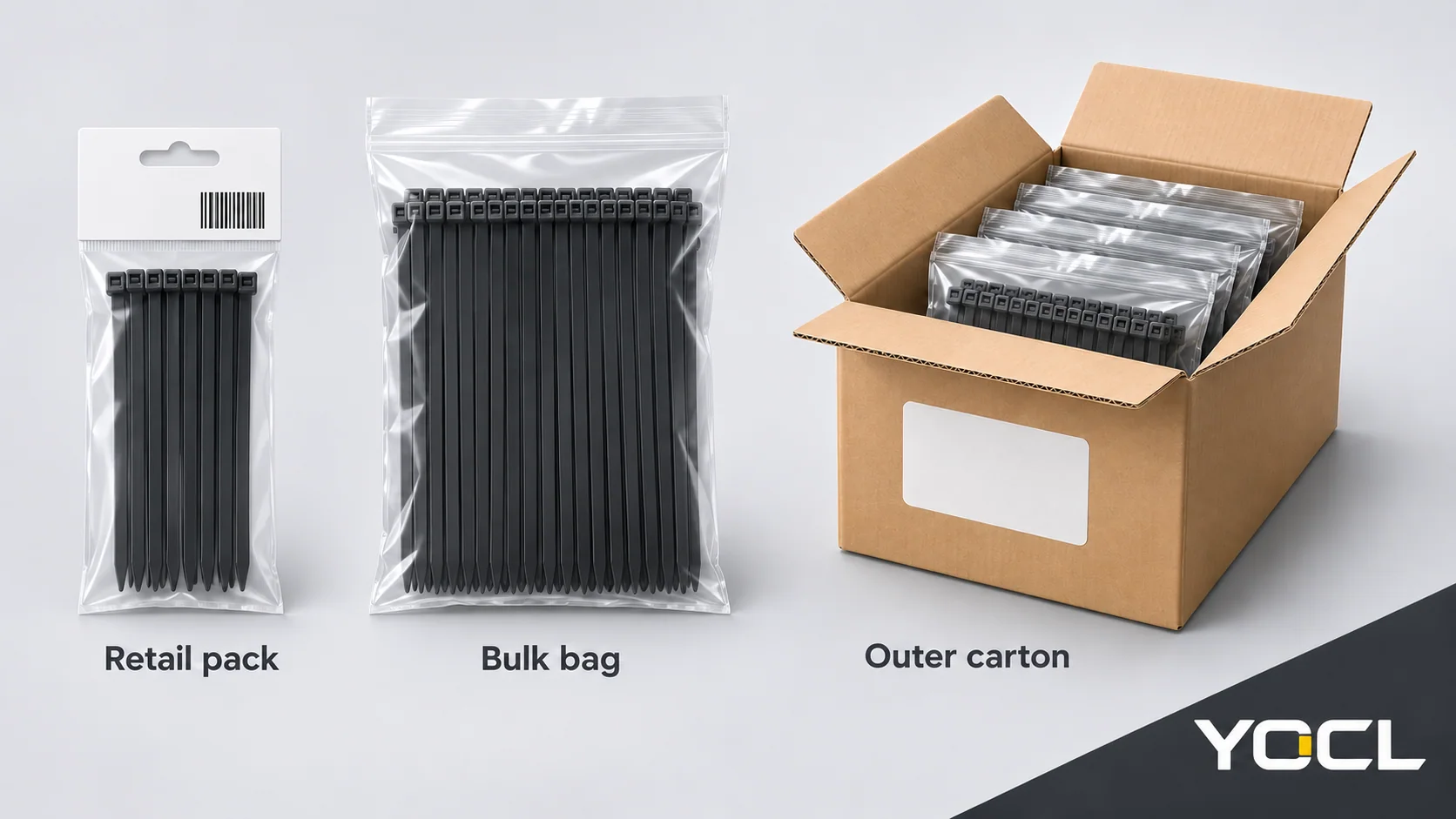
Describe the intended sales format before approving the design. For retail, ask whether a hanging bag, header card or printed box is feasible and appropriate for the channel. Confirm how the product is displayed, how the pack opens and where its label remains readable. For bulk supply, ask about bags or inner packs that support counting, identification and your warehouse’s handling needs. These are format choices to confirm, not assumed YOCL packaging options.
Write the packing hierarchy as ties per pack -> packs per inner carton, if used -> inner cartons or packs per outer carton. Include the resulting total ties per outer carton and the agreed handling dimensions and weight limits. Do not write only “carton quantity”: it leaves unclear whether the number refers to ties, bags or boxes. Keep each assortment’s size breakdown visible at the selling-unit level.
For printed boxes or headers, approve the following artwork details:
- Dieline and assembled form: final size, cut and fold lines, glue or seal areas, closure and any hanging hole; check the folded or filled sample as well as the flat proof.
- Brand presentation: current logo file, orientation, approved colours, print finish and which panels face the buyer.
- Data placement: correct SKU, quantity, description, barcode and batch area, with no critical information lost at a fold, seal or closure.
- Copy and claims: spelling, units, language versions and evidence for every technical claim or certification mark proposed for the private-label product.
- Print handoff: approved file format, fonts or outlined text, image quality, and the printer’s bleed and safe-area requirements.
- Version control: named artwork revision, approval date, approver and the affected SKUs; withdraw superseded files from the production instruction.
Treat a change from a bag to a box as a new pack-layout review. The approved text may remain valid, but the print surface, folded panels, barcode position and quantity presentation need checking in the new form.
5. Private-label sample sign-off: approve what changed
The extra private-label approval is a comparison with the already-qualified product. The general sample and supplier-approval process covers the underlying sampling and acceptance workflow. Here, concentrate on the added branded configuration:
| Private-label difference | Evidence needed before sign-off |
|---|---|
| Marked tie replaces a plain tie | Actual mark on the proposed location; visibility after looping and trimming; agreed durability result and disposition of any effect on the tie |
| Custom colour replaces an approved colour | Finished tie matched to the agreed physical reference; confirmation that required performance evidence covers the offered version |
| Your SKU replaces the supplier’s public reference | Verified cross-reference, correct label text and a batch-identification route that still reaches the supplied product |
| Branded pack replaces stock packaging | Filled and closed pack with approved artwork, correct contents, readable required information and agreed barcode checks |
| Pack quantities or assortment change | Physical contents reconciled with the retail label, inner-pack definition and outer-carton total |
Request the branded tie inside its proposed finished packaging. An unmarked stock sample plus a digital artwork proof leaves the interaction unapproved: the label may obscure the product, the logo may be invisible after use, or the contents may not match the retail code. If the sample uses temporary labels or a substitute printing method, record exactly what it can approve and what remains open.
On the private-label approval sheet, record the supplier model/private-label SKU pair, colour reference, logo file, label file, packaging revision and sample identifier together. Give each a disposition of approved, approved with a recorded condition, or not approved. A packaging signature should not silently approve a changed material, unsupported outdoor claim or altered locking geometry.
YOCL’s OEM and ODM project process confirms sample scope, cost and timing by project. When requesting a quotation through the cable ties manufacturer page, attach this private-label approval sheet and identify any open items. Ask for minimum quantity and schedule confirmation for the specific configuration, rather than assuming stock-product terms apply.
FAQ
What is the difference between OEM and private label cable ties?
OEM means original equipment manufacturing and describes a supplier making cable ties to an agreed customer specification. Private label describes cable ties sold under the buyer’s brand, which may involve the product, its labels or its packaging. The arrangements can overlap: a private-label order may use an existing tie with branded packaging or include agreed product changes. Confirm the actual scope rather than relying on either term to define tooling, exclusivity or ownership.
Can cable ties carry my own logo?
A logo on a cable tie is a project-specific feasibility question. Confirm the selected model, marking method, available area, orientation and required durability; also check whether the mark remains visible after tightening and trimming. A logo on a bag does not mean the tie itself is marked. YOCL invites discussion of logo positions and printing options on its OEM and ODM page, but that does not confirm every method for every tie.
Can I order cable ties in a custom colour?
A custom-colour cable tie request needs supplier confirmation for the chosen model, material, quantity and performance requirements. Specify a named colour reference and approve a physical finished-tie sample under agreed viewing conditions. Confirm repeat-batch acceptance and any required UV evidence separately. Matching a brand colour does not establish UV resistance, and YOCL’s public pages do not guarantee every custom colour for every cable-tie model.
What should I confirm about labels, barcodes and retail packaging?
Confirm the private-label SKU, supplier-model cross-reference, description, size, colour, contents quantity, batch field and applicable market-facing text. Agree the barcode identifier, symbology, print layout and retail/warehouse acceptance requirements for each packing level. Approve the filled retail pack and assembled box against the correct artwork revision, checking that labels remain readable and the decoded barcode identifies the actual product and selling quantity.
What MOQ applies to private label cable ties?
There is no single publicly stated YOCL minimum order quantity for private-label cable ties. YOCL says minimum quantities depend on the product and customization scope and are confirmed with the quotation. Request written terms for the exact model, colour, logo and packaging configuration, including whether quantities can be combined across variants. Do not assume the minimum for a stock or plain-packed tie also applies to a branded version.
References
- YOCL ELECTRIC – OEM and ODM, first-party customization enquiry scope and project-specific commercial terms.
- UL Solutions – Cable Ties for Cable Management, section on resistance to ultraviolet light and coloured stabilized polymers.
- GS1 – What should I check to ensure good quality barcodes?, barcode print and packaging checks.