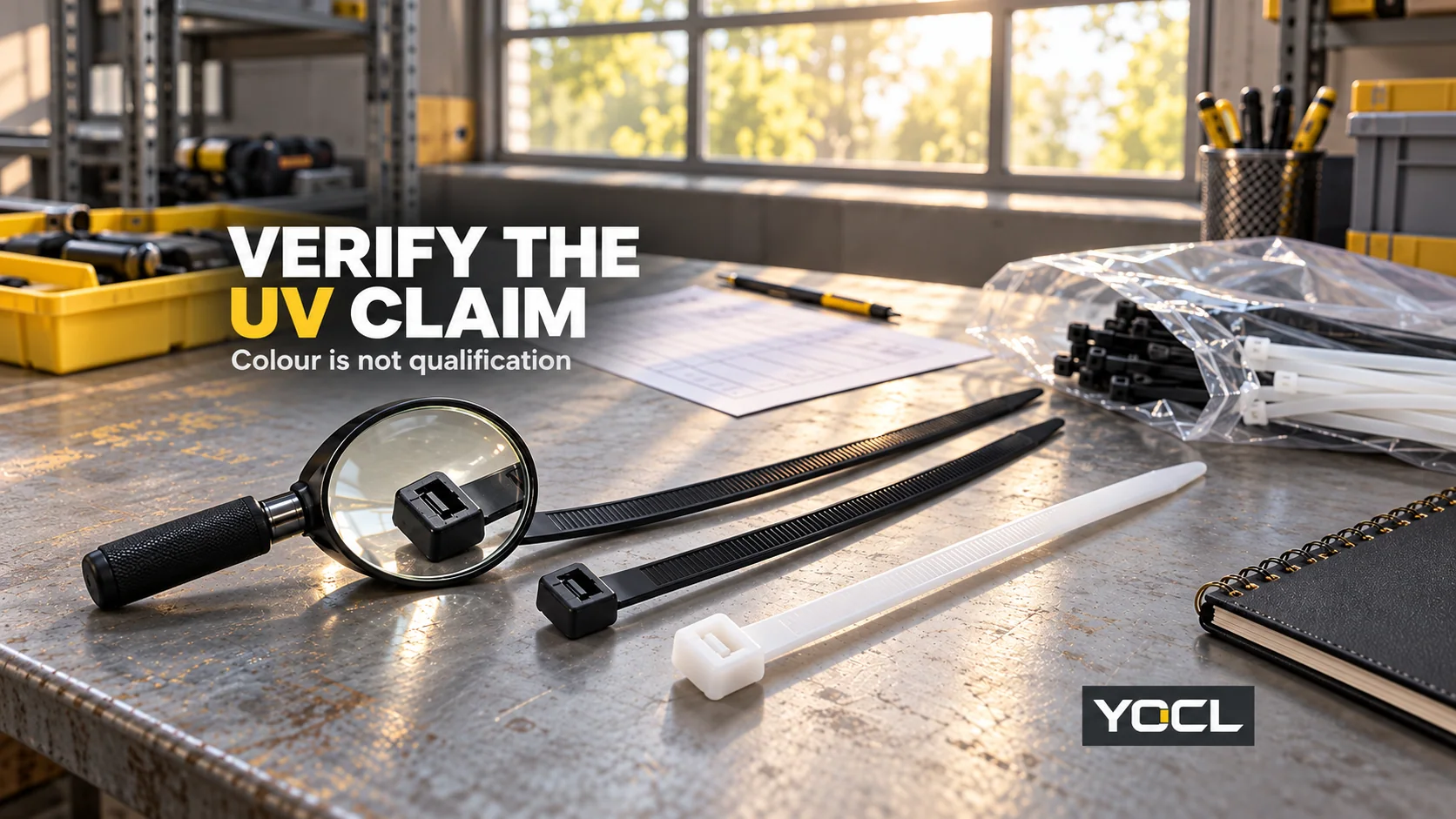
Choose standard cable ties for protected service when their exact specifications meet the duty. For sunlight or another ultraviolet (UV) exposure, choose a specifically documented UV-resistant construction. Verify the finished tie, exposure evidence and remaining performance—not just its colour, polymer name or initial tensile figure.
“Standard” describes a product version, not a universal indoor rating. “UV-resistant” adds an exposure-related claim; it does not automatically establish higher strength, higher temperature capability or a fixed outdoor lifespan.
Compare Both Versions Against the Same Duty
| Verification point | Standard candidate | UV-resistant candidate |
|---|---|---|
| Protected location without relevant UV exposure | May qualify on its documented service limits | May also qualify; UV protection alone may add no required function |
| Sun-exposed location | Do not approve without applicable exposure evidence | Confirm the exact version and evidence covering the intended exposure |
| Black colour | Does not establish a UV claim | Does not identify the stabilizer formulation or qualification |
| Initial loop strength | Check the model and test basis | Check separately; UV resistance is not a strength multiplier |
| Performance after exposure | Cannot be assumed from initial data | Request the evaluated property, method and acceptance result |
| Temperature, fluids and fixing arrangement | Verify each required condition | Verify each required condition; a UV claim does not resolve them |
| Procurement decision | Accept only for a covered duty | Accept only when identity and evidence align with the duty |
If the environment or evidence remains unresolved, hold both candidates. A more expensive “outdoor” tie is not an automatic substitute for verification.
Two Black Ties Can Require Different Purchasing Decisions
YOCL’s YC Standard Nylon Cable Ties are offered in natural and black polyamide 6.6 (PA66). Their published specification explicitly states “UV resistant: No.” The black version therefore cannot be selected for UV-exposed duty on colour alone.
The same record states a material flammability classification and an operating range. Those are different characteristics from UV resistance. A material flame classification does not establish finished-product outdoor qualification.
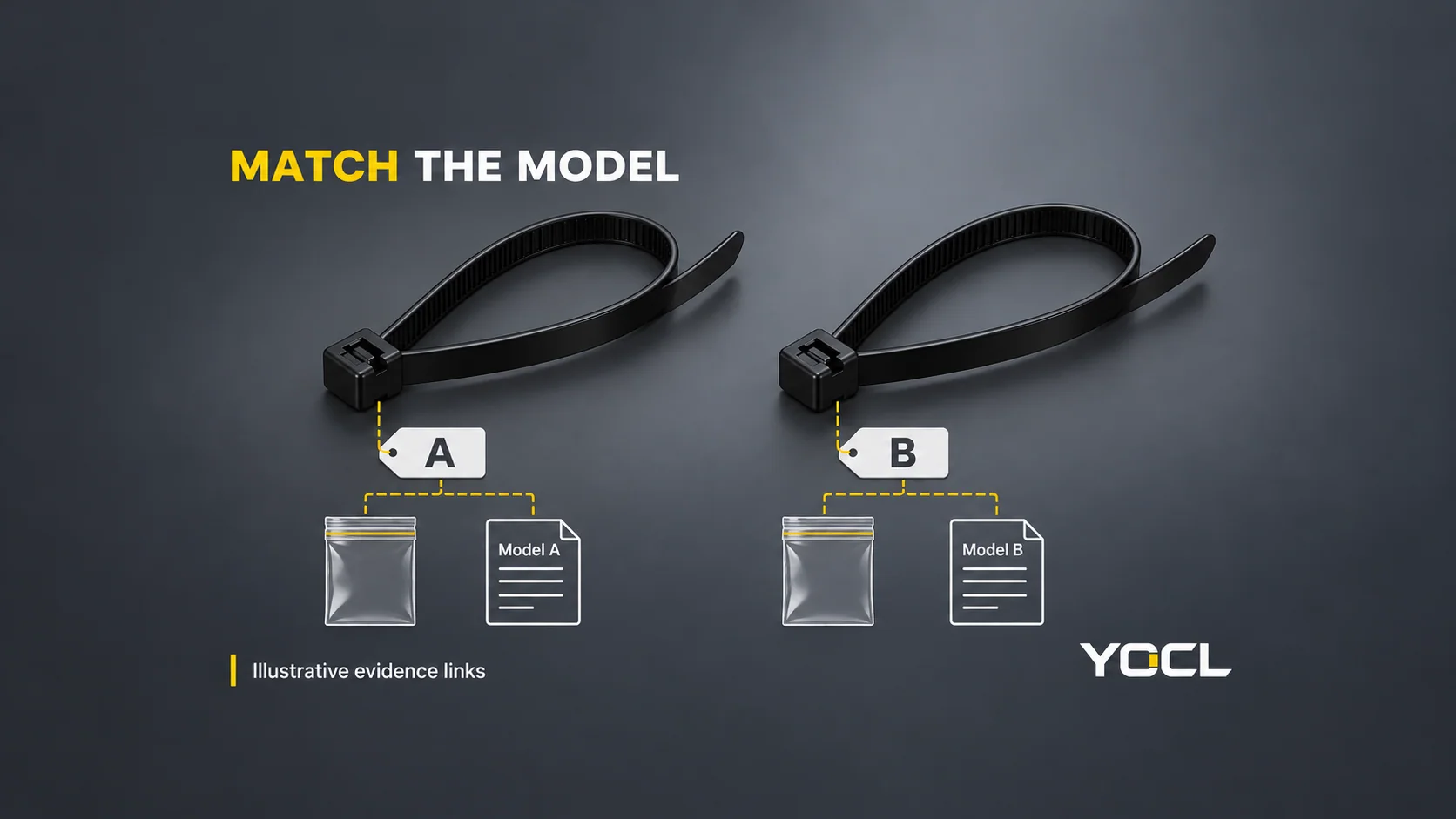
Consider a hypothetical quotation offering two black ties of the same nominal dimensions:
- Candidate A has a traceable standard-series record stating that it is not UV resistant.
- Candidate B is described as “UV-stabilized,” but the supplied report names a different product and does not establish coverage of the offered tie.
For an exposed route, reject A for the UV requirement and hold B pending a valid evidence link. For protected bundling, A may remain eligible after the other requirements are checked. Neither price nor matching appearance changes these decisions.
Follow the Evidence from Part Number to Result
Ask the supplier to connect offered part → construction → evaluated sample → exposure method → functional result. A report is useful only when this chain is clear.
1. Identify the Construction Actually Being Supplied
Record the manufacturer, series, model, size, colour and material grade. Check which variants a report covers and why; do not assume one tested size or colour represents every item in a catalogue.
A resin declaration can identify an ingredient, but does not by itself establish the assembled tie’s performance. Likewise, a general company certificate does not identify the offered product’s exposure qualification. For a claimed certification, request the applicable record and scope rather than accepting a logo on a quotation.
2. Read More Than the Exposure Duration
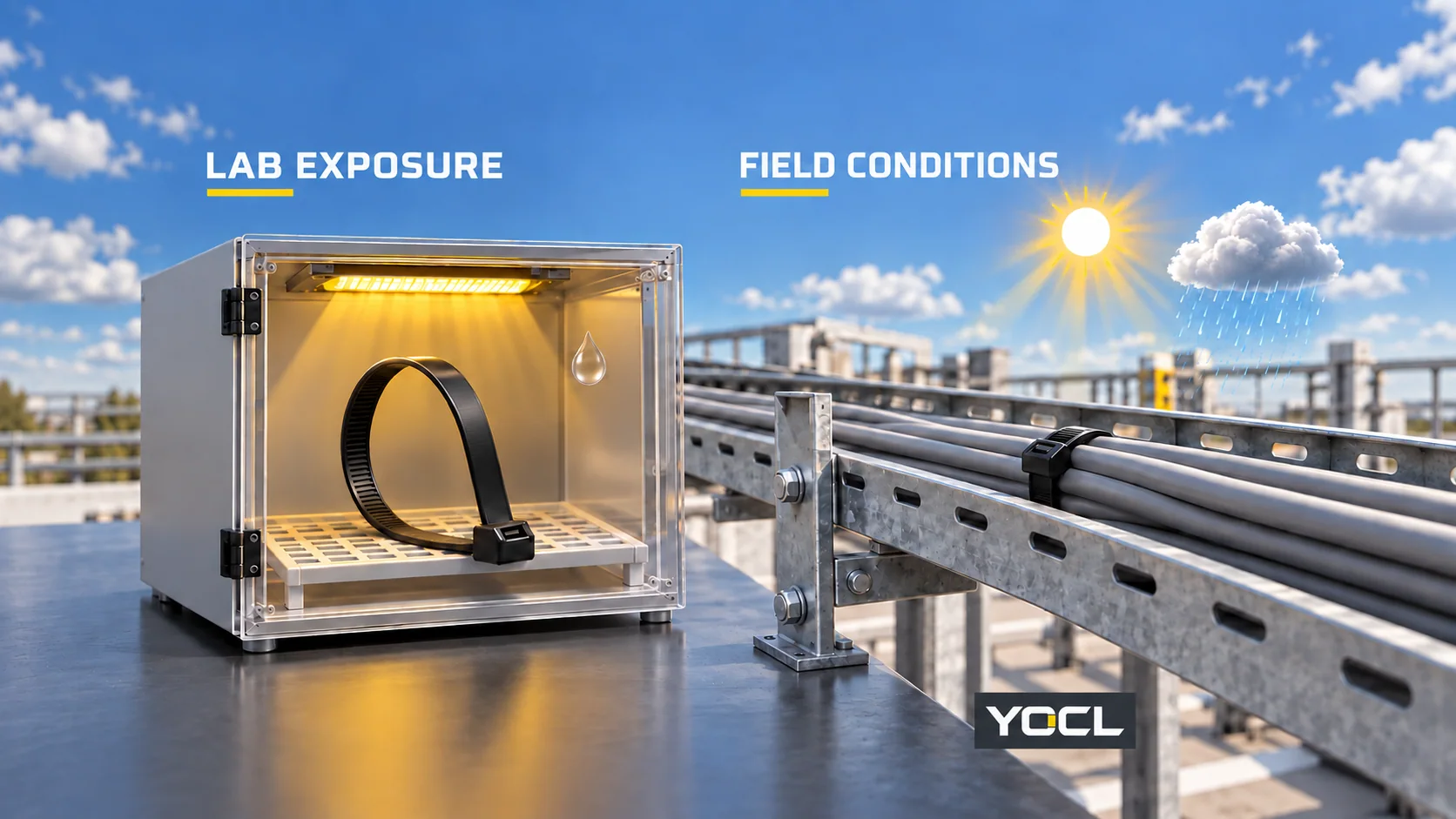
UL Solutions’ cable-management guide describes strength investigation after UV and water exposure using ISO 4892-2, Method A, Cycle 1. It also connects applicable ratings to package marking and notes that stabilized polymers can be supplied in different colours. This describes an evaluation framework, not proof that a YOCL model is certified.
Request the report’s method and edition, exposure cycle, light source, duration, specimen identity, conditioning and measured result. These fields let you determine whether two reports describe comparable evaluations. A headline such as “tested for many hours” leaves the essential acceptance question unanswered.
IEC 62275:2022, edition 4.0, covers cable ties and associated fixing devices for managing or securing electrical wiring systems. Its public catalogue scope is a standards reference; citing it does not establish conformity of a particular tie. The full paid standard was not consulted for this article.
3. Verify the Property Needed After Exposure
A colour photograph or “no visible change” statement does not answer whether the tie can still perform its fastening function. Request the applicable functional test and its result, including whether the finished locking construction was evaluated.
Compare before-and-after data using the report’s own acceptance criterion. Do not invent a universal retained-strength percentage or compare results with different conditioning and methods as if they were equivalent. If only an initial tensile value is provided, post-exposure performance remains unverified.
Test Hours Are Not Outdoor Service Years
There is no defensible universal rule converting accelerated exposure hours into years on a roof or outdoor machine. NIST’s accelerated-weathering research explains the difficulty of correlating laboratory and outdoor exposure because UV spectrum, intensity, moisture and temperature vary. Validated correlation models and outdoor data are needed for meaningful prediction; that research is not a cable-tie lifetime guarantee.
A completed exposure test may support the declared qualification under its conditions. A claim such as “suitable for ten years at this site” needs additional applicable evidence, including the installation environment and the supplier’s defined limits. Ask whether a stated period is a warranty, a qualification statement or a validated prediction.
UV Resistance Must Fit the Rest of the Installation
Heat resistance and UV resistance must be checked separately. YOCL’s YC H-series heat-resistant ties declare a higher operating-temperature range, but that listing does not establish UV qualification. Do not substitute the H suffix for outdoor evidence.
UL distinguishes installation temperature from service temperature, and loop tensile strength from long-term static load-bearing capability. An exposed installation also needs suitable fixing devices. Evaluate those requirements independently; a qualified tie cannot make an unsuitable base or support arrangement acceptable. UL Solutions.
| Your installation | Start with | What can reverse the choice? |
|---|---|---|
| Protected control-panel bundling without UV exposure | A standard model meeting the remaining requirements | Temperature, material compatibility, fit or mechanical evidence is inadequate |
| Outdoor cable routing in sunlight | A documented UV-resistant version | Report does not cover the supplied construction or required exposure |
| Hot equipment with sunlight exposure | A construction covering both duties | Heat-resistant designation lacks UV evidence, or UV-qualified version lacks temperature suitability |
| Unknown chemical exposure or unresolved sustained support duty | Neither candidate yet | Resolve the missing compatibility or support evidence first |
If neither nylon candidate qualifies, reassess the fastening construction. The separate nylon vs stainless steel cable-tie comparison covers that material-family decision.
Put the Verification into the Order
Use this acceptance brief when reviewing the YOCL cable-tie range:
- Duty: location, sunlight/UV exposure, temperatures, fluids, bundle size and fastening function.
- Identity: exact part number, dimensions, colour and material version; link the delivered package and batch to the accepted specification.
- Evidence: applicable report or certification scope, exposure conditions, tested property and acceptance result.
- Changes: require review of substitutions affecting construction or evidence coverage before accepting them.
For YOCL’s standard YC series, the public UV declaration already rules it out for that requirement. For another offered version, request its own supporting documents before bulk approval. The right outcome may be standard, UV-resistant or neither; the evidence and duty decide.
Related reading: common causes of nylon cable tie breakage.
References
- YOCL ELECTRIC — YC Standard Nylon Cable Ties, first-party material, colour and UV declarations; accessed 11 October 2026.
- UL Solutions — Cable Ties for Cable Management, UV exposure, marking, temperature and mechanical-function guidance.
- IEC — IEC 62275:2022, edition 4.0; public catalogue scope only.
- NIST — Measurement Science Tools for Accelerated Weathering of Polymers Project, laboratory/outdoor correlation limits.
- YOCL ELECTRIC — YC Heat Resistant Nylon Cable Ties, first-party H-series declaration; accessed 11 October 2026.