
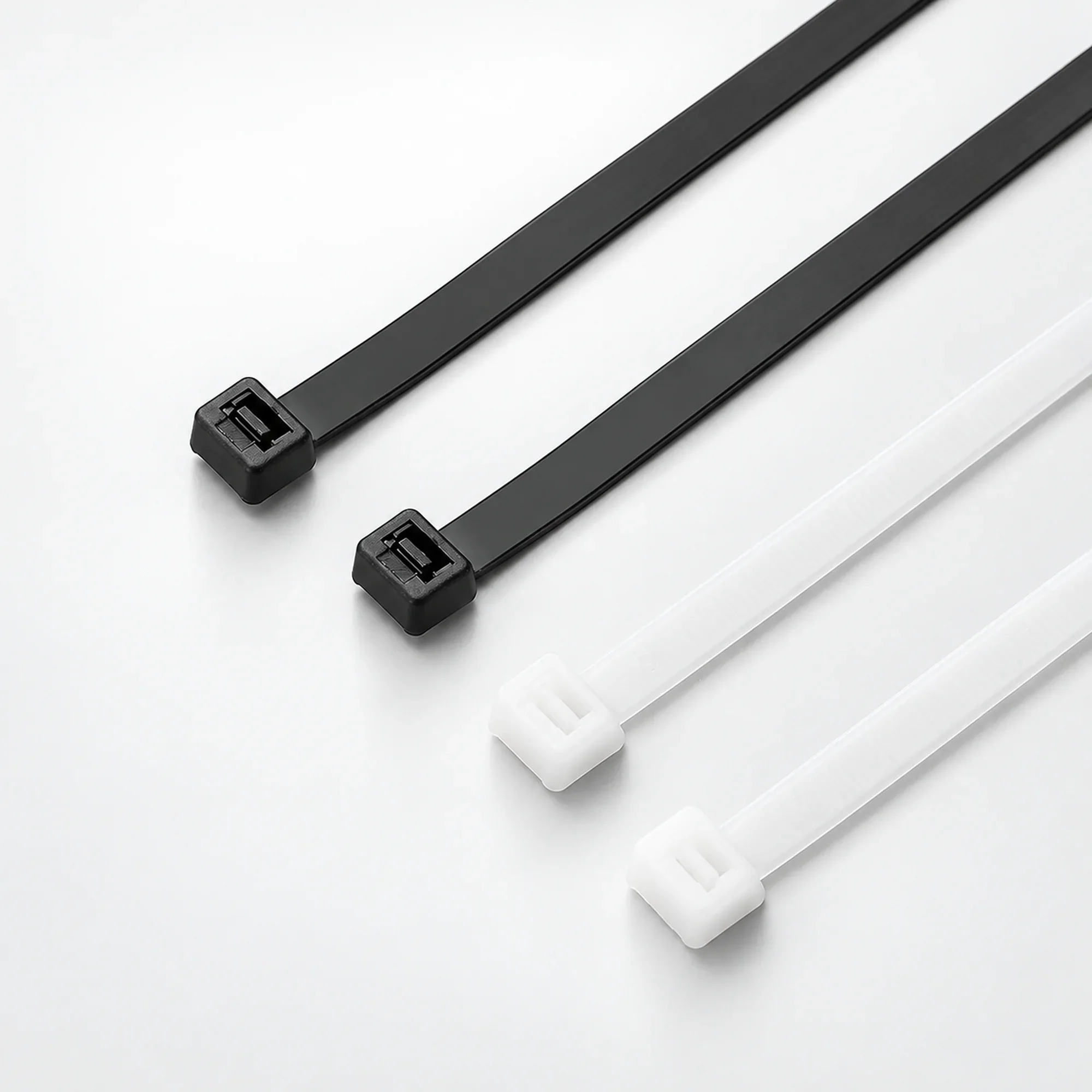
A nylon cable tie is a flexible polyamide strap with a head that retains the strap as a loop around a bundle. Often called a zip tie, it brings wires or other permitted items together through its strap-and-lock construction. The head design, material grade and declared ratings determine the particular product’s capabilities.
The familiar single-loop tie is one form. Nylon ties also include larger-duty constructions, double-loop layouts and heads with different locking elements. Understanding those distinctions helps you identify the right product family before comparing individual sizes.
Start with the question you need to answer
Use the following guides for decisions that need more detail than a product overview:
| Your question | Read next | The task it covers |
|---|---|---|
| Which dimensions and strength fields should I compare? | Cable Tie Size and Tensile Strength Chart | Read model rows, units and bundle limits together. |
| Will the tie suit sunlight or another ultraviolet (UV) exposure? | UV-Resistant vs Standard Cable Ties | Assess the specified construction and its exposure evidence. |
| Should this fastening use nylon or stainless steel? | Nylon vs Stainless Steel Cable Ties | Compare the two constructions against the same duty. |
| Why are ties cracking or breaking? | Why Do Nylon Cable Ties Break? | Investigate stock, installation and service conditions. |
| How does the bundle attach to a panel or surface? | Cable Tie Mounts Explained | Identify the separate tie-to-mount and mount-to-surface interfaces. |
Construction, material and rating are three different descriptions
A description such as “heavy-duty, heat-resistant nylon cable tie” combines several questions:
- Construction: how many loops does it form, what head does it use, and what physical space does it need?
- Material: which polymer and specified grade or formulation are supplied, and are other materials present in the locking assembly?
- Rating: what does the exact model declare for bundle size, strength and relevant environmental conditions?
These descriptions can overlap. A double-loop tie may also belong to a particular material grade. A larger strap still needs its own exposure declaration. Treating each adjective as an entirely separate product type can hide the specification you actually need.
For a drawing or parts schedule, begin with the visible construction and complete part identity. Add the material and performance requirements as separate fields. That gives the next reader a clearer description than a colour or broad family name alone.
Recognize the main nylon cable tie constructions
The head and strap layout are useful starting points because they change how the tie occupies space and contains the bundle.
| Construction branch | What distinguishes it | YOCL example |
|---|---|---|
| General single-loop bundling | An internally serrated strap and locking head form the familiar loop. | GT series nylon cable ties |
| Extra-heavy-duty family | A separately specified construction with its own dimensions and loop-strength declaration. | GT-EHD cable ties |
| Double-loop form | A two-opening head allows two loops for separately contained bundles. | YC double-loop nylon cable ties |
| Nylon tie with a metal locking element | The polymer strap works with a stainless steel barb in the head. | HSS-TL stainless-barb cable ties |
“Heavy-duty” is a family description to investigate, rather than a shared numerical rating across suppliers. A usable comparison still requires the model and its declared data.
Double-loop ties change the bundle layout
The YC double-loop form has two head openings. Its purpose is to contain two bundles in separate loops, rather than put both inside one common loop. The product listing identifies separate loop-diameter fields, D1 and D2; the two sides therefore need their own fit check.
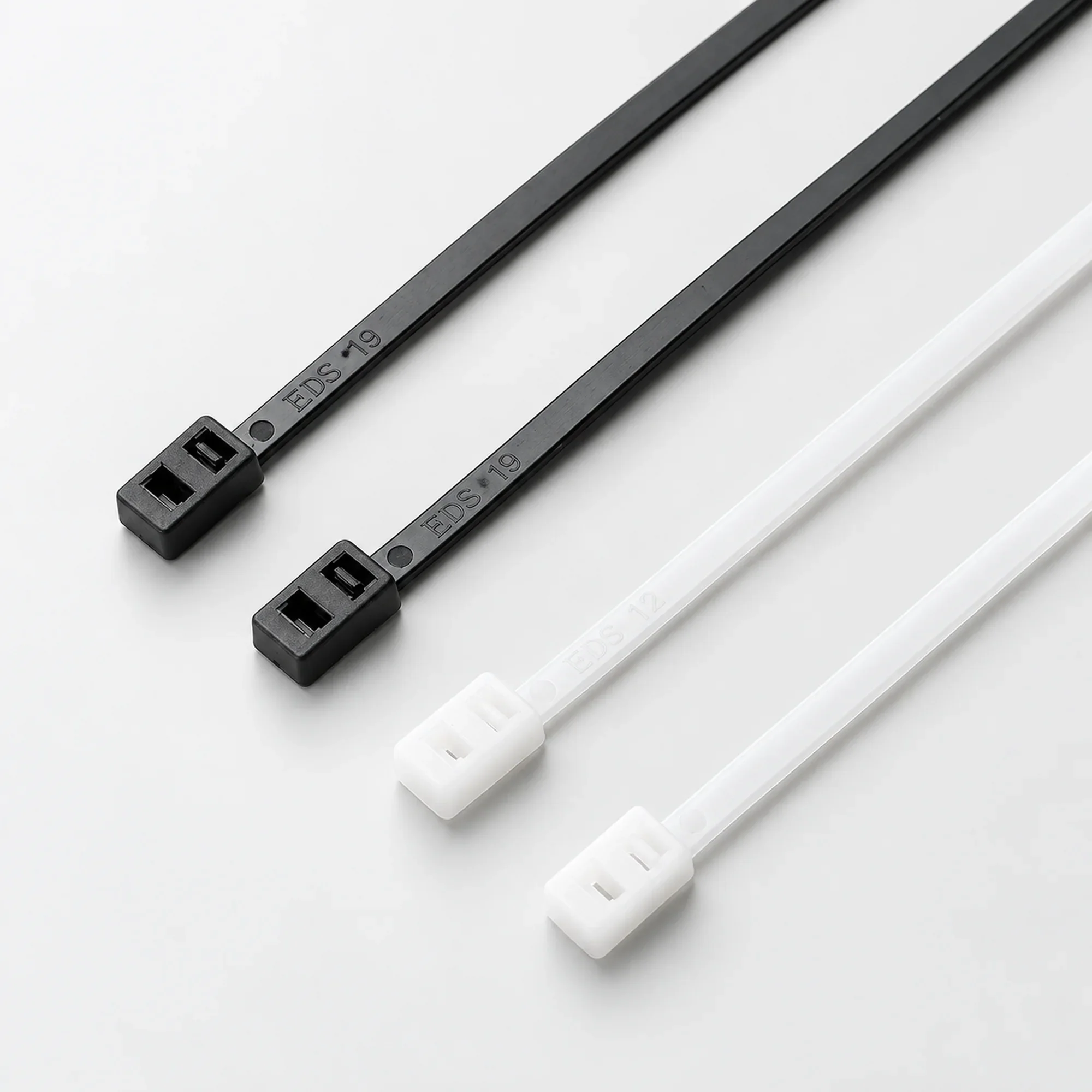
This is a layout distinction. It does not establish an installation sequence, the required tightening method or a combined allowable load. Those questions belong to the selected product and its application documents.
Other catalogue branches include different head profiles, multiple-locking and buckle constructions. Identify the actual mechanism before assigning release or reuse requirements. A name containing “lock” does not, by itself, explain whether a tie is intended to be reopened.
What does “nylon” tell you about the material?
Nylon identifies a polyamide material family. The more specific polymer designation is part of the product specification: for example, YOCL’s GT and YC Standard listings identify polyamide 6.6, commonly written PA66 or nylon 66.
That material name is a starting point. It does not specify every environmental property of the supplied tie. The catalogue also separates heat-resistant, cold-weather and flame-retardant branches. Read those as requirements to verify for a particular product configuration, rather than properties inherited by every nylon tie.
A useful material description therefore keeps three things visible: the base polymer, the supplied grade or version, and the relevant declaration for the intended environment. Preserve the exact model identity when moving from a catalogue page to a quotation or technical document.
A nylon strap can have a stainless steel locking barb
HSS-TL is declared as PA66 with a stainless steel barb. Its metal element is in the locking head; the product remains a different construction from a cable tie made with a stainless steel band.
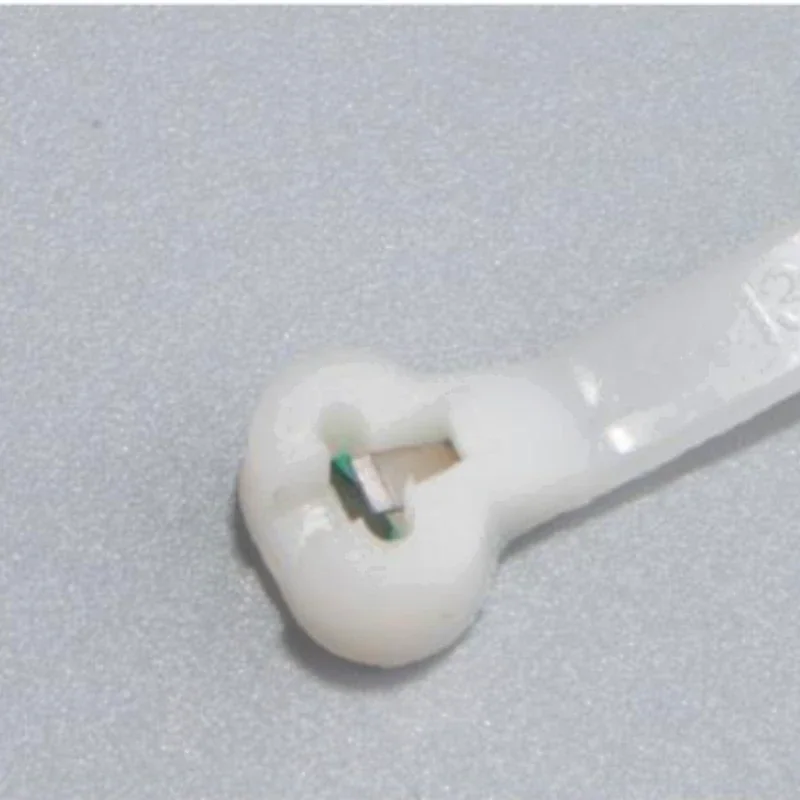
This example separates the strap material from the locking-element material. Where a specification restricts metallic components, check the complete construction. Describing only the strap as nylon leaves that question open.
Read the rating fields separately
The specification fields below answer different questions. Keep their values attached to the exact model and product version.
| Field | What to learn from it |
|---|---|
| Length, actual width and bundle range | The tie’s physical envelope and declared bundle fit. A model code alone is not the dimension table. |
| Loop tensile strength | A characteristic of the engaged strap-and-lock assembly, rather than a long-term support-load allowance. |
| Installation and operating temperatures | The conditions for fitting the product and the conditions for its service are separate declarations. |
| UV resistance | Exposure suitability requires the relevant declaration; colour alone is insufficient. |
| Material flammability class | Identify what material and classification are stated; keep this separate from finished-product certification. |
The loop-strength and temperature distinctions are described in UL Solutions’ cable-management guidance. Its evaluation guidance does not establish a certification for a YOCL model.
For a concrete documentation boundary, YC Standard product information distinguishes its stated material flammability classification from finished-product UL listing. Keep the scope of the evidence with the claim instead of shortening both to “UL certified.”
A tie’s loop strength and a fixing device’s mechanical strength are also different parameters. Assess the complete arrangement when the task includes supporting cable weight; the tie’s strength figure alone does not resolve that duty.
The fixing point is a separate part of the system
A loose tie can bring a bundle together without attaching that bundle to a panel. A separate mounting base adds a fixing interface; a mounting-style tie instead incorporates a fixing feature in its own construction. The chosen tie, fixing and receiving surface must suit their assigned jobs.
Identify which interface remains unresolved before requesting another component. A need for a panel attachment is a different question from choosing the strap width or the locking-head form. The mount guide in the navigation table follows that attachment chain in detail.
Identify the family, then request the exact model data
Start with the construction that matches the bundle arrangement. State the polymer/version, physical space, relevant exposure and required performance fields, then confirm them against the selected model’s documentation.
For available series and a model enquiry, use the YOCL nylon cable tie range. Include the bundle arrangement, dimensions, environment and any project-specific documentation requirement so the product identity and evidence can be checked together.
Related reading: See cable clips and clamps explained.
References
- YOCL ELECTRIC — GT series nylon cable ties; first-party construction and PA66 declaration.
- YOCL ELECTRIC — GT-EHD extra-heavy-duty cable ties; first-party construction-family information.
- YOCL ELECTRIC — YC double-loop nylon cable ties; two-loop description, separate loop fields and source product image.
- YOCL ELECTRIC — HSS-TL stainless-barb cable ties; declared material construction and source head image.
- YOCL ELECTRIC — YC Standard nylon cable ties; material/classification boundaries and source cover image.
- YOCL ELECTRIC — Nylon cable ties product family; catalogue branch navigation.
- UL Solutions — Cable Ties for Cable Management; loop strength, fixing devices, environmental declarations and marking.