
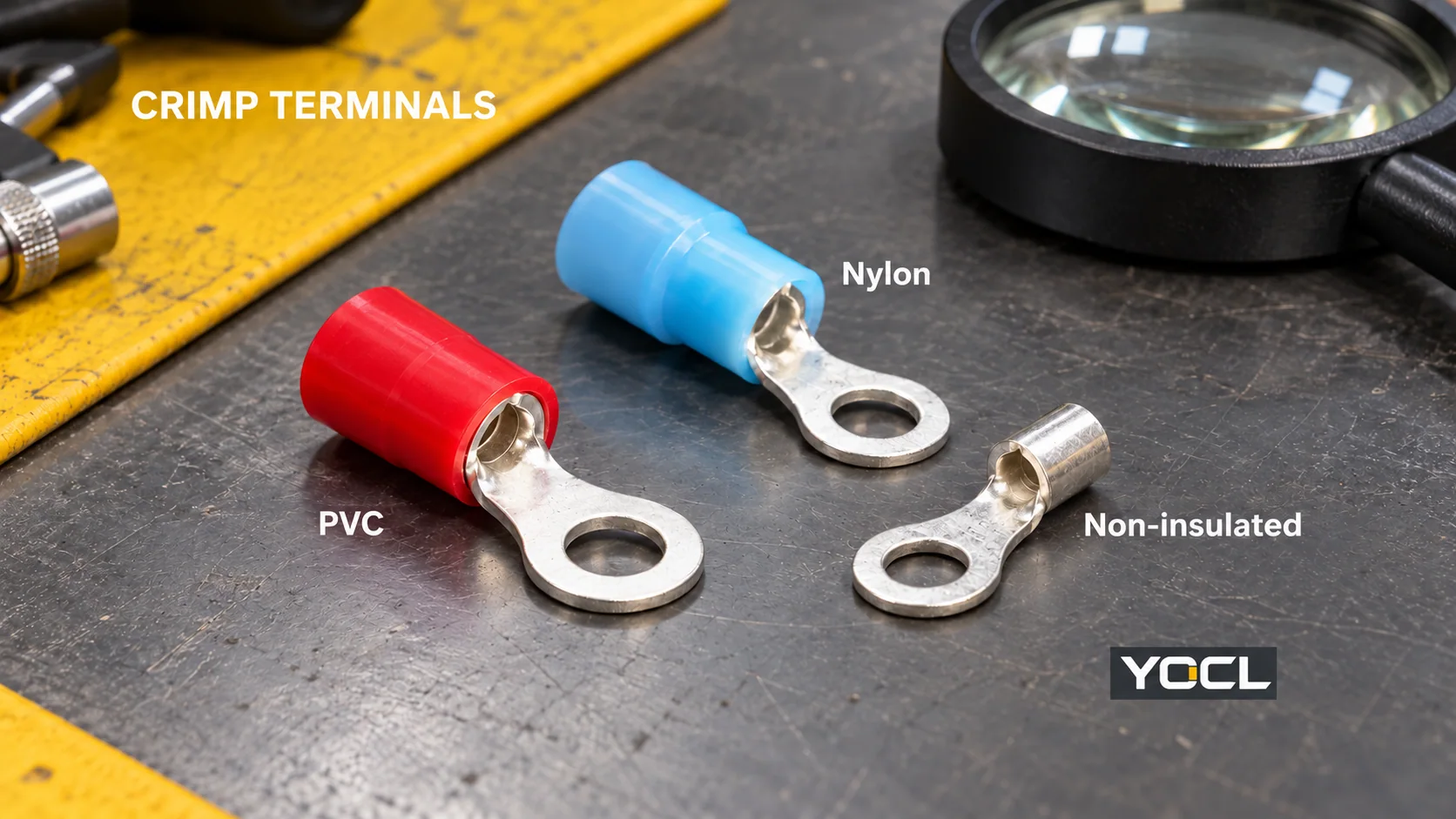
Choose PVC when a documented pre-insulated terminal meets the installation’s requirements. Choose nylon when the specific nylon model offers the ratings and crimp construction you need. Choose a non-insulated terminal when the finished assembly provides the required insulation, protection and clearances separately. None is a universal upgrade: sleeve material, barrel construction and environmental sealing are different decisions.
Compare terminals for the same conductor and equipment connection. This article uses ring terminals as a consistent example; changing from a ring to a fork, pin or disconnect introduces another mating-interface decision.
Quick Comparison: What Changes Between the Three?
| Decision factor | PVC-insulated | Nylon-insulated | Non-insulated |
|---|---|---|---|
| Barrel covering | A PVC sleeve on the specified model | A nylon sleeve on the specified model | No factory insulating sleeve |
| Equipment contact | A pre-insulated ring still has an exposed metal eyelet | A pre-insulated ring still has an exposed metal eyelet | Both barrel and eyelet are exposed |
| Crimp construction | May be single or double crimp | May be single or double crimp | Follow the exact barrel and tooling design |
| Temperature and exposure | Use the model’s declared limits | Use the model’s declared limits | Bare metal does not establish unlimited temperature or chemical suitability |
| Installation space | Include sleeve and tool-access dimensions | Include sleeve and tool-access dimensions | Include any separate cover or sleeving in the finished dimensions |
| Water sealing | An ordinary sleeve does not establish a sealed joint | An ordinary sleeve does not establish a sealed joint | Separate protection needs its own qualification |
| Selection priority | Qualify the exact PVC construction | Qualify the exact nylon construction | Qualify the terminal plus the protection arrangement |
YOCL’s wire-terminal range separates these families while asking for conductor size, connection dimensions and assembly requirements. The table compares construction choices, not certified performance classes.
An Insulating Sleeve Does Not Cover the Whole Connection
PVC and nylon identify the polymer sleeve. The conductive terminal inside still makes the electrical connection. On a pre-insulated ring terminal, the sleeve surrounds the barrel area while the ring tongue remains available for bolting to the equipment.
That distinction is visible in YOCL’s RV PVC ring-terminal examples and RNY/RNYD nylon ring-terminal examples. The RNB non-insulated ring omits that sleeve altogether.
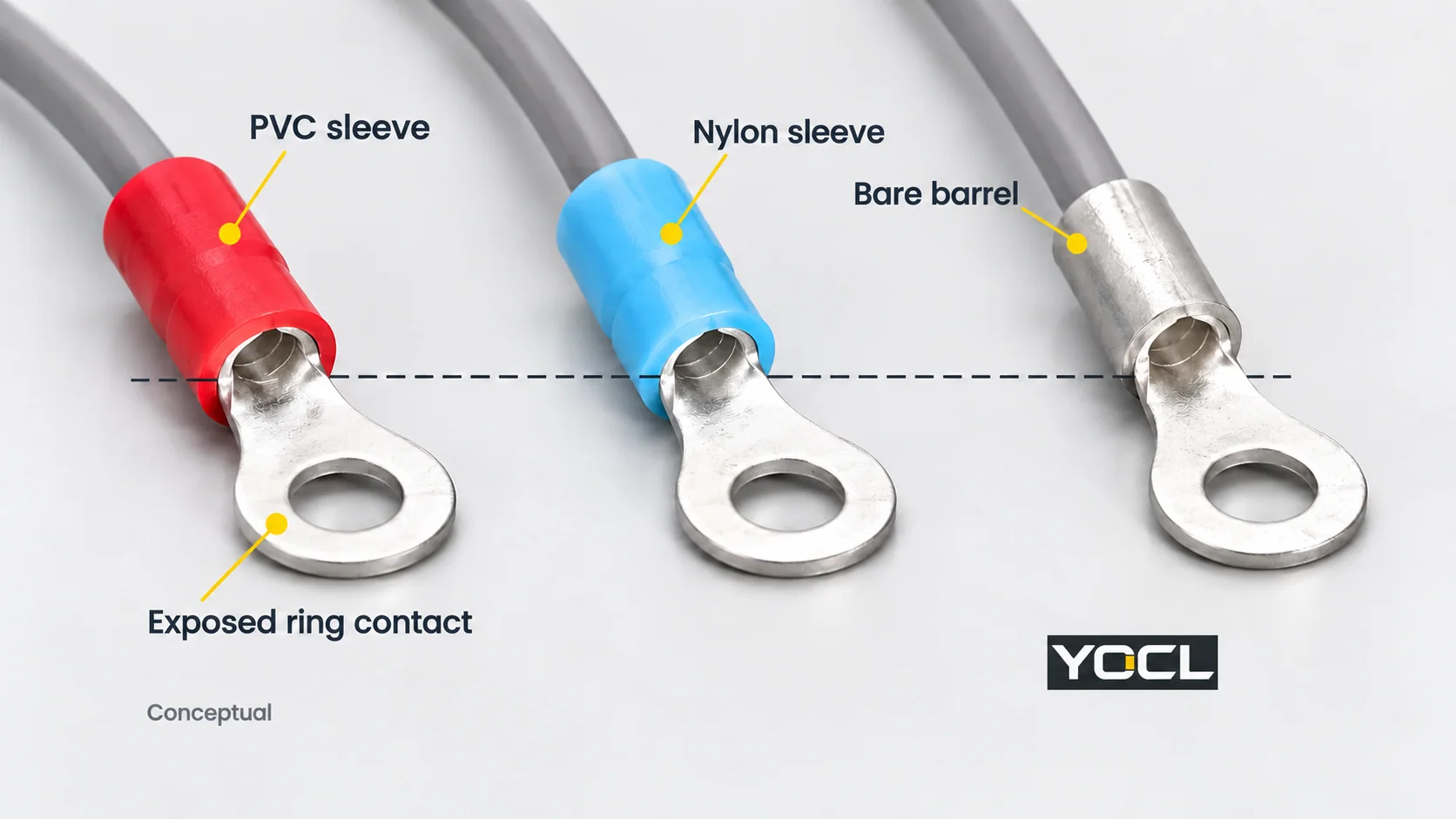
For non-insulated terminals, decide how the assembly supplies protection: a suitable cover, sleeving, barriers or an equipment enclosure, as applicable. Confirm coverage and clearance in the assembled connection. An enclosure around a bare terminal is not, by itself, proof that every internal spacing or accessibility requirement has been met.
Equally, adding a sleeve over the barrel does not make an exposed bolted ring connection safe to touch. Select the required finished protection arrangement before deciding which terminal is more convenient to install.
Nylon Does Not Automatically Mean Double Crimp
Insulation material and crimp construction are independent labels. YOCL offers a useful counterexample:
- RVD: a PVC-insulated double-crimp ring terminal with an additional copper tube described in the product information.
- RNY: a nylon-insulated single-crimp ring terminal.
- RNYD: a nylon-insulated double-crimp ring terminal with a copper tube and sleeve construction.
These distinctions come from the RVD description and reference drawing and the RNY/RNYD catalogue. Choosing nylon alone does not select the double-crimp version; choosing PVC does not exclude it.
The conductor connection and any designed insulation-support feature have different jobs. Match the terminal to the wire’s conductor and insulation dimensions, then follow the specified tooling method for that construction. “Double crimp” does not automatically mean performing two squeezes with any available tool.
For a moving harness, assess the complete termination and cable support. A sleeve label or an additional tube alone is not evidence of a quantified vibration rating or pull-out improvement.
Temperature and Exposure: Use Product Data, Not a Material Ranking
YOCL’s RNY/RNYD product information lists a 105°C temperature figure for its three conductor groups. That is a declaration for those nylon products, not a universal limit for every nylon terminal. The published RV information does not supply a matching temperature figure; do not fill that gap with a generic PVC value borrowed from another supplier.
Before choosing a terminal for a hot location, establish the temperature at the connection and obtain the relevant operating limits and conditions for each candidate. Removing a polymer sleeve does not remove limits imposed by the conductor, terminal body, equipment connection or any added protection.
The same approach applies to oils, cleaning chemicals, sunlight and cold installation conditions: assess the exact product against the actual exposure. Do not assume every nylon sleeve is UV-resistant, chemically compatible or suitable for an engine compartment.
For wet service, choose a documented protection or sealing arrangement. A coloured sleeve and a visually neat heat-shrink retrofit do not establish an ingress rating. Review the connection, tubing or cover and installation method as an assembly.
Same Wire Range and Hole Size: A Replacement Example
These YOCL ring terminals share a declared conductor range of 0.5–1.5 mm² and a 4.3 mm bolt hole, but their overall lengths differ:
| Model | Insulation construction | Conductor range | Hole diameter | Overall length L |
|---|---|---|---|---|
| RV 1.25-4S | PVC-insulated | 0.5–1.5 mm² | 4.3 mm | 19.6 mm |
| RNY 1.25-4S | Nylon-insulated, single crimp | 0.5–1.5 mm² | 4.3 mm | 20.6 mm |
| RNB1.25-4S | Non-insulated | 0.5–1.5 mm² | 4.3 mm | 14.4 mm |
Values are from the RV, RNY/RNYD and RNB model tables. They are catalogue dimensions, not measurements of completed crimps.
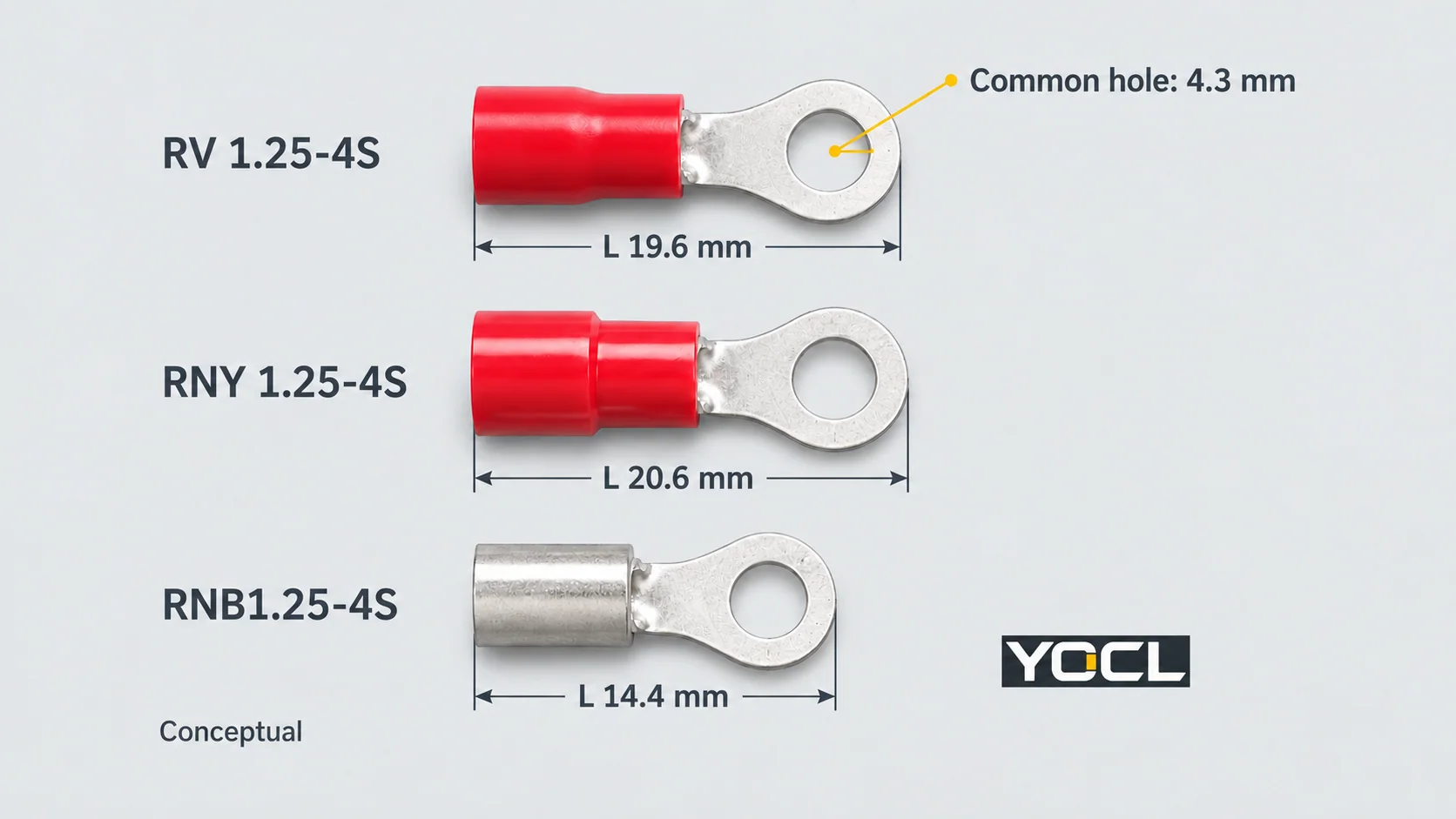
The shorter bare component may suit a different layout, but a separate cover can change the final space requirement. The longer sleeved component may affect wire bend clearance or tool access. Check the complete drawing and installed arrangement rather than treating the shared hole as a drop-in replacement approval.
Sleeve colour is also insufficient. YOCL’s RV range repeats red across different conductor groups. Specify the complete model and conductor range; do not turn a familiar colour into a universal wire-size rule.
Tooling and Qualification Decide the Completed Connection
A tool must suit the terminal’s barrel, conductor range and insulation construction. Do not select a die merely because its colour matches the sleeve, and do not use a bare-terminal indent profile on a sleeved terminal unless the applicable instructions permit it.
The public scope of IEC 60352-2:2024 includes appropriately designed uninsulated and pre-insulated crimp barrels. It addresses connection suitability under mechanical, electrical and atmospheric conditions. That provides a standards framework; it does not approve an arbitrary terminal–wire–tool combination.
As a scoped workmanship example, NASA-STD-8739.4A, Change 4, §12.3.3 follows manufacturer-recommended contact–conductor combinations, while §12.3.5 addresses crimp-process testing and traceability. These requirements concern NASA critical cable and harness work; their tool settings or test values are not universal instructions for commercial ring terminals. NASA standard.
For a supplier substitution, review the applicable preparation and crimping instructions, finished dimensions and required connection evidence. Appearance alone cannot confirm the conductor crimp hidden beneath a sleeve.
Certification scope matters too. UL Solutions identifies wire connectors, equipment-wiring terminals and ferrules under different standards in its connector certification overview. PVC, nylon and bare are construction descriptions, not certification marks. This comparison does not assert a UL listing for the YOCL examples.
Which Construction Should You Choose?
- A protected assembly with an established PVC terminal and tooling process: keep the qualified PVC model unless a specific requirement calls for a change. Nylon is not an automatic upgrade.
- A nylon model whose documented ratings meet a requirement: choose that exact model and its single- or double-crimp version deliberately. Confirm the complete assembly, not just the polymer name.
- An assembly designed around separate covers or barriers: assess a non-insulated terminal together with that protection. Include fitting and inspection work in the cost comparison.
- Different connection positions in one product: use different qualified constructions where their protection, access or tooling requirements differ.
- Unknown temperature, exposure or tool compatibility: choose none yet; resolve the missing qualification before treating the candidates as alternatives.
Compare total assembly cost after the alternatives qualify: terminal price, tooling, separate protection, installation effort and inspection. For YOCL enquiries, provide the conductor details, mating dimensions, protection arrangement and required quantities through the wire-terminal and ferrule range.
If the connection instead requires stranded-end preparation for insertion into a terminal, see the wire-ferrule guide. For cable-to-equipment termination families and interfaces, see the cable-lug guide.
Related reading: See ring-versus-spade terminal choice.
References
- YOCL product information — RV Pre-Insulated Ring Terminal — stated PVC groups, conductor ranges and model dimensions.
- YOCL product information — RNY/RNYD Nylon Ring Terminals — single/double construction, declared temperature figure and dimensions.
- YOCL product information — RNB Non-Insulated Ring Terminals — bare construction and model dimensions.
- YOCL product information — RVD Double-Crimp Ring Terminal — PVC double-crimp construction and reference drawing.
- IEC — IEC 60352-2:2024 — public abstract for solderless crimped connections; full paid standard not consulted.
- NASA — NASA-STD-8739.4A, Change 4 — §§12.3.3 and 12.3.5, within its critical-workmanship scope.
- UL Solutions — Connector Certification Services — distinctions between connector, terminal and ferrule certification scopes.