
Nylon cable ties can break from moisture/temperature condition, installation damage or overload, or unsuitable service exposure. The first diagnostic question is when the failure occurs: before installation, while tightening, or after service. A broken head alone cannot identify the cause.
Secure a bundle that has lost restraint before disturbing its remaining ties. Follow the equipment’s isolation procedure where electrical access is involved. Retain broken pieces, packaging and unused samples from the affected batch.
- Separate a fracture from an intact strap that slips through the lock.
- Do not continue tightening suspect stock, reuse cracked ties or pull on installed wiring as a test.
Start with failure timing, then check the evidence
The branches below are investigation priorities, not a statistical ranking of causes.
| Observed symptom | Possibilities to investigate | Safe check | Interpretation | Next action |
|---|---|---|---|---|
| Unused ties crack during normal handling | Stock condition, cold handling or product defect | Record packaging, storage history, batch and ambient conditions; retain unopened stock | A stock/environment issue is plausible, not proven | Hold affected stock and request supplier assessment |
| Ties fail mainly during tightening or cutting | Tool setting, handling, tie fit or stock condition | Review the approved method on spare, non-energized assemblies | Failure associated with one process points toward that process | Correct the method and verify with suitable replacement stock |
| Strap slips without breaking | Wrong threading, damaged lock or unsuitable application | Photograph the intact head/strap and review insertion instructions | Loss of locking differs from strap fracture | Replace the tie; investigate the locking arrangement |
| Failures develop after sunlight, heat or chemical exposure | Material/application mismatch or combined ageing | Compare the exposure record with exact-model declarations | An uncovered exposure is a selection gap, not a confirmed chemical diagnosis | Replace affected ties with a documented suitable construction |
| Fractures recur at a contact point | Abrasion, a sharp edge or movement | Inspect the removed tie, contact surface and cable jacket | Repeated local damage prioritizes the routing/interface | Correct the contact or support arrangement before replacement |
| Failures span different storage and installation conditions | Batch, material or dimensional issue remains possible | Preserve traceable samples and incident records | Field observations cannot isolate the defect | Escalate for agreed testing rather than assuming installer error |
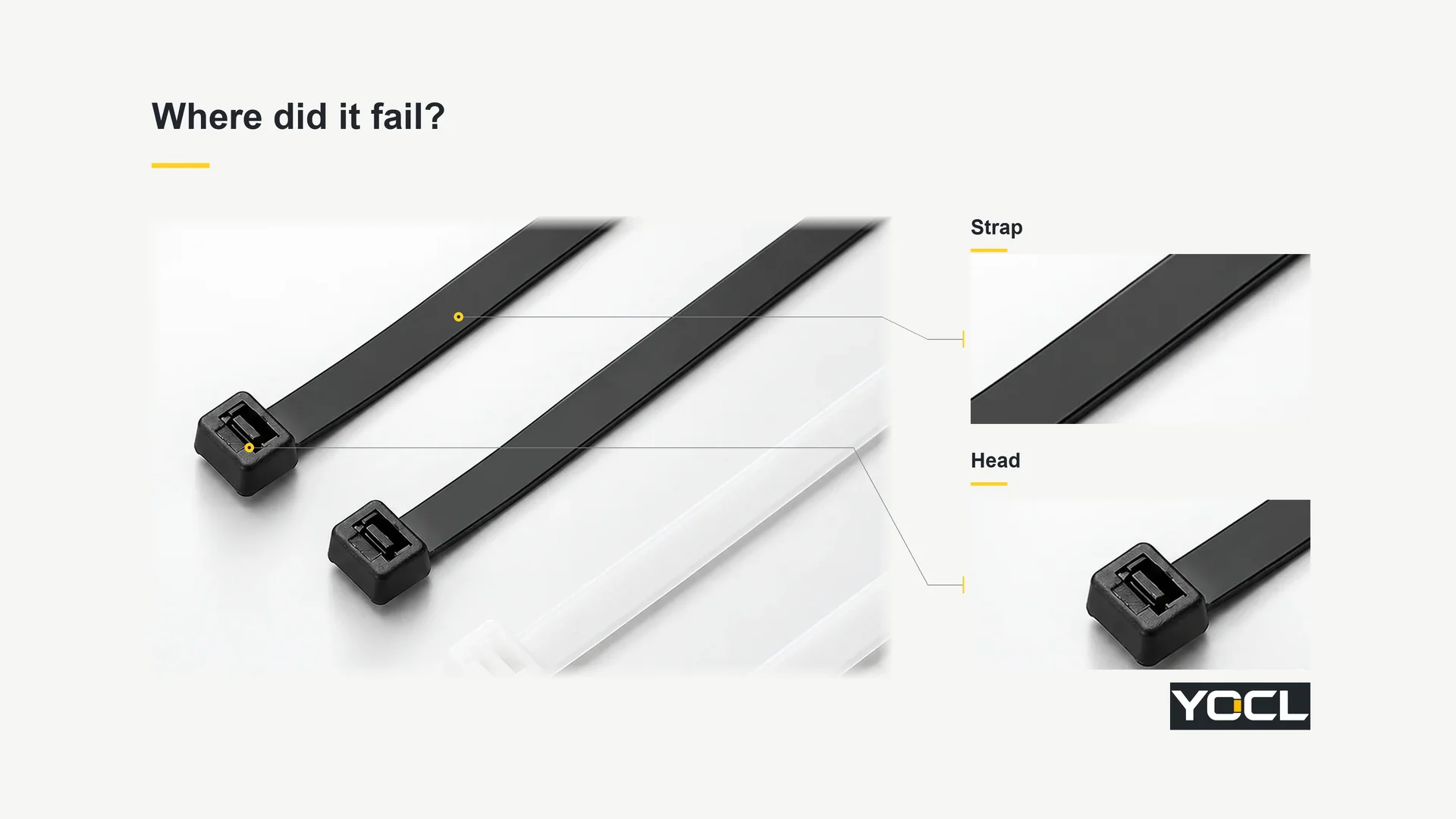
Unused stock: investigate moisture and installation temperature
Polyamide 6.6 (PA66) exchanges water with its surroundings. NEMA Application Guide 7 explains that moisture conditioning helps a nylon tie’s locking feature remain flexible during installation. Drying reduces impact resistance; flexibility and loop tensile strength do not change in the same way. “It feels stiff” is therefore not a strength measurement.
Keep unused stock in its original sealed packaging until needed, protect it from sunlight and rotate inventory. Record when a bag was opened and whether it spent time near heating or in unusually dry conditions. Follow the supplier’s storage instructions rather than adopting a universal shelf-life limit.
Cold installation is a separate question from cold service. A tie’s declared operating range does not automatically permit installation at its lowest service temperature. NEMA’s temperature guide distinguishes these conditions and describes potential assembly breakage when nonmetallic ties are installed too cold. Obtain the exact product’s installation limit.
Retain an unopened same-batch bag for supplier comparison. Packaging and improvised bend checks do not establish batch acceptance.
Can brittle ties be restored with water?
NEMA discusses moisture reconditioning, but that does not establish a general field-repair recipe. Ask the manufacturer whether a controlled conditioning process and subsequent verification are appropriate for unused stock. Do not boil, soak or spray an installed assembly to recover ties. Reconditioning cannot repair a crack, replace missing material or establish that an exposed tie still meets its specification.
During installation: separate tool tension from tie strength
NEMA Application Guide 8 distinguishes tool tension, which pulls the tail during installation, from loop tensile strength, which loads the engaged loop. A catalogue force figure is not a tension-tool setting. Use the tie/tool manufacturer’s recommended method and application-specific setting; do not derive it by multiplying the tensile figure by an arbitrary percentage.
Check that the bundle fits the exact model’s declared diameter range and that there is access to feed the strap without forcing or twisting it. Review tool compatibility, setting, condition and cutting action. Excessive tightening can damage cable insulation; insufficient tightening can permit movement and chafing. A neat cut does not prove correct tension.
Compare unused, traceable samples on spare assemblies. Keep model, bundle geometry and conditions fixed while reviewing one variable. Formal acceptance requires an agreed sampling and test procedure.
In a hypothetical comparison, failures with both a tool and the approved manual method leave stock condition and temperature open. Failures confined to one tool/setup prioritize that setup. Neither result proves a material defect or certifies an installed bundle.
The cable tie size and tensile strength guide explains the separate catalogue fields. Increasing width or length alone cannot correct an unsuitable process or exposure.
After service: reconstruct exposure and contact conditions
Inspect removed parts and the installation record. Note whether failures concentrate beside a heat source, on exposed routes, at an edge or in moving sections. Record temperatures, sunlight, cleaning fluids, chemical concentration where known, duration and mechanical movement. Discolouration or a single fracture photograph is a clue, not a reliable cause identification.
Sunlight: verify the construction, not the colour
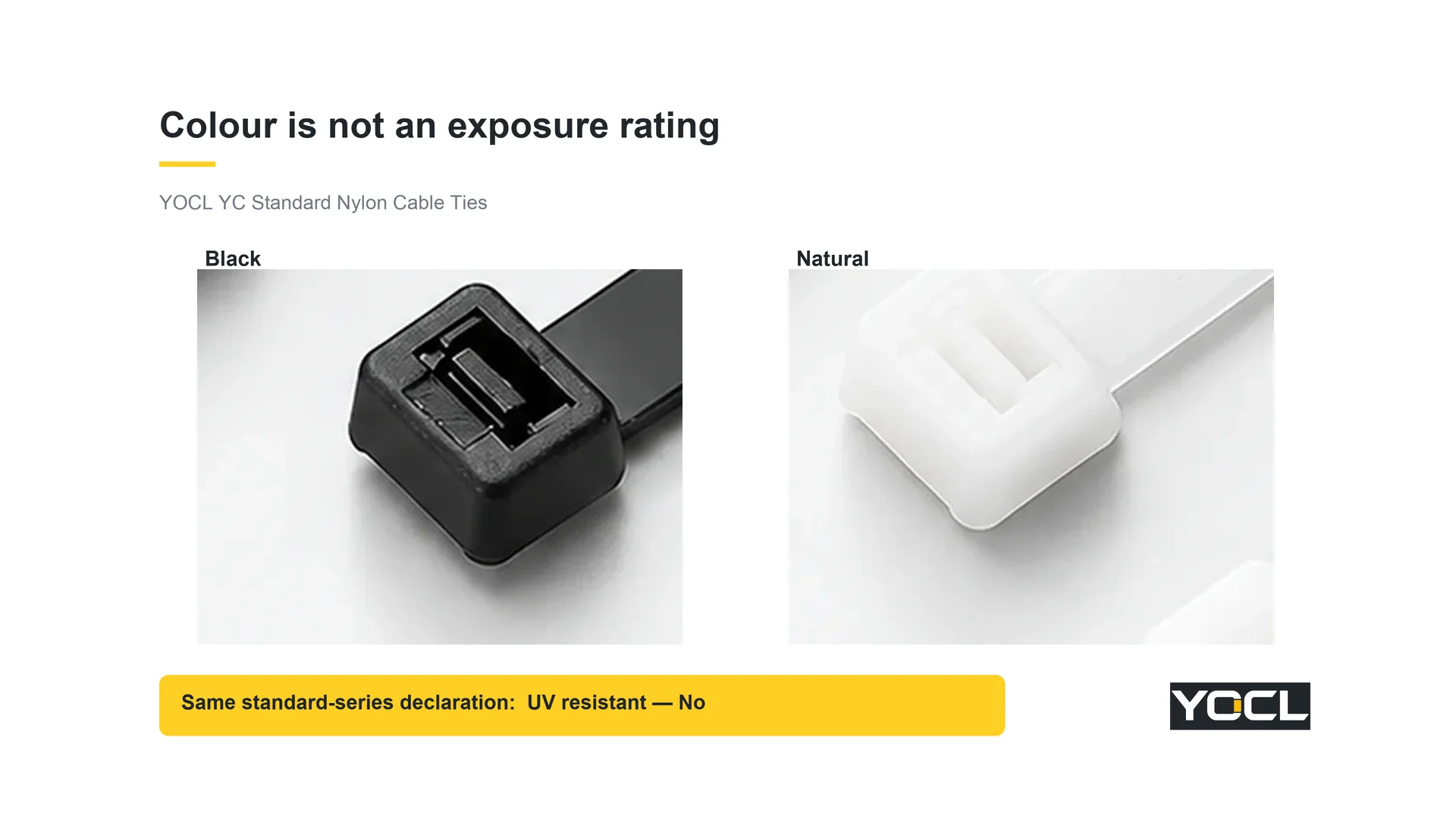
YOCL’s YC Standard Nylon Cable Ties list natural and black PA66 and explicitly state “UV resistant: No.” Black YC stock therefore does not meet a UV-resistance requirement merely because it is black. This declaration identifies a selection mismatch; it does not prove that UV caused a particular break.
UL Solutions describes separate environment and UV investigations. For an exposed route, obtain evidence covering the offered construction. The UV-resistant versus standard guide covers that purchasing decision.
Heat, fluids and movement: check the combined duty
NEMA’s temperature guide notes that prolonged use outside declared temperature limits can reduce mechanical performance, and that moisture, chemicals and vibration can interact with temperature. Compare the local application environment with the tie’s documented limits, not just the cable jacket’s marked temperature.
For chemical exposure, NEMA Application Guide 3 cautions that some environments can deteriorate nonmetallic materials too. Identify the actual substance and conditions; “industrial grade” is not a compatibility result.
Check the contact surface and movement where straps show rubbing or notching. If the bundle imposes sustained support duty, reassess the support system: UL distinguishes loop tensile strength from long-term static load-bearing capability. A larger printed tensile number does not resolve that duty by itself.
Replace, verify and close the investigation
Replace fractured, cracked or slipping ties. Assess adjacent ties that shared the suspect stock, installation process or exposure; replacing only the visibly failed item may leave the same condition in place. Inspect the cables and fixing points for damage before returning the equipment to service.
Close the investigation only after the selected replacement is documented for the duty, the storage or installation correction is recorded, and the bundle is secured without jacket damage or unwanted movement. Where failure repeats or evidence is inconclusive, hold affected stock and agree supplier testing. Do not release a batch on a hand-pull or bend check.
Send the model/batch, packaging history, failure stage, tool/method, bundle dimensions, exposure record and photographs through the YOCL cable-tie product page when requesting assessment documents.
References
- NEMA — Cable Ties Application Guide 7: Exposure to Moisture, March 2021, pp. 1–2.
- NEMA — Cable Ties Application Guide 4: Temperature Considerations, March 2021, pp. 1–3.
- NEMA — Application Guide 8: Why Use Cable Tie Hand Tools?, March 2021, pp. 1–4.
- YOCL product information — YC Standard Nylon Cable Ties, first-party material, colour and UV declarations, checked 16 October 2026.
- UL Solutions — Cable Ties for Cable Management, environment, UV and loop-strength/support distinctions.
- NEMA — Cable Ties Application Guide 3: Corrosive Atmospheres, March 2021, p. 1; chemical tables are not reproduced.