
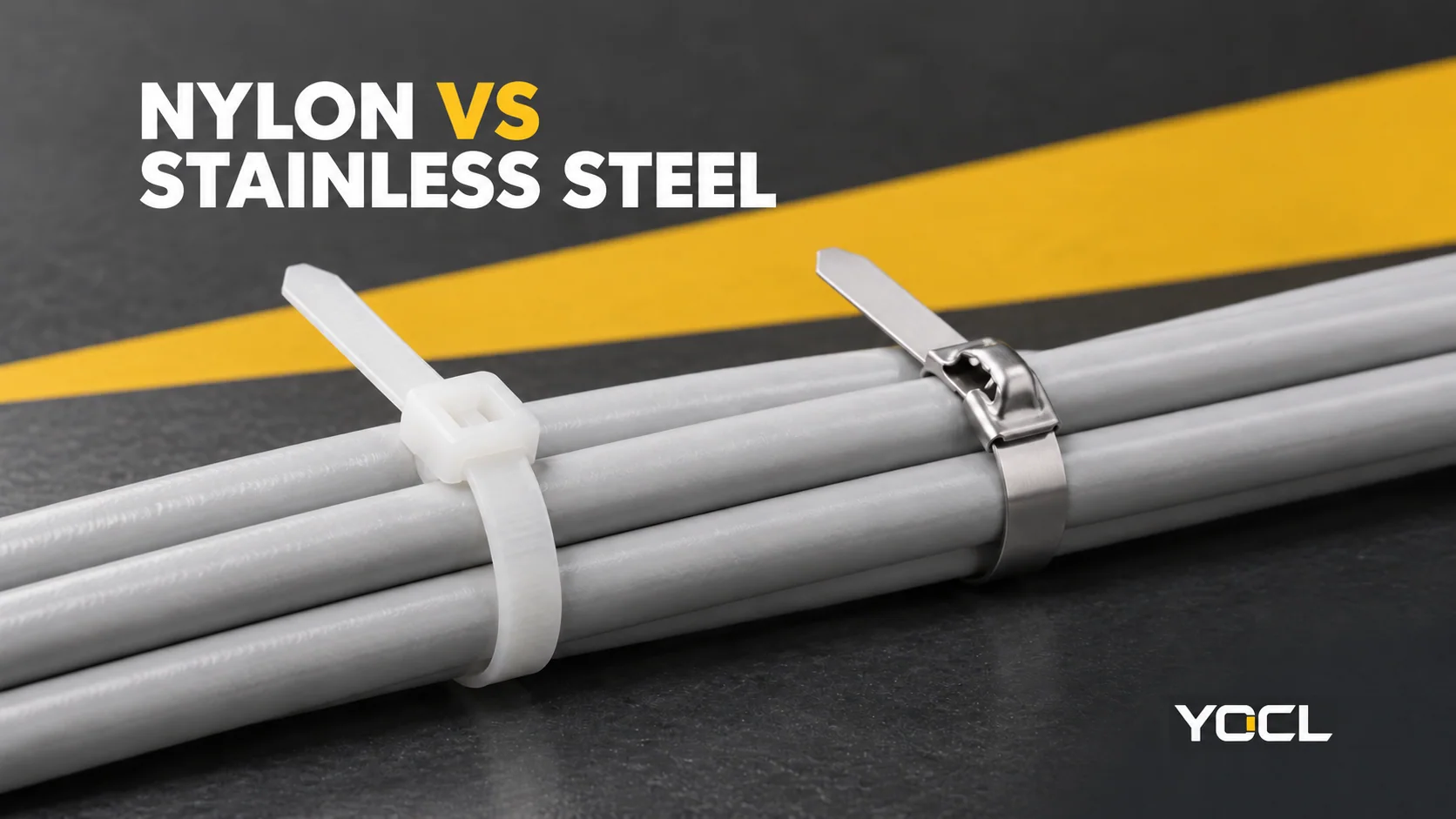
Choose nylon cable ties for routine bundling in protected locations when the specific grade meets the temperature, exposure and strength requirements. Consider stainless steel when those requirements rule out the nylon candidate, then check the steel grade, coating and cable contact. Steel is not automatically the better choice: a coated steel tie can have a lower temperature limit than a heat-resistant nylon tie.
Make the comparison for the same bundle, location and fastening task. Eliminate unsuitable candidates first; compare installation effort and cost among the remaining options.
Nylon vs Stainless Steel Cable Ties: Quick Choice Matrix
| Installation requirement | Nylon candidate | Stainless steel candidate | Decision rule |
|---|---|---|---|
| Protected indoor cable bundling | Standard nylon when its model ratings cover the task | Possible, but extra strength may add no useful function | Start with nylon; justify a change by a specific requirement. |
| Elevated temperature | Heat-resistant grade with documented limits | Uncoated or coated construction with its own limits | Compare finished-tie ranges, not material names. |
| Direct sunlight | A specifically documented UV-resistant version | Check grade and any polymer coating against the exposure | Black colour alone does not qualify nylon. |
| Salt spray or chemical contact | Verify resistance to the actual substance and exposure | Verify alloy, coating and installation conditions | Neither material is universally corrosion- or chemical-proof. |
| Contact with cable jackets | Check strap contact and tightening | Check band edges, head, coating and tension | Preserve the jacket; greater strength is not permission to tighten harder. |
| Frequent access to the bundle | Consider a documented releasable design | Check whether the selected lock permits release | Choose by release mechanism, not material alone. |
| Specified fire or smoke performance | Check finished-tie evidence for the application | Check the exact metal/coating construction | Material identity or resin flame class alone is insufficient. |
| Sustained cable-weight support | Requires an appropriate support system | Requires an appropriate support system | A tensile figure alone does not establish support capacity. |
Temperature: Compare the Exact Construction
The material family is only a starting point. These YOCL catalogue examples show why:
| Specific construction | Published operating range | What the comparison tells you |
|---|---|---|
| YC standard nylon cable ties | −40°C to +85°C | Standard nylon has a defined temperature boundary. |
| YC heat-resistant nylon cable ties, H series | −40°C to +150°C | A different nylon grade changes eligibility. |
| BZ uncoated ball-lock stainless steel cable ties | −80°C to +538°C | This range belongs to uncoated BZ. |
| BZB PVC-coated stainless steel cable ties | −40°C to +70°C | The coated product cannot inherit the uncoated range. |
These are published product ranges, not results of a comparative test or guarantees of service duration.
Fire and smoke requirements need separate evidence. YC’s published UL 94 V-2 material classification does not establish a finished-product UL listing or qualify the tie for every fire-controlled application. YC product specifications.
For a tie location reaching 100°C, the listed upper limits eliminate YC standard and BZB. YC H-series and uncoated BZ remain temperature candidates; cable contact, exposure and mechanical requirements still decide between them. Selecting “steel” without checking its coating could produce the wrong result.
Also separate operating temperature from installation temperature. A tie suitable for cold service may have a different minimum temperature for fitting it. UL Solutions distinguishes these limits and notes that conductor heat can affect tie temperature. Confirm the applicable temperature evidence for continuous duty. UL Solutions cable-management guide.
Outdoors: Sunlight and Corrosion Are Separate Questions
Black nylon does not automatically mean UV-resistant
YOCL’s YC standard series is offered in natural and black, but its product specification explicitly states not UV resistant. Do not select that black version for sun-exposed service on colour alone. The UV status of another series must come from that series’ documentation. YC standard specifications.
UL’s guide describes UV qualification through exposure testing and product marking; colour alone is insufficient. A UV designation also does not promise a universal number of outdoor service years. UL Solutions.
Stainless steel still needs exposure-specific selection
For salt spray, coastal equipment or washdown, specify the environment before choosing the alloy. The British Stainless Steel Association explains that even 316 can suffer pitting and crevice corrosion in seawater. “Stainless” does not mean suitable for every marine condition. BSSA seawater guidance.
If stainless steel remains the candidate, use the separate 304 vs 316 cable-tie comparison to assess grade selection. For chemicals, identify the substance, concentration, temperature and contact duration; assess the nylon or coating as well as the steel. Hold the choice open when compatibility evidence is missing.
Cable Contact: Coated Steel Is Still a Steel Tie
An all-nylon strap and a nylon- or PVC-coated steel band are different constructions. The coating adds a contact barrier; the underlying band remains metallic. YOCL’s BZB product description identifies PVC coating over stainless steel, with a metallic locking head. That description does not establish a tested electrical-insulation rating. BZB product details.
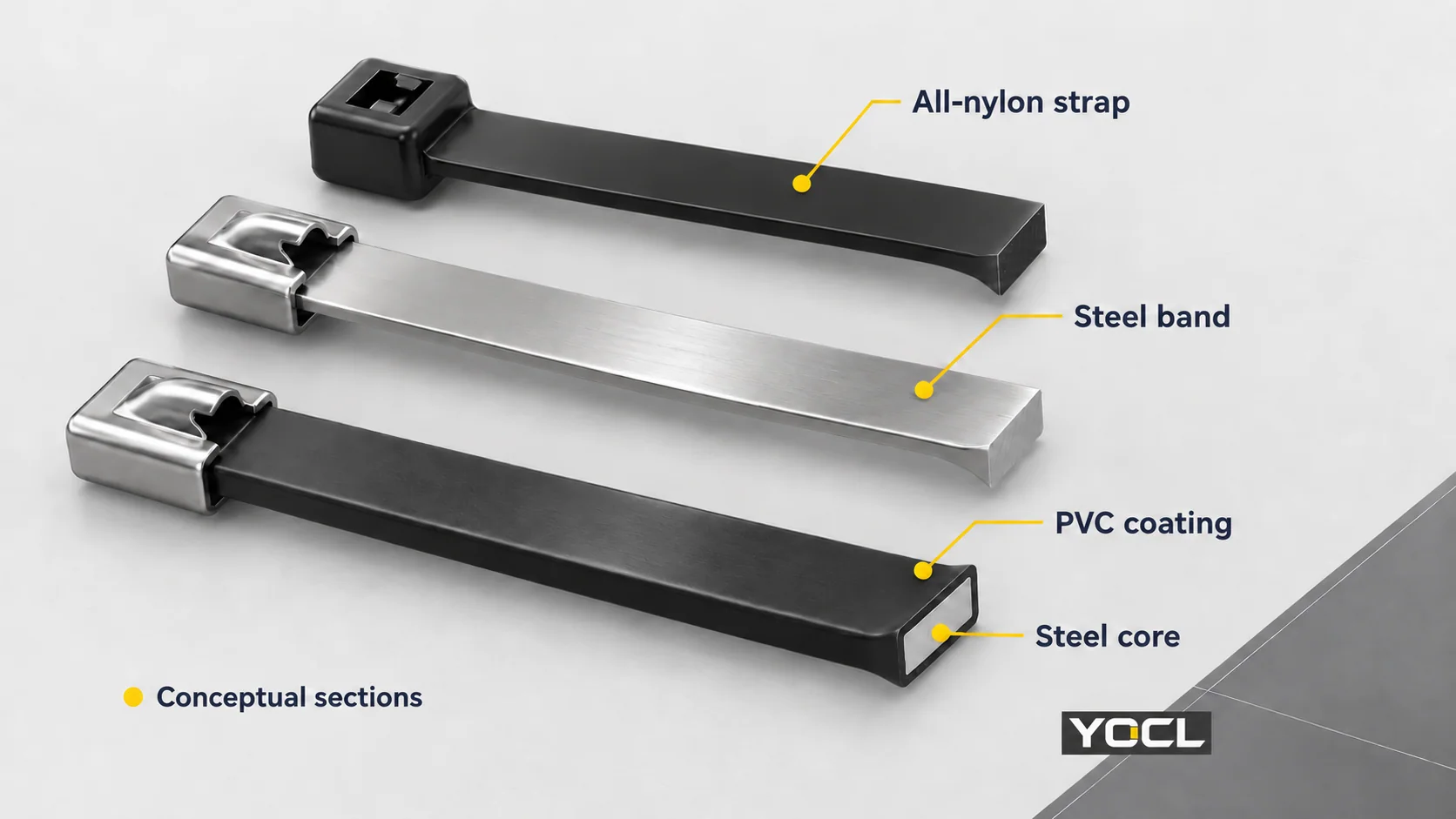
Where metallic contact is prohibited, an uncoated steel tie is not a candidate. A polymer coating alone is insufficient evidence to approve a coated one. Keep cable fastening separate from the installation’s electrical-insulation requirements.
For either material, assess the jacket surface, strap width, contact at the head and tightening method. Inspect for indentation or damage in a representative assembly. A coated band may help separate the steel from the jacket, but excessive tension or a damaged coating can defeat that purpose.
Fit matters too. Check the model’s permitted bundle diameter and space for its head and tail. For example, YOCL lists YC-5×200 as 200 mm long, 4.8 mm wide, with a 50 mm maximum bundle diameter. A steel tie of the same length is not automatically an interchangeable fit. YC size table.
Strength: Compare the Installed Loop and the Fastening Task
Avoid statements such as “steel is five times stronger.” Compare specific sizes, complete locking constructions, test methods and environmental conditioning. A wider nylon tie and a narrow steel band are not a controlled material comparison.
For a similar-width catalogue example, YC-5×200 lists 50 lbf at 4.8 mm, while the BZ width table lists 225 lbf at 4.6 mm. The higher published figure makes that steel construction worth assessing for a higher-strength task; unmatched test conditions prevent turning these figures into a universal material ratio.
UL distinguishes assembled-loop tensile performance from long-term static load bearing. It also distinguishes securing cables into position from supporting their weight. Increasing the tensile number does not, by itself, qualify a tie or its mounting base for sustained support. UL Solutions.
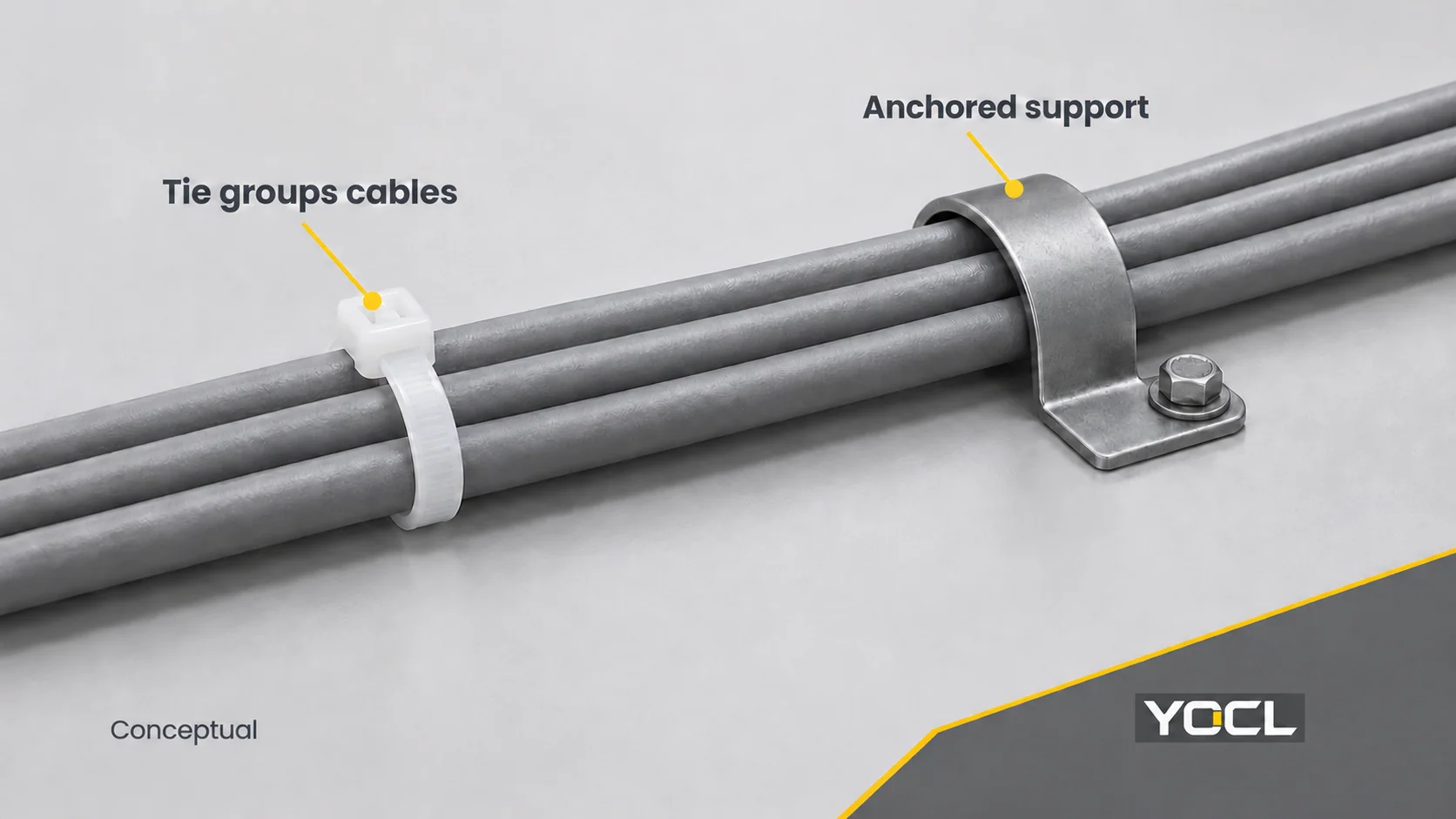
If the task includes sustained weight, vibration or movement, evaluate the complete support and fixing arrangement. The cable-tie mount guide covers base interfaces separately. For lifting, select purpose-rated lifting equipment rather than either cable-tie family.
IEC 62275:2022 covers metallic, non-metallic and composite cable ties and associated fixing devices. Its scope gives a common standards context; it does not prove that a particular catalogue item meets the standard.
Installation, Maintenance and Cost
Compare installation work using the actual ties. Follow the manufacturer’s method for threading, tensioning and cutting; do not assume every steel lock requires the same tool. Plan access for the locking head and use a cutter suitable for the strap material. Inspect the trimmed end and cable jacket.
For bundles opened regularly, a releasable lock may matter more than changing from nylon to steel. Confirm intended release and reuse behaviour; otherwise budget for replacement ties when the bundle is opened. The stainless steel cable-tie guide explains the relevant steel constructions.
Compare installed cost after both candidates qualify: tie price, required tools, fitting time in the actual workspace, access during servicing and replacement work. Use current quotations and your assembly trial. A lower purchase price cannot rescue an unsuitable tie, and a higher-priced material does not guarantee a better installation.
Which Should You Choose for Your Installation?
- Protected control-panel bundling: choose an appropriately sized nylon model when its temperature, exposure and mechanical data cover the task. Steel needs a specific reason to replace it.
- A hot machine location: assess heat-resistant nylon and the exact steel construction. The 100°C example above rules out two specific candidates without declaring a material-wide winner.
- A system with protected and exposed sections: use different qualified ties in different zones where appropriate. One material need not serve the entire route.
- Unknown chemical exposure or an unqualified weight-support task: choose neither candidate yet. Resolve compatibility or select a suitable support system before selecting the tie.
To compare YOCL options, start with the cable-tie product range and provide the bundle diameter, tie-location temperature, exposure, fastening function and maintenance needs.
Related reading: See coated and uncoated stainless ties.
References
- YOCL — YC Standard Nylon Cable Ties — standard-series temperature, UV status and model dimensions.
- YOCL — YC Heat Resistant Nylon Cable Ties — H-series published operating range.
- YOCL — BZ Ball-Lock Stainless Steel Cable Ties — uncoated BZ published operating range.
- YOCL — BZB PVC-Coated Stainless Steel Cable Ties — coating construction and published operating range.
- UL Solutions — Cable Ties for Cable Management — temperature, UV qualification, loop strength and support distinctions.
- British Stainless Steel Association — Stainless Steels for Seawater Applications — limits of stainless steel corrosion resistance in seawater.
- IEC — IEC 62275:2022 — public scope of the cable-tie and fixing-device standard.