
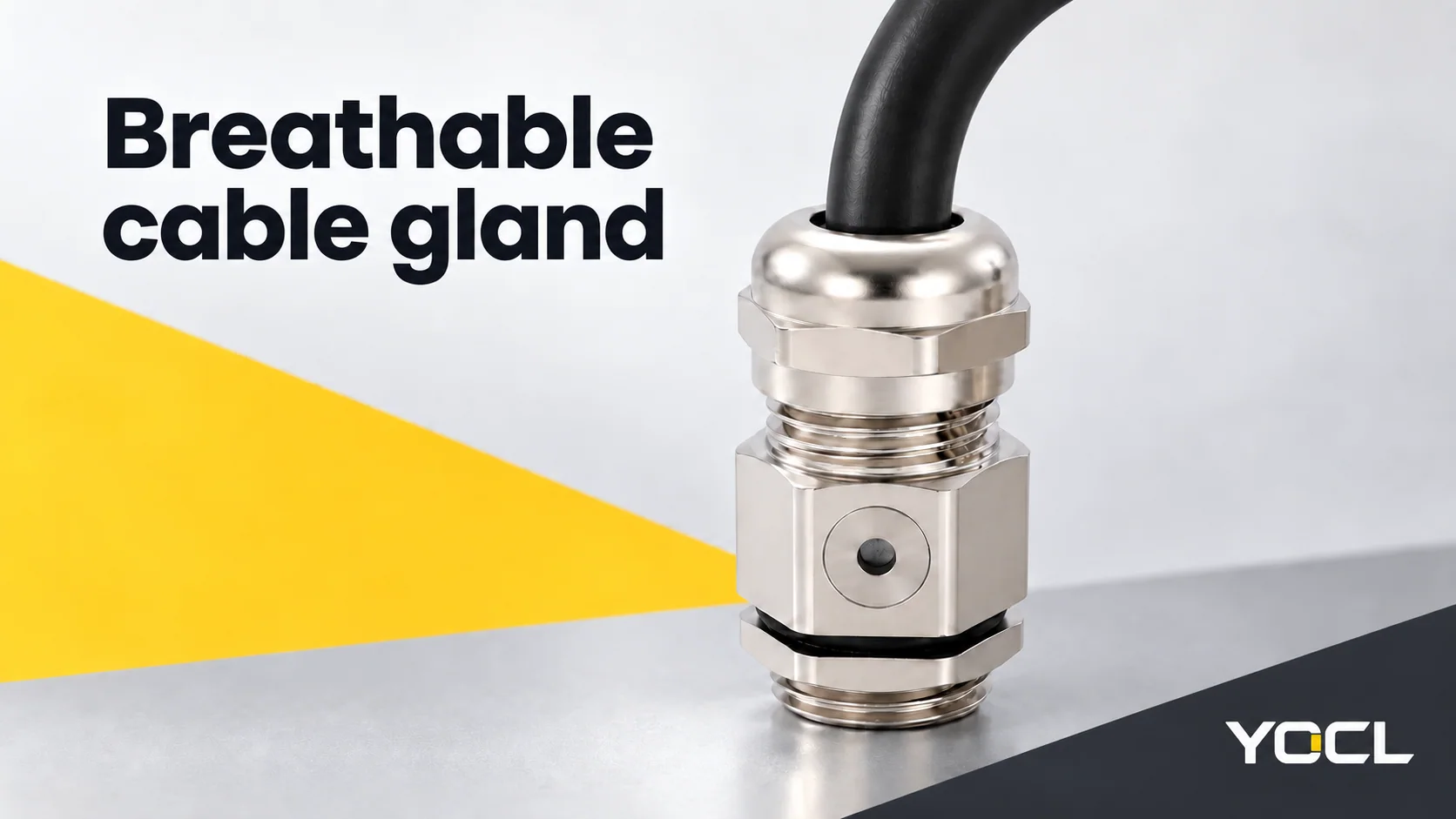
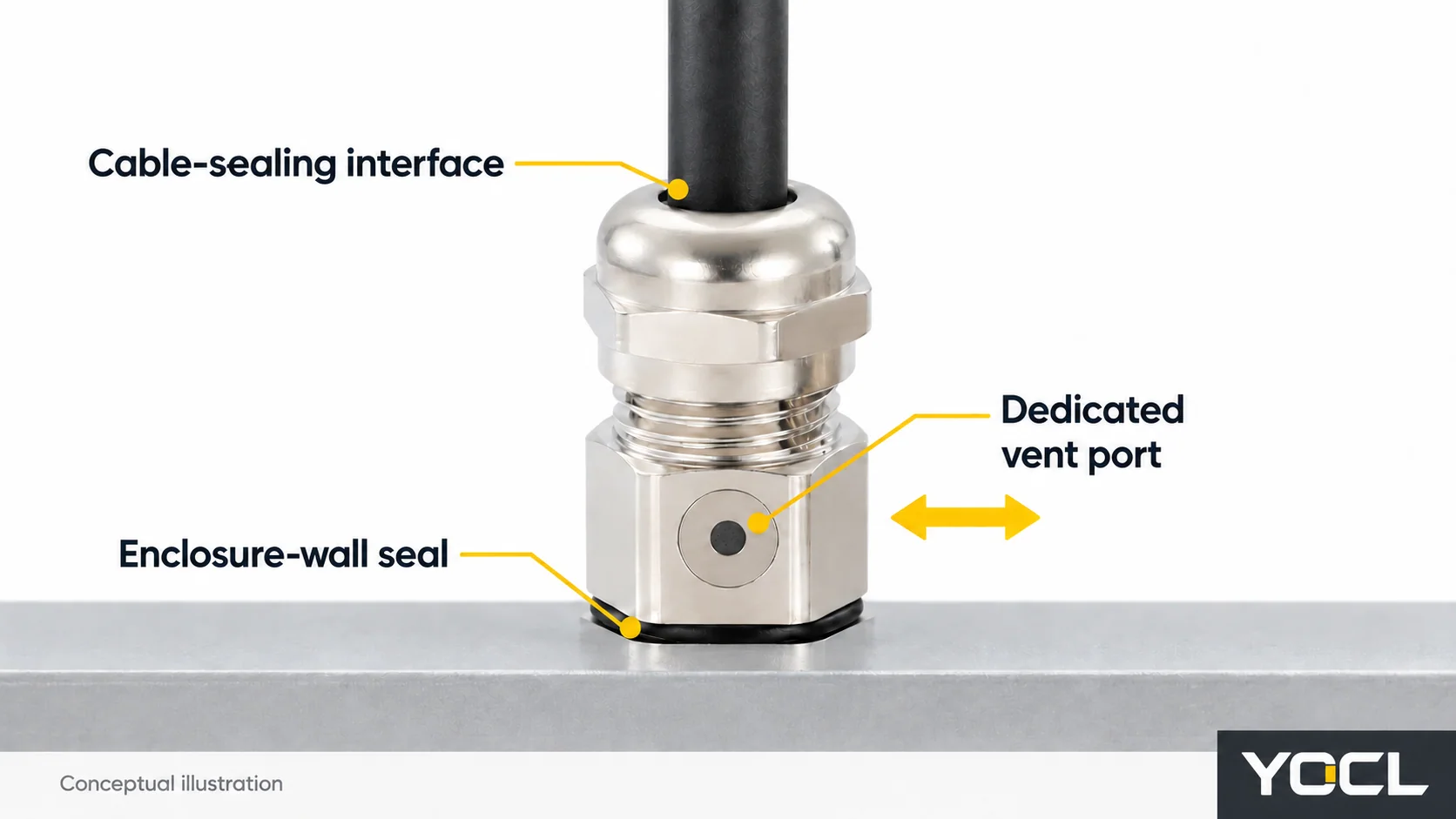
A breathable cable gland combines a sealed cable entry with a designed breathing path that allows air exchange for pressure equalization. The cable remains sealed in the fitting, and the fitting remains sealed against the enclosure wall. Air travels through the dedicated venting feature rather than through a loose cable seal.
You may also see the names vented cable gland or pressure-equalizing cable gland. These names describe a function; the exact vent construction, airflow and mechanical performance depend on the model. The useful way to understand the fitting is to separate three questions: how it seals around the cable, how it seals to the enclosure, and how its breathing path works.
One Cable Entry, Three Independent Checks
A breathable gland occupies a cable-entry position in the enclosure. Adding a venting function does not remove either of the sealing interfaces that an ordinary cable gland needs.
| Interface or function | What it does | What must remain distinct |
|---|---|---|
| Cable-to-gland interface | Seals around the cable jacket and provides the declared cable retention | A loose compression seal is an uncontrolled leakage path, not the venting function |
| Gland-to-enclosure interface | Seals the fitting’s mounting joint at the enclosure wall | A correctly sealed cable cannot compensate for leakage at the wall joint |
| Dedicated breathing path | Provides controlled gas exchange through the model’s venting feature | Its airflow and water resistance need their own performance evidence |
The cable-gland definition in the GSO public adoption preview of IEC 62444:2010 includes sealing and retention. It treats strain relief as a function a gland may additionally provide. The visible definitions also distinguish retention under static loading from anchorage under dynamic and torque loading. A breathable product name therefore does not establish a particular anchorage class or strain-relief capability.
This distinction matters when a cable is pulled, bent or moved during service. Check the exact mechanical declaration as well as the cable diameter range. For the broader cable-fit and mounting questions, use how to choose a cable gland.
How Can a Sealed Cable Entry Breathe?
The breathing feature provides a separate route across the enclosure boundary while the cable and mounting seals remain closed. In membrane-based designs, the membrane is part of that route. Its position and the channel connecting it to the enclosure must come from the product drawing; they cannot be assumed from the term “breathable.”
Temperature changes create the reason for pressure equalization. For a fixed amount of air in a rigid, sealed volume, warming raises pressure and cooling lowers it. This follows the gas relationship explained by NASA Glenn. If outside pressure remains unchanged, the resulting difference can drive air outward during warming and inward during cooling through an available breathing path. Once air passes through a vent, the amount of enclosed gas changes, so the sealed-volume relationship alone cannot predict the enclosure’s actual pressure or equalization time.
An appropriate hydrophobic porous membrane can permit gas and water-vapor transport while resisting liquid entry. Original research by Hou et al. in Nature Communications demonstrates these material mechanisms and shows that liquid-entry resistance has a finite pressure limit. That study concerns membrane distillation, not cable glands; it supports the physical explanation, not a YOCL membrane specification or product rating.
The practical result is that a controlled breathing path can coexist with a sealed cable entry. It does not mean that the fitting has an unlimited waterproof barrier, actively cools the enclosure, drains pooled water or sets a target humidity.
Pressure Equalization Does Not Guarantee a Dry Enclosure
Incoming air can contain water vapor. Condensation can still form when a surface falls below the local air’s dew point, as described in the National Weather Service dew-point explanation. Whether moisture leaves through a passive breathing path depends on the conditions on both sides; it is not a guaranteed drying process.
If your main question concerns pressure changes, water vapor or condensation, continue with what an enclosure vent plug does. Those mechanisms apply to the venting function, while the breathable cable gland also has to perform its cable-entry job.
Integrated Gland or a Separate Vent Opening?
A breathable gland integrates the cable-entry and breathing functions into one fitting. A conventional gland plus a separate vent plug gives each function its own fitting and mounting position. This is an enclosure-layout decision before it is a comparison of individual product ratings.
| Question | Breathable cable gland | Conventional gland plus separate vent plug |
|---|---|---|
| Where does the cable enter? | Through the integrated gland | Through the conventional gland |
| Where is the breathing feature? | In the integrated fitting’s documented venting construction | In a separate vent fitting at its own enclosure opening |
| What is coupled in the layout? | Cable-entry location, gland clearance and access to its vent feature | Cable-entry placement and vent placement can be evaluated separately |
| What needs evidence? | Cable sealing and retention, wall sealing, and the integrated vent’s performance | The gland’s entry performance, the vent’s performance, and both mounting joints |
| Which resource follows? | The integrated model’s cable range, drawing and flow data | The gland specification and a separate vent specification |
A conventional cable gland by itself does not demonstrate a pressure-equalization function. Equally, putting a vent into an integrated gland does not prove that it passes more or less air than a separate plug. Compare the actual flow data and test conditions of the candidate configurations.
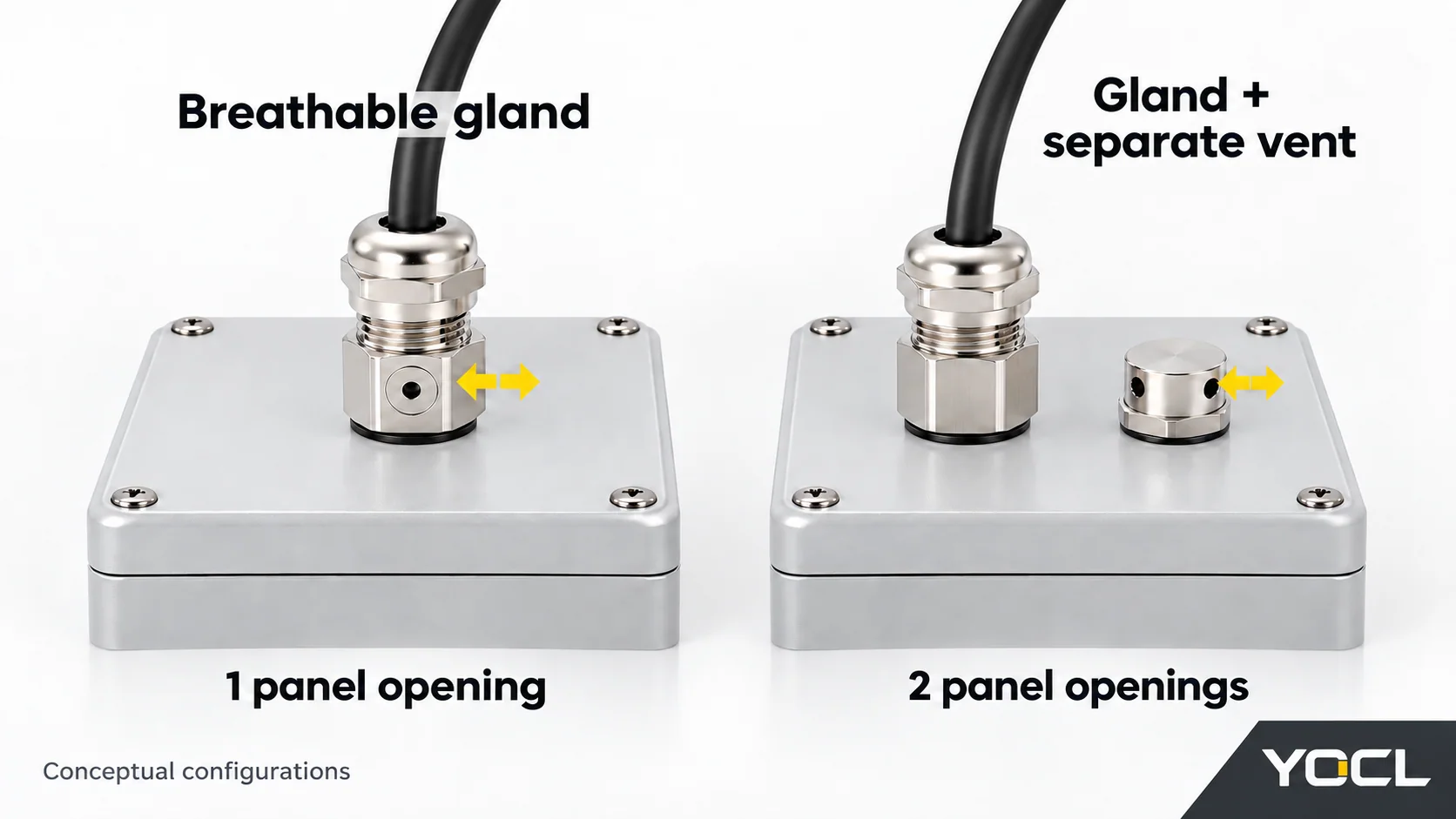
For a layout with an independent breathing opening, the YOCL breather vent plug range provides the separate product route. Keep its performance assessment tied to that vent’s own mounting and test data.
Read Cable-Entry and Breathing Data Separately
Two glands can accept the same cable and enclosure thread yet have different declared airflow. Cable fit therefore cannot stand in for a venting specification.
For example, the YOCL nickel-plated brass breathable gland document lists two M12 × 1.5 configurations with a 4–8 mm cable range. One declares minimum airflow of 100 mL/min at a pressure differential of 70 mbar; the other declares 200 mL/min at the same differential. Their entry-thread lengths are 7 mm and 7.5 mm respectively. These are separate catalogue entries, so the thread designation and cable range alone do not identify the complete configuration.
Those figures are manufacturer declarations at a stated test point. They do not show that one assembled enclosure will equalize pressure twice as fast. Equalization also depends on the enclosure, the pressure change and the vent’s behavior across the relevant operating conditions.
| Data group | Read it for this question |
|---|---|
| Cable range and mechanical declaration | Does this configuration seal and retain the actual cable, with the required anchorage or strain-relief performance where applicable? |
| Mounting drawing and wall seal | Does its entry thread, available length and specified wall-sealing arrangement fit the enclosure? |
| Airflow and test conditions | What flow is declared, at what pressure differential and conditions? Is a flow curve available for the intended pressure changes? |
| Environmental and ingress evidence | What exposure, seal material and temperature conditions are documented, and what assembly and test conditions support the claimed ingress rating? |
Missing data must remain a separate question. The YOCL VO-BR breathable brass gland page identifies a breathable design but does not provide a quantified airflow value. The 70 mbar values from the other brass range cannot be assigned to VO-BR.
A Breathing Claim, a Mechanical Claim and an IP Rating Answer Different Questions
IEC 62444:2010 covers construction and performance requirements and tests for complete cable glands as supplied by the responsible manufacturer or supplier. IEC 60529 provides the classification framework for enclosure ingress protection. Their official abstracts establish those scopes; neither abstract establishes a particular YOCL model’s compliance or airflow.
An ingress protection (IP) designation is therefore not an airflow specification or a condensation-prevention result. The nickel-plated brass page declares IP68 but does not state its immersion depth and duration. For an immersion requirement, obtain the conditions and supporting evidence for the exact configuration and intended enclosure assembly rather than treating the catalogue label as a complete exposure specification.
Physical access to the breathing feature also belongs in the enclosure layout. Identify the vent feature from the drawing and account for nearby components, covers and any required clearance. Its intended gas route must remain available when the fitting is mounted.
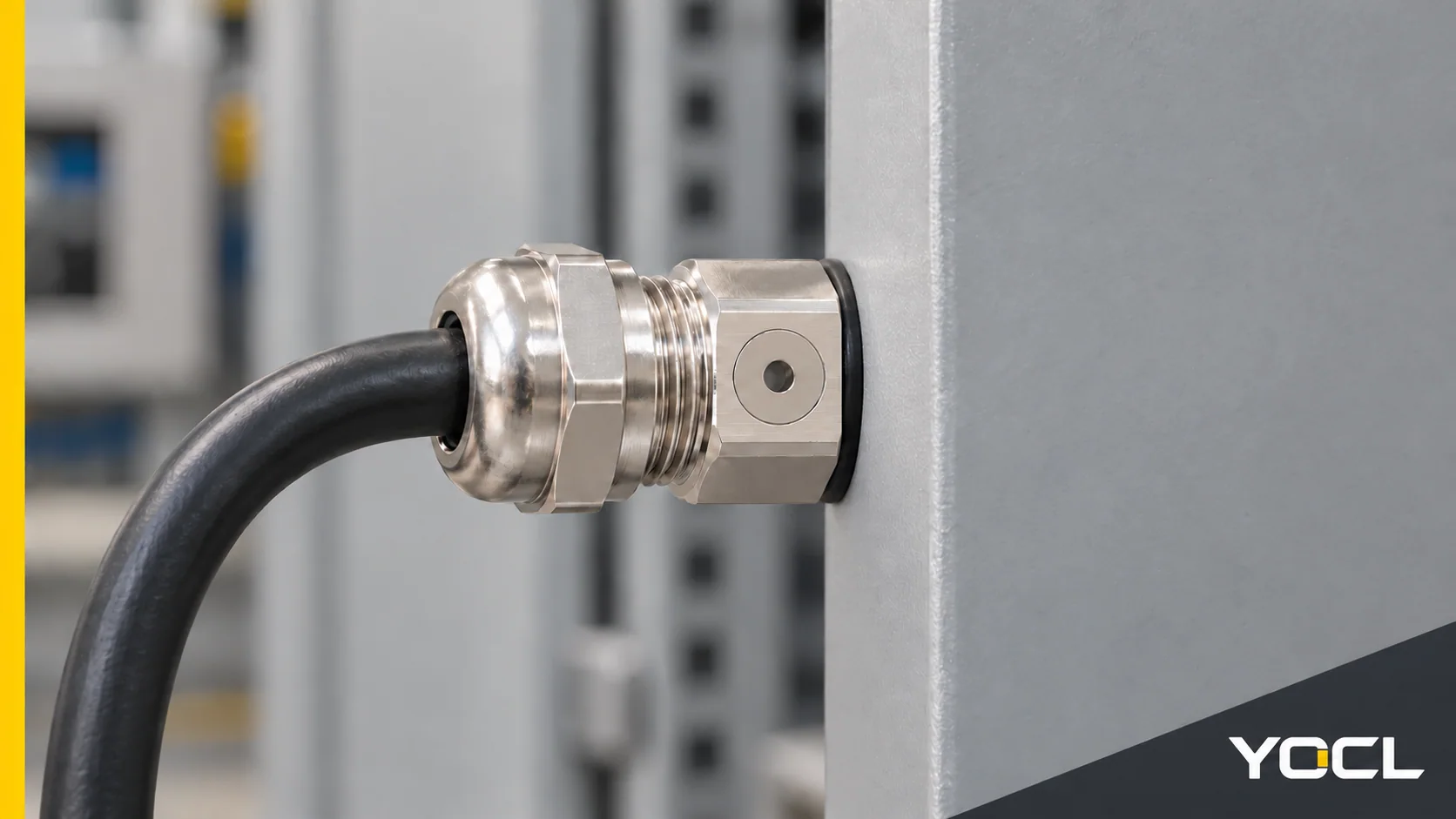
To evaluate an integrated fitting, start with the YOCL breathable cable gland range and the exact candidate’s documentation. Match the cable-entry requirements and the venting requirements independently, then confirm that both functions are supported in the intended enclosure layout.
Related reading: comparing cable gland body materials.
References
- GSO IEC 62444:2025 public adoption preview, endorsing IEC 62444:2010. Visible definitions 3.1, 3.4 and 3.5; preview provenance confirmed through the official GSO catalogue.
- NASA Glenn — Equation of State, updated May 13, 2021. Gas-pressure relationship and fixed-volume assumptions.
- Hou et al. — A super liquid-repellent hierarchical porous membrane for enhanced membrane distillation, Nature Communications 14, 6886, October 28, 2023. Original research used for qualitative membrane physics, not cable-gland performance.
- National Weather Service — Dry Bulb, Wet Bulb and Dew Point Temperatures. Dew-point section.
- YOCL — Nickel-Plated Brass Waterproof Breathable Cable Gland. First-party configuration, airflow and ingress declarations; accessed October 5, 2026.
- YOCL — VO-BR Breathable Brass Cable Glands. First-party product information; accessed October 5, 2026.
- IEC 62444:2010, edition 1.0, August 19, 2010. Official abstract and publication metadata only.
- IEC 60529:1989+AMD1:1999+AMD2:2013 CSV, edition 2.2, August 29, 2013. Official abstract and publication metadata only.