
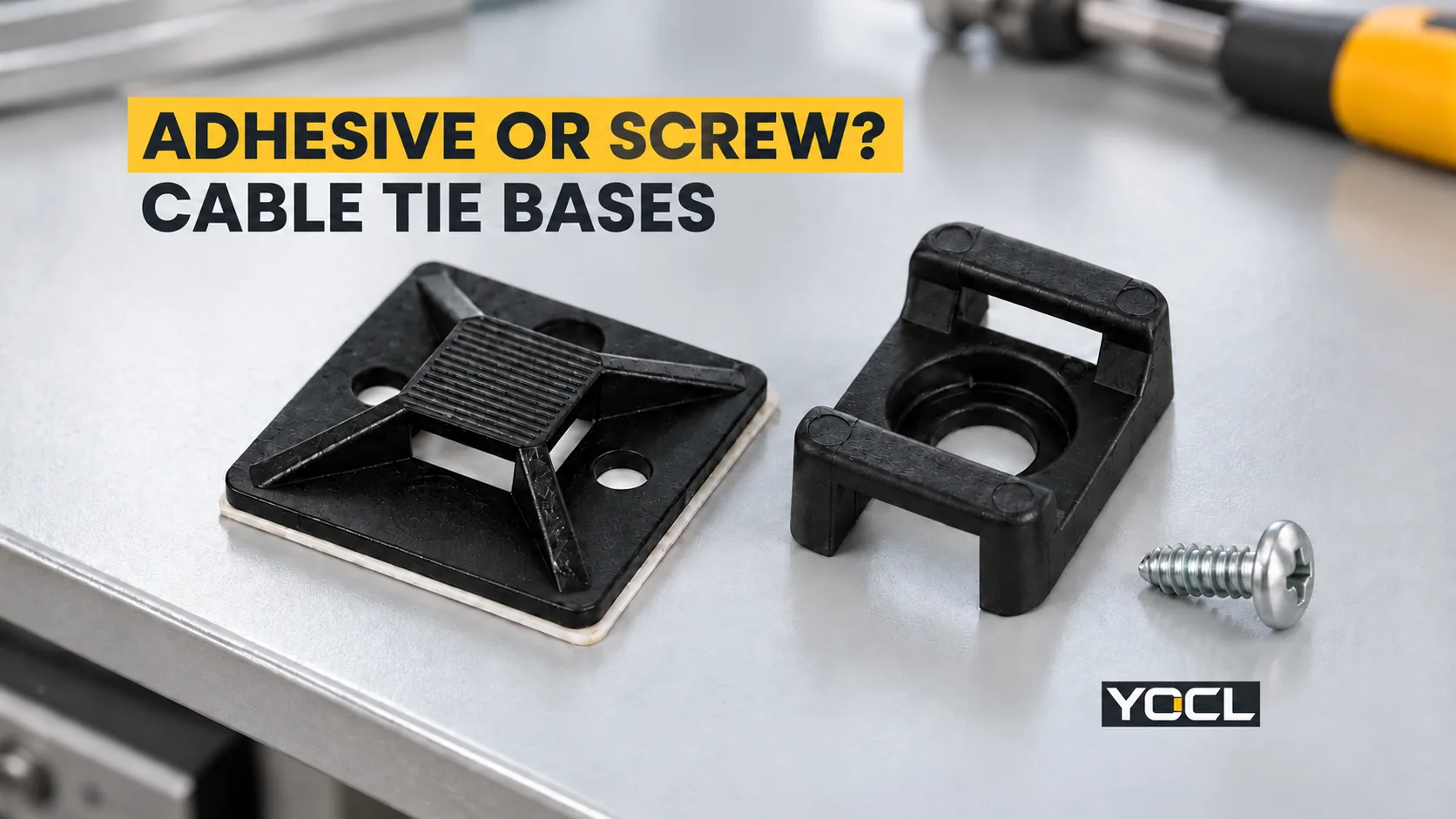
Choose an adhesive base when holes are prohibited and the exact backing is qualified for your surface and mounting duty. Choose a screw-mounted base when mechanical fixing is allowed and the fastener-to-structure connection is specified. For sustained load, movement or harsh exposure, select the documented assembly; neither method wins from its name alone.
This comparison concerns separate cable tie bases used with a separate strap. Mounting cable ties combine the strap and a fixing feature in one component. The attachment questions are related, but the parts are different.
Compare the Fixing Routes on the Same Basis
| Installation condition | Adhesive base | Screw-mounted base | Choice |
|---|---|---|---|
| Holes are prohibited in the mounting surface | Can provide a no-drill route if the bond is qualified | Requires an allowed existing or new mechanical attachment | Investigate adhesive first; a drilling restriction is not evidence that the adhesive will hold. |
| Actual coating or polymer has documented bonding suitability | Can qualify with the specified preparation and backing | Can also qualify if the receiving structure and fastener are suitable | Either may work; compare access and assembly process. |
| Bonding suitability is unknown, but a mechanical fixing is fully specified | Adhesive acceptance remains unresolved | Has a defined alternative attachment route | Prefer the verified screw arrangement. |
| Sustained load, vibration or cable movement is present | Needs evidence for that surface, load and exposure | Needs evidence for the mount, fastener and receiving structure under that duty | Do not choose from “light duty” or “heavy duty” labels alone. |
| Frequent bundle opening is needed | A suitable tie can be serviced while the base remains attached | A suitable tie can be serviced while the base remains attached | Tie serviceability and base attachment are separate choices. |
| Neither bond nor receiving structure is established | Not established | Not established | Resolve the attachment design before choosing either. |
The cable tie mounts guide maps adhesive, screw and push-in formats. Here the task is narrower: deciding between bonding and mechanical fixing for your installation.
Start with the Surface and Permission to Modify It
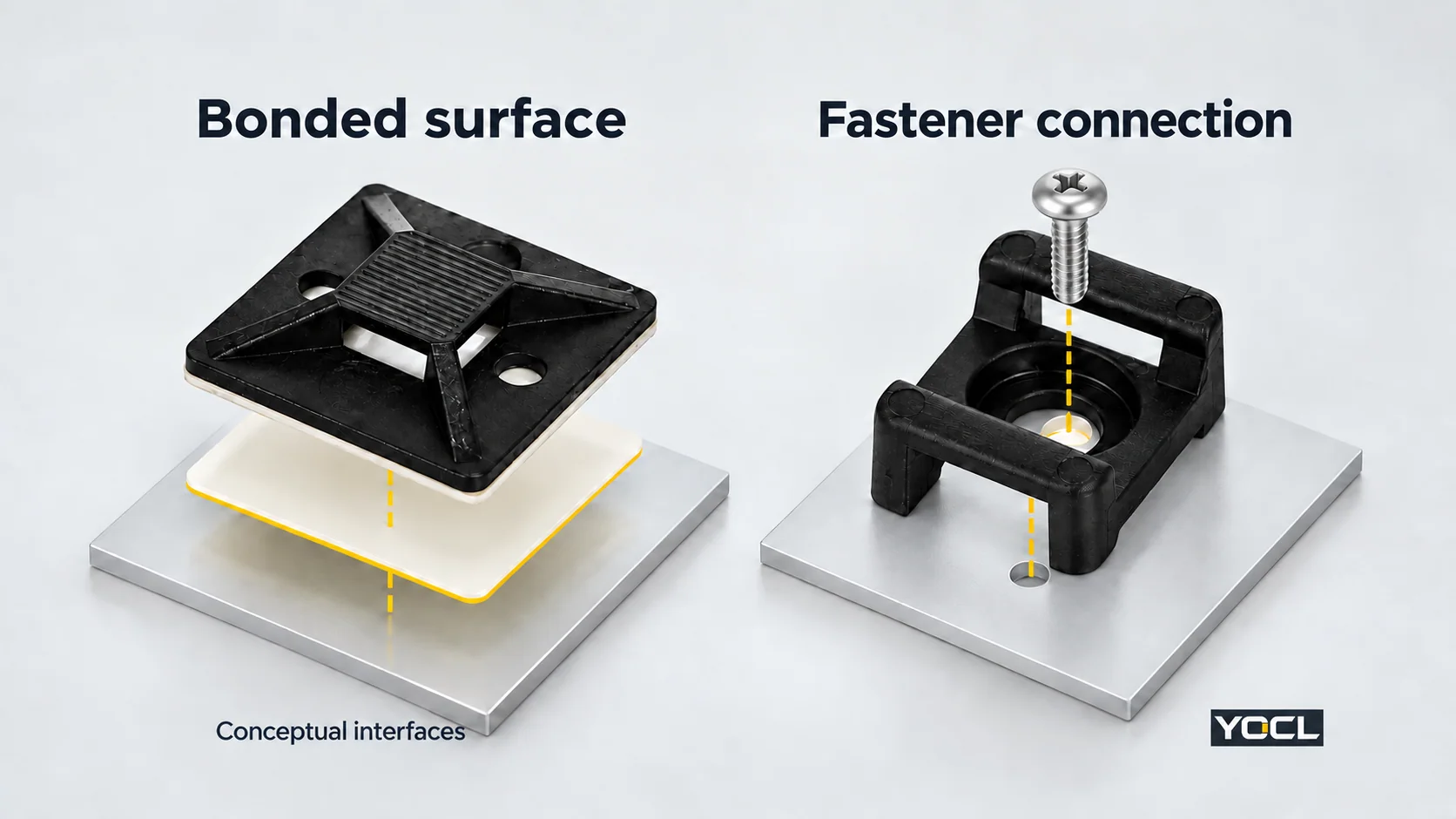
Adhesive: identify what the backing actually touches
A base on painted steel bonds to the paint surface, not directly to the underlying steel. Record the coating, its condition and the adhesive’s suitability for it. “Metal panel” is too broad a specification for that joint.
The UK’s National Physical Laboratory surface-testing guide identifies surface preparation, roughness, wettability and absorbency as bonding considerations. Its public abstract also ties assessment to the materials, bonding process, loading and service conditions. A smooth-looking surface alone does not establish a qualified bond.
YOCL HT self-adhesive mounts provide adhesive-backed nylon bases. Their public record identifies the backing and base geometry, but does not give a substrate-specific working load or a complete adhesive qualification schedule. Obtain the applicable backing, preparation, application conditions and time before loading for the selected supply.
Use those instructions to plan the assembly process. Do not turn a generic solvent, pressing time or waiting period into a rule for every adhesive base.
Screw mounting: identify what receives the fastener
A screw route exchanges the bonding question for a mechanical-interface question. The screw needs an appropriate receiving arrangement, and its head must retain the base without obstructing the cable tie or bundle.
YOCL HC saddle mounts have a central fixing feature and separate strap openings. Their catalogue does not assign a screw size or tightening torque. The drawing’s fixing-hole dimension is a fit input, not permission to choose a nominal screw size by matching the number.
Confirm the fastener, receiving material, engagement arrangement and available access together. Thin sheet, a threaded boss and a specified through-fastening are different cases. Where creating a hole is restricted, that restriction remains part of the choice.
Compare Evidence for the Actual Mounting Duty
A tie’s stated strength cannot substitute for the fixing’s performance. UL Solutions’ positioning-device application guide distinguishes loop tensile strength from fixing-device mechanical strength and states that a tie rating does not establish long-term static load capacity.
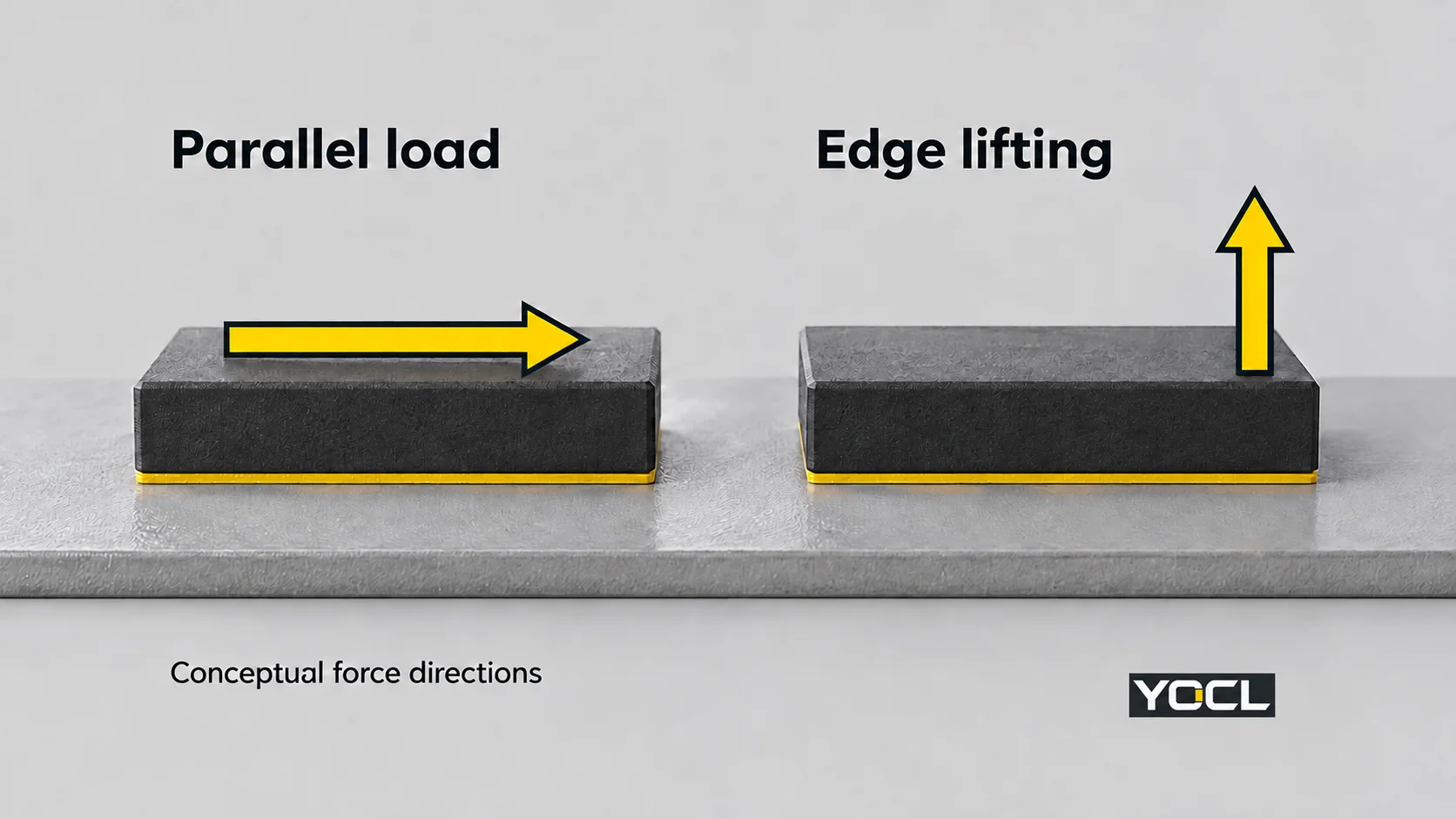
For both routes, specify the load direction and duration, including any sustained bundle load or repeated movement. A brief pull test and an ongoing load are different evidence questions.
ASTM D3654/D3654M-06(2024) provides a useful example: its public scope addresses pressure-sensitive tape adhesion under constant loading parallel to the bonded surface. Its public significance statement warns that results on a standard steel panel may not represent adhesion to other surfaces. A tape result therefore cannot become a universal installed-base load rating.
Record installation conditions separately from service exposure: temperature, moisture, cleaning chemicals, ultraviolet light and movement can be relevant to the selected configuration. A screw fixes the attachment mechanically; it does not automatically qualify the nylon base, hardware or receiving structure for outdoor use.
Also identify the duty. IEC 62275:2022 covers cable ties and associated fixing devices for wiring management and securement, while its public scope notes that additional requirements can apply to support applications. A base that positions a harness must not be assigned primary weight-support duty without the relevant assembly evidence.
Three Conditions That Lead to Different Choices
These are hypothetical selection cases, not YOCL tests or customer installations.
| Known condition | Appropriate choice | What makes the choice defensible |
|---|---|---|
| An enclosure surface cannot be drilled; the actual coating/backing combination and routing duty have qualified instructions and performance evidence | Adhesive | It satisfies the modification restriction and the documented bond conditions. |
| A mounting plate has an approved receiving connection; a compatible saddle/fastener assembly meets the duty, while the adhesive-to-coating combination is unqualified | Screw-mounted | The mechanical route is established and the bonding route is not. |
| An exposed or moving harness needs support, but neither candidate has evidence for the complete attachment and environment | Neither yet | Changing fixing style does not resolve missing support or exposure evidence. |
If both candidates satisfy the same duty, compare process access and service requirements. The adhesive route includes surface preparation and any specified delay before loading. The screw route includes hardware access and any permitted hole preparation. Price or apparent installation speed should be compared only after those requirements are included.
Service the Bundle Without Confusing It with Base Removal
Opening or replacing the cable tie does not necessarily require removing the base. Choose a compatible strap and sufficient head/slot access for the intended service operation, whichever attachment route you use.
Relocating the fixing point is a different job. An adhesive-backed base needs its applicable removal and replacement-backing instructions; do not assume the used backing can be reapplied. A screw base needs access to the fastener and a suitable receiving arrangement at the new location. Neither relocation route guarantees a mark-free surface.
A base with both backing and a screw hole also needs a defined fixing role. UL Solutions’ guide distinguishes adhesive used to locate the device before a mechanical fastener is installed from adhesive acting as the main securement. Specify the intended route; do not add two separate strength figures to claim a combined capacity.
Record the Choice Before Ordering
A useful decision record contains:
- Surface: material, exact coating or polymer, condition and permission to drill or fasten.
- Attachment: backing/substrate qualification, or mount/fastener/receiving arrangement.
- Duty: positioning or support, load direction/duration, movement and exposure.
- Fit and process: tie width, routing, available footprint, access and preparation requirements.
Choose adhesive when the no-drill bond is established; choose screw when the mechanical attachment is established and allowed. Either is defensible when both meet the same requirements. Neither is established when a critical surface, fixing or duty condition is unresolved.
For a review of YOCL cable tie bases, send that record with the required models and quantities. If the strap itself must incorporate the mounting feature, identify that requirement separately from a base-and-tie assembly.
Related reading: See troubleshooting adhesive mount failures.
Related reading: See coated and uncoated stainless steel ties.
References
- YOCL ELECTRIC — Mounting Cable Ties; first-party integrated strap/fixing product scope.
- National Physical Laboratory — Surface testing for bonding, Measurement Good Practice Guide 77, Issue 2 (2025); public abstract only.
- YOCL product information — HT Self-Adhesive Cable Tie Mounts; backing, visible exterior and published specification scope.
- YOCL product information — HC Saddle Cable Tie Mounts; screw-fixed exterior, strap openings and fixing-interface information.
- UL Solutions — Positioning Devices: Cable Ties for Cable Management of Electrical Installations — Application Guide; currently linked public guide, especially strength, mounting hardware and adhesive roles on page 3.
- ASTM International — ASTM D3654/D3654M-06(2024): Shear Adhesion of Pressure-Sensitive Tapes; public scope and significance/use only. Full paid standard not consulted.
- IEC — IEC 62275:2022: Cable ties for electrical installations, edition 4.0, November 22, 2022; public scope only. Full paid standard not consulted.