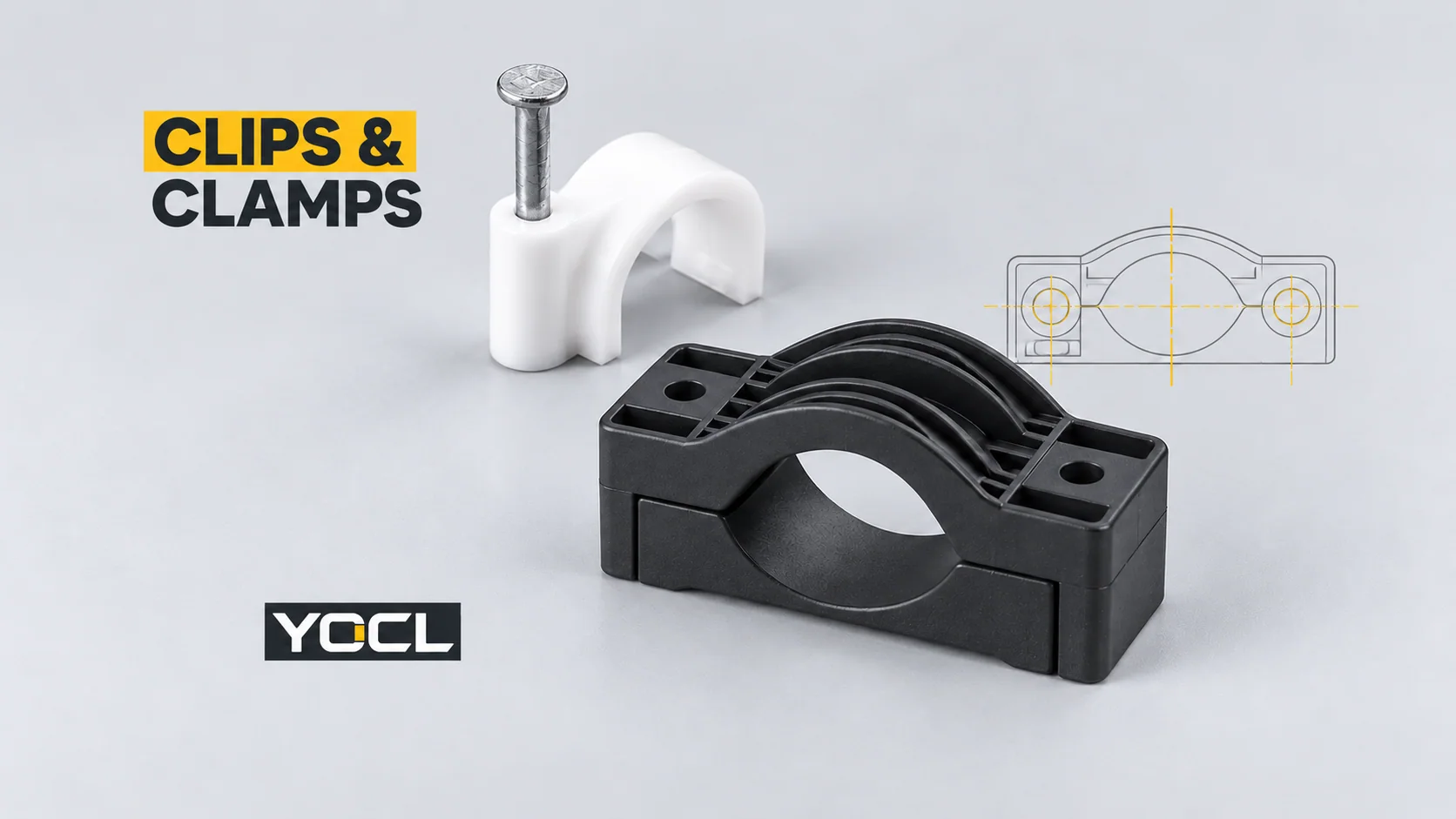
Cable clips and clamps are mechanical fixing accessories that hold a cable or conduit along a route. Their retaining shape engages the cable or tube, while a nail, moulded fixing stem or separate fastener attaches the body to a surface. Cable fit and surface attachment are separate checks.
A clip or clamp body can engage the cable directly. A separate cable tie mount instead anchors a tie that holds the bundle; see the cable tie mount guide for adhesive, screw and push-in bases.
The terms clip, clamp and saddle describe varied commercial forms. The name alone does not establish a load rating or a stronger-versus-weaker hierarchy. Start with the retained object and the two physical interfaces.
Identify What the Body Retains
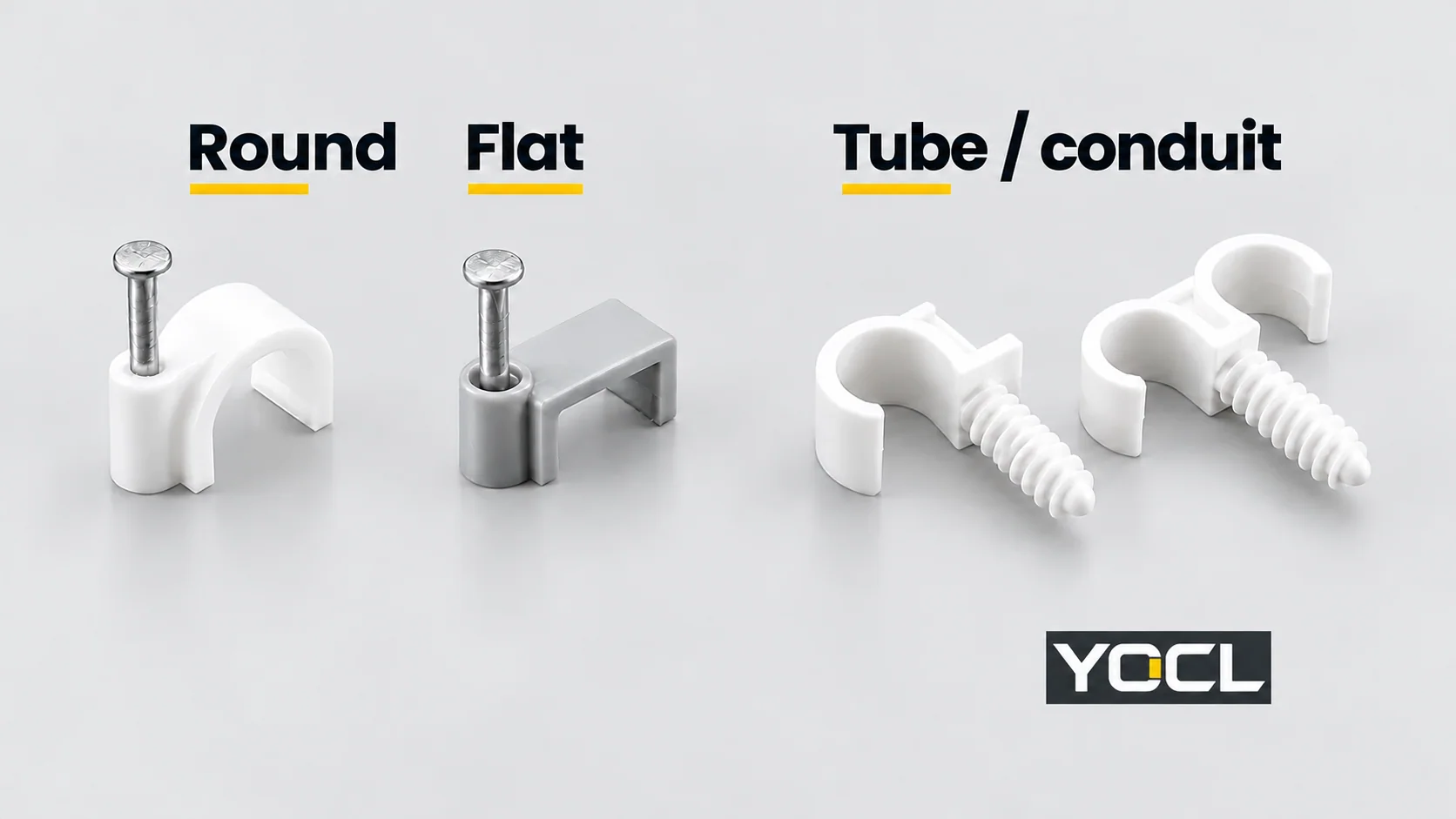
The YOCL cable clips and clamps range includes several retaining geometries:
| Retaining form | What to identify | Next fit check |
|---|---|---|
| Curved or hook profile | A body shaped around a round cable | Actual cable outside diameter and the selected item’s size or interval |
| Flat profile | A shallower, wider cable seat | Cable width and thickness, plus the item drawing |
| Single or double tube seats | One or two openings for conduit or tubing | Tube outside diameter, seat count and routing arrangement |
| Shaped closing clamp | An opening within a larger mounted body | Opening shape, cable arrangement and mounting layout |
Curved, Flat and Hook Clips
YOCL’s Circle Cable Clips use a rounded polyethylene (PE) body and steel nails. Flat Cable Clips use a flat-profile PE body with a nail. Their retaining shapes answer different cable-profile questions even though both use nail-in attachment.
Hook Cable Clips have item-specific cable intervals. The published 5–20 mm series span covers several items, not one hook that fits the entire span. Read the interval for the selected item.
Tube Seats and Shaped Clamps
YOCL’s single and double plastic tube clamps are one-piece PE forms for 20 mm or 25 mm tubing. A single form retains one tube; a double form retains two. Match the conduit itself, not the diameter of the wires running inside it.
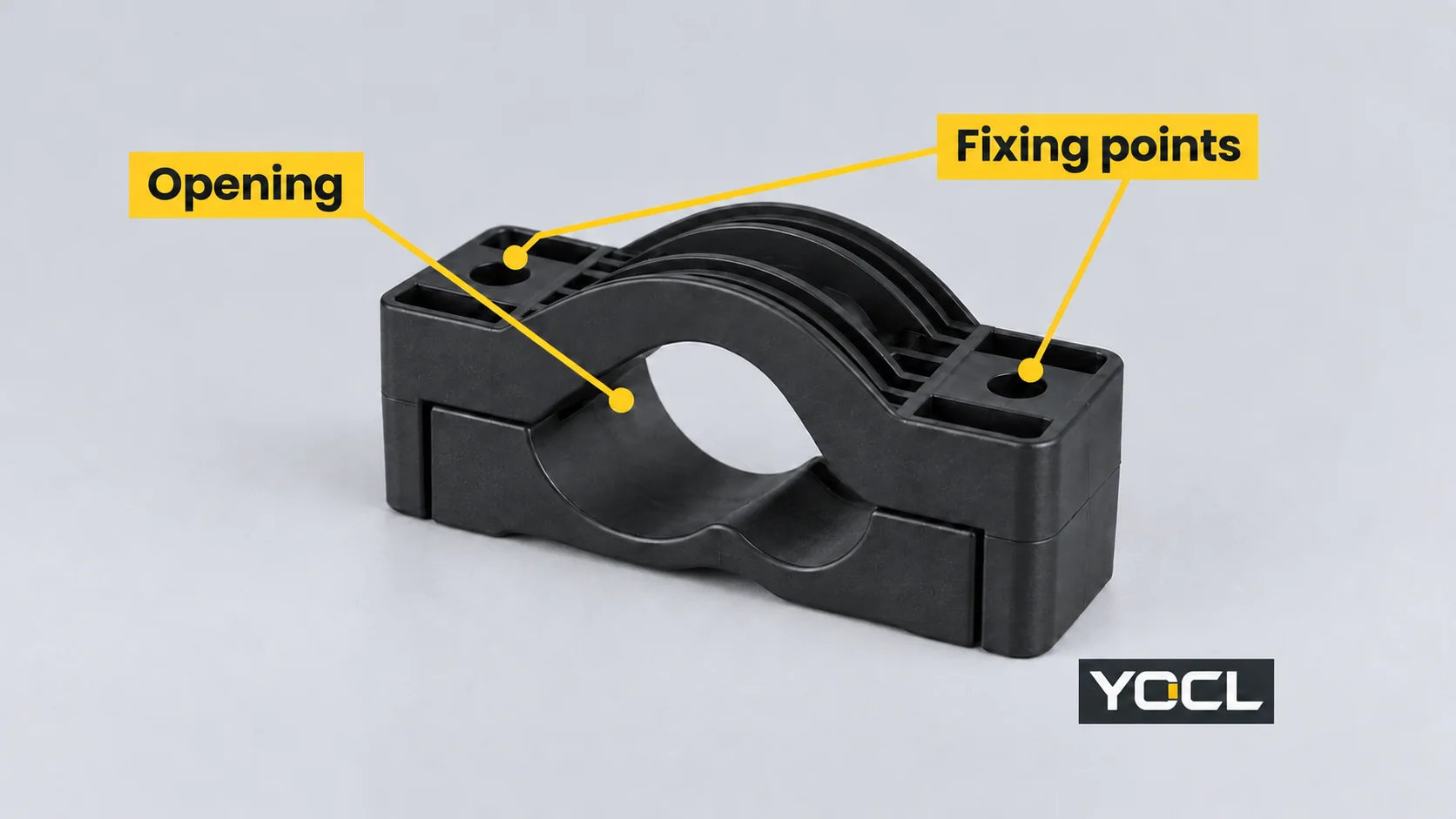
The K-series clamp drawing shows a central opening and two mounting positions. The SY three-core clamp record uses its own shaped arrangement and a cable-range notation beginning with 3 ×. That notation must not be replaced with one overall bundle diameter.
For either shaped clamp, obtain the actual cable arrangement and complete model drawing. A model designation is not a substitute for an opening measurement.
Identify How the Body Attaches to the Surface
Retention geometry and attachment can vary independently.
Nail-in fixing: the nail attaches the clip body to a compatible receiving surface. The steel nail’s presence does not establish suitability for every masonry, board, coating or metal panel. Confirm the selected item and substrate arrangement.
Even one series can change its fixing layout. YOCL’s Circle record lists single nails for its 4–25 mm items and two nails for the listed 30, 32, 35, 40 and 50 mm items. Plan the actual fixing points rather than treating the whole family as one-nail construction.
Moulded fixing stem: the tube-clamp reference shows a projecting ribbed stem. Its visible shape identifies an attachment feature, but the published table does not provide an installation-hole tolerance, pull-out rating or removal/reuse instruction. Those need the exact fixing document.
Mounting holes: a shaped clamp’s holes must match the fastener and receiving structure. Read hole centres, hole size, clearance and overall envelope separately. Neither a hole diameter nor the number of holes establishes an approved bolt, tightening torque or load capacity.
Read the Size Field Before Comparing Parts
A nominal size does not describe every dimension of the accessory.
Consider two actual round-clip entries:
| YOCL item | Published D | Published height | Published nail size |
|---|---|---|---|
| Circle 8MM | 8.0 mm | 9.4 mm | 1.9 × 18 mm |
| K-type Circle K-8MM | 8.0 mm | 13.0 mm | 2.5 × 22 mm |
The two D values match, while the body heights and nails differ. A request for an “8 mm round clip” therefore leaves the actual series and mounting details unresolved.
Dimension letters also vary between records. In the tube-clamp table, 20 Single lists tube size 20 mm and d1 = 20 mm, but D = 10 mm. D cannot simply be read as the retained tube diameter because it meant a cable-fit dimension elsewhere.
For flat cable, provide its external width and thickness. A flat-clip item designation is not conductor cross-sectional area in mm². Match the table’s H, A and B labels to a confirmed drawing before deciding what fits.
Opening, Fixing Centres and Overall Span
The K drawing distinguishes overall span A, fixing-hole centre spacing C, plan width F and hole diameter φ. The internal opening has separate D/E dimensions. These describe different physical interfaces.
The K and SY public tables do not state their dimensional units. Confirm the unit with the final drawing before making a dimensional selection. In the SY record, M labels a mounting-hole dimension; it is not evidence of a metric-thread designation.
Match the Required Duty to the Evidence
Positioning and Building Support
In its US/Canadian context, the public scope of UL 1565, Positioning Devices includes clips and clamps used to position wiring. It excludes building-structure support hardware, which it routes to separate support standards. It also does not evaluate mechanical protection or electrical insulation provided by the device.
Specify whether the accessory locates the route or must provide primary support. Then request the selected fixing system’s evidence for that duty. No YOCL certification is inferred from the standard’s scope.
Short-Circuit Restraint
A clamp shape does not establish cable-cleat fault performance. IEC 61914:2021 addresses cable cleats and intermediate restraints, with resistance to electromechanical forces where declared. Its scope includes cleats relying on a specified mounting surface for retention.
A fault-restraint requirement therefore needs a documented cable-cleat arrangement and declared performance. It cannot be assigned to a general routing clip from its appearance.
Fire-Support Requirements
YOCL’s metal clip range offers carbon-steel and stainless-steel forms. Metal construction alone does not qualify the cable, clip, nail and substrate as a complete fire-resistant system.
The IET’s UK cable/fire FAQ, discussing BS 7671:2018, explains the concern about premature collapse obstructing evacuation or firefighting. This is a defined installation question, not a universal material rule.
For a specified fire duty, obtain the selected configuration’s applicable test evidence and installation instructions. A product name or catalogue fire-exposure statement cannot supply the missing system conditions.
Choose the Next Document by the Unresolved Interface
| Unresolved question | Document or information needed |
|---|---|
| Will the body retain this cable or conduit? | Actual external profile/dimensions and exact item opening or acceptance range |
| Will it attach to this surface? | Nail, stem or fastener instructions and the receiving substrate/structure |
| Will the fixing points fit the available space? | Hole centres, fixing details and overall envelope in confirmed units |
| Does it provide the required support or restraint? | Selected-system mechanical evidence, installation orientation and relevant conditions |
| Is it suitable for outdoor, vibration or fire duty? | Exact material/environment or installed-system qualification for that requirement |
For review through the YOCL cable clips and clamps range, send the exact series/item, cable or conduit dimensions, retained arrangement, surface/fixing details, required duty, environment and quantity. Include the drawing revision and units when comparing shaped clamps.
Related reading: See clip and clamp retention comparison and cable-accessory manufacturer checklist.
References
- YOCL product information — Cable Clips & Clamps — retaining-family map and cable/surface input requirements.
- YOCL product information — Circle Cable Clips — round form, item-specific nails and dimensions.
- YOCL product information — Flat Cable Clips — flat profile and H/A/B dimension fields.
- YOCL product information — Hook Cable Clips — individual cable-acceptance intervals.
- YOCL product information — Single & Double Plastic Tube Clamps — seat count, tube sizes, exterior stem and table labels.
- YOCL product information — K Series Cable Clamps — exterior drawing and mounting/opening labels; units unconfirmed.
- YOCL product information — SY Three-Core Cable Clamps — arrangement notation and mounting-hole labels; units unconfirmed.
- YOCL product information — K-Type Circle Cable Clips — K-8MM dimensions and nail specification.
- UL Standards & Engagement — UL 1565, edition 6, Positioning Devices — official public scope; published 2022, revised 2024. Full paid requirements not consulted.
- IEC — IEC 61914:2021, edition 3.0 — official public abstract on cleats and declared restraint performance; full standard not consulted.
- YOCL product information — Metal Fire-Resistant Steel Cable Clips — material/fixing forms; installed fire performance needs configuration-specific evidence.
- IET — Cables and Fire Protection FAQs — UK support rationale, explicitly discussing BS 7671:2018.