
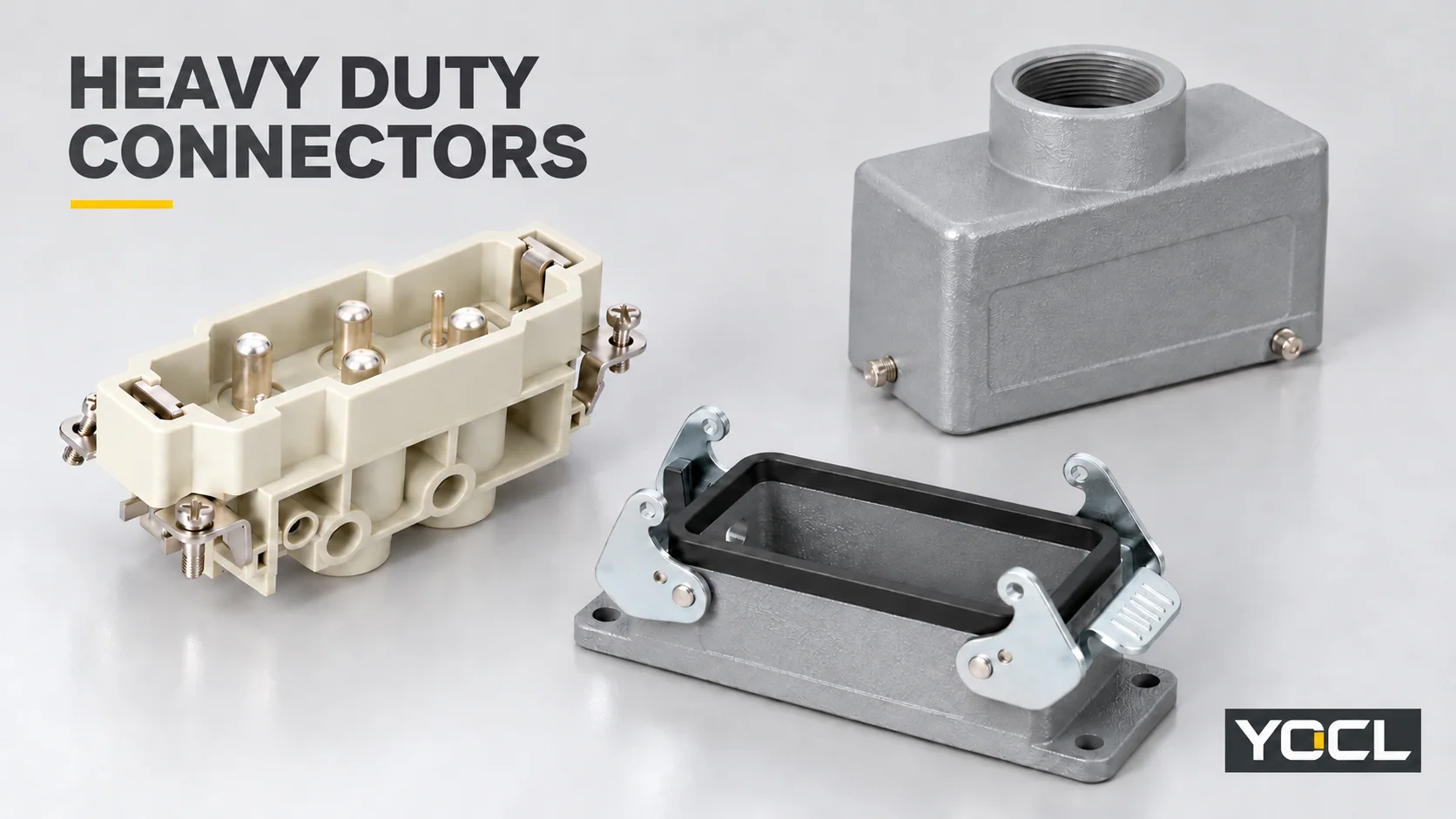
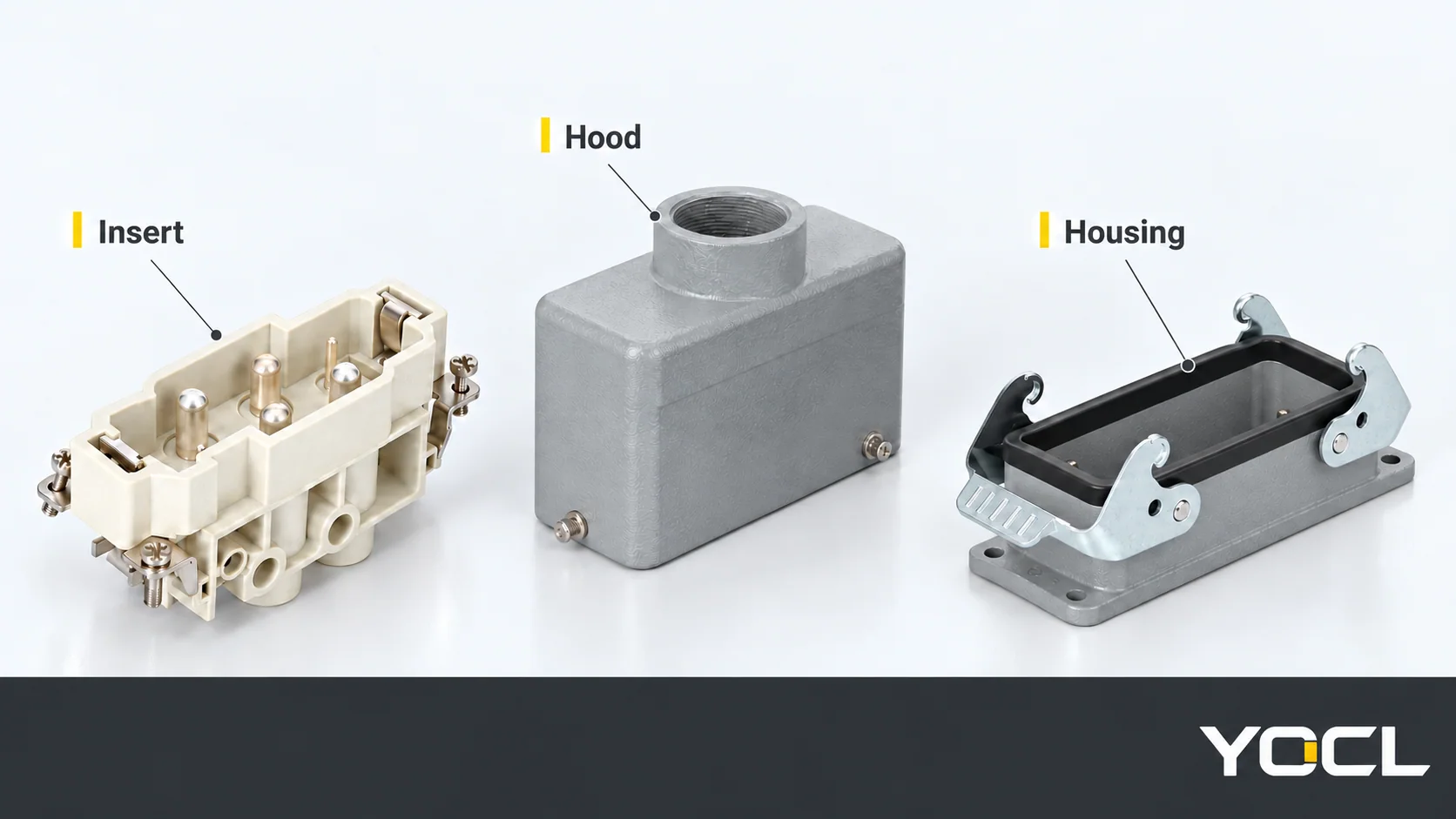
A rectangular heavy duty connector is a detachable electrical connection built from matched inserts and mating protective shells. The insert carries the contacts and wire terminations; the hood covers the cable side; the housing or base provides the opposing mounting arrangement. Locks, seals and cable-entry fittings complete different parts of the assembly. YOCL’s heavy duty connector range separates these component choices.
Reading a connector therefore means answering three questions: which circuits connect, which mechanical parts mate, and under what conditions the completed connection may operate. A shell designation answers only part of that task.
A heavy duty connector is a matched assembly
Use this map to separate the information in a product record before interpreting a complete-set code.
| Layer | Parts and function | What the designation identifies | What remains to be established |
|---|---|---|---|
| Contacts and circuits | Inserts hold the contact interfaces and conductor terminations | Insert variant and contact arrangement | Counterpart, circuit assignments and conductor requirements |
| Shells and mounting | Hood and mating housing/base locate and enclose the insert pair | Shell format, entry approach and mounting form | Exact mating drawing, locking arrangement and space for the cable |
| Complete assembly | Entry fittings, seals and locking complete the selected configuration | The particular combination being supplied | Declared operating conditions and protection in the specified assembly state |
Male and female describe the contact interface. They do not, by themselves, tell you which half is panel-mounted or which circuit side supplies power. Record the insert pair and the shell arrangement separately rather than treating either description as a complete connection specification.
Exterior references: YOCL HK-4/2 catalogue. These separate parts identify component categories, not a verified assembly.
Hood, housing and mounting describe the mechanical path
In a cable-to-panel arrangement, the cable-side hood mates with a panel-mounted housing or base. In a cable-to-cable arrangement, the mating enclosure also accommodates a cable. Those layouts need different mounting information even when the electrical insert requirement is unchanged.
Top entry and side entry describe the cable approach to the hood. They do not change the insert’s circuit count. A useful assembly drawing shows the selected insert pair, both shell references, locking points and entry locations together; a list of similar-looking components leaves those relationships unresolved.
Published pairing: HK-4/2-TEOBA — H16B-TG-RO upper shell / H16B-AG-LB mating shell. Obtain its parts breakdown to establish the supplied inserts, entry fitting and accessories rather than decoding unspecified contents from the suffix.
A cable-entry thread and a cable sealing range also answer different questions. Use the existing cable gland selection guide for the diameter and thread checks, then confirm the gland against the chosen shell entry. Similar shell sizes or familiar series names are insufficient evidence for mating compatibility across products or brands.
Read each rating against its component and conditions
Current concerns carrying capability under specified conductor, contact-loading and thermal conditions. Voltage is a separate operating value; an ambient-temperature range alone cannot establish current capability. These definitions appear in the original IEC 61984 public preview, §§3.15, 3.22 and 3.27.
When reading a record, keep four evidence fields separate:
- Contact groups: Which contacts share a rating, and which have a different function or limit?
- Termination: Which conductor construction and size, preparation and connection method are accepted?
- Thermal conditions: Which ambient temperature and loading arrangement support the declared current, and is a derating curve supplied?
- Completed enclosure: Which mating state, shells, entries, seals and covers support the declared protection?
These are document questions, not values to estimate from the connector’s appearance. A maximum figure on a catalogue page cannot fill every field.
Carrying current is separate from switching permission
IEC 61984 separates carrying current from live or loaded engagement/disengagement permission and breaking capacity. Its interlock definition concerns energization or separation; a fastening latch alone does not demonstrate that function. See the same preview, §§3.8–3.9, 3.12 and 3.28.
Look for explicit instructions for the selected assembly before deciding whether energized mating or disconnection is permitted. The figures in the HK example below do not answer that question.
Protection belongs to a stated enclosure configuration
Ingress protection concerns access, solids and water under defined tests, separately from electrical current capability (IEC 61984 §3.37).
YOCL’s HK record lists IP65 as a catalogue enclosure-selection entry. Confirm its applicable assembly state and required sealing parts. An open mating face, an empty hood and a completed enclosed connection are different configurations, so the designation should not be transferred between them without supporting documentation. Chemical exposure or hazardous-area suitability needs its own evidence.
HK-4/2: one shell format, two electrical contact groups
| Contact group | Contact count | Declared current | Declared voltage |
|---|---|---|---|
| Main | 4 | 80 A | 690 V |
| Auxiliary | 2 | 16 A | 400 V |
Source: YOCL HK-4/2 product record. These are manufacturer declarations; the public record does not assign AC/DC use or specify the current’s conductor and thermal conditions.
The H16B shell references are mechanical catalogue designations. They do not turn this arrangement into sixteen electrical contacts. Read the circuit configuration from the insert record and the enclosure pairing from the shell schedule.
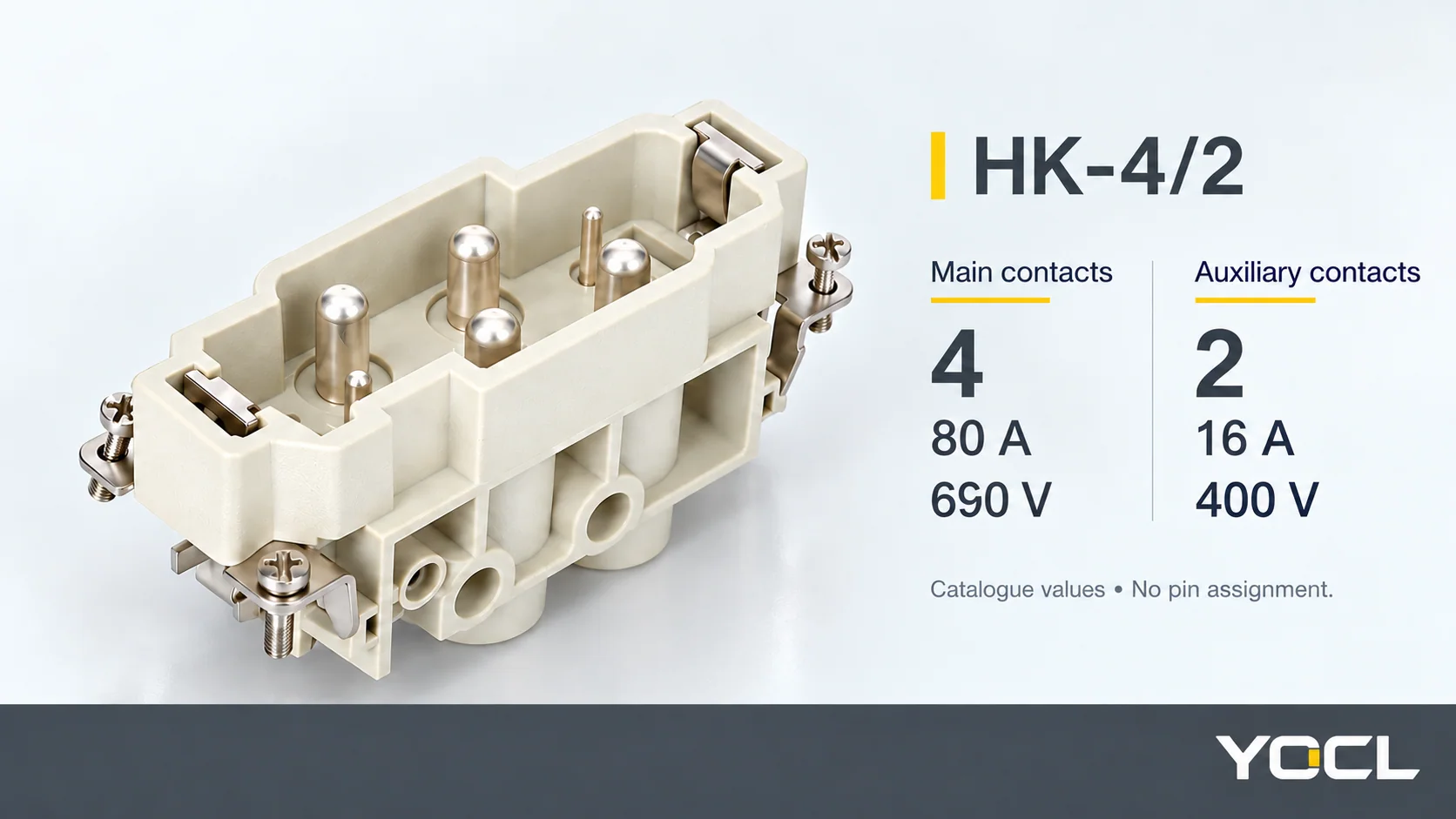
Keep the groups separate; do not total their current ratings. A shell-only purchase description omits this electrical distinction.
Find the document that answers the next question
Move from the part name to the document that resolves the remaining interface or duty question.
| Reader question | Verified next resource | Obtain or confirm |
|---|---|---|
| Which rectangular format fits the proposed arrangement? | YOCL format selector | Insert pair, both shells, entry direction and complete-set reference |
| What does this mixed-contact model declare? | HK-4/2 product record | Group-specific ratings, current conditions, accepted conductors and exact mating drawing |
| How do cable diameter and entry thread relate? | Cable gland selection guide | Cable sealing range and gland-to-shell entry fit |
| Does the selected assembly meet the operating and enclosure duty? | YOCL technical enquiry details | Instructions for the actual parts schedule, loaded duty, mating permission and protection state |
If the requirement concerns a keyed industrial plug and socket, continue with industrial plugs and sockets explained. That interface family has its own matching rules; it does not replace the rectangular insert-and-shell schedule.
For a rectangular assembly enquiry, send YOCL the circuit requirements, proposed parts schedule, cable-entry details and environment so the response can address the particular connection.
Related reading: See top-entry and side-entry hood routing.
Related reading: battery connector mating and polarity checks; battery connector types and selection basics.
References
- YOCL ELECTRIC — Heavy Duty Connectors. First-party component and configuration information; accessed 8 October 2026.
- YOCL ELECTRIC — HK-4/2 Heavy Duty Connector. Public catalogue data and exterior references; accessed 8 October 2026.
- IEC 61984:2008, edition 2, including October 2011 corrigendum — original public preview. Definitions in §§3.8–3.9, 3.12, 3.15, 3.22, 3.27–3.28 and 3.37; full paid clauses were not consulted.