
Heat shrink tubing is a polymer sleeve supplied in an expanded size that contracts when heated under the product’s specified conditions. It covers wires, terminals and connection parts for electrical insulation, identification or protective covering. An adhesive-lined grade can also create a bonded interface when its materials and installation suit the application.
To understand a heat-shrink product, separate three questions: how far it can recover, how its wall is built, and whether it contains adhesive. A 3:1 ratio describes diameter recovery. Single wall describes construction. Adhesive lining describes an inner material. None of these fields supplies the other two.
Where heat shrink tubing fits in an electrical connection
The sleeve sits around an existing wire or connection. Its purpose may be covering a terminal, insulating an exposed conductive section, identifying a conductor by colour, or protecting a surface. Those functions still require the right grade and dimensions for the equipment.
The electrical connection itself must already be suitable. Tubing does not establish a correct crimp, compatible conductor joint or adequate mechanical restraint. A close-fitting sleeve can cover a connection without bonding to it; sealing the sleeve ends is a separate requirement.
Recovery has three distinct states:
- Supplied or expanded: the larger bore that allows the sleeve to slide over the part.
- Freely recovered: the smaller bore it can reach under specified recovery conditions, without an internal object stopping it.
- Installed: the sleeve conforms to the object inside it, so its actual diameter and wall build depend on that geometry.
NASA’s KSC-E-165 Revision F, section 3.8.1.1.1 documents the expanded/recovered size relationship in ground-support-equipment fabrication: the expanded size clears the object, while the recovered size is smaller than it. That is a useful dimensional principle, rather than a general approval of a tubing installation.
What do 2:1, 3:1 and 4:1 shrink ratios mean?
The shrink ratio compares expanded inside diameter with freely recovered inside diameter. Read it as a nominal diameter relationship, then use the actual supplied and recovered limits in the model’s size table.
For example, Seattle City Light’s Material Standard 7374.70 specifies an “expanded-recovered” ratio separately from internal diameters and wall thickness. Its particular utility products and installation requirements are not general YOCL specifications.
For an idealized 12 mm starting bore, the arithmetic is:
| Nominal ratio | Ideal freely recovered bore | Meaning |
|---|---|---|
| 2:1 | 12 ÷ 2 = 6 mm | Half the starting inside diameter |
| 3:1 | 12 ÷ 3 = 4 mm | One-third of the starting inside diameter |
| 4:1 | 12 ÷ 4 = 3 mm | One-quarter of the starting inside diameter |
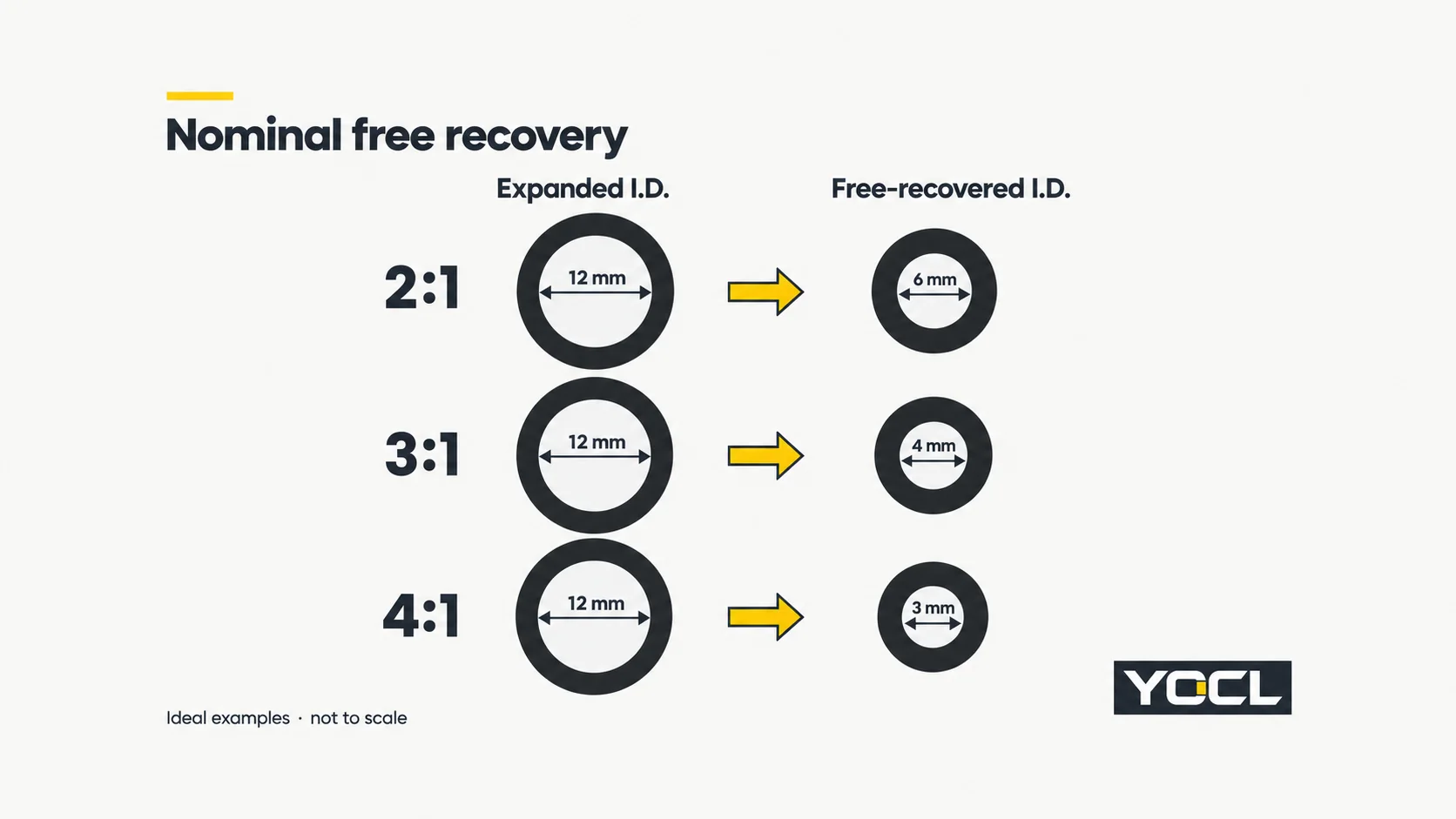
These are illustrative values before product tolerances, not a catalogue size recommendation. They describe free recovery. On a cable that prevents the sleeve reaching that bore, the installed diameter remains larger.
A higher ratio provides a wider nominal diameter-recovery range for the same starting bore. It can therefore help accommodate a larger transition between the feature the sleeve must clear and the surface it must grip. The actual fit still depends on the model’s dimensions and application range.
The ratio does not describe length reduction, wall count or electrical duty. If coverage length matters, check the product’s declared longitudinal change rather than applying the diameter ratio to the cut length.
Wall thickness, wall count and adhesive are different fields
Wall thickness describes the wall build
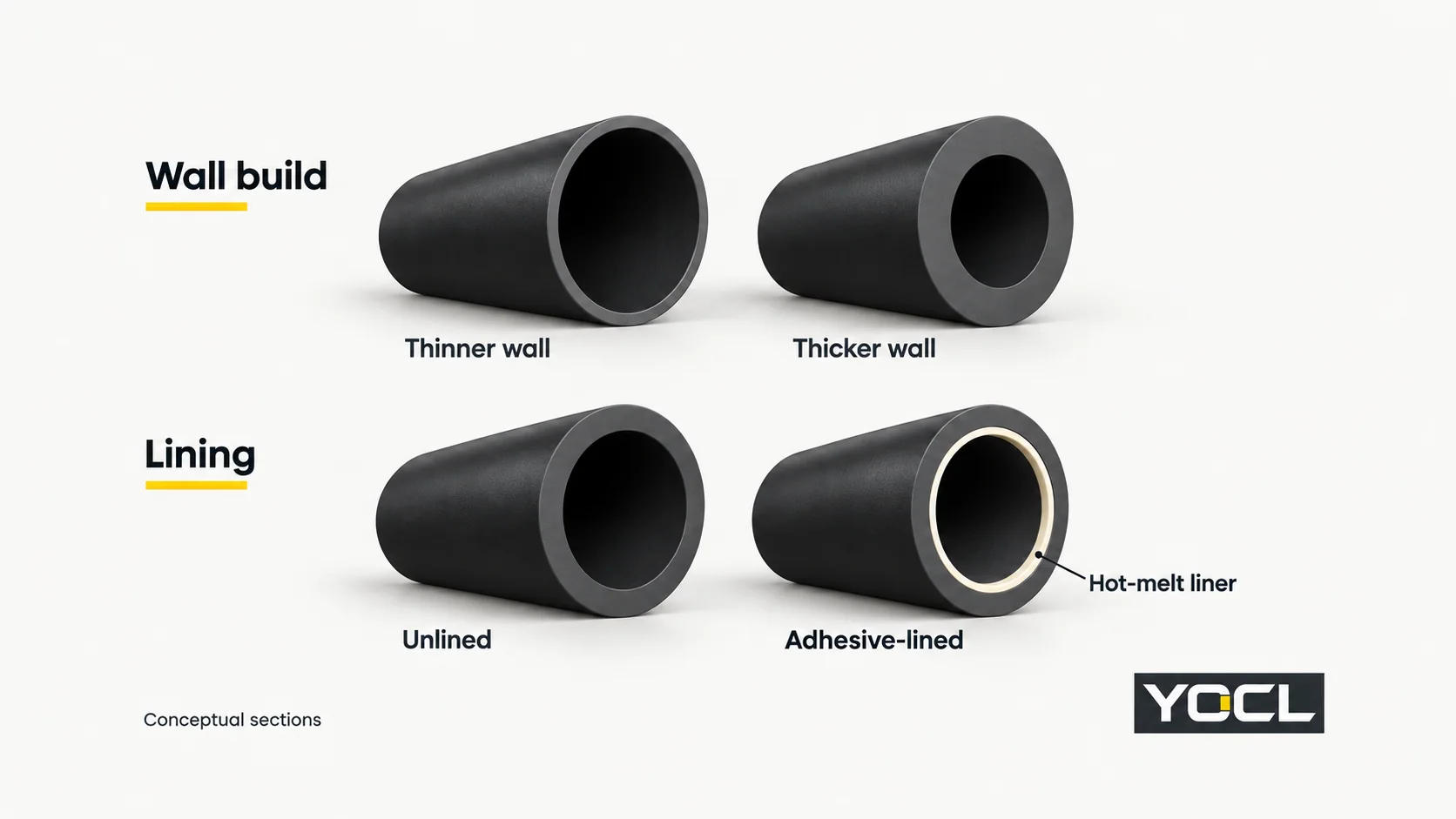
Thin-wall, medium-wall and thick-wall descriptions concern the sleeve’s wall build. Compare the published thickness and its measurement state: as supplied, freely recovered or installed. A recovered-wall figure cannot automatically be used as the finished wall on every cable diameter.
The public scope of IEC 60684-3-214:2019 distinguishes medium-wall and thick-wall polyolefin types at the same nominal 3:1 ratio. This illustrates why wall build and ratio need separate fields; the scope does not establish a universal thickness classification for every product.
Wall count describes the construction
For the common electrical-wiring constructions discussed here, single-wall tubing is an unlined sleeve. Adhesive-lined dual-wall tubing combines an outer sleeve with an attached hot-melt inner liner. The liner remains a distinct material even though both layers form one tubing product.
“Single wall” does not mean every such sleeve has the same thin wall, and “dual wall” is not a universal thick-wall designation. Check dimensions rather than ranking the wall build from the number of layers.
Adhesive adds an interface function
During the specified heating process, the adhesive liner softens and flows at compatible mating surfaces. This can provide a bonded interface for a required environmental seal. The result depends on the liner, cable jacket, contact geometry, installation and exposure; an adhesive-lined description alone does not prove waterproof performance.
IEC 60684-3-248:2007 describes dual-wall polyolefin sleeving with adhesive inner walls in nominal 2:1, 3:1 and 4:1 variants. Its official public scope identifies the construction family, not certification of a YOCL model.
YOCL’s own catalogue makes the separation tangible: 4:1 Zero-Halogen single-wall tubing declares no internal adhesive, while HS3X 3:1 dual-wall tubing declares a hot-melt inner layer. These are first-party product declarations. The larger ratio does not identify the lined product.
For the actual choice between the two constructions, see Single Wall vs. Dual Wall Heat Shrink Tubing, which compares their functions, application conditions and model data.
Material and temperature still matter
Material names identify another part of the specification. Polyolefin and polyvinyl chloride (PVC), for example, do not by themselves tell you the shrink ratio, liner construction or every service property. NASA’s heat-shrink subsection includes both crosslinked polyolefin and non-crosslinked PVC examples, so one manufacturing explanation should not be imposed on all tubing.
Also distinguish recovery conditions from operating temperature. Initial shrink, full recovery and any adhesive-activation requirements describe the installation process. An operating range describes subsequent service. Use the selected model’s documentation for each field; a recovery figure is not a heat-gun setting.
NASA’s same subsection makes heat exposure dependent on tubing size and type and requires avoiding damage to the covered object. Cable jackets and nearby components therefore matter alongside the sleeve itself. This hub provides terminology; the model’s instructions govern the actual process.
For electrical or environmental properties, use the exact grade and relevant evidence. UL Solutions’ insulating-tubing guidance explains that conditions of acceptability record voltage, temperature and optional ratings. A colour, ratio or liner description cannot substitute for that record, and no YOCL certification is asserted here.
Which information do you need next?
Read a product description as a set of separate fields. Each field answers a different question:
| Your question | Field or resource to check | What it cannot establish by itself |
|---|---|---|
| Will the sleeve pass over the part and recover onto it? | Minimum supplied bore, maximum recovered bore and permitted application range | Sealing or electrical suitability |
| How much recovery is available? | Nominal ratio alongside the actual size table | Length change, wall count or adhesive presence |
| How much space will the finished sleeve occupy? | Wall thickness with its measurement state and installed-build information | Finished outside diameter from a free-recovery value alone |
| Does the connection need a bonded interface? | Unlined/adhesive-lined construction, liner compatibility and sealing evidence | A guaranteed moisture rating from “dual wall” alone |
| What heating and service conditions are allowed? | Model instructions, recovery fields and operating range | A universal heat setting from the material name |
| Does the grade meet the equipment’s duty? | Exact material/grade documentation and applicable certification or test record | Complete equipment suitability from a generic product label |
The YOCL heat-shrink tubing catalogue organizes single-wall and adhesive-lined series with their individual product information. Use it to find the relevant construction and ratio, then check the exact model’s dimensions, instructions and evidence. For an enquiry, describe the part to be covered and its intended function rather than requesting only “3:1 heat shrink”.
References
- NASA Kennedy Space Center — KSC-E-165 Revision F, 2021. Sections 3.8.1.1 and 3.8.1.1.1; ground-support-equipment sleeving, dimensions and heat-exposure requirements.
- Seattle City Light — Material Standard 7374.70, 2012: Tubing, Heat Shrink Type, Medium Wall. Section 3; expanded-recovered ratio terminology and separate dimension fields.
- IEC — IEC 60684-3-214:2019: Thick- and medium-wall polyolefin sleeving. Official public scope; wall categories at a common nominal ratio.
- IEC — IEC 60684-3-248:2007: General-purpose dual-wall polyolefin sleeving. Official public scope; adhesive inner walls and nominal 2:1, 3:1 and 4:1 variants.
- YOCL product information — 4:1 Zero-Halogen Single-Wall Heat Shrink Tubing. Declared ratio and absence of an internal adhesive layer.
- YOCL product information — HS3X 3:1 Dual-Wall Adhesive-Lined Heat Shrink Tubing. Declared ratio and material layers.
- UL Solutions — Insulating Tubing Testing and Certification. Model conditions of acceptability and optional ratings.