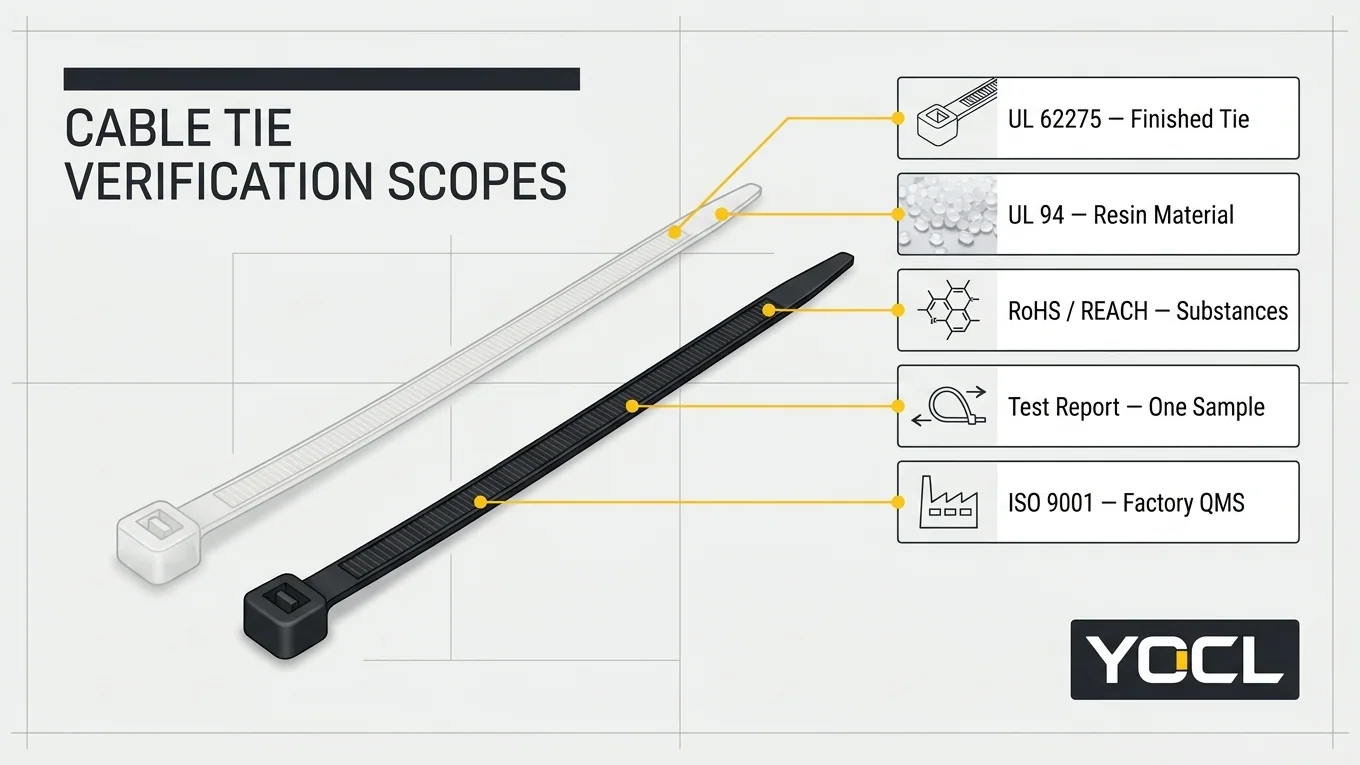
Evaluating cable tie certifications requires separating five documents that supplier quotations routinely merge into one claim: UL 62275 product listings, UL 94 material classifications, RoHS and REACH declarations, third-party test reports, and ISO 9001 certificates. Each answers a different question—name the document, the issuer, the scope, and the independent check.
Buyers lose control of procurement quality when a plastic supplier’s resin card, a single-sample pull report, or a factory management certificate is accepted as proof that a finished cable tie is certified for electrical installations. What a given market or contract legally requires of an importer is the importer’s own determination. This guide covers document literacy—what each supplier file actually proves, what to ask for, and how to check it.
Product Listing to UL 62275: Certification of the Finished Cable Tie
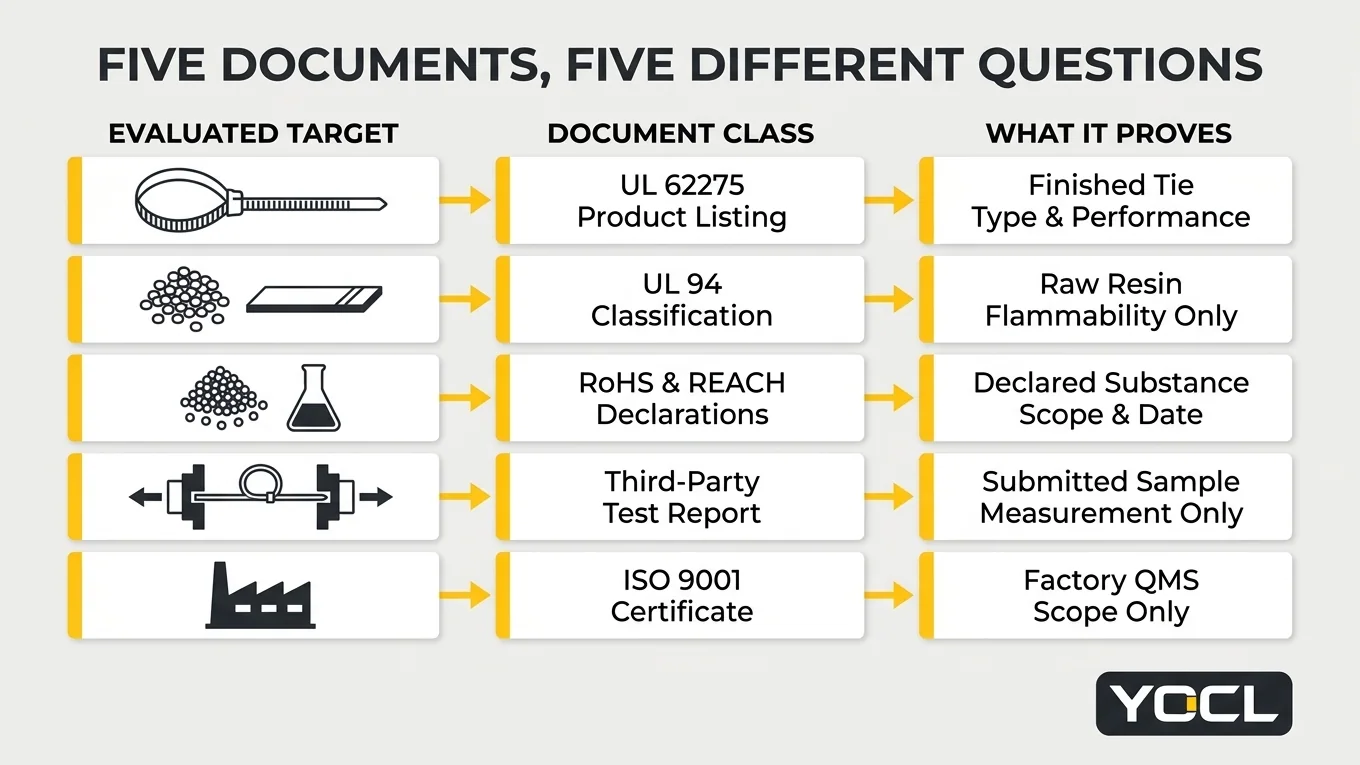
A UL 62275 product listing certifies the finished cable tie as a made product—covering its type designation, mechanical strength, and temperature performance—issued with ongoing follow-up by the certifier and traceable to a public file. Any “UL” claim that cannot be traced to a file is a claim, not a listing.
Under UL 62275 (Standard for Cable Management Systems — Cable Ties for Electrical Installations), the certifying body tests the complete moulded or formed tie rather than raw pellets alone. That evaluation assigns product type designations—including the securement and support types referenced in whether you can use zip ties in a breaker panel—and qualifies service and installation temperature ratings (for temperature limits themselves, see whether zip ties are heat resistant). Unlike a one-off lab test, an active listing includes ongoing factory follow-up surveillance by the certifier.
What to ask: Request four items before accepting a listing claim: the certifier’s name, the file number, the exact legal company name on the file, and which specific models, colors, and type designations the file covers.
How to verify: Check UL listings directly in UL Solutions’ public UL Product iQ directory. Register a free user account and search by the stated file number, exact company name, or model designation. Confirm that the file is active, that the standard is UL 62275 for cable ties rather than a plastic resin category, that the listed company matches your supplier or declared manufacturer, and that your exact quoted part numbers and types appear inside the covered models table.
Material Flammability Classification to UL 94: Resin Rating, Not Product Listing
A UL 94 flammability classification rates a raw plastic material tested on standard bar specimens—belonging to the polymer resin rather than to any finished cable tie moulded from it. A datasheet line reading “material: UL 94 V-2 nylon” states the material classification; it never states that the finished tie is UL listed.
Under UL 94 (Standard for Tests for Flammability of Plastic Materials for Parts in Devices and Appliances), polymer producers submit standardized test specimens of defined thicknesses, and recognized resin grades are recorded on material files commonly called UL Yellow Cards (for what the grades mean, see flame-retardant cable ties and UL 94 ratings). When a moulder converts polyamide 66 (PA66) resin into cable ties, citing that resin rating describes only the raw material input. Moulding heat, regrind content, colorants, and thin strap geometry can alter finished-part burning behavior—so a UL 94 material statement and a UL 62275 product listing must never be treated as interchangeable.
What to ask: Ask whether the UL 94 line refers to the base PA66 resin maker’s Yellow Card or a tested compound at strap thickness, and request the polymer manufacturer and resin grade name if material traceability is required.
How to verify: Look up the polymer producer and resin grade in UL Product iQ to check the recognized minimum thickness and color scope (such as “all colors” versus natural resin only), and record it strictly as raw-material evidence rather than finished-tie certification.
Substance Declarations Under RoHS and REACH: Conformity Files, Not Certifications
RoHS and REACH are declaration-based European substance regimes, not product safety certifications. No European agency issues an official “RoHS certificate” or “REACH certificate” for a cable tie; a framed “RoHS certificate” from a testing company is at most a supporting analytical test report on one submitted sample.
RoHS (EU Directive 2011/65/EU, as amended) restricts named hazardous metals, flame retardants, and phthalates in covered products; legal conformity sits in the manufacturer’s declaration and technical documentation. REACH (Regulation (EC) No 1907/2006) operates the same way for cable ties: the operative buyer document is the supplier’s declaration, including the Substance of Very High Concern (SVHC) communication duty when any European Chemicals Agency (ECHA) Candidate List substance is present in the tie above 0.1 percent weight by weight. Because the SVHC Candidate List is updated periodically, an undated logo proves nothing.
What to ask: Request a signed declaration naming the exact directive or regulation (Directive 2011/65/EU and Regulation (EC) No 1907/2006 with the referenced SVHC Candidate List update), the exact cable tie product scope and colors covered, and its issue date.
How to verify: Reject standalone RoHS or REACH badges without a written document. Check that the issuer’s legal name, covered part series, legislative edition, and date are current, and confirm that any attached chemical test report matches the homogeneous material and color ordered.
Third-Party Laboratory Test Reports: Measured Results on One Submitted Sample
A third-party test report is a laboratory’s record of what it measured on the specific sample submitted to it, tested against the standard and edition named in the report. It is a point-in-time sample measurement—not a product listing, not a family-wide approval, and not backed by ongoing production surveillance.
Three reading rules prevent buyers from over-reading laboratory PDFs:
- Sample-only coverage: The report covers only the sample described inside it—defined by strap dimensions, material, color, and submission date—not automatically an entire product family or future batches.
- Laboratory checkability: The report reference can be checked directly with the issuing laboratory to confirm the document is genuine and unaltered.
- Not a listing: No certifier follow-up stands behind factory production after the test date.
Keep tensile numbers straight as well: a test report whose measured loop break value exceeds a datasheet figure does not “beat” the datasheet. They are two different kinds of statement—one sample’s measured result versus the manufacturer’s published minimum specification (for tensile values across sizes, see the cable tie size and tensile strength chart).
What to ask: Request the complete, uncropped laboratory report—never just a cover page—showing sample description, test standard and edition, test date, and issuing laboratory.
How to verify: Check report authenticity with the issuing laboratory and confirm that the tested sample’s dimensions, material, and color match the tie on your order.
Factory System Certification to ISO 9001: Management Scope, Not Product Approval
An ISO 9001 certificate confirms that a factory operates an audited quality management system within the activity scope printed on the certificate. It says nothing about the mechanical, thermal, or flammability performance of any individual cable tie, and its scope line and expiry date are the fields to read.
ISO develops ISO 9001 (Quality Management Systems — Requirements) but never issues certificates; accredited registrars audit how the facility manages quality processes. When reviewing an ISO 9001 certificate for cable ties, check that the scope covers manufacturing of cable ties or wiring accessories at the production site rather than trading alone, and check the expiry date. For broader supplier vetting, see how to choose a cable accessories manufacturer in China.
What to ask: Request the full ISO 9001 certificate showing legal entity name, manufacturing address, accredited registrar, scope line, and validity dates.
How to verify: Match the company name and factory address to your supplier, read the scope line and expiry date, and verify active status through the issuing registrar’s directory.
Supplier Ask-List for Cable Tie Certifications: What Each Document Proves
Sorting cable tie certifications and supplier attachments through one buyer ask-list stops mismatched paperwork before procurement approval. Use the five-row verification table below to check what each document proves, what to request from your supplier, and how to verify it independently:
| Document | What It Actually Proves | What to Request from the Supplier | How to Check It |
|---|---|---|---|
| UL 62275 product listing | Finished tie certified for type, mechanical, and thermal performance with follow-up | Certifier name, file number, exact company name on file, and covered models/types | Look up file number or company in UL Product iQ; match active status and models |
| UL 94 classification | Raw plastic resin specimen met a flammability class at tested thickness | Base resin Yellow Card vs compound details; polymer maker and resin grade | Check resin grade in UL Product iQ; confirm thickness/color; never treat as tie listing |
| RoHS & REACH declarations | Supplier declares conformity with Directive 2011/65/EU and Regulation (EC) No 1907/2006 | Signed declaration naming directive/regulation, SVHC status, product scope, and date | Verify legal issuer, covered SKUs/colors, current legislative edition, and issue date |
| Third-party test report | What the lab measured on the submitted sample against the named standard | Complete uncropped report showing sample details, standard/edition, lab, and date | Check report reference with issuing lab; match tested sample to ordered SKU |
| ISO 9001 certificate | Factory runs a quality management system within the printed scope | Full certificate showing factory name, site address, registrar, scope, and expiry | Read scope line and expiry date; verify active status with issuing registrar |
Verification Rule: Require a traceable UL 62275 file lookup whenever an installation specification demands a listed finished cable tie; accept UL 94 cards, dated RoHS and REACH declarations, lab reports, and ISO 9001 certificates strictly for resin flammability, substance compliance, single-sample data, and factory QMS scope—never as substitutes for a product listing.
How to Read a Real Product Page: YOCL’s Published Position
YOCL ELECTRIC’s cable tie pages publish a material flammability classification—Document Type 2—and publish no UL 62275 listing, no certificate or file numbers, and no RoHS or REACH declarations; for documents beyond that material classification, buyers request them directly for their order and check them by the methods above.
Specifically, YOCL’s HSS Nylon Cable Ties page describes the strap as “Nylon 66 (PA66), with catalogue material flammability designation 94V-2” and lists “94V-2, as stated in the catalogue” in its technical table, while YOCL’s BZ ball-lock stainless steel cable tie page states stainless steel grades, uncoated or coated finishes, and width-specific minimum tensile strengths. Under the five-document spine, “catalogue material flammability designation 94V-2” is strictly a material statement for the PA66 nylon—not a UL product listing. Because the checked pages publish no UL 62275 listing, no certificate or file numbers, and no RoHS or REACH declarations, buyers who require further documentation request it from YOCL (or any supplier) against the exact SKU and check what is supplied, without filling the gap with assumptions in either direction.
Frequently Asked Questions
Is “UL 94 V-2 material” the same as UL listed?
No. “UL 94 V-2 material” is a flammability classification of the raw plastic resin tested on standard specimens, whereas “UL listed” for a cable tie means the finished tie itself is certified to UL 62275 under a traceable file with ongoing certifier follow-up. The two are never interchangeable.
My supplier sent a “RoHS certificate” — what do I actually have?
At most, you hold either a supporting laboratory test report on a submitted sample or a supplier conformity declaration styled like a certificate. Because no European authority issues RoHS certificates for cable ties, read the text to confirm which document it is, the exact product scope covered, and its date.
A test report shows a higher tensile strength than the datasheet — which one is true?
Both can be true because they make different statements. A test report records what one submitted sample measured on the test date, while a datasheet states the maker’s published minimum specification across production—and neither document is a product listing.
Does the factory’s ISO 9001 certificate mean its cable ties are certified?
No. An ISO 9001 certificate covers only the factory’s quality management system within the activity scope printed on the certificate. It certifies management processes at that site and says nothing about the performance or product certification of any individual cable tie.
References
- UL 62275 — UL Standards & Engagement / UL Solutions, Cable Ties for Cable Management (Standard for Cable Management Systems — Cable Ties for Electrical Installations): finished cable tie certification scope, type designations, and follow-up surveillance.
- UL 94 — UL Standards & Engagement / UL Solutions, Combustion (Fire) Tests for Plastics (Standard for Tests for Flammability of Plastic Materials for Parts in Devices and Appliances): plastic material flammability classification on standard specimens.
- UL Product iQ — UL Solutions, UL Product iQ Online Certification Directory (public verification platform via ul.com): lookup route for active UL listings, company names, covered models, and recognized plastic materials.
- EU Directive 2011/65/EU (RoHS) — European Parliament and Council, Directive 2011/65/EU on the Restriction of the Use of Certain Hazardous Substances in Electrical and Electronic Equipment: restricted-substance scope and manufacturer declaration regime.
- Regulation (EC) No 1907/2006 (REACH) — European Parliament and Council, Regulation (EC) No 1907/2006 concerning the Registration, Evaluation, Authorisation and Restriction of Chemicals: chemical substance regulation and SVHC communication duty.
- ISO 9001 — International Organization for Standardization, ISO 9001:2015 Quality Management Systems — Requirements and ISO public certification guidance (iso.org): quality management system scope boundary.
- YOCL ELECTRIC Product Information — HSS Nylon Cable Ties: published PA66 construction and catalogue material flammability designation 94V-2.