Short Answer: Flame retardant cable ties are not fireproof. Their material is classified for self-extinguishing behaviour after a test flame is removed; this does not guarantee that fire cannot spread through a cable bundle. Within the three classes discussed here, V-0 is stricter than V-1, followed by V-2. Start with the grade required by the equipment or project specification, then verify the supporting file and material report. YOCL publishes a V-0 material classification for its YC flame-retardant series.
The purchasing task is to connect a requirement to an identifiable product and its evidence. A description saying “flame retardant” is a starting point, not a complete approval. The class, supplied material, model and intended location must agree. A higher material class does not remove the need to check mechanical suitability or the installation’s separate requirements.
1. What Is a Flame Retardant Cable Tie?
A flame-retardant nylon tie uses a formulation selected for improved behaviour under a defined flammability test. The YOCL YC flame-retardant series is described as flame-retardant Nylon 6.6, also called PA66. The purpose of the formulation is to limit sustained burning after the ignition source is removed, rather than make a polymer incapable of ignition.
Nylon can soften, melt and, depending on the formulation and exposure, produce drops or continue burning. It is misleading to assign the same behaviour to every ordinary PA66 tie: standard grades can already have a declared flammability class. What matters is the particular grade’s evidence, not whether the catalogue places “flame retardant” in the product name.
For the underlying construction and material terminology, use What Is a Nylon Cable Tie?. Here, the distinction is between the material’s stated response to a test flame and the other properties needed to hold a cable bundle in service.
Flame retardant does not mean fireproof or heat resistant. The current YC flame-retardant product page states an operating temperature of -40°C to +85°C. That service range is a separate declaration from UL 94 V-0; V-0 does not authorize operation at a higher temperature or establish how long the fastening will retain a load during a fire.
The same separation applies to other material descriptions. YOCL publishes halogen-free and silicone-free declarations for this series, but neither phrase, by itself, supplies a smoke-release result, a finished-product approval or an installation fire rating. Keep each required property on its own line in the purchasing specification instead of treating a collection of favourable terms as interchangeable evidence.
2. UL 94 V-0, V-1 and V-2 Compared
UL Solutions’ explanation of plastics flammability testing describes small-scale material classifications. The following table summarises only the requested individual afterflame-time distinction and the flaming-drop criterion. It is not a complete test procedure, and the “Typical use” column describes a specification decision rather than permission to install a product in a particular building or vehicle.
| Rating | Self-extinguishes within | Flaming drips | Typical use |
|---|---|---|---|
| V-0 | ≤10 seconds after removal of the test flame | Must not ignite the cotton indicator through flaming particles or drops | A candidate where the specification requires V-0; strictest of these three classes |
| V-1 | ≤30 seconds after removal of the test flame | Must not ignite the cotton indicator through flaming particles or drops | A candidate where the specification permits V-1, with its separate application checks |
| V-2 | ≤30 seconds after removal of the test flame | Cotton ignition from flaming particles or drops is permitted by this criterion | A candidate only where the specification accepts V-2 |
The cotton-indicator wording matters. V-0 and V-1 are often abbreviated as “no flaming drips”, but the cited UL criterion concerns ignition of the indicator below the sample. Do not turn that shorthand into a guarantee that nothing can melt, detach or fall in an actual fire. Equally, V-2 permits the relevant dripping outcome; it does not mean every V-2 item must drip when exposed.
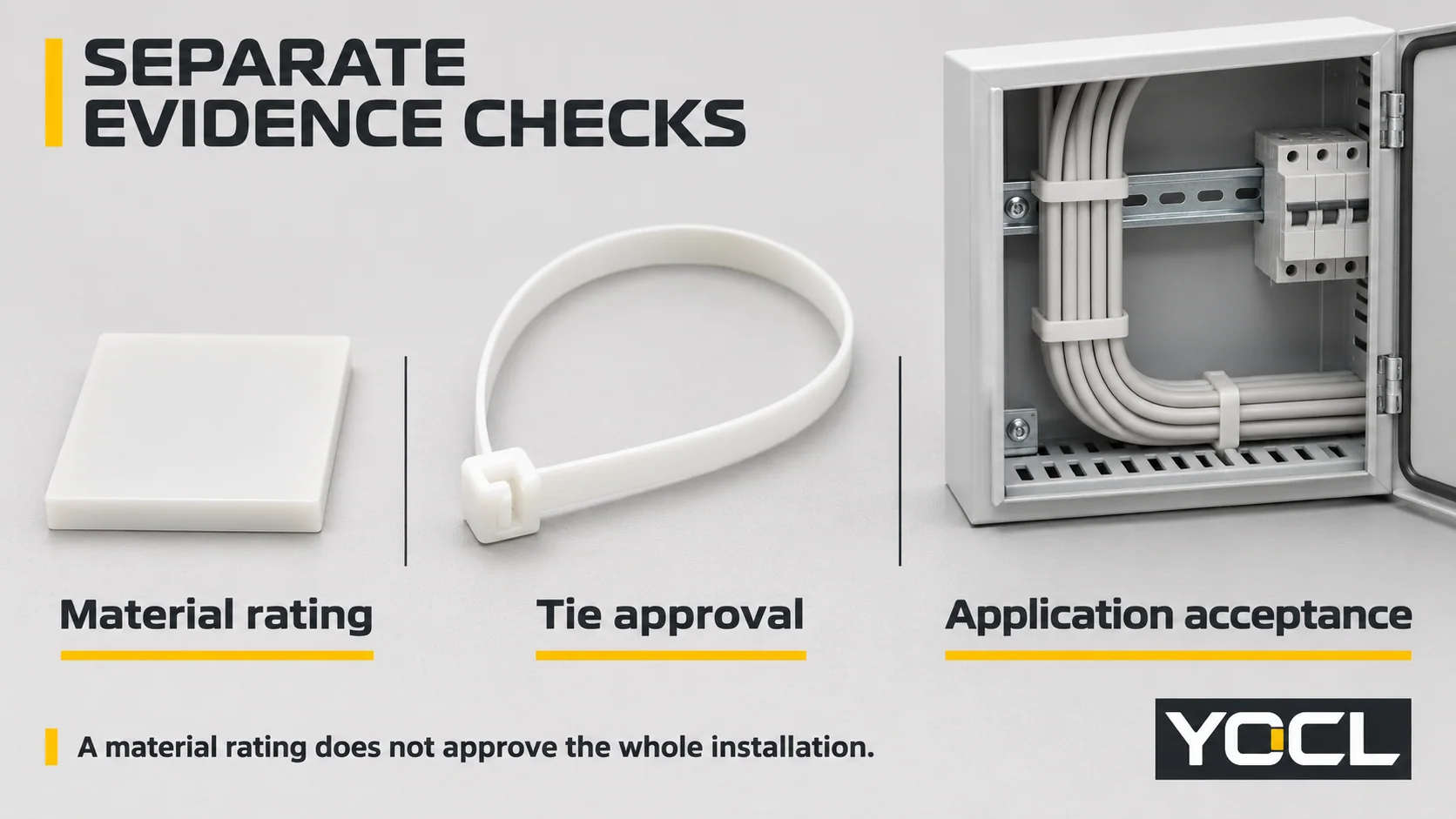
Material Evidence Is Not Finished-Tie Approval
A UL 94 class describes material flammability within its evaluated scope. It is not, by itself, a UL Listing or Recognized Component approval for the complete cable tie. A resin recognition can be genuine while the finished fastener still needs a different product investigation or acceptance decision.
The relevant material identity includes its grade, evaluated colour and applicable thickness scope. Changing a pigment, additive package or formulation can require reassessment; a V-0 statement for one grade cannot be assigned to every nylon part. The UL Yellow Card guide explains how these fields belong to the material record. A card for a different grade or an unconnected supplier is not evidence for the ordered tie.
3. Where Flame Retardant Cable Ties May Be Specified
Whether a tie is required depends on the equipment specification, installation rules and responsible design authority. Do not infer a universal legal mandate from the name of a location. These are settings in which a purchaser may encounter an explicit flammability requirement:
- Distribution and control cabinets: closely grouped wiring and adjacent electrical components make the material class a relevant item in the equipment’s component specification.
- Data-centre racks: concentrated cable routes and equipment arrangements make it important to distinguish the tie’s material declaration from any separate smoke or air-handling-space requirements.
- Transport and rail equipment: passenger environments and evacuation considerations can make material fire behaviour part of a broader approved specification; a V-0 declaration alone does not qualify a tie for every vehicle.
- Lift systems and building electrical installations: cable routing near occupied areas can prompt a project-specific class requirement, but the selected tie still needs approval for its actual role and location.
For an outdoor portion of any route, ultraviolet exposure is a separate requirement and cannot be inferred from V-0.
Ask who owns the requirement before substituting a grade: the cabinet builder, equipment manufacturer, project engineer or approving authority may define different evidence. If a drawing specifies V-0, do not accept V-2 merely because both are self-extinguishing classifications. If it specifies an additional fire or smoke assessment, changing the UL 94 class alone may not resolve it.
Document the requirement at the actual fastening location. “Inside a data centre” and “inside an environmental-air space” are not equivalent descriptions. An unspecified fire-safety preference should be clarified before ordering rather than converted into an invented regulation or an unsupported claim of compliance.
4. Flame Retardant Versus Ordinary Nylon Cable Ties
The useful comparison is between documented grades, not a white tie and a black tie. Appearance cannot demonstrate a flame class. For the YC flame-retardant series, the current published colour is natural; that is a series-specific offering, not a rule that every flame-retardant tie must be white, natural or any other colour.
| Comparison point | Flame-retardant nylon tie | Ordinary nylon tie |
|---|---|---|
| Material | A specified flame-retardant formulation; YC is published as flame-retardant PA66 | A specified base grade whose actual formulation and declared properties still need checking |
| After the ignition source is removed | Evaluated according to the stated class; YC publishes V-0 | Grade-dependent; “ordinary” does not mean automatically unrated or unable to self-extinguish |
| Molten or flaming drops | Read the precise class criterion and report; do not promise zero melting | Read its declared class; do not assume the outcome from the product name |
| Colour | Current YC flame-retardant page: natural | Check the selected series; colour alone proves no fire property |
| Price direction | A modified formulation may carry a premium; verify a matched quotation | Compare the same dimensions, quantities and evidence requirements before treating it as cheaper |
| Application | Candidate where its material class and other requirements match the specification | Candidate where its declared class and other properties are accepted |
No published matched price comparison is available here, so the table does not state an established percentage or guaranteed price order. Request quotations for the same mechanical duty, material documentation and packing basis. A lower-priced substitute that lacks the specified evidence is not an equivalent offer.
Stainless steel is a different construction and material choice, not another grade of flame-retardant nylon. An uncoated steel band is noncombustible, while any coating and the complete fastening’s acceptance still need consideration. Use the nylon versus stainless steel comparison for that separate decision. Do not substitute steel solely because a plastic flammability class appears on a drawing.
5. Select and Verify the Tie in Four Steps
Confirm the Required Class
Record the exact class from the specification and identify any separate component, smoke, environmental or mechanical requirement. Resolve unclear wording such as “fireproof ties” before requesting a quote. A supplier needs a checkable requirement, not an implication that a small plastic fastener provides structural fire protection.
Within the comparison requested here, YOCL’s published YC material class is V-0, which is more stringent than the V-2 class that IGOTO states for its ties in its own article; this compares published declarations, not independent comparative testing or overall product quality.
The class is an entry condition, not a complete selection. Establish whether the required evidence concerns the supplied material, the finished tie or the installed equipment. Keep the responsible approver’s decision with the purchasing record so that later substitutions can be assessed on the same basis.
Check the Class, UL File Number and Material Report
Use a three-part evidence request: the stated UL 94 class, the relevant UL file number and the material test report. Treat this as a procurement verification package, not a claim that every laboratory test report automatically creates UL certification.
Match the file holder and material-grade designation to the supplied formulation. Read the applicable colour and thickness coverage and check what the report actually tested. Establish how the tie manufacturer links its finished model to that material. A file number without a matching record, or a report without an identifiable material, leaves that connection unresolved.
The current YC product page publishes V-0 as a material declaration and explicitly distinguishes it from finished-product UL Listing. The inspected page does not link a supporting UL file number or material test report. Request those documents before accepting an order whose specification requires that evidence; this article cannot supply a missing certificate number.
If finished-product recognition or Listing is required, verify that separately for the exact tie. Do not accept an unrelated logo, a resin manufacturer’s number or a general company certificate as a substitute. Record unresolved evidence as pending rather than marking the item approved because the product description contains “UL 94”.
Match the Actual Model Parameters
The YC Flame-Retardant Nylon Cable Ties product page currently lists 64 models, with lengths of 80–1500 mm, actual widths of 2.4–12 mm and model-specific tensile values of 18–200 lbf. These are series limits, not a claim that every length is offered in every width or strength category.
Use the chosen row’s actual dimensions, bundle fit and tensile declaration. Do not derive strap width solely from the model-code number. Use the cable tie size and tensile-strength chart to check the strength class by model; this article does not reproduce the full model table. A tensile figure is not an allowable structural working load, and selecting a stronger tie does not resolve a missing flammability document.
The current page also declares the series halogen-free and silicone-free, with natural colour. Keep those statements distinct from the fire class when preparing the order. If a buyer requests a different colour or formulation, obtain evidence for that supplied configuration rather than assuming that the natural grade’s declaration transfers unchanged.
Validate Samples and Incoming Traceability
Approve a sample against the selected model, material identity, natural colour and agreed documentation. On receipt, compare package and batch identifiers with the purchase specification and supplied records. Keep the accepted sample reference and document revision so that a later delivery can be assessed against the same requirements.
A casual lighter demonstration is not a substitute for the specified laboratory assessment. Material flammability depends on the evaluated test scope, and an informal ignition attempt cannot prove product recognition, low smoke or suitability for an installation. If confirmation testing is required, agree the laboratory, applicable method and acceptance basis before ordering; do not improvise a receiving test beside cable stock.
When identifiers differ, hold the affected batch for clarification. A familiar appearance or apparently successful burn demonstration does not close a traceability gap. The useful supplier response is an explicit link between the delivered lot, selected model and supporting material evidence.
6. Installation and Service Precautions
Flame-retardant nylon ties use the same general fastening approach as comparable nylon ties, subject to the actual model’s instructions. Installation does not upgrade a declared material class or convert it into a whole-assembly fire rating. Avoid damage during fitting, and do not use excessive tightening to compensate for a mismatched size or route.
Replace ties with damaged heads or straps, unacceptable deterioration or evidence of overload/stretching. Use Why Do Nylon Cable Ties Break? for the separate condition investigation. V-0 does not mean a mechanically compromised tie can remain in service or continue to hold a bundle during fire exposure.
For safe replacement access, follow How to Remove Cable Ties, particularly its standard-nylon removal method, rather than improvising a cutting action against cable insulation. The removal procedure is not repeated here.
Do not use this material declaration to approve the tie as a structural fixing, primary load-bearing support or fire-survival restraint. Maintain the cable route’s intended supports and follow the complete assembly’s requirements. Mechanical function, material flammability and fire endurance answer different questions.
7. Common Misunderstandings
“V-0 means it cannot burn.” V-0 is a defined material-test classification. It does not make nylon noncombustible or guarantee that a cable bundle will resist a developing fire. The removed-ignition-source condition is part of understanding self-extinguishing behaviour.
“UL 94 means the complete tie is UL certified.” A published material class and a finished-product certification are different claims. Verify which material or product the record covers and do not assign an approval to the finished tie from the letters on a resin document.
“A flame-retardant tie is a high-temperature tie.” Flammability and operating temperature are separate properties. Use the published YC service range and the actual application’s limits; the class does not grant extra temperature capability.
“V-0 can go straight into a plenum.” Environmental-air spaces can require separate smoke and heat-release evidence. UL’s cable-management guidance discusses evaluation under UL 2043 for relevant nonmetallic products in those spaces. V-0 alone is not plenum acceptance, and an environmental-air-space approval must not be expanded automatically to every fabricated duct. The YC product page states no plenum or UL 2043 approval, so none is claimed for this series.
“Natural colour or halogen-free proves low smoke.” These are separate descriptions. Natural identifies a colour configuration; halogen-free is a material declaration. Neither substitutes for the smoke/heat evidence required by the actual project.
FAQ
What does UL 94 V-0 mean for cable ties?
V-0 requires the individual material specimen’s afterflame time to be no more than 10 seconds after the test flame is removed, with no ignition of the cotton indicator by flaming particles or drops. YOCL’s YC flame-retardant nylon tie page publishes a V-0 material classification. That declaration does not itself establish finished-product UL Listing or fireproof performance.
What is the difference between UL 94 V-0, V-1 and V-2?
Within these three material classes, V-0 has an individual afterflame limit of 10 seconds; V-1 and V-2 have a limit of 30 seconds. V-0 and V-1 do not permit cotton-indicator ignition from flaming particles or drops; V-2 permits that outcome. These are selected classification distinctions, not a complete laboratory test procedure or an installation approval.
Where are flame retardant cable ties required?
They are required where the applicable equipment, project or installation specification calls for that material class. Cabinets, racks, transport equipment and building electrical systems are settings in which such requirements may be specified, not proof of a universal legal obligation. Confirm the exact location, class and additional product or application evidence with the responsible approver.
Are flame retardant cable ties the same as plenum-rated ties?
No. A UL 94 V-0 declaration alone does not establish plenum acceptance. Relevant air-handling-space applications can require separate low-smoke and heat-release evaluation, such as UL 2043, and the allowed installation location must match that evaluation. YOCL’s YC page states no such approval; do not infer it from the material class.
How do I verify that a cable tie is truly flame retardant?
Check the stated UL 94 class, the relevant UL file number and the material test report. Match the material grade, colour and applicable thickness scope to the selected tie, then verify the supplied model and batch linkage. Check finished-product certification separately if required. A catalogue claim, logo or informal burn demonstration alone does not complete that verification.
For an enquiry, identify the model and evidence required on the YC flame-retardant product page. The YOCL cable tie families and cable ties and fixings category provide the related fastener range. Send the required class, service conditions, dimensions and document requirements together so the response addresses the actual specification.
References
- UL Solutions, Combustion (Fire) Tests for Plastics, vertical-class timing and cotton-ignition distinction; this article is a limited summary, not the full standard text.
- UL Solutions, Guide to the UL Solutions Yellow Card, material identity, colour, thickness and recognition scope.
- UL Solutions, Cable Ties for Cable Management, product/application boundaries and environmental-air-space considerations.