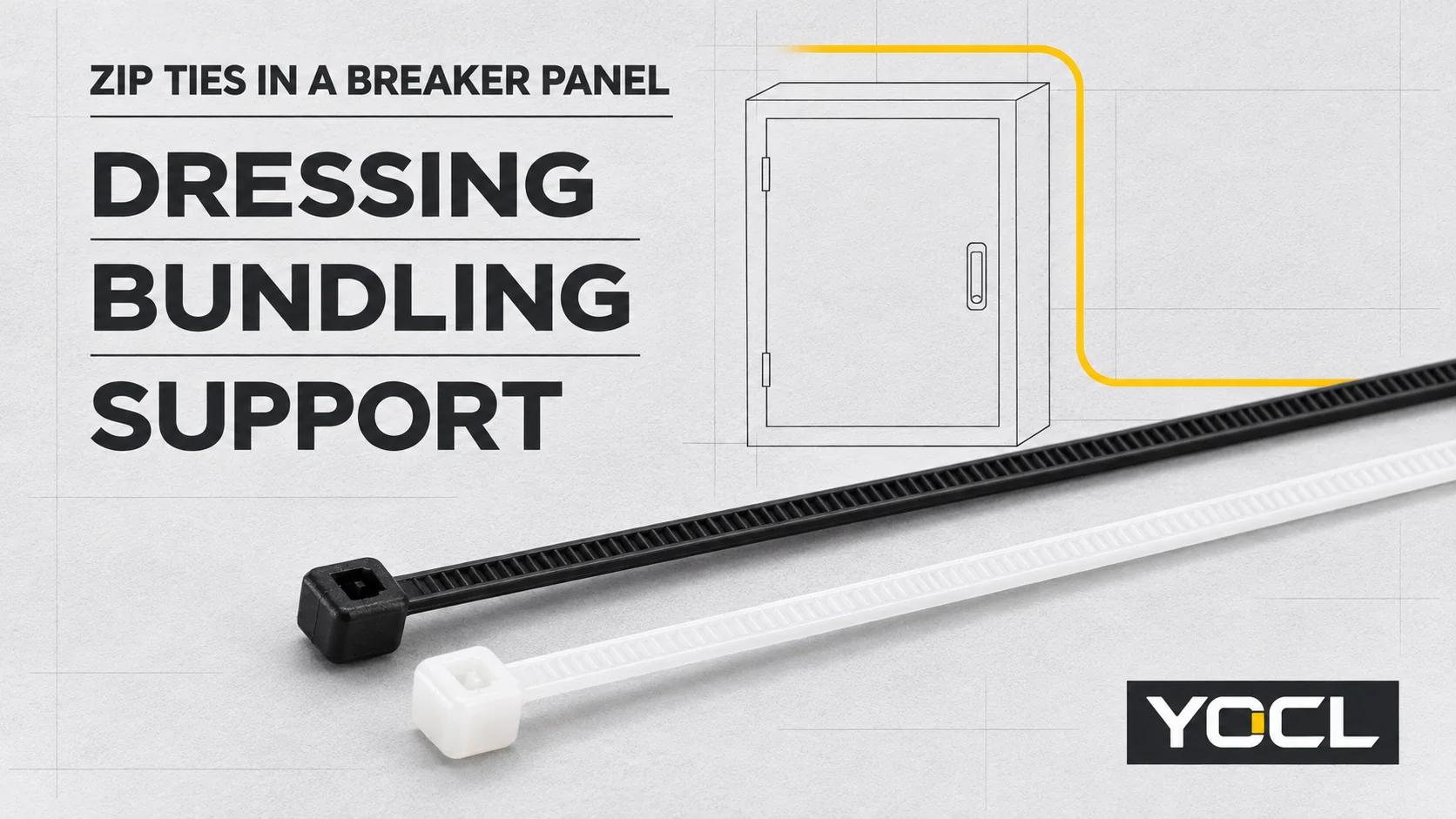
Yes, zip ties in a breaker panel can be used for conductor dressing, provided the arrangement meets the equipment instructions and applicable installation requirements. A tie is not automatically an ampacity-adjustment trigger: conductor count, spacing and the continuous grouped length matter. A short dressed group is different from conductors kept together along an extended run. Supporting the weight of an entering cable is a separate job, for which the tie must be listed and identified for securement and support. The adopted local edition, amendments and authority having jurisdiction (AHJ) govern the actual installation; this is an explanation, not a site-specific approval.
The inspection argument hides three different questions
The inspection story behind this question is familiar in trade discussions: an electrician dresses conductors with ties, an inspector objects to bundling, and the ties are removed. That reported outcome does not establish a universal ban or prove that every tied group needs adjustment. It shows why the discussion must identify the actual condition being judged, rather than treating the presence of plastic straps as the whole issue.
| Question | What decides it |
|---|---|
| May the conductors be dressed together? | Equipment instructions, access and undamaged insulation |
| Does the arrangement need ampacity adjustment? | Applicable conductor count, spacing and grouped length |
| May the ties support an entering cable run? | Listed-and-identified support duty and the complete attachment arrangement |
These decisions overlap physically but are not interchangeable. A neat panel can have an unsuitable support outside it. A support-rated tie can still hold cables in a grouping that needs thermal assessment. An inspector’s preference for serviceable routing is also not a numerical adjustment factor.
Only qualified persons should assess or alter panel wiring under the required isolation and verification procedures; switching off a main breaker does not establish that every part of the enclosure is dead. The following checks judge arrangements, not teach live-panel modification.
NEC question 1: dressing conductors inside the panel
There is no blanket NEC prohibition on cable ties simply because they are inside a panelboard. That does not authorize every pattern, every material or every attachment point. Treat ties as a way to maintain an orderly route, subject to the panel manufacturer’s instructions and the requirements applying to the complete assembly.
Good dressing keeps conductors identifiable and accessible without turning the wiring space into a compressed rope. Ties should not deform insulation, bear against sharp edges, obscure needed markings or pull on terminations. A route that looks straight only because the wires are under tension needs reconsideration. Leave usable slack for service within the enclosure’s permitted space and routing; excess conductor packed into tight loops is not automatically better workmanship.
Do not specify an arbitrary tool setting as the safe tension. The tie, tool and insulation combination controls the result. Our cable tie gun guide explains that setup task. Whether installed by hand or by an approved tool, the aim here is restraint without crushing, followed by a clean tail cut and inspection for damage.
Serviceability matters after the cover is fitted. A qualified electrician should be able to trace and access a conductor without pulling a whole group against its terminals. Organise around the actual circuit routes, leave the required equipment clearances and avoid unnecessary restraint points. A photograph of tidy wiring is not evidence that these conditions have been met.
Dressing verdict: zip ties may organise the route, but they do not override panel instructions, justify damaged insulation or settle the separate bundling and support questions.
NEC question 2: when does bundling require derating?
The central provision is NEC 310.15(C)(1), using the 2020/2023 numbering. Earlier editions used 310.15(B)(3)(a). This article discusses that edition framework, not an assertion that it is the edition adopted in every jurisdiction today.
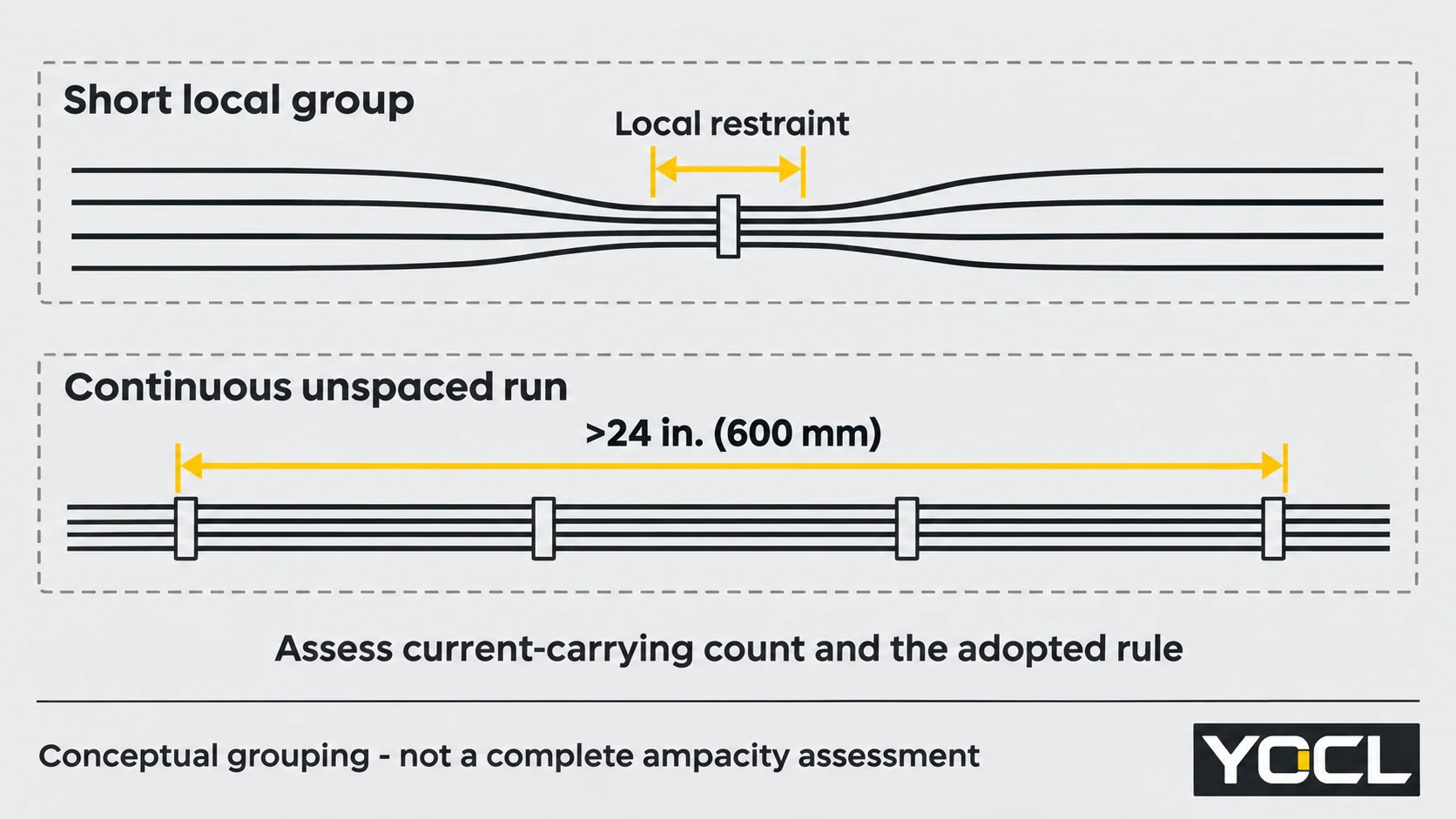
The rule addresses more than three current-carrying conductors in a raceway or cable, and conductors or cables outside raceways installed without maintaining spacing for a continuous length longer than 24 in. (600 mm). There is also a short-raceway provision excluding adjustment for conductors in raceways not exceeding that length. Those are related but distinct conditions; an enclosure is not simply a short raceway.
NFPA’s public code-development record reproduces the applicable rule and table within the revision process. Read its base text separately from proposed changes. Mike Holt’s explanation based on the 2023 NEC also distinguishes raceway/cable conductor count from cables bundled without spacing. The useful question is what arrangement exists, not what the installer calls it.
Count conductors, not straps or cable jackets
CCC means current-carrying conductor. Equipment grounding conductors do not count for this adjustment. A neutral carrying only the unbalanced current of the corresponding circuit generally does not count, but neutrals are not universally excluded: circuit configuration and load characteristics can require them to be counted. Have that classification established before selecting a table row.
Do not count each multiconductor cable as a single CCC, or count the tie heads as evidence of how many conductors matter. Identify the circuits and their applicable conductor contributions. A bundle that looks small can contain several relevant conductors, while visible grounding wires may not contribute to the adjustment count.
Use the adjustment table only after establishing its trigger
| Current-carrying conductors | Adjustment factor |
|---|---|
| 4–6 | 80% |
| 7–9 | 70% |
| 10–20 | 50% |
| 21–30 | 45% |
| 31–40 | 40% |
| 41 or more | 35% |
These are the Table 310.15(C)(1) factors in the stated edition framework. They modify the applicable conductor ampacity, not the tie’s strength or an assumed breaker setting. Other installation conditions and applicable limits still need checking; this is not a complete circuit-sizing calculation. Local amendments can also change the table or its application.
Measure the continuous grouping, not the gap between ties
A tie at a point does not manufacture a long bundle. If the actual close grouping is short and the conductors genuinely separate beyond it, the outside-raceway continuous-length trigger just described has not been established merely by finding a tie.
Conversely, widely spaced ties can maintain a continuous close group between them. Removing some straps does not reset the length if the conductors remain together. Follow the route through bends and entry approaches; do not measure only the small patch of jacket directly under each strap.
A run outside or above the panel can therefore need adjustment even when the dressing inside is brief. Likewise, a large enclosure is not an automatic exemption for a long close group within it. Location alone does not settle the question. Neither does calling a tightly maintained route a service loop.
Resolve a disputed layout without inventing an exemption
Electricians and inspectors can disagree about whether a particular route maintains spacing, especially where conductors briefly converge and then follow the enclosure edge. The code does not turn the phrase “zip tie” into a universal pass/fail test. Ask which continuous portion, conductor count and adopted provision underpin the objection.
For a genuinely short dressing concern, the accepted correction may be to remove unnecessary ties and re-dress the conductors. But that is not a guaranteed substitute for ampacity review. If the cables remain close for the relevant length, the thermal issue remains. A qualified electrician must assess an actual adjustment problem rather than assuming that cutting a strap has changed the installation condition.
Derating verdict: short point restraint alone does not establish this bundling trigger; a maintained unspaced run beyond the stated length can. Shorter grouping does not waive other applicable wiring-method requirements or authorize ignoring the AHJ’s accepted layout.
NEC question 3: may cable ties support the entering cable run?
Yes, when they are listed and identified for securement and support and used in the permitted arrangement. The blanket claim that cable ties cannot support NM cable is wrong. The opposite claim that any bag of ties can do so is wrong as well.
NEC 334.30 recognises listed-and-identified cable ties among the methods for securing and supporting nonmetallic-sheathed cable. Its general spacing requirements include support intervals not exceeding 4½ ft, securement within 12 in. of enclosure entries, and a cable length between entry and nearest support not exceeding 18 in. These conditions are not alternative choices. Apply the adopted text and its applicable exceptions to the actual run.
The wording can be inspected in NFPA’s public revision material for 334.30. That document includes proposed edits, which should not be confused with enacted text; the support wording and dimensions above are the existing-rule features relevant here.
UL Solutions’ cable-management application guide distinguishes bundling, securing and supporting. In the UL 62275 system, Type 2S and Type 21S identify ties investigated for primary support within the applicable scope. Check the exact listing, package identification, intended cable use and instructions. A material flammability designation or a tensile figure does not establish support approval.
The support arrangement includes the fixing device and its attachment to the supporting surface. An appropriate tie paired with an unsuitable mount does not create an acceptable system. Nor does a support designation permit attaching cables to arbitrary conductors or equipment parts. Verify the complete load path and the installation surface, not just the strap.
What the YOCL HSS page establishes
The YOCL HSS nylon cable tie page describes a PA66 bundling series with catalogue material flammability designation 94V-2 and model-specific size, bundle-range and tensile data. Those fields can inform a dressing-product enquiry; they do not establish panel approval or primary support duty.
The current public HSS page does not declare a UL 62275 listing or identification for securement and support. This article therefore does not present HSS ties as support-grade products. Ask for the exact model’s documentation before specifying that duty, and do not substitute a catalogue tensile value for the missing listing.
For ordinary product identification, the nylon cable ties category is a documentation starting point, not a list of approved panel-support assemblies. A buyer should state whether the enquiry concerns dressing or supporting cable weight; otherwise the supplier can answer a different question from the one the installation actually presents.
Support verdict: listed-and-identified ties can be a permitted NM support method. General-purpose ties with no supporting documentation must not be assumed to satisfy that requirement.
What ties must never substitute for
- Required cable-entry hardware. A tie around the conductors does not replace the connector or clamp required at the enclosure entry.
- An approved cable support. Dressing straps must not carry a run’s weight on the assumption that tightening them more supplies the missing support rating.
- Undamaged insulation. A strap that flattens, cuts or sharply indents insulation is not acceptable dressing merely because the conductors look orderly.
- Accessible equipment. Do not use ties to force wires across required access, obstruct equipment operation or place sustained pull on terminations.
- A thermal assessment. Taking ties away does not clear a long unspaced group if its layout has not changed.
Neutral and earth-bar separation is another independent issue. The subpanel neutral-versus-earth-bar guide covers that boundary; tidy routing cannot correct a bonding error.
Outside the United States: BS 7671 is a separate assessment
For a UK installation, do not import the NEC length threshold, adjustment table or NM support intervals. BS 7671 uses its own installation methods and grouping rating factors in Appendix 4. The IET’s Appendix 4 explanation illustrates that approach; it is dated guidance, so use the applicable current requirements for the job.
Fire-related support is also a separate question. BEAMA’s premature-collapse guidance addresses keeping wiring systems from falling prematurely during a fire. Do not reduce that assessment to an escape-route-only rule, and do not assume it imposes a simple metal-tie requirement on every internal consumer-unit dressing point. The wiring system, enclosure, containment and supporting arrangement need to be judged together under the relevant instructions and applicable edition.
The parallel is the distinction between heat dissipation, positioning and support. The numerical rules and acceptance documents remain those of the UK system, not a blended international rule.
Practical review checklist for zip ties in a breaker panel
Use this record to review the proposed arrangement before treating appearance as acceptance:
| Review item | Evidence of a suitable arrangement |
|---|---|
| Purpose of each tie | Identified as dressing, securement or weight-bearing support |
| Grouped route | Actual continuous close length established, including the entry approach |
| Conductor count | Relevant current-carrying conductors identified by circuit |
| Contact with insulation | No crushing, sharp-edge bearing or termination strain |
| Service access | Conductors remain identifiable and accessible with permitted slack |
| Fixed points | Suitable mount, attachment and surface; complete support evidence if needed |
| Finished tie | Cleanly trimmed tail and no damage from fitting or cutting |
Where a fixed dressing point is needed, use the cable tie mounts guide to review the attachment interface. It does not turn an adhesive base or screw mount into an approved panel accessory by default. The equipment and surface restrictions remain controlling.
For the over-tightening principle, the data-cable damage article shows why local pressure matters. Its Ethernet and optical-fiber findings are not power-conductor ampacity limits. Here the inspection question is whether the actual insulation has been deformed or damaged, not whether a network-cable result can be converted into a universal tie tension.
Keep the final record specific: the layout being accepted, the adopted framework, the purpose of the ties and any unresolved support or grouping question. If the only concern is unnecessary restraint, a qualified person can agree a revised dressing arrangement. Changes to cable support, entries, conductors or circuit sizing need the corresponding professional assessment rather than an improvised panel repair.
FAQ
Are zip ties in a breaker panel automatically a code violation?
No. Their presence alone does not establish a violation. Check the panel instructions, the physical dressing, the actual grouping condition and whether the ties carry cable weight. Local adoption and the AHJ determine acceptance of the specific arrangement.
Does every zip tie mean I must derate the conductors?
No. A point restraint is not the same as an extended unspaced group. Under the NEC framework discussed here, evaluate the conductor count and continuous length. Removing a tie also does not eliminate the need for assessment if the conductors remain closely grouped.
Can a listed cable tie support NM cable near the panel?
Yes, if the exact tie is listed and identified for securement and support, the complete attachment arrangement is suitable, and the applicable NM support requirements are met. A generic listing claim or a tensile-strength label alone does not establish those conditions.
Does a nylon flammability designation prove support suitability?
No. Material flammability, bundling strength and primary-support investigation answer different questions. Ask for the exact support identification and instructions. YOCL’s published HSS material designation is not presented here as a support listing.
References
- NFPA, public code-development record for the 2023 cycle, base text and Table 310.15(C)(1); proposals are not adopted law.
- Mike Holt, Conductors, based on the 2023 NEC, conductor-count and grouping explanation.
- NFPA, public revision agenda containing 334.30, securing/supporting text; distinguish existing text from proposed edits.
- UL Solutions, Cable Ties for Cable Management of Electrical Installations: Application Guide, bundling versus support and Type designations.
- YOCL product information, HSS Nylon Cable Ties, declared material and catalogue scope.
- IET, Changes to Appendix 4, dated explanation of grouping factors.
- BEAMA, Premature Collapse Guide, separately scoped UK wiring-support guidance.