
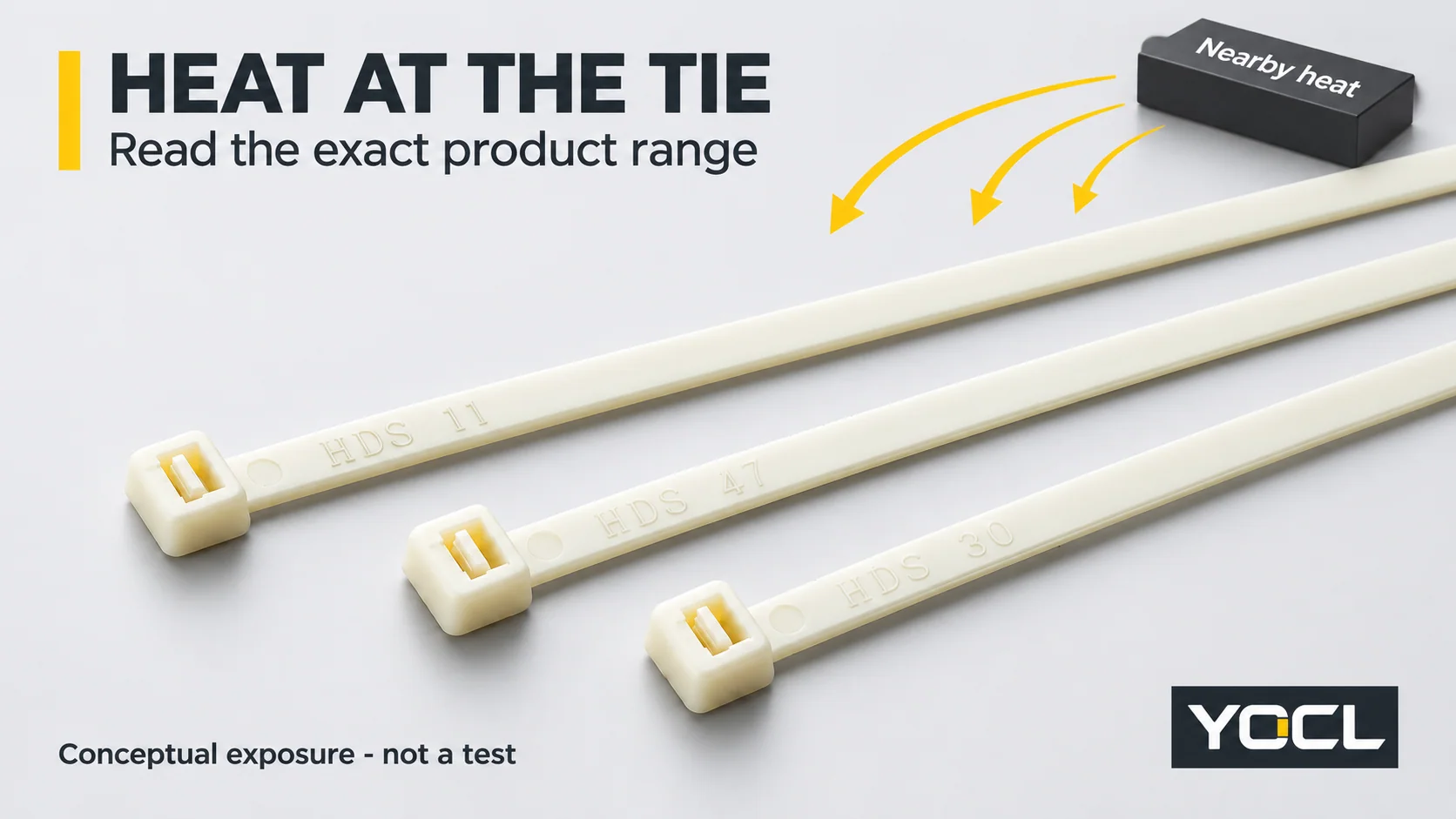
Are zip ties heat resistant? Only within the operating range declared for the exact product. The material name alone is insufficient: PA66 appears in several temperature grades. A standard tie without a declared range is an unknown for hot service, not a product to approve using a familiar industry number.
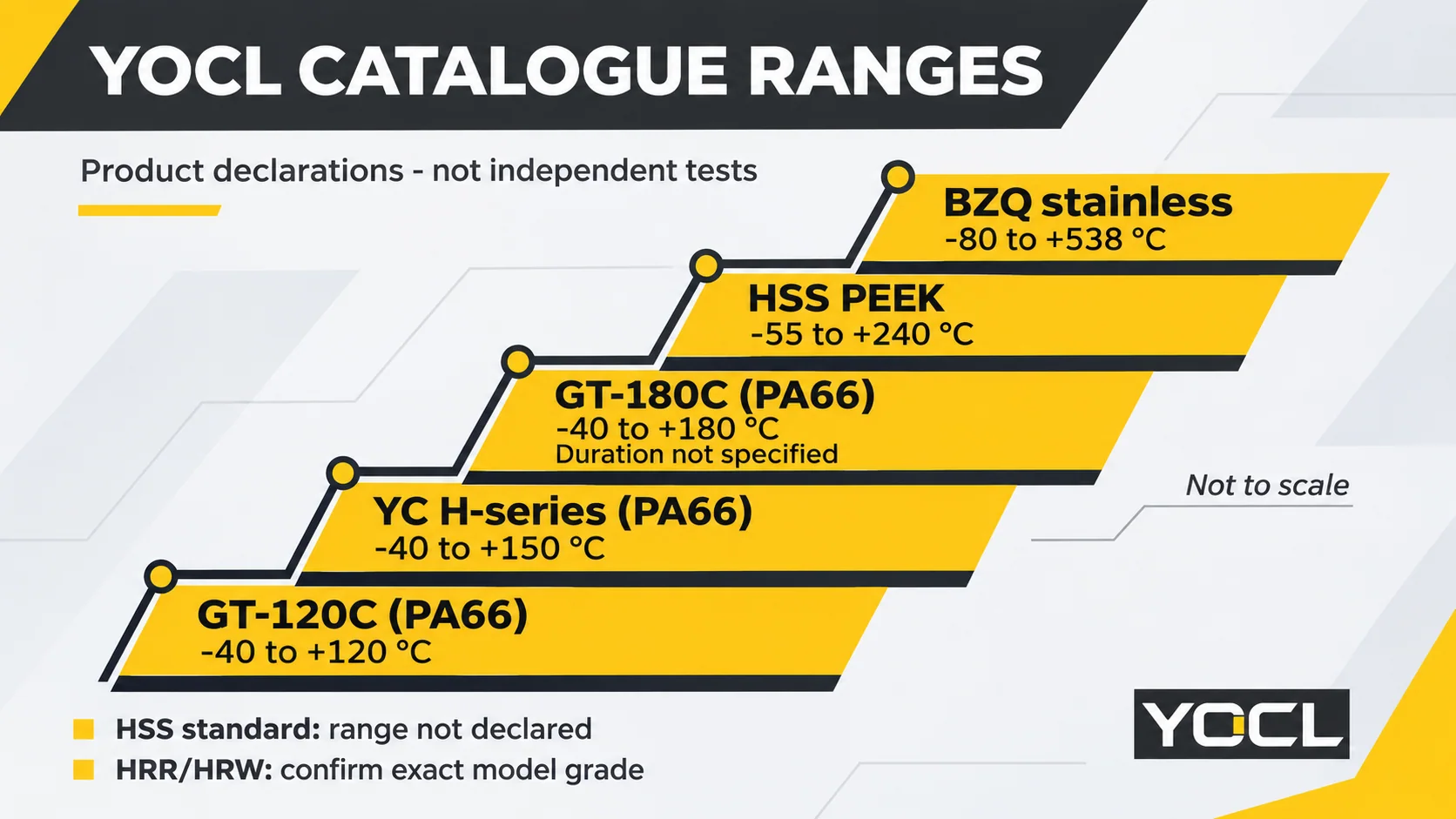
YOCL’s catalogue provides this temperature ladder:
- GT-120C PA66: -40 to +120 °C.
- YC heat-resistant PA66: -40 to +150 °C.
- GT-180C PA66: catalogue -40 to +180 °C; exposure duration is not specified.
- HSS PEEK: -55 to +240 °C.
- BZQ stainless steel: working range -80 to +538 °C.
These are product-page declarations, not independent test results or interchangeable material limits. YOCL’s standard HSS page publishes no operating range; HRR/HRW requires confirmation of the exact temperature grade. Use the linked table below to check each source, then compare the declaration with the temperature at the tie.
Three distinctions that determine the answer
Operating range is not melting point, peak exposure or full-strength retention
An operating range concerns the environment in which the product is intended to perform its normal function. It is not the temperature at which the polymer becomes liquid. A tie can lose useful mechanical performance without visibly melting, so the absence of melted material does not establish suitability.
Nor should a brief temperature excursion be treated as proof of continuous service capability. A short-exposure allowance, if available, needs its own documented conditions. Do not invent one by extending the operating maximum or by assuming that a tie which survived once will remain suitable indefinitely.
NEMA’s temperature guide describes operating limits in terms of maintaining the intended function in normal use. It also warns that prolonged exposure outside the declared limits can cause loss of mechanical properties. Near those limits, other environmental stresses can further reduce performance. NEMA, Temperature Considerations
A range therefore does not promise that the full published loop tensile strength remains available at its upper endpoint. Ask for the strength-versus-temperature and exposure information required by the application. Leave margin rather than treating the catalogue maximum as a preferred operating target; there is no universal margin to add to every installation.
The wording on the actual listing matters. GT-180C specifically says that exposure duration is not specified. Its catalogue range can identify a candidate, but the listing alone does not settle a sustained-duty requirement. Confirm that duty before approval.
Flammability is a separate declaration
A UL 94 designation describes material burning behaviour in a standardized test, not the temperature at which a tie may operate. YOCL’s HSS standard page states catalogue 94V-2 without an operating range, while its GT-120C and YC heat-resistant pages also state V-2 alongside their separate temperature declarations. The class therefore cannot identify the temperature grade. For the burning-class explanation, use Flame Retardant Cable Ties: UL 94 Ratings; it is a different selection question.
The temperature at the tie matters more than room temperature
A room reading may miss the conditions where the strap and locking head actually sit. A warm cable bundle, a nearby engine component, a steam line, a luminaire or a hot enclosure surface can raise local exposure through conducted or radiant heat.
“Ambient plus nearby heat” describes the sources to consider, not an arithmetic rule for adding unrelated thermometer readings. Establish the actual local conditions under representative operation, including the hottest relevant operating state. A reading taken with the equipment idle may miss the exposure that governs the selection.
UL Solutions calls for selecting operating temperatures for the final application environment, with additional consideration of surrounding heat sources and conductor heating. Its guidance explains product evaluation; it does not certify any YOCL tie listed here. UL Solutions, Cable Ties for Cable Management
Are zip ties heat resistant? Compare these declared product limits
This table keeps product identity attached to every temperature figure. The same base polymer appears on different rows because formulation and grade matter. The “candidate duty” column describes a selection direction, not approval for a particular engine, appliance or installation.
| YOCL product and material | Product-page temperature declaration | Candidate duty | Documentation boundary |
|---|---|---|---|
| HSS standard nylon ties, PA66 | No operating-temperature range stated | Ordinary bundling only after the required exposure is documented | Unknown for hot service; do not borrow another PA66 product’s rating |
| GT-120C heat-resistant ties, PA66 | -40 to +120 °C operating | Warm enclosures or locally heated routes whose conditions fit the declaration | Confirm the exact model, loading and exposure requirements |
| YC heat-resistant nylon ties, heat-resistant PA66 | -40 to +150 °C operating | A higher-temperature polymer candidate where the lower rung is insufficient | The page lists 64 H-series models; select the exact model, not just the family name |
| GT-180C heat-resistant ties, PA66 | Catalogue -40 to +180 °C; exposure duration not specified | A hotter-service candidate pending confirmation of the actual duty | Do not turn the catalogue maximum into an unlimited continuous-service promise |
| HSS HRR/HRW heat-stabilized ties | Listed grade options +120 / +150 / +180 °C | A configurable heat-stabilized family | Across 13 configurations, the page supplies no model-to-grade mapping; obtain it before selection |
| HSS PEEK ties, PEEK | -55 to +240 °C operating | A higher-temperature polymer candidate beyond the listed PA66 rungs | Three configurations; verify the exact application’s material compatibility and mechanical requirements |
| BZQ double-wrap ball-lock ties, stainless grades 201/304/316 listed | -80 to +538 °C working | A metal-restraint candidate when its complete specification fits | Uncoated product declaration; temperature alone does not approve the assembly; see stainless steel cable ties explained |
Read the table as a set of declared product options. It does not establish universal limits for all PA66, PEEK or steel ties, and a higher endpoint does not make a product suitable for every environment below it.
For example, the YC page also declares halogen-free and silicone-free properties. Those describe additional requirements a buyer may have; they do not establish a chemical compatibility result or temperature-dependent working load. Keep each requirement separate rather than treating a longer feature list as broader approval.
Likewise, a temperature range for the tie does not raise the permissible exposure of the cable jacket, a fixing device or the equipment being restrained. The complete arrangement must remain suitable. Replacing only the tie cannot resolve a route that exposes another component beyond its documented conditions.
What happens when a tie is pushed beyond its range?
Heat can change stiffness and deformation under load before a tie shows obvious damage. A polymer strap may become more compliant, while sustained force produces creep: gradual deformation with time. The bundle can lose restraint even though the head remains engaged and the strap has not melted.
Continued exposure can also accelerate chemical ageing and lead to embrittlement or strength loss. These mechanisms can interact; they are not a guaranteed sequence in which every tie first softens and then becomes brittle. Formulation, duration, loading and the surrounding environment affect the outcome.
The Canadian Conservation Institute describes temperature-dependent changes in softness, creep and strength, and the acceleration of polymer deterioration with increased temperature. That is general material guidance, not a cable-tie lifetime test or a YOCL performance curve. Canadian Conservation Institute, Caring for Plastics and Rubbers
For selection, the useful consequence is that “still intact” is an inadequate acceptance criterion after unknown hot exposure. Tightening a softened or aged tie again does not restore its original documented condition. Secure an affected bundle appropriately and have suspect restraints assessed or replaced without using installed cables as test pieces.
A cracked head, a loose loop or a changed strap is not, by itself, proof that temperature caused the problem. The separate diagnostic task is covered in Why Do Nylon Cable Ties Break?. Here, the decision is whether the proposed temperature exposure is supported before installation.
Choosing a temperature rung without guessing
Define the exposure at the intended tie position
Describe where the head and strap will sit, what they will touch and what nearby sources can heat them. Include changes between normal operation, prolonged running and relevant shutdown or cooling conditions. Do not substitute a general location label such as “engine bay” for an exposure specification.
Where conditions are uncertain, have a competent person determine representative local temperatures using an appropriate measurement method. Do not reach into energized or moving equipment to obtain a reading. A measurement should relate to the actual route and operating condition, rather than a convenient accessible surface elsewhere.
Both ends of the declared range still matter. A higher maximum is not permission to ignore the minimum or the separate conditions for fitting the tie. Installation behaviour and failure diagnosis remain separate checks; this article does not supply a universal cold-installation rule.
Require a declared range that clears that exposure
Compare the established exposure with the exact product declaration and allow a defensible margin for uncertainty and variation. Do not choose a product solely because its upper endpoint matches the highest reading you happened to record. Check the equipment requirements and obtain manufacturer advice where loading or combined exposure makes the margin uncertain.
An enclosure that feels only warm may still contain a locally hotter route. Conversely, the presence of a hot component nearby does not automatically require the highest rung if the actual tie position has a different, documented environment. The goal is an evidenced specification, not the largest number in the catalogue.
For sustained service, ask what the declaration establishes about duration and mechanical performance. UL Solutions distinguishes maximum operating-temperature evaluation from additional long-term material investigation. Neither a broad catalogue range nor the guidance itself proves that a particular YOCL product has undergone that additional investigation.
Treat missing information as a selection result
For standard HSS, the answer is straightforward: the public page does not declare an operating range. Do not fill the blank with a commonly repeated standard-nylon figure. Ask for the exact product’s applicable declaration; until it is available, keep HSS unapproved for the proposed hot-service duty.
For HRR/HRW, a family listing of temperature options is insufficient. Ask which grade applies to the exact ordered configuration and require that identity on the order documentation. Neither the suffix nor the strap dimensions provide the missing mapping. A quotation that simply repeats the family maximum leaves the original question unanswered.
If the declaration remains incomplete, change the candidate or reconsider the route. Choosing another documented product is different from assuming that all versions share the most favourable published option. A controlled parts list should preserve the complete grade identity so that a later reorder does not silently change the exposure capability.
Keep the approval request specific
Send the supplier the intended environment and ask for the following evidence in the response:
- The exact series, model and supplied temperature grade, including the applicable operating range.
- Confirmation of the intended duration, load and combined environmental conditions where these are important.
- Identification of any limits affecting the locking assembly, mounting arrangement or contacting materials.
- Consistent grade identification in the quotation, product documentation and supplied package.
A temperature-compatible sample can confirm fit and handling, but an uneventful trial does not establish long-term retention. Record the accepted documentation rather than relying on the appearance of a sample or the wording on a generic sales category.
Heat resistance and UV resistance are different exposure requirements; use UV-Resistant vs Standard Cable Ties for the separate outdoor-exposure decision.
FAQ
Can zip ties go near an exhaust?
Only if the exact tie’s documented conditions cover the actual exposure at its location, with suitable margin and compatibility of the surrounding assembly. A product name or room-temperature reading cannot establish that. Assess conducted and radiant heat, reconsider the route where necessary, and do not invent a universal safe distance from the exhaust.
Are black zip ties more heat resistant?
Colour alone is not a temperature grade. Natural and black versions may be offered within a family, but the exact supplied product still needs its own applicable range. Do not infer an upgrade from colour, an appearance similar to another tie or an undocumented substitute on a reorder.
What if a standard nylon tie page does not list a temperature range?
Treat the product as unknown at temperature and request a declaration for the exact model and intended duty. YOCL’s standard HSS page currently has that gap. A range from another nylon tie cannot fill it, even if both products use PA66 or look alike.
Can I use the full listed tensile strength at the maximum temperature?
Do not assume so. The temperature declaration and the published strength figure do not, by themselves, establish retained strength under prolonged hot loading. Request the applicable mechanical-performance evidence and application guidance. Where those are unavailable, do not create a temperature-dependent working load from the catalogue’s headline figures.
References
- NEMA: Cable Ties Application Guide No. 4, Temperature Considerations, March 2021, operating environment and declared-range boundaries.
- UL Solutions: Cable Ties for Cable Management, application temperature, mechanical properties and evaluation scope; not a YOCL certification record.
- Canadian Conservation Institute: Caring for Plastics and Rubbers, general creep and temperature-related deterioration mechanisms.
- YOCL: the seven exact product pages linked in the temperature table, checked against their published specifications. These are first-party catalogue declarations, not independent test reports.