
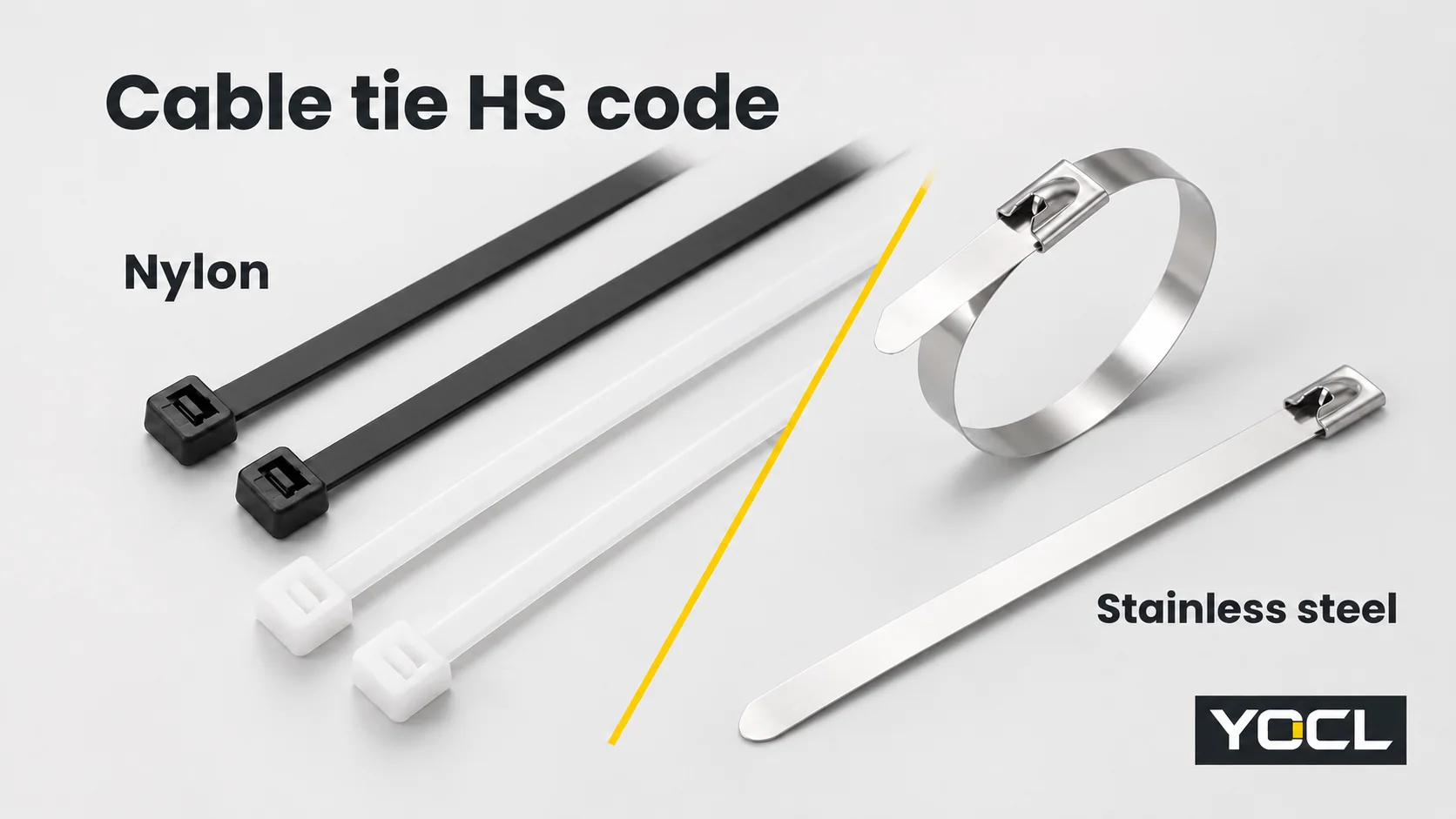
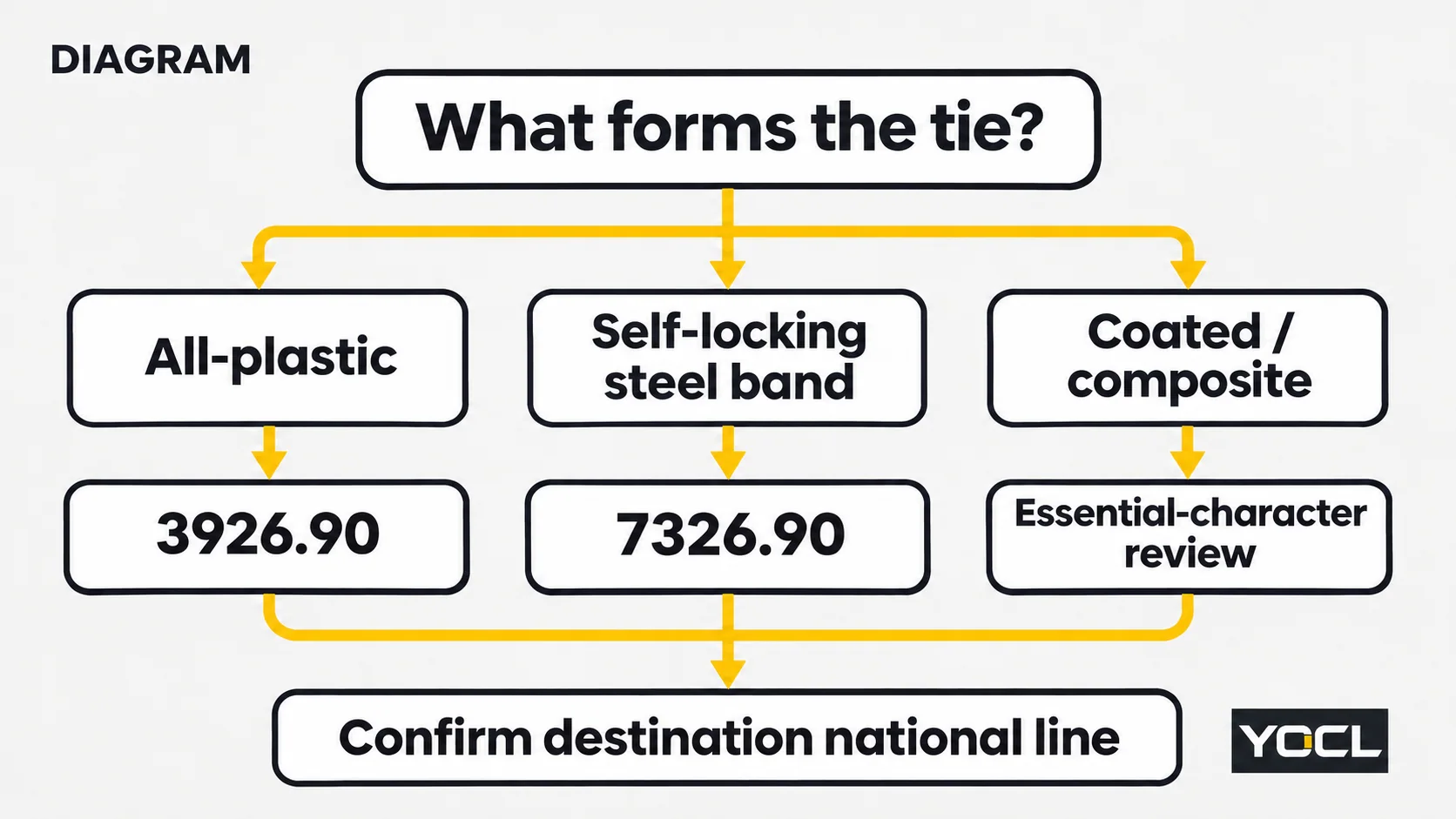
There is no single cable tie HS code. Cable ties have no dedicated named provision in the Harmonized System: ordinary all-plastic ties generally follow 3926.90, while self-locking stainless steel band ties generally follow 7326.90. These are international six-digit stems. Coatings, separate metal components and retail sets can require further analysis before a destination-country national line is selected.
This is general classification information, not a binding ruling. Published rulings concern particular parties, goods and circumstances; they are examples of classification practice, not permission to copy a result. The importer of record remains responsible for the declaration, including when using a broker, as CBP’s importer guidance explains for US entries. Treat a supplier’s code as a starting point for confirmation with a destination-country customs broker or an advance/binding ruling.
| Construction established by the specification | Main six-digit starting point | Limit of the lookup |
|---|---|---|
| Plastic body and locking construction, such as a moulded nylon tie | 3926.90 — other articles of plastics | Establish the actual construction; a separate metal locking component needs review. |
| Self-locking stainless steel band tie, including ball-lock or ladder construction | 7326.90 — other articles of iron or steel | This branch concerns band constructions; do not extend it to every article called a steel tie. |
| Coated/composite construction, metal insert or a retail kit containing other articles | Construction-specific review | The outer surface or commercial name cannot settle classification. |
Read the HS hierarchy before choosing the national line
The World Customs Organization develops and maintains the Harmonized System. Its structure moves from two-digit chapters to four-digit headings and six-digit subheadings. For plastic ties, that means Chapter 39, heading 3926 and subheading 3926.90. For the stainless band constructions discussed here, it means Chapter 73, heading 7326 and subheading 7326.90.
The residual word “other” matters. A cable tie does not acquire a dedicated provision just because its trade name is familiar. Classification starts with the heading terms and relevant legal notes, then moves through the appropriate subheadings. The USITC Harmonized Tariff Schedule identifies these headings as other articles of plastics and other articles of iron or steel, respectively.
Only the first six digits form the international layer. Countries add national tariff subdivisions and statistical detail, commonly producing eight- or ten-digit codes. Two shipments may share the same six-digit stem yet require different full codes in different destinations. HMRC’s commodity-code guidance expressly warns that overseas supplier codes need checking; the European Commission likewise describes the Combined Nomenclature as an EU extension of the HS, updated annually.
Cable tie HS code for nylon and other plastic constructions
A conventional moulded polyamide 6.6 (PA66) tie has a plastic strap and a moulded locking head. Where that construction is an article of plastics and no more specific provision applies, heading 3926 leads to the residual subheading 3926.90. The material and completed construction establish the branch; colour, packaging artwork and the words “zip tie” do not create separate international stems.
Two original US decisions support that explanation. CBP NY N023805, dated March 7, 2008, described nylon plastic ties for bundling wires. CBP NY N208537, dated April 3, 2012, concerned nylon cable ties from Japan, including a push-mount design used in wiring harnesses. Both United States historical CBP rulings used HTSUS 3926.90.9980. This is a historical US national example: confirm the current US line and its applicability at shipment time.
The second decision is useful because it describes both a conventional zip tie and a push-mount tie. Their intended use in a transmission harness did not, in those facts, displace classification as plastic articles. It does not establish that every automotive clip or every fixing accessory belongs in the same provision.
A separately verified United Kingdom HMRC advance-ruling example, ruling 600014659, records commodity code 3926909790 for packs of thirty nylon ties measuring 4.8 × 380 mm. Confirm the current UK national line and applicability at shipment time. That record illustrates a national extension of the same plastics stem; it does not turn the UK suffix into an international code.
Standard nylon and heat-stabilised variants remain candidates for the plastics branch when the finished article retains that plastic-body construction. A metal-detectable polypropylene tie containing dispersed metal filler or pigment is also a plastic article in the construction described here. Dispersed filler is different from a separate metal core, pawl or barb. Obtain the material declaration rather than interpreting “metal-detectable” as “made of metal.”
YOCL’s nylon range supplies examples of constructions, not declared customs classifications. Use the nylon cable tie overview to distinguish a moulded plastic lock from a design with a separate steel barb. Do not transfer the all-plastic lookup to the latter without review.
Cable tie HS code for self-locking stainless steel bands
For ordinary self-locking stainless steel band ties, the relevant residual branch is heading 7326, subheading 7326.90. A ball-lock band and a ladder-style band use different locking arrangements, but both are steel articles of the constructions discussed here. Confirm the actual band form and locking mechanism before applying that starting point.
An explicit manufacturer example helps distinguish the international stem from a national suffix. United States manufacturer-published national-line example: Brady’s SSTIE-127-7316 product trade data identifies a 316 stainless steel tie and lists HTS 7326.90.8688. Confirm the current US national line at shipment time. This is Brady’s published information for its product, not a customs ruling, a universal code or a classification declaration for YOCL goods.
For these self-locking band constructions, choosing 201, 304 or 316 stainless steel does not by itself change the six-digit stem. The grade identifies the alloy; it is not a separate international cable-tie category. Performance differences belong in the 304 versus 316 cable tie comparison, rather than being used to invent different classification branches.
YOCL’s BZ ball-lock and JT ladder families illustrate the band and lock descriptions. Their presence in a catalogue establishes construction examples, not an assigned HS code. The stainless steel cable tie overview explains those forms. For the separate installation-material decision, see nylon versus stainless steel cable ties.
Coatings, metal components and sets need a closer review
A coating is not the whole article
Plastic on the outside does not automatically make a tie an article of plastics. The General Rules for Interpretation are applied in order. Heading terms and notes come first. For composite goods that cannot be resolved under the preceding rules, GRI 3(b) considers the material or component giving the article its essential character, insofar as that criterion applies.
In the United States historical ruling CBP NY N247377, November 14, 2013, the goods were plastic-covered iron or steel wire ties with decorative hand-shaped ends, packed three to a retail card. CBP found that the wire directly performed the cable-holding function and gave the composite article its essential character. The decision therefore placed those particular goods in 7326.20, the six-digit provision for articles of iron or steel wire. That verified wire-core example demonstrates why the exterior coating alone cannot decide the chapter. It does not classify flat stainless band ties or every coated cable tie.
YOCL’s BZB description, for example, identifies a PVC-coated stainless steel band with a metallic locking head. That is construction information to give the broker, not evidence that the wire-core ruling applies. Send the drawing showing whether the working member is a flat band or wire, together with the coating description. The separate coated versus uncoated stainless tie guide addresses product choice.
Separate metal locking parts change the question
A nylon strap incorporating a steel pawl or barb is not the same factual construction as a fully moulded plastic lock. Identify the separate component, its material and its role in retaining the strap. Give those facts to the broker for the applicable heading and essential-character analysis under the USITC General Rules of Interpretation. Neither the small size of the insert nor the predominance of visible plastic settles the outcome by itself.
Retail kits need their own packing description
Distinguish a bag containing only ties from ties sold with mounting bases, tools or other articles. A mixed pack requires review of whether it qualifies as a set for retail sale and which classification rules apply. Where GRI 3(b) applies, essential character is assessed for the qualifying set; no automatic result follows from calling the package a “cable tie kit.”
Provide the contents, quantities, functions and retail presentation. A common carton does not by itself resolve the set question. Branding and packaging specifications can be discussed through OEM and private-label cable ties; the classification review needs the actual goods as presented for import.
Give the broker a construction record, not just a product name
Use a short factual packet tied to the exact item being shipped. A catalogue family name may cover several constructions; the broker needs the ordered configuration.
| Information to provide | What to make explicit |
|---|---|
| Material declaration | Strap/body resin or steel grade; coating material; dispersed filler versus separate metal parts |
| Dimensioned drawing or datasheet | Band versus wire form, dimensions and the location of any core, pawl or insert |
| Head and lock photographs | Clear exterior views showing the actual locking arrangement, not a similar series |
| Packing description | Bulk ties or retail presentation; every additional item in a mixed pack, with quantities |
| Destination country and shipment timing | The national schedule and version requiring confirmation |
| Supplier-stated classification, if supplied | Its country, source and rationale, kept separate from the importer’s confirmed declaration |
Keep the specification, photographs and packing description consistent with the commercial item. If the supplied version changes from an all-plastic lock to a metal barb, or from loose ties to a mixed retail kit, flag the change before reusing an earlier classification assessment.
This remains general information. Published rulings apply within their particular facts and parties; supplier invoice or packing-list codes are starting points. The importer of record must confirm the declaration with a destination-country broker or seek an advance/binding ruling for prospective shipments requiring certainty. CBP’s request requirements describe the prospective-shipment route in the US. YOCL construction information helps describe the goods; it is not a customs ruling or a brokerage service.
FAQ
Is there one HS code for all cable ties?
No. The principal starting points are 3926.90 for all-plastic constructions and 7326.90 for self-locking stainless band constructions. Composite goods and different steel forms require their own analysis.
Can I copy the ten-digit code from an earlier shipment or supplier invoice?
Use it as a research starting point. Confirm that the goods, destination and current national schedule still match. A previous declaration does not remove the importer’s responsibility for the next one.
Does stainless steel grade change the code?
Changing between 201, 304 and 316 does not itself change the six-digit stem for the same self-locking steel band construction. Grade remains a specification fact to disclose.
Which chapter applies to plastic-coated steel ties?
The construction and applicable legal rules decide. Essential character may be decisive for a composite article; a surface coating alone is insufficient. Put the core/band, coating and lock details before the broker before shipping.
References
- CBP — Tips for New Importers and Exporters: importer responsibility when using a broker.
- WCO — What is the Harmonized System?: international nomenclature and maintenance.
- USITC — Harmonized Tariff Schedule: heading and subheading structure; current schedule.
- HMRC — Finding commodity codes: international digits and overseas supplier codes.
- European Commission — Combined Nomenclature: EU extensions and updates.
- CBP — NY N023805, March 7, 2008, and NY N208537, April 3, 2012: historical nylon-tie decisions.
- HMRC — Advance Tariff Ruling 600014659: nylon-tie national example.
- Brady — SSTIE-127-7316 product specifications: manufacturer-published US trade data only.
- WCO — General Rules for Interpretation: ordered rules and essential character.
- CBP — NY N247377, November 14, 2013: historical plastic-coated wire-core example.
- USITC — General Rules of Interpretation, current 2026 schedule: composite goods and retail sets.
- CBP — Requirements for Electronic Ruling Requests: prospective transactions and product information.