
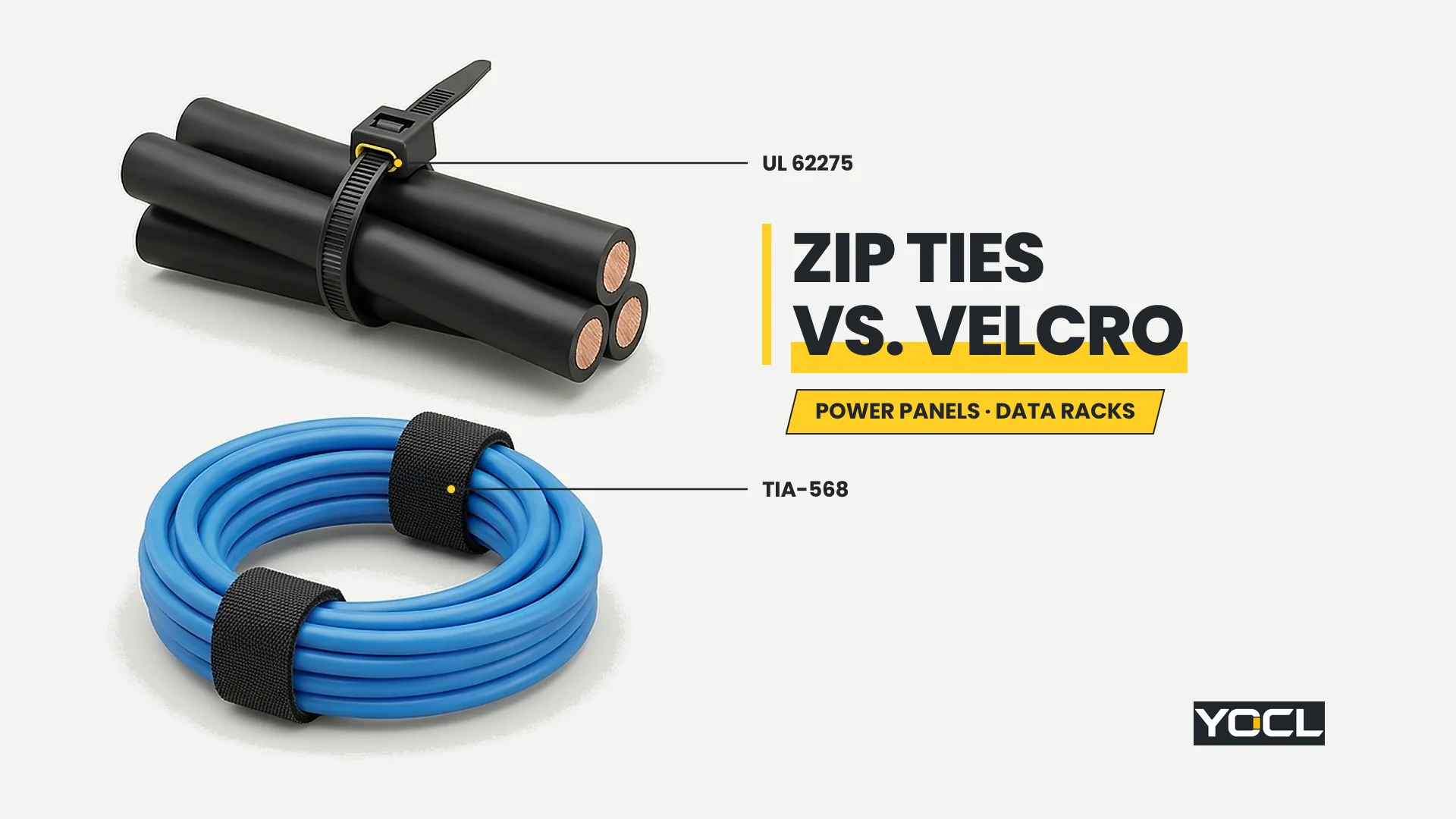
Choosing between zip ties vs velcro cable management comes down to mechanical load, jacket sensitivity, and how often a bundle will be opened. Wide hook-and-loop straps (commonly called Velcro) protect Cat6A Ethernet and optical fiber bundles inside server racks during frequent moves, adds, and changes, while PA66 nylon and releasable cable ties deliver the tensile retention, environmental stability, and UL 62275 Type 21S support required in power panels and industrial harnesses.
Treating either fastener as universal creates avoidable failures. Cinched narrow nylon straps crush delicate twisted-pair geometry in data closets, whereas textile hook-and-loop straps slip, collect oil or dust, and fail mechanical load checks on heavy industrial power feeders. Separating power zones from data zones—and using releasable nylon ties where serviceable power routing is required—gives installers a repeatable engineering boundary.
Zip Ties vs. Velcro Cable Management: Side-by-Side Engineering Comparison
Zip ties vs velcro cable management is fundamentally a trade-off between concentrated mechanical lock strength and distributed low-pressure adjustability. Standard nylon PA66 cable ties use a molded ratchet pawl to lock a narrow strap permanently under high loop tensile load, whereas hook-and-loop straps rely on soft woven textile shear over a wider contact footprint that opens and closes without cutting tools.
Compare all three practical bundling options—standard nylon zip ties, releasable nylon zip ties, and hook-and-loop straps—across seven engineering dimensions before standardizing a facility BOM:
| Selection Dimension | Standard Nylon Zip Ties (PA66) | Releasable Nylon Zip Ties (PA66) | Hook-and-Loop Straps (Velcro) |
|---|---|---|---|
| Loop tensile retention | High; scales from 80 N miniature ties to 1,100 N+ extra-heavy straps | Medium to high; slightly below equal-width single-use ties due to release tab | Low to moderate; relies on textile peel and shear rather than a rigid pawl |
| Radial compression on cable jackets | Concentrated on a narrow strap (2.5 mm to 12.7 mm); over-tightening indents soft jackets | Concentrated like nylon ties, but hand-tensioned and easily backed off | Widely distributed (typically 12 mm to 25 mm wide); minimal jacket indentation |
| Reopen and reuse capability | Single-use; must be cut off and replaced on every cable change | Reusable across dozens of service cycles via finger-release lever | Highly reusable across hundreds of moves, adds, and changes (MAC) |
| Cut and nick hazard during service | High if cut with standard side cutters near thin data jackets | None during reopening; no blades needed near live cables | None; peels open cleanly by hand |
| Temperature, oil, UV and dust | Broad industrial range (standard, UV-black, heat-stabilized, UL 94 V-0 grades) | Matches PA66 industrial grades; solid polymer resists oil and dust | Standard fabric traps dust, oil, and metal filings; softens at elevated heat |
| Code support and plenum listing | Available in UL 62275 Type 21S (primary support) and UL 2043 AH-2 plenum grades | Bundling and positioning; verify listing per exact series | Fire-retardant UL 2043 plenum grades exist for air-handling spaces; not a Type 21S power support substitute |
| Unit cost at bulk volume | Lowest cost per tie for OEM and panel-building production | Moderate cost; lower lifecycle cost than repeated cut-and-replace | Highest cost per strap; pays back quickly in high-churn data racks |
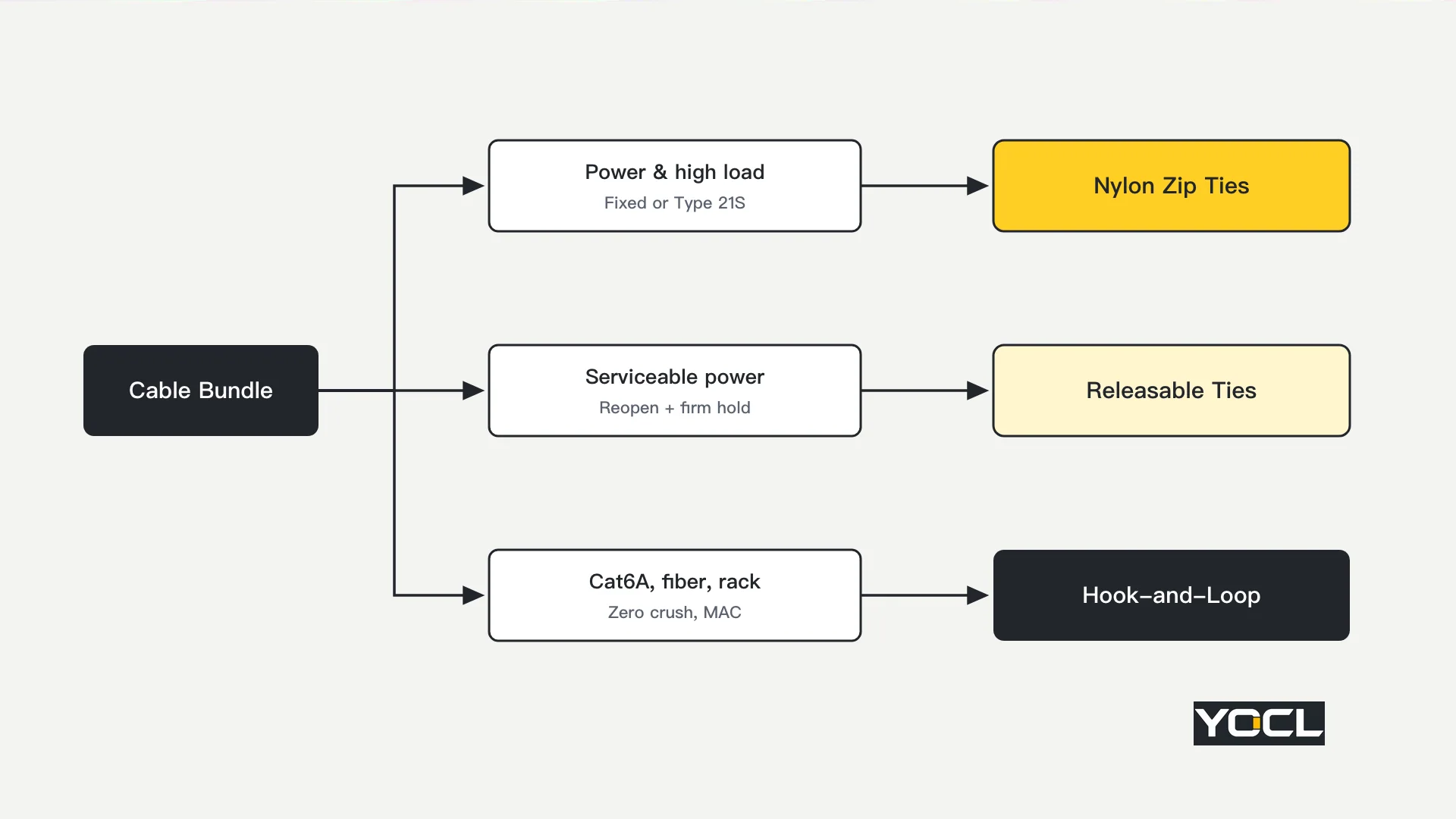
Choose wide hook-and-loop straps whenever the bundle contains high-speed copper data or optical fiber cables that require frequent rework; switch to PA66 nylon zip ties whenever the bundle carries heavy power conductors, faces oil, UV, or high heat, or requires permanent mechanical retention at scale.
Why Data Racks and Server Cabinets Favor Hook-and-Loop Straps
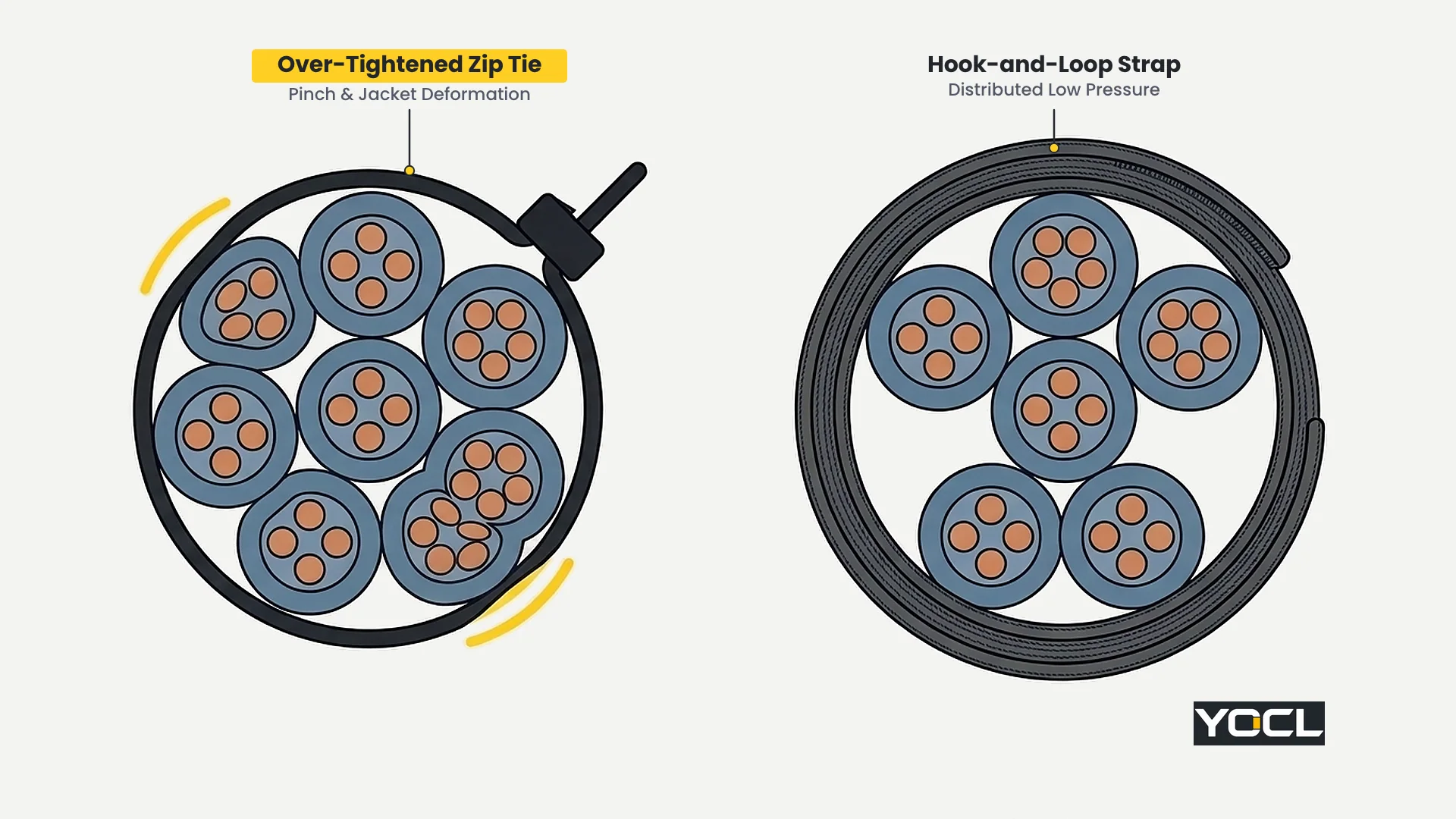
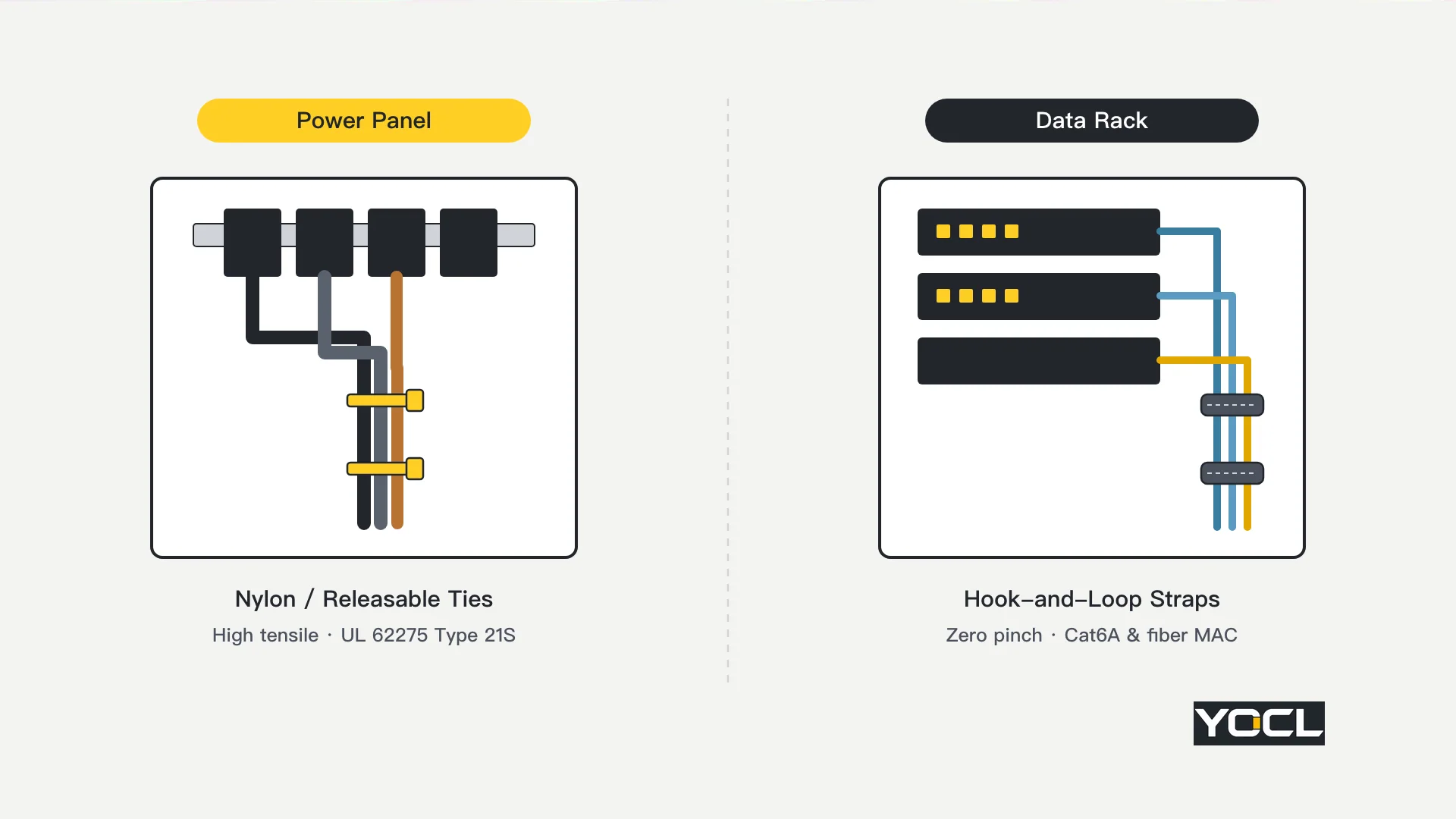
Structured cabling standards including ANSI/TIA-568 and BICSI installation guidelines favor wide hook-and-loop straps over rigid zip ties for dressing copper Cat5e, Cat6, Cat6A, and optical fiber inside server racks and telecommunications closets. The soft woven strap spreads clamping force across a broad contact band, making it nearly impossible for an installer to crush pair geometry or leave sharp flush-cut plastic stubs inside dense patch bays.
For teams evaluating cable ties for server rack deployments, three operational realities explain why hook-and-loop dominates the data side of the cabinet:
- Zero blade risk during moves, adds, and changes: Replacing a single patch cord in a 48-port switch bundle secured with permanent nylon ties forces a technician to slide diagonal cutters between tightly packed jackets. One slip nicks an adjacent Cat6A shield or snaps a fiber jumper. Hook-and-loop peels open by hand in seconds.
- Consistent low radial pressure: Twisted-pair Ethernet and optical fiber rely on undisturbed internal geometry to pass channel certification. For the detailed physics of how over-cinched ties induce alien crosstalk, impedance shifts, and fiber microbending, see can zip ties damage Ethernet and fiber optic cables.
- Plenum-rated fire-retardant options exist: Standard consumer hook-and-loop straps must never be placed in air-handling ceilings or raised-floor plenums regulated under NEC 300.22(C). However, fire-retardant hook-and-loop straps tested to UL 2043 (Plenum Rated AH-2) are specifically manufactured for data-center plenum pathways.
That does not mean nylon cable ties have zero place inside a server rack. Rear power distribution unit (PDU) AC cords, fixed rack-grounding conductors, and static rear chassis harnesses carry heavy round power jackets that benefit from firm nylon retention. Whenever nylon ties are used near mixed rack wiring, set a calibrated tension tool to a low, consistent breakaway force and cut flush—see how to choose and set tension on cable tie guns.
Why Power Panels and Industrial Harnesses Require Nylon or Releasable Zip Ties
Power panels, switchgear cabinets, industrial machinery harnesses, and outdoor cable trays impose mechanical weight, vibration, ambient heat, and chemical exposure that quickly overwhelm textile hook-and-loop straps. In these zones, PA66 nylon cable ties provide positive mechanical pawl locking, predictable loop tensile ratings, and non-porous polymer surfaces that do not absorb cutting oil, moisture, or conductive metallic dust.
Code and listing boundaries also separate power installations from data-rack dressing:
- Primary mechanical support (UL 62275 Type 21S): When a fastener is used to support power cables or raceways under North American electrical rules, general bundling straps are not enough—the tie must carry the appropriate UL 62275 support listing (such as Type 21S) matched to the installation. For the full breakdown of NEC breaker-panel dressing, ampacity derating, and Type 21S support boundaries, see can you use zip ties in a breaker panel.
- Plenum and flame-retardant spaces (NEC 300.22 and UL 94): Air-handling plenums require UL 2043 low-smoke, low-heat-release listings, while enclosed control panels often specify flame-retardant UL 94 V-0 nylon ties. Review material classifications in flame-retardant cable ties and UL 94 ratings or check YOCL flame-retardant nylon cable ties when panel specifications call for V-0 polyamide.
- High loop tensile sizing: Heavy multi-conductor power trunks require matched strap widths and tensile grades rather than undersized 2.5 mm ties. Match bundle diameter and load using the cable tie size and tensile strength chart and browse YOCL standard nylon cable ties.
Where Releasable Nylon Cable Ties Bridge the Gap
Releasable nylon cable ties bridge the gap between permanent zip ties and textile hook-and-loop straps whenever an industrial panel, test rig, or equipment harness requires repeated service access alongside solid polymer retention. Built from PA66 nylon with an integrated finger-release tab on the locking head, a releasable tie resists oil, coolant, and cabinet heat while opening cleanly without side cutters.
Typical engineering zones where releasable nylon ties outperform both standard zip ties and Velcro include:
- Control-panel commissioning and factory acceptance testing (FAT): Panel builders can dress power and I/O looms neatly, trace or swap conductors during debugging, and relock the exact same ties without littering the cabinet floor with cut tails.
- Equipment maintenance harnesses in dusty or oily environments: Unlike woven hook-and-loop strips that clog with metal shavings and oil mist until the hooks stop gripping, a solid nylon ratchet head maintains mechanical engagement after wipe-down.
- Temporary heavy-cable rigging: When thick power cables need firm temporary clamping that exceeds textile peel strength, releasable ties hold securely and release in seconds.
For release-lever designs, width options, and sizing rules, see releasable cable ties explained, or review YOCL releasable nylon cable ties and our releasable cable ties manufacturer range.
Practical Selection Rules: Choosing by Zone, Cable Type and Code
Standardizing zip ties vs velcro cable management across a facility works best when drawings assign one clear fastener rule to each physical zone instead of leaving the choice to individual installers. Use the following six-zone matrix to lock in the right fastener before kitting materials:
| Installation Zone | Primary Cable Type | Recommended Fastener | Key Verification Check |
|---|---|---|---|
| Server rack patch bay & vertical trunk | Cat6 / Cat6A copper & optical fiber | Wide hook-and-loop straps (12 mm to 25 mm) | Keep wraps snug without flattening jackets; zero side cutters needed for MAC |
| Overhead data tray in air-handling plenum | Plenum-rated data & low-voltage trunks | UL 2043 plenum-rated hook-and-loop or plenum nylon ties | Verify NEC 300.22(C) / AH-2 listing on exact part packaging |
| Server rack rear PDU & AC power feed | Heavy round AC power cords | Standard or releasable PA66 nylon cable ties | Route power separately from data trunks; trim tails flush |
| Industrial control panel & breaker cabinet | Power feeders, motor leads, control wiring | Standard PA66, UL 94 V-0, or UL 62275 Type 21S nylon ties | Confirm Type 21S listing if supporting cable weight; check conductor derating |
| Outdoor trays, high-heat or oily machinery | Armored, UV-exposed, or oil-resistant cables | UV-black, heat-stabilized nylon, or stainless steel ties | Avoid textile hook-and-loop that degrades, absorbs oil, or loses peel strength |
| Control-panel FAT & serviceable power looms | Power & discrete control harnesses needing rework | Releasable PA66 nylon cable ties | Confirm release-tab clearance inside wire ducts and mounting channels |
Assign wide hook-and-loop straps to every high-churn data and fiber zone, specify PA66 nylon ties for fixed power, outdoor, and code-supported industrial zones, and stock releasable nylon ties for serviceable industrial looms where textile straps cannot handle heat, oil, or mechanical load.
For buyers and panel builders sourcing industrial nylon, flame-retardant, UV-resistant, or releasable fasteners in volume, explore YOCL ELECTRIC cable ties manufacturer and nylon cable ties manufacturer collections to match exact widths, bundle diameters, and material grades to your project schedule.
Frequently Asked Questions
Are nylon zip ties banned in server racks?
No, nylon zip ties are not universally banned in server racks, but structured cabling standards such as ANSI/TIA-568 and BICSI strongly favor wide hook-and-loop straps on copper Cat6/Cat6A and optical fiber bundles. If nylon ties are used inside a rack, reserve them for rear AC power cords or fixed harnesses and never over-tighten them onto data jackets.
Can hook-and-loop straps (Velcro) be used in air-handling plenum spaces?
Only fire-retardant hook-and-loop straps specifically tested and listed for air-handling spaces—typically under UL 2043 (Plenum Rated AH-2)—may be used in NEC 300.22(C) plenums. Standard consumer textile hook-and-loop straps fail smoke and heat-release limits and will fail electrical inspection in plenum ceilings or raised floors.
Can hook-and-loop straps replace UL 62275 Type 21S cable ties for supporting power cables?
No, general hook-and-loop bundling straps are not a drop-in substitute for UL 62275 Type 21S listed cable ties when the fastener serves as primary mechanical support for power cables or conduits. Always verify that the exact fastener carries the required UL 62275 Type 21S listing and tensile rating for the supported load.
Are releasable nylon cable ties a good substitute for Velcro on Cat6A or fiber cables?
Releasable nylon cable ties eliminate the blade-nicking hazard during rework, making them useful for serviceable power and control looms, but their narrow rigid strap can still indent delicate Cat6A or fiber jackets if pulled too tight. For dense data-rack patch bundles, wide soft hook-and-loop straps remain the safer first choice.
References
- UL 62275 / CSA C22.2 No. 62275 / IEC 62275 — Cable Management Systems – Cable Ties for Electrical Installations (UL / CSA / IEC).
- NFPA 70 — National Electrical Code (NEC), Section 300.22(C) Air-Handling (Plenum) Spaces and Cable Support Provisions (National Fire Protection Association).
- UL 2043 — Fire Test for Heat and Visible Smoke Release for Discrete Products and Their Accessories Installed in Air-Handling Spaces (UL).
- ANSI/TIA-568 & BICSI TDMM — Commercial Building Telecommunications Cabling Standard and Telecommunications Distribution Methods Manual (TIA / BICSI).
- YOCL ELECTRIC — Can You Use Zip Ties in a Breaker Panel?
- YOCL ELECTRIC — Can Zip Ties Damage Ethernet and Fiber Optic Cables?
- YOCL ELECTRIC — Releasable Cable Ties: Release Mechanisms, Sizes and When to Use Them
- YOCL ELECTRIC — Cable Tie Guns: How to Choose and Set Tension
- YOCL ELECTRIC — Flame-Retardant Cable Ties and UL 94 Ratings
- YOCL ELECTRIC — Cable Tie Size and Tensile Strength Chart