
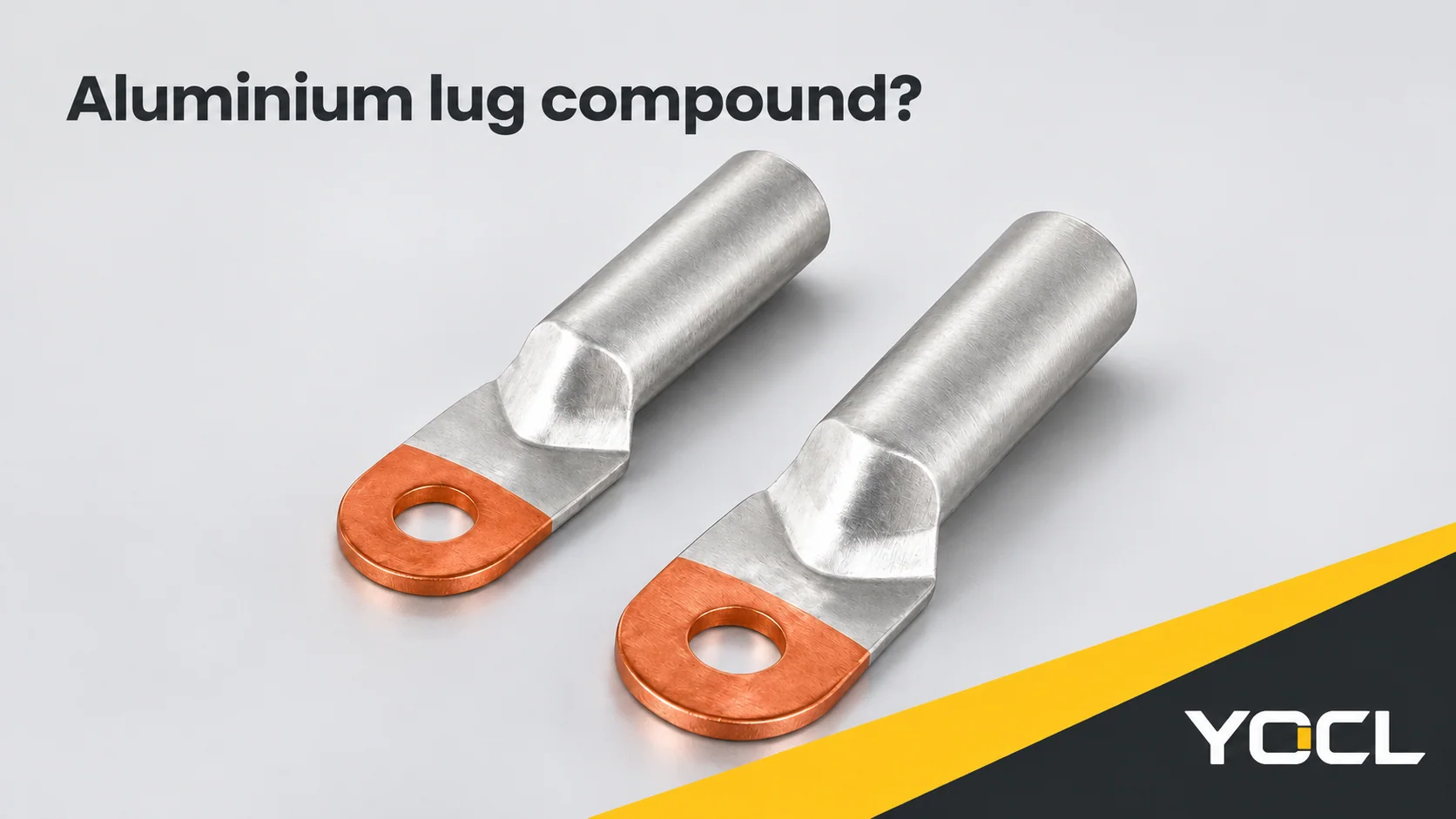
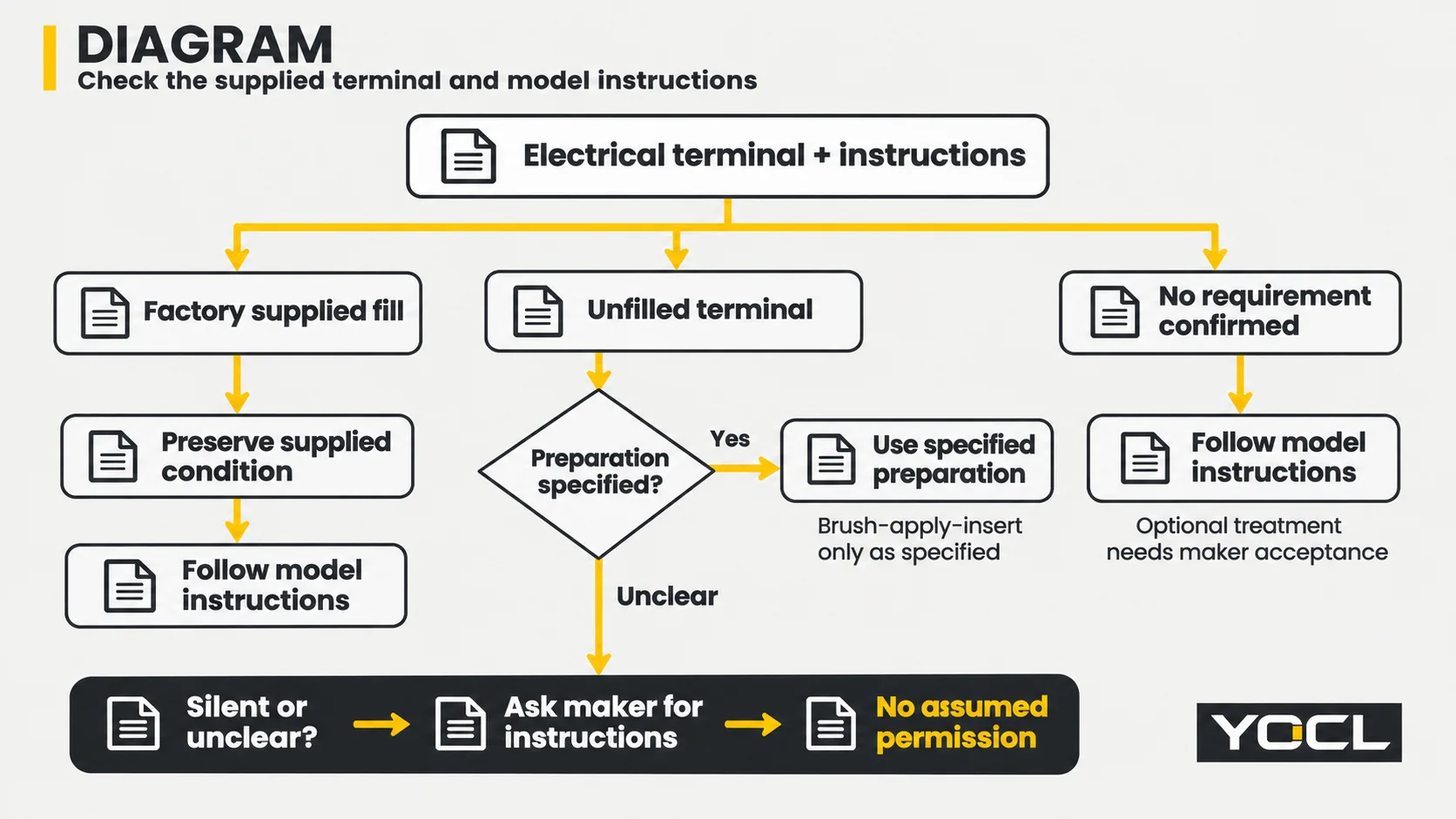
Sometimes. The aluminium lug antioxidant compound decision depends on the barrel as supplied and the instruction for that exact connector. Aluminium alone does not answer the question. Start by identifying which of these three situations applies.
Factory prefilled: preserve the supplied fill and follow the model’s installation instructions. Burndy’s Type YA-A terminals provide a documented example; the supplied compound is not an invitation to clean out the barrel or add a different product.
Dry barrel: use the preparation specified for that compression or mechanical lug. Where its instruction calls for brushing and inhibitor, those actions belong to the installation. A dry-looking barrel does not establish either a compound requirement or permission to choose one.
Maker does not require it: there is no universal aluminium-lug mandate. The IAEI discussion below explains why. However, a confirmed non-requirement and a product page that says nothing are different evidence states; missing instructions need clarification.
Why aluminium raises the compound question
Aluminium develops an electrically resistive surface oxide film when exposed to air. The relevant question is how the specified termination deals with that interface when the connection is made. A bottle labelled antioxidant does not, by itself, establish the preparation for a particular lug.
Burndy’s YA28A1 specification sheet, identifying the terminal as Type YA-A, describes its PENETROX compound as containing suspended metallic particles that penetrate wire oxides, establish electrical continuity and form an airtight connection. In Burndy’s account, the function is to break through the film during make-up and seal the interface against renewed oxidation.
That is Burndy’s explanation of its own compound and connector system. It does not establish the composition, compatibility or treatment instruction for another maker’s lug. Nor does the existence of an oxide film settle whether an installer needs to add compound: the connector may already contain it, or its documented termination method may not require it.
The useful chain is therefore supplied condition → model instruction → permitted preparation. Skipping the middle link turns a legitimate interface concern into an unsupported installation recipe.
Case 1: the barrel is factory prefilled
For a factory-prefilled product, the aluminium lug antioxidant compound question begins with what is already supplied. Burndy’s YA-A literature states that these terminals contain PENETROX and have colour-coded end caps. Burndy identifies contamination prevention before use as a purpose of those caps. The fill and cap are documented features, rather than an assumption drawn from the appearance of a metal barrel.
The practical implication is to preserve that supplied configuration. Do not scrape out original fill to replace it with something described as fresh, or top it up on the assumption that extra treatment improves the connection. This is a bounded inference from Burndy’s declared factory fill, not a quotation of a Burndy prohibition on removal or addition. An explicit instruction for the actual model controls any further preparation.
Think of the decision as preserving the connector you specified. Once you substitute a compound or alter the fill, the original prefill declaration no longer describes exactly what you have prepared. A general statement that two materials inhibit oxide is insufficient evidence that they are interchangeable in that connector.
Keep the supplied barrel protected until preparation and insertion under its instruction. If the original fill has been lost, contaminated or deliberately removed, obtain the maker’s corrective direction rather than inventing a refill method. The missing information is how that particular supplied condition can be restored or whether another connector is needed.
Prefill also leaves the tooling decision intact. Conductor insertion and crimping still belong to the specified connector–conductor–tool combination. Use the separate guide to matching cable lugs, crimp dies and conductors for that task; compound is not evidence of a tooling match.
Case 2: a dry barrel needs its own preparation instruction
For a dry compression barrel or mechanical lug, resolve the aluminium lug antioxidant compound decision from the actual model’s written preparation requirements. Look for whether inhibitor is specified, what treatment is permitted, and how preparation relates to insertion and termination. The absence of factory fill does not supply these answers.
An instruction that specifies brushing, applying the approved treatment and immediate insertion gives those actions an order. It is not permission to borrow a different maker’s paste or to turn that sequence into a general method for every aluminium termination. Likewise, a mechanical connector needs its own instructions rather than a compression procedure with the crimping step replaced by tightening.
What the actual 3M example says
3M’s Cold Shrink QT-III 7665-S-8 and 7665-S-8(L) instructions, document 78-8119-6025-7 Rev H, May 2016, give a concrete preparation example. For 3M compression lugs and stem connectors, sections 3.2 and 7.2 direct the installer to brush aluminium strands, insert and withdraw the conductor to transfer existing antioxidant paste, brush that paste into the strands, then insert immediately. Crimping follows the applicable directions, with excess inhibitor removed afterward. Its cable-preparation sections determine insulation removal from barrel depth and the specified allowance; there is no transferable strip length.
Crucially, this example uses paste already in the lug or connector. It demonstrates a documented preparation sequence, not a dry-barrel instruction to fill any lug. The cited steps specify wire brushing without identifying stainless steel. Sections 3.3 and 7.3 send users of 3M’s named mechanical shearbolt products to their separate packed instructions.
Those distinctions matter at the bench. Before transferring any step, check the heading above it: which connector type, conductor and termination system does it cover? A nearby procedure in the same manual may address a different configuration. Retaining that scope is part of using the instruction correctly.
Why a specified step is not merely a preference
In jurisdictions applying the National Electrical Code (NEC), 110.3(B) provides the instruction-following mechanism: listed equipment is installed and used according to instructions included in its listing or labelling. UL Solutions’ code-compliance overview states this principle under its 110.3(B) heading. Its surrounding equipment discussion is not lug-specific compound guidance.
For the lug decision, the point is limited: an applicable preparation instruction cannot be dismissed as an optional habit. This provision supplies no universal compound recipe, and it does not establish that a particular YOCL model is listed. Determine the applicable installation requirements for the project separately.
Case 3: the maker does not require compound
The aluminium lug antioxidant compound answer can also be that added inhibitor is not required by the maker’s applicable instruction. That deserves fair treatment, rather than being portrayed as careless installation.
In “Aluminum Alloy Conductors: 45 Years of Reliable Installations”, Christel Hunter explains that the very thin oxide film can be broken by the force of a compression or set-screw termination. The IAEI article pairs this with following the equipment listing and maker’s instructions. It says inhibitor can be required for aluminium or copper where the maker specifies it, while describing brushing and inhibitor as insurance where they may be unnecessary.
This is the counterweight to a blanket requirement. The article appeared in IAEI’s November/December 2015 issue; its web page carries a January 18, 2016 date. It is an explanatory source, not an installation instruction for an unidentified connector.
“Not required” also differs from “forbidden.” The first describes an obligation that is absent; the second describes an action that is excluded. Neither statement, standing alone, identifies every compatible optional compound. If optional treatment is proposed, establish its acceptability for the actual connector instead of treating an insurance analogy as permission to select any product.
There is a further distinction between a complete instruction that does not call for inhibitor and a sales page containing only dimensions. The latter may simply omit installation information. A buyer cannot promote that omission into a confirmed preparation method. Ask for the model instruction and a clear answer about the proposed treatment before proceeding on that basis.
The three cases therefore remain consistent: preserve documented supplied fill, perform specified preparation, and respect a genuine non-requirement without inventing a universal rule in either direction.
What compound never fixes
Compound does not correct a wrong die, a missed crimp, incorrect tightening torque, a lug unsuitable for the conductor material, nicked strands or a loose joint. A mechanically incorrect termination remains incorrect with compound present. These are separate acceptance questions; completing one preparation step does not excuse a failure elsewhere.
Use how to crimp cable lugs for the supported crimping and inspection process. For a connection already running hot, use the cable-lug overheating guide to investigate the cause rather than adding inhibitor as a repair. Any corrective installation work belongs on isolated equipment under the applicable work procedure.
If the unresolved choice is connector construction, the mechanical versus compression lug comparison addresses that decision. If it is the two connection materials, use the copper, aluminium and bimetallic lug comparison. Neither choice can be resolved by buying compound first.
Buyer and installer checklist: establish the actual barrel condition
Use these questions before ordering or preparing the lug. Each asks for evidence that changes the next action, rather than a general assurance that a connection product is suitable.
| Question | Evidence to obtain | What it changes |
|---|---|---|
| Is this model factory prefilled? | An explicit statement for the supplied model or configuration | Whether there is original fill to preserve |
| Does its instruction mention inhibitor or brushing? | The applicable installation document and preparation section | Whether treatment is specified, unnecessary, excluded or still unresolved |
| Which treatment is accepted? | The maker’s identification or compatibility direction | Whether the proposed compound belongs in this connector |
| What strip length and insertion endpoint apply? | Model-specific preparation information | How the conductor is prepared and seated |
| What die or mechanical termination method applies? | The documented tooling or connector instruction | Which separate termination process is acceptable |
Keep the model identifier with the answer. A statement about a similar-looking lug, a different barrel size or another connector family may not resolve the supplied product. For purchasing records, retain the instruction revision and the manufacturer’s written clarification with the order so the installer receives the same decision basis.
If a distributor supplies the answer, ask which manufacturer document it comes from and whether it covers the ordered configuration. A verbal assurance that compound is customary leaves the original question open: what preparation applies to the lug that will actually arrive?
What YOCL’s DL and DTL-1 pages establish
YOCL’s DL aluminium cable lugs page lists 15 models, DL-10 through DL-630, with aluminium construction and mounting-hole, barrel and palm dimensions. Its DTL-1 copper-aluminium connecting terminal page lists 15 models with an aluminium barrel and copper palm, again with model-specific dimensions.
Neither current page states that the barrels are prefilled, and neither publishes a compound instruction. Those material and dimensional descriptions do not establish whether YOCL supplies fill, requires added inhibitor or prohibits it. For a YOCL lug, ask the manufacturer for the selected model’s installation instruction and compound direction; do not infer either answer from the catalogue’s silence.
A useful request identifies the exact model and conductor and asks: “Is this supplied prefilled? What conductor preparation and compound, if any, does its installation instruction specify?” That produces an answer tied to the part, instead of an unsupported yes/no about aluminium in general.
Paste in spring or push-in connectors for aluminium building wire is a different connector family and treatment system, governed by that connector maker; see can you use lever connectors on aluminum wiring?.
Short FAQ
Do all aluminium lugs need antioxidant compound?
No universal rule follows from aluminium construction. Separate original factory fill, a model instruction specifying preparation and a confirmed non-requirement. If the installation document is missing, resolve that gap rather than choosing one of those answers by appearance.
My lug came prefilled: should I add more or replace the fill?
Preserve the original supplied fill unless the model instruction directs otherwise. The Burndy example supports retaining its documented configuration; it is not evidence for a refill quantity, a substitute compound or an additional coating.
Can compound rescue a lug connection that runs hot?
No. Adding compound does not establish why a connection is hot or correct an unsuitable or mechanically defective termination. Investigate and correct the underlying problem before returning the connection to service.
References
- Burndy/Hubbell, YA28A1 specification sheet, Type YA-A, features on page 1: original fill, caps and attributed compound mechanism.
- 3M, QT-III 7665-S-8 / 7665-S-8(L) instructions, May 2016, 78-8119-6025-7 Rev H, preparation sections and sections 3.2–3.3 / 7.2–7.3.
- UL Solutions, UPS Safety and Compliance with UL 1778, 110.3(B) explanation only.
- Christel Hunter, IAEI Magazine, Aluminum Alloy Conductors: 45 Years of Reliable Installations, November/December 2015.
- YOCL ELECTRIC product information: DL and DTL-1, construction, dimensions and published documentation scope.