
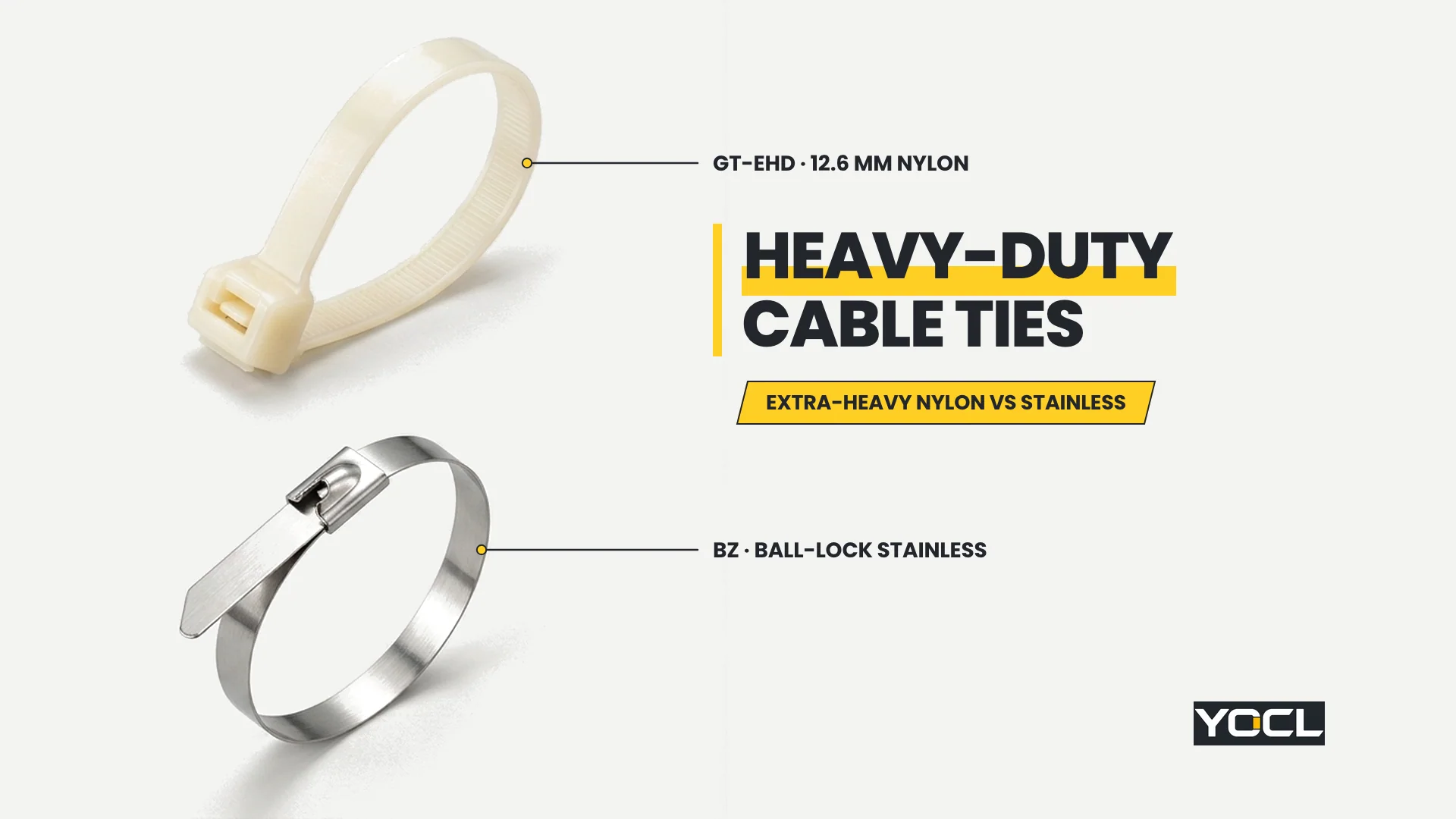
Heavy duty cable ties are high-width or metallic bundling straps chosen when standard nylon ties approach their bundle-diameter, edge-abrasion, or temperature limits—such as YOCL ELECTRIC’s 12.6 mm GT-EHD nylon ties (113.4 kgf / 250 lb) and BZ ball-lock stainless steel ties (1,000–4,100 N).
However, “heavy duty” is not a standardised engineering grade, so choosing safely requires stripping away the marketing label and evaluating strap width, minimum loop tensile strength, and material against site conditions. To keep neighbouring topics distinct, standard nylon sizing belongs to the cable tie size and tensile strength chart, converting loop tensile strength into working loads belongs to how much weight a cable tie can hold, general polymer-versus-metal behaviour belongs to nylon vs stainless steel cable ties, and polymer weatherability belongs to UV-resistant vs standard cable ties.
Why “Heavy Duty” Is Not a Standardised Grade: Read Three Numbers Instead
No international electrical or mechanical standard defines a “heavy-duty” class for cable ties. Two fasteners both sold under that label can differ several-fold in minimum loop tensile strength, strap geometry, and heat tolerance because every supplier applies the phrase at a different threshold.
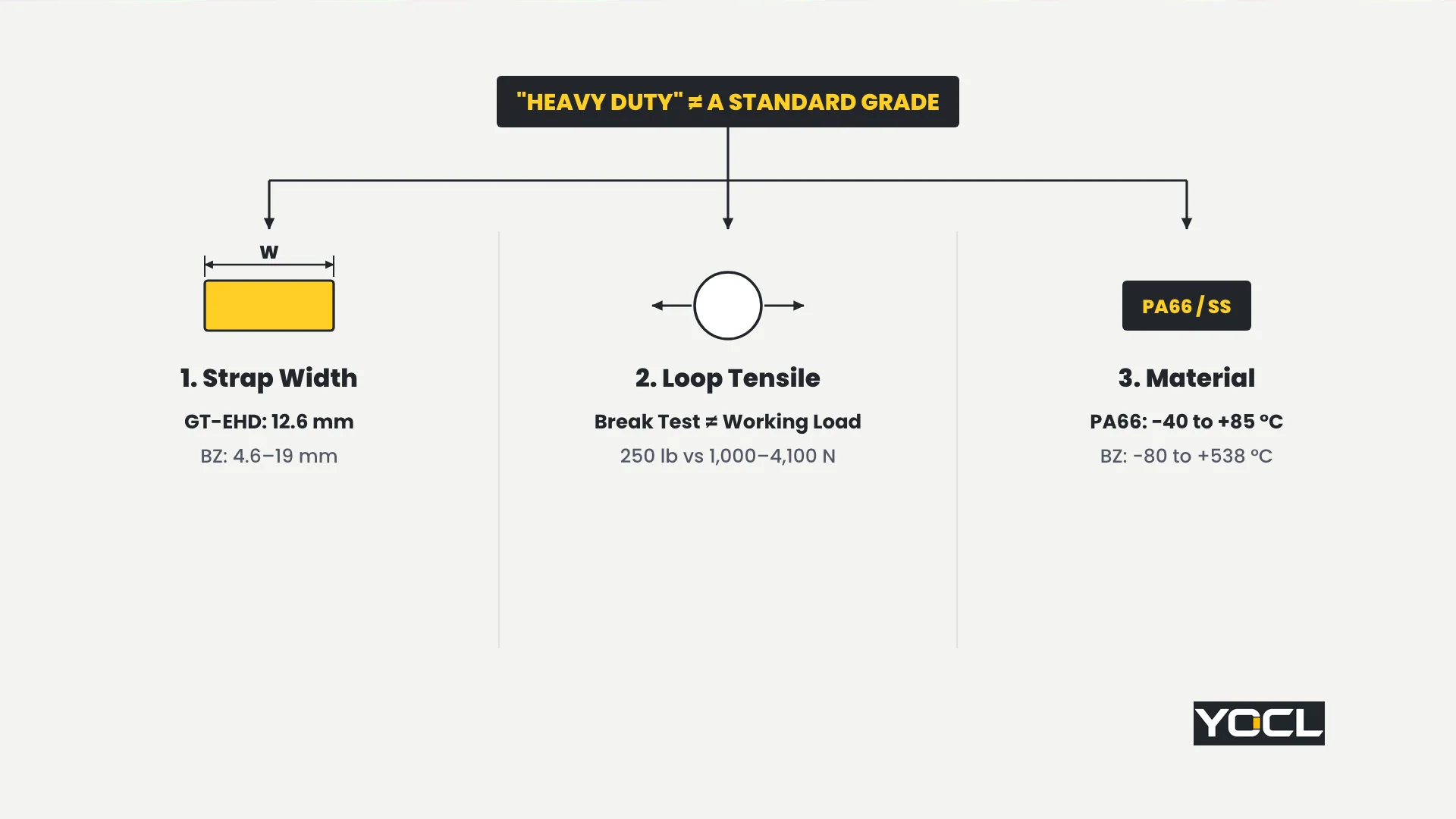
Ignore the marketing heading and evaluate every heavy-duty listing through three comparable parameters:
- Strap width: Width is the fastest visual tell on nylon ties. Extra-heavy nylon steps up where standard nylon widths end (for example, YOCL’s GT-EHD family jumps to 12.6 mm wide, compared with the narrower standard widths in the cable tie size and tensile strength chart). By contrast, stainless steel reaches high tensile figures through alloy strength rather than strap bulk—starting at 4.6 mm wide and scaling up to 19 mm.
- Minimum loop tensile strength: This is the minimum force at which a locked loop breaks in a pull test, not a continuous working-load rating. Keep each family in its published units (kgf / lb for GT-EHD, N for BZ) rather than converting or merging them into a single ranked table, because material behaviour under load differs fundamentally.
- Material and temperature window: Polyamide 6.6 (PA66) operates within −40 to +85 °C (GT-EHD), whereas uncoated stainless steel (BZ) covers −80 to +538 °C and polyester/epoxy-coated stainless (BZP / BZPM) covers −80 to +150 °C.
When a Standard Cable Tie Is Out of Its Depth: Five Step-Up Triggers
Before stepping up to extra-heavy nylon or stainless steel, verify why a standard cable tie is no longer adequate for the installation. In electrical and industrial work, five observable job conditions signal that a standard strap has reached its practical limit:
- Large, heavy cable bundles near the top of standard capacity: Multi-core power feeders, armoured control trunks, and grouped conduit runs whose finished bundle diameter and dead weight push standard widths toward the upper boundary of their bundle-diameter and tensile classes—leaving little margin if one tie takes extra load during dressing.
- Dynamic or moving loads rather than static support: Bundles exposed to rotating-equipment vibration, wind sway on open outdoor cable trays, vehicle chassis motion, or repeated thermal expansion and contraction cycles that work a narrow pawl harder than a static indoor loom.
- Sharp support edges under a tensioned strap: Perforated cable-tray cutouts, stamped steel knockouts, galvanized strut slots, or unchamfered enclosure brackets that can nick, score, or chafe a polymer strap under tension.
- Heat or chemical exposure beyond PA66 limits: Boiler rooms, exhaust-adjacent routing, kiln enclosures, or process areas exceeding +85 °C or carrying oils, solvents, or corrosive washdown agents that degrade standard polyamide.
- Outdoor runs where tie failure drops critical hardware: Overhead spans, vertical risers, solar-array framing, or exposed utility racks where a snapped tie allows heavy cables to drop onto sharp edges, walkways, or live buswork.
Route 1: GT-EHD Extra-Heavy-Duty Nylon Cable Ties (12.6 mm / 250 lb Class)
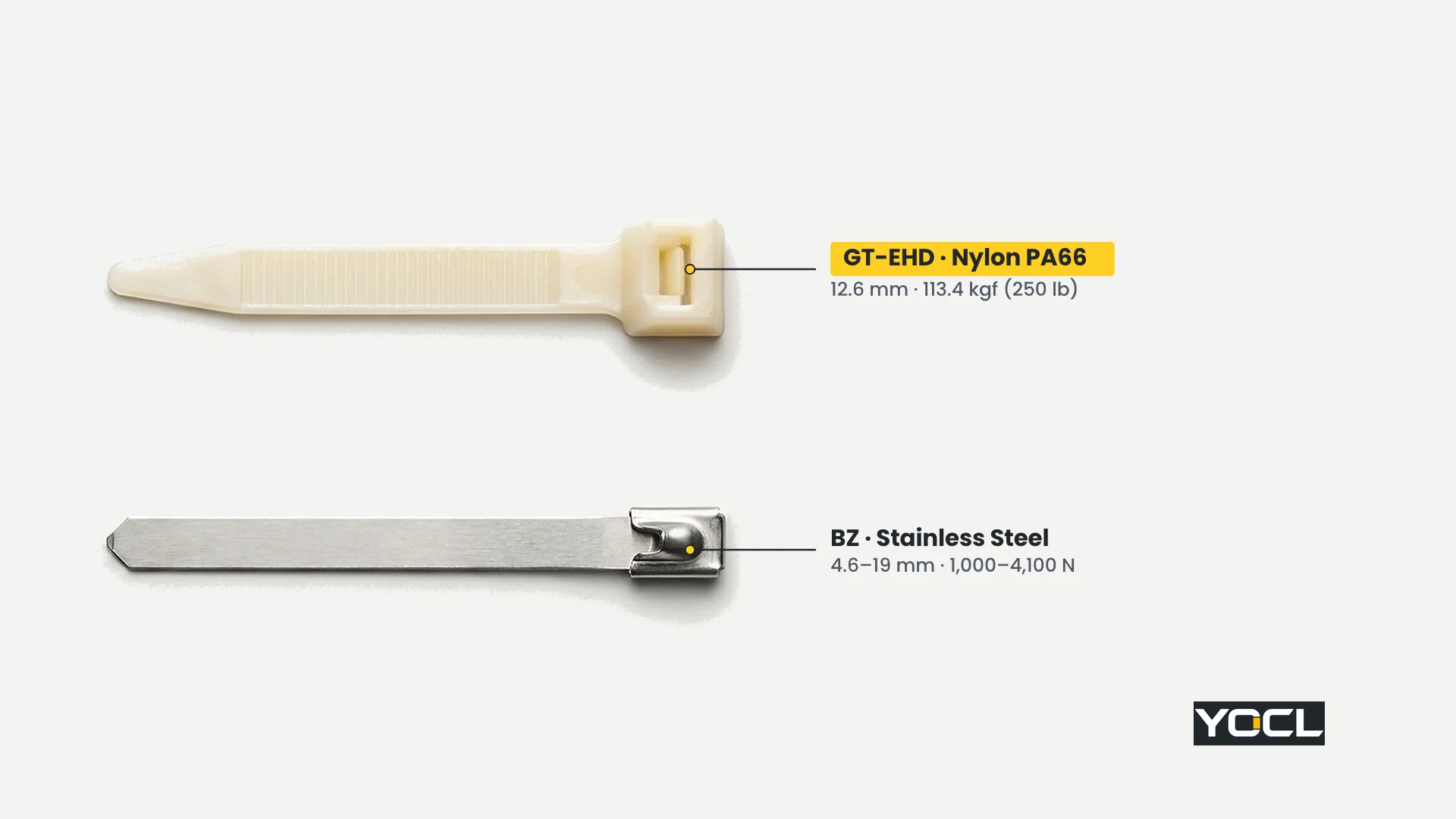
YOCL’s GT-EHD extra-heavy-duty cable ties are one-piece Polyamide 6.6 (PA66) ties with a stated UL 94 V-2 material flammability classification, an operating temperature range of −40 to +85 °C, and colours available on request. All four models share a 12.6 mm strap width and a 113.4 kgf (250 lb) minimum loop tensile strength.
| Part Number | Length (mm) | Width (mm) | Max. Bundle Diameter (mm) | Min. Loop Tensile Strength (kgf) | Min. Loop Tensile Strength (lb) |
|---|---|---|---|---|---|
| GT-290EHD | 295 | 12.6 | 76 | 113.4 | 250 |
| GT-480EHD | 480 | 12.6 | 120 | 113.4 | 250 |
| GT-580EHD | 580 | 12.6 | 152 | 113.4 | 250 |
| GT-730EHD | 730 | 12.6 | 204 | 113.4 | 250 |
Selection Rule: Choose GT-EHD when the environment stays strictly inside −40 to +85 °C, smooth tray or panel surfaces will not abrade nylon, and your bundle diameter fits 76–204 mm (note that GT-290EHD measures 295 mm long rather than 290 mm). Caution from the product page: minimum loop tensile strength is given in kgf and pounds-force and is not a working-load rating.
What this nylon step-up buys is straightforward: one wide 12.6 mm one-piece PA66 strap, familiar pawl-and-tooth handling, and a constant 250 lb (113.4 kgf) minimum loop tensile rating across all four lengths—meaning tensile strength does not drop as you move from GT-290EHD to GT-730EHD, only maximum bundle diameter increases. Its ceiling is equally clear: PA66 stops at +85 °C and retains nylon’s normal sensitivity to UV weathering and chemicals (for UV grade differences and nylon-versus-steel fundamentals, see UV-resistant vs standard cable ties and nylon vs stainless steel cable ties).
Route 2: BZ Ball-Lock Stainless Steel Cable Ties (4.6–19 mm Envelope)
YOCL’s BZ ball-lock stainless steel cable ties use a self-locking ball-lock mechanism across 61 width/length combinations spanning seven widths from 4.6 mm to 19 mm, with minimum tensile strengths from 1,000 N to 4,100 N depending on width.
| Series | Coating Finish | Steel Grades Listed | Width Envelope (mm) | Min. Tensile Envelope (N) | Operating Temperature Range |
|---|---|---|---|---|---|
| BZ | Uncoated metal | 201, 304, 316 | 4.6–19 (7 widths, 61 sizes) | 1,000–4,100 | −80 to +538 °C |
| BZP | Coated band (polyester / epoxy) | 201, 304, 316 | 4.6–12 | 1,000–3,115 | −80 to +150 °C |
| BZPM | Fully coated (polyester / epoxy) | 201, 304, 316 | 4.6–12 | 1,000–3,115 | −80 to +150 °C |
Selection Rule: Choose BZ uncoated stainless steel whenever operating heat exceeds +85 °C (up to +538 °C), sharp metal tray edges would cut nylon, or high-tensile metal retention up to 4,100 N (at 19 mm width) is needed; step to BZP or BZPM (up to +150 °C) when cable jackets require a protective polymer barrier against bare metal edges.
Stainless steel answers three demands that no PA66 tie can meet: extreme temperature tolerance (−80 to +538 °C uncoated), resistance to abrasion against sharp steel supports, and a tensile envelope reaching 4,100 N at 19 mm width. Within the metal route, grades 201, 304, and 316 step up corrosion resistance (covered in 304 vs 316 stainless steel cable ties), while polyester or epoxy coatings protect delicate cable sheaths and isolate dissimilar metals (covered in coated vs uncoated stainless steel cable ties).
How to Choose Heavy Duty Cable Ties: Duty, Environment, and Material Order
Specifying heavy duty cable ties reliably follows a strict three-step decision order—starting with physical duty and bundle diameter, filtering next by site environment (temperature first), and reading the matching family table last.
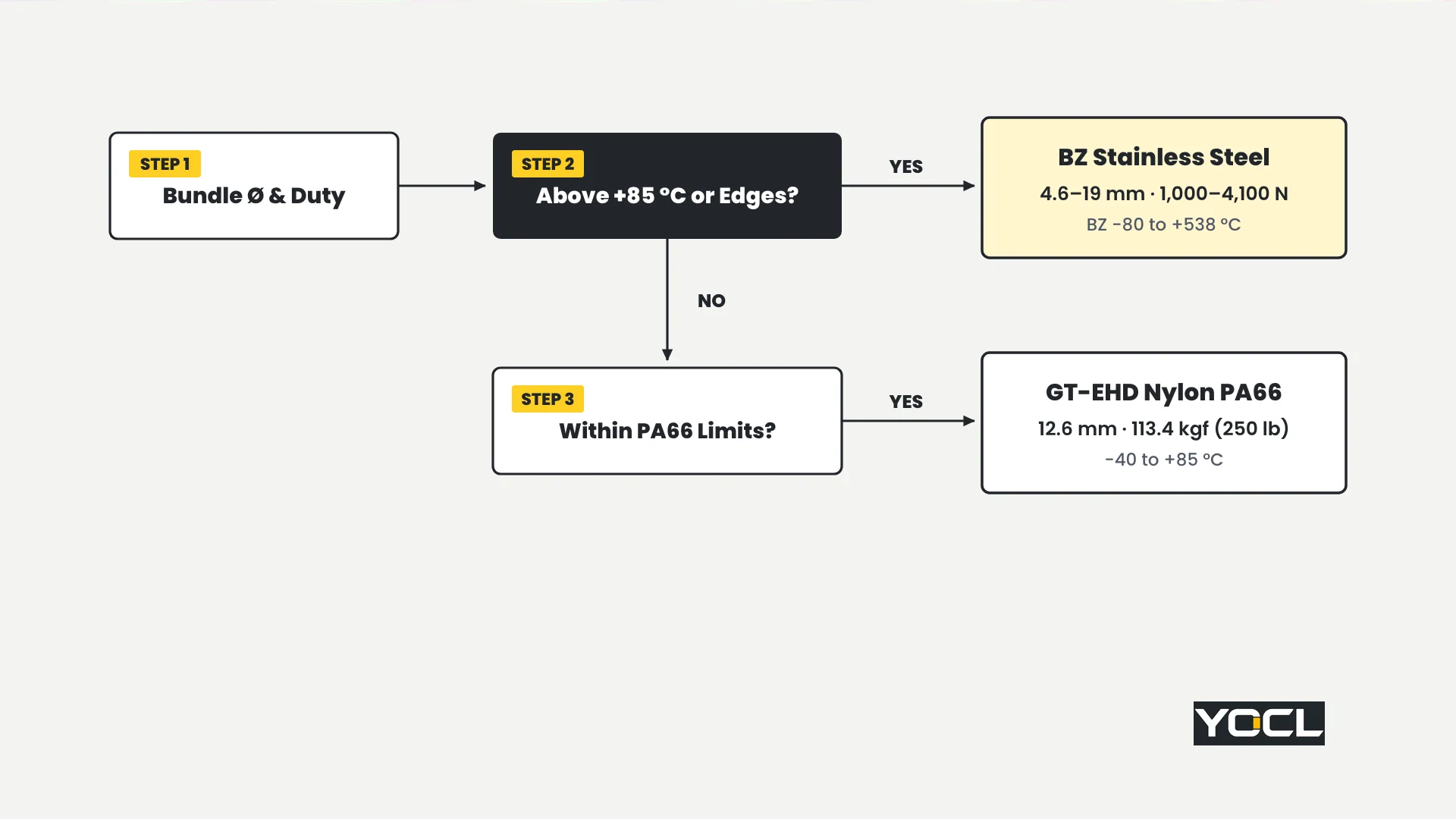
Apply these three steps in order before issuing a purchase order:
- Establish the duty (bundle diameter and required load class): Measure the finished bundle diameter and determine the load class the installation requires. Remember that every published loop tensile figure—whether 113.4 kgf (250 lb) on GT-EHD or 1,000–4,100 N on BZ—is a pull-to-break figure, not a continuous working load; use how much weight a cable tie can hold to apply safety factors rather than sizing directly at the break number.
- Establish the environment (temperature eliminates routes fastest): Check continuous and peak ambient temperature first. Anything above +85 °C closes the GT-EHD PA66 nylon route immediately and pushes selection into BZP/BZPM (−80 to +150 °C) or uncoated BZ (−80 to +538 °C). Next check chemical splash, UV exposure, and whether the strap bears against sharp metal edges.
- Pick the material route and read its table by width and bundle capacity: Only after duty and environment lock in your route should you select the exact GT-EHD part number (by bundle Ø 76–204 mm) or BZ width/length entry (from the product page’s 61-entry chart).
Consider two identical 110 mm diameter power-cable bundles carrying the same static weight class in different environments:
– Indoor plant-room switchgear feeder (ambient +40 °C, smooth ladder rungs): Because continuous ambient heat stays well inside −40 to +85 °C and the bundle rests on smooth, non-abrasive rungs away from UV or chemical splash, extra-heavy nylon (GT-480EHD, 12.6 × 480 mm, max bundle Ø 120 mm, 113.4 kgf / 250 lb minimum loop tensile) handles the bundle cleanly with fast nylon tooling and familiar one-piece handling.
– Hot, exposed outdoor process-tray run (ambient +110 °C near process piping, sharp punched tray slots): The exact same load class now sits above PA66’s +85 °C operating ceiling and crosses bare punched steel edges exposed to weather. Extra-heavy nylon is eliminated at Step 2; BZ ball-lock stainless steel (or BZP/BZPM where cable jackets need polymer edge protection up to +150 °C) is the required route, with steel grade (201, 304, or 316) matched to local atmospheric corrosion.
Installation Tooling for Heavy-Duty Nylon and Stainless Steel Ties
Heavy-duty straps cannot be tensioned cleanly or trimmed flush by bare hand alone: both material routes require installation tools rated for their strap width and material. For 12.6 mm extra-heavy nylon ties such as GT-EHD, select a heavy-duty nylon tensioning gun sized for wide straps so the pawl locks squarely without over-stressing the neck (see cable tie guns: how to choose and set tension). For BZ, BZP, and BZPM stainless steel ties across 4.6–19 mm widths, use dedicated metal tension-and-cut tools matched to the strap width—such as the tool models listed per width on the BZ specification page—to pull the ball-lock tight and shear the tail cleanly without leaving sharp burrs (see how to tension and cut stainless steel cable ties).
Frequently Asked Questions
What makes a cable tie “heavy duty”?
There is no industry standard defining a “heavy duty” cable tie class—the phrase is an unstandardised catalogue label that varies by seller. Compare any heavy-duty listing solely by its three measurable parameters: strap width, minimum loop tensile strength, and material (along with its stated operating temperature window).
Can a 250 lb heavy-duty nylon tie hold a 250 lb load?
No. As YOCL’s GT-EHD product page explicitly cautions, minimum loop tensile strength (113.4 kgf / 250 lb) is a laboratory pull-to-break figure, not a continuous working-load rating. Real installations must derate loop tensile strength for load type, vibration, and environment; see how much weight a cable tie can hold.
Should I use extra-heavy nylon or stainless steel outdoors?
Site environment decides—there is no universal winner. Check temperature first (GT-EHD PA66 stops at +85 °C, whereas BZ spans −80 to +538 °C and BZP/BZPM spans −80 to +150 °C), followed by UV exposure, chemical/salt corrosion, and sharp tray edges.
Can I use two standard cable ties instead of one heavy-duty tie?
No—doubling standard straps is not a rated fastening method. Two hand-tensioned ties share load unevenly, so one strap takes the peak stress first and breaks before the second carries half the load; neither tie’s published loop tensile rating doubles. Specify a single tie class sized for the actual duty.
References
- YOCL ELECTRIC Product Information — GT-EHD Extra Heavy Duty Cable Ties: PA66 12.6 mm × 295–730 mm specifications, 113.4 kgf (250 lb) minimum loop tensile strength, UL 94 V-2 material classification, −40 to +85 °C operating temperature, and working-load caution.
- YOCL ELECTRIC Product Information — BZ Ball-Lock Stainless Steel Cable Ties: 201/304/316 stainless steel grades, uncoated BZ (−80 to +538 °C) and coated BZP/BZPM (−80 to +150 °C) series, 61 entries across 4.6–19 mm widths, and 1,000–4,100 N minimum tensile strength envelope.