
Short Answer: YOCL’s selected YC standard nylon rows declare 18-200 lbf, so none establishes a single-tie 1,000 lb capacity. The BZQ stainless range lists 1,050 lbf at 12.7 mm width and 1,250 lbf at 16 mm. Those are strength figures, not safe hanging weights. Using the illustrative factor of 3 below, even those single ties fall short of a 1,000 lb service load. Actual support needs application evidence, including unequal loading when multiple ties are used.
The number on a cable tie specification answers a different question from the weight you want to suspend. A buyer may see a large force value and assume that a lower hanging weight must be acceptable. That skips the test basis, service conditions, load path and installation evidence needed to establish an allowable load.
This guide uses YOCL’s published selected nylon rows and BZQ steel declarations to make that difference concrete. The calculations are illustrative screening arithmetic. They do not assign a working-load limit to a product whose public page does not provide one.
1. What a tensile rating actually means
The locked loop is the test object
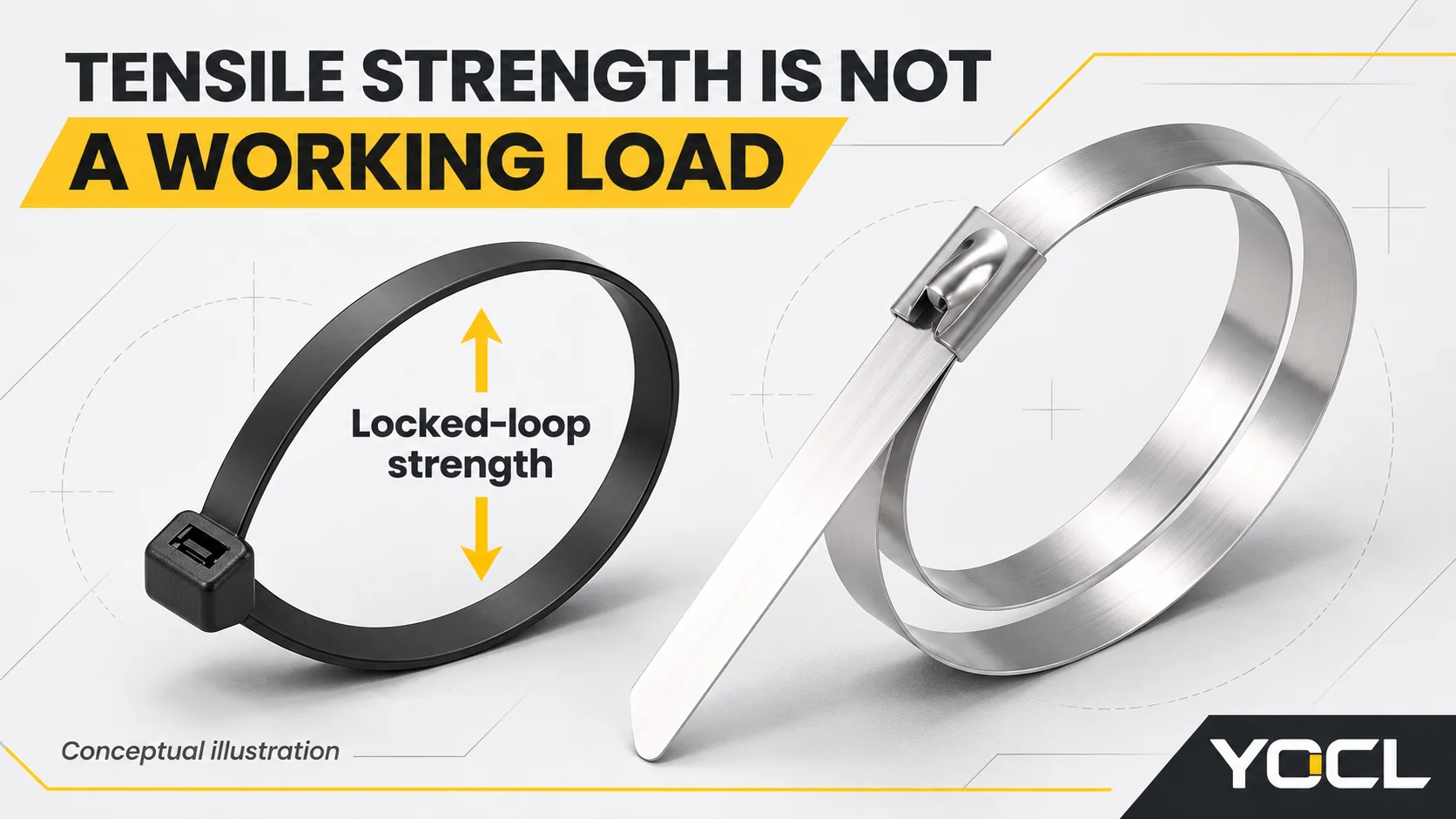
Loop tensile strength concerns a complete tie with its locking mechanism engaged. In a destructive loop test, force is applied from inside the closed loop until the assembly fails, stressing the strap and lock together. A failure can involve the strap or the locking arrangement; testing a straight piece of material is not the same assessment. The NEMA classification guide describes the inside-out loading of a locked loop.
Treat the catalogue figure as breaking-strength information rather than a safe working load. There is an important qualification: a declared minimum is not a promise that every specimen breaks at precisely that force. Standards can also use withstand tests. UL Solutions distinguishes breaking and withstand evaluations according to the product’s declared test classification in its cable-management application guide.
The practical message is unchanged: the printed number belongs to a strength-test declaration, not an allowable hanging-weight declaration. Loop tensile strength is not a safe working load, and dividing it by a convenient number does not create a manufacturer-approved working-load limit.
Why the laboratory number does not describe the installation
A test uses defined specimen preparation, conditioning, loading and installation arrangements. An installed tie may encounter a different bundle shape, contact edge, temperature, loading duration or force direction. Those differences can reduce usable performance. They do not establish that every field result must always be lower than every laboratory result.
The IEC 62275:2022 public preview, Section 6.2.1, explicitly separates loop tensile strength from long-term static load-bearing capability. That standard’s terminology does not prove that a particular YOCL catalogue entry was tested to the IEC method.
For the actual YC declarations, check tensile force by model in the selected-row chart. Keep its units and exact model identity. Here, lbf means pound-force; the proposed 1,000 lb hanging load is treated as a 1,000 lbf static weight for the illustrative arithmetic. It is not a statement about an accelerated, swinging or impact-loaded object.
2. What the published nylon and stainless figures tell you
| Material | YOCL model example | Declared minimum tensile | What it is for |
|---|---|---|---|
| Standard nylon | Selected YC standard rows, including YC-3×200 through YC-12×300 | 18-200 lbf across the selected rows; published as declared tensile force | Cable bundling where the exact model and application are suitable; this is not a general hanging-load rating |
| Stainless steel | BZQ double-wrap ball-lock series | Listed lbf values corresponding to the minimum-strength entries: 630 at 7.9 mm; 1,050 at 12.7 mm; 1,250 at 16 mm | Higher declared-strength double-wrap fastening; service suitability still requires application evidence |
| Flame-retardant nylon | YC flame-retardant series | Comparable order of strength to standard nylon; verify the exact model on the product page | Cable bundling where the specified flame-retardant construction is required; no extra load allowance follows from that description |
The header does not make all three source declarations identical test claims. The YC chart calls its force column “Declared tensile”; BZQ publishes minimum strength in N and a separate listed lbf column. The standard nylon product page supplies the complete model specifications. For flame-retardant construction, use the YC flame-retardant product page, rather than inferring force from its material description.
The specific YC examples in the chart are YC-3×200 at 2.4 mm and 18 lbf; YC-4×200 at 3.4 mm and 40 lbf; YC-5×200 and YC-5×300 at 4.8 mm and 50 lbf; YC-8×300 at 7.6 mm and 120 lbf; and YC-12×300 at 12 mm and 200 lbf. These are selected model declarations, not the complete YC catalogue or independently verified test results.
Width and force rise across those examples, but there is no supported “pounds per millimetre” formula. The change from 2.4 to 12 mm accompanies a change from 18 to 200 lbf; it does not establish a linear relationship or allow interpolation for an unlisted construction. Length also does not determine force by itself.
For material differences beyond this arithmetic, see nylon versus stainless steel cable ties and stainless steel cable ties explained. Choosing 304 versus 316 stainless steel concerns the corrosion environment; grade selection is not a substitute for reading the exact tie’s strength declaration.
3. How many ties would a 1,000 lb load require?
First separate a strength claim from a working-load claim
No single standard nylon tie in the selected YC chart reaches 1,000 lbf. Its highest selected entry is 200 lbf. Five such declarations add to 1,000 lbf on paper, but that sum is neither a safe service load nor evidence that five installed ties share force equally.
The BZQ product page lists these width-specific pairs:
- 7.9 mm: minimum tensile 2,800 N; listed strength 630 lbf.
- 12.7 mm: minimum tensile 4,600 N; listed strength 1,050 lbf.
- 16 mm: minimum tensile 5,500 N; listed strength 1,250 lbf.
The two wider versions therefore exceed 1,000 lbf in the page’s listed strength column. This answers the catalogue-strength question. It does not establish that either can safely hang a 1,000 lb object. The N and lbf pairs are reproduced as listed catalogue values; the calculations below use the listed lbf figures consistently, rather than claiming exact unit equivalence.
Apply the same illustrative factor throughout
For this example only, use a factor of 3. It is supplied as an illustration, not a YOCL requirement, a verified product rating or an industry-mandated factor. The buyer’s responsible engineer must establish the actual design basis.
- Start with the proposed static weight: 1,000 lbf. This is the example’s target, not a product specification.
- Multiply by the illustrative factor: 1,000 x 3 = 3,000 lbf of aggregate declared strength before any allowance for unequal loading.
- Check the single-tie arithmetic. The page-listed 1,050 / 3 = 350 lbf and 1,250 / 3 is approximately 416.7 lbf. Neither result reaches the target. Neither is an assigned working-load rating.
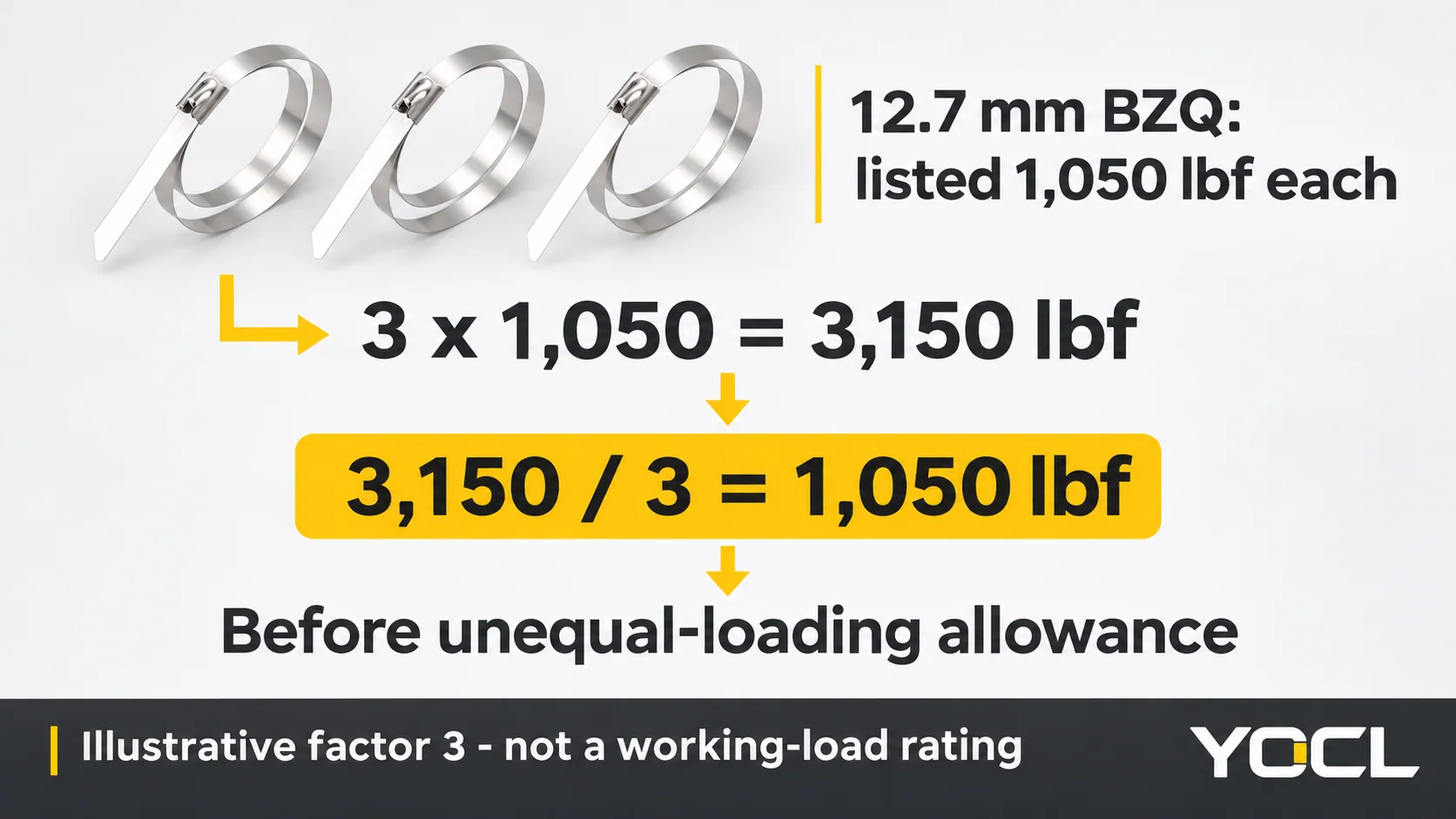
- Check a multiple-tie starting count. With the 12.7 mm BZQ declaration, 3 x 1,050 = 3,150 lbf, and 3,150 / 3 = 1,050 lbf before unequal-loading allowance. With the 16 mm declaration, 3 x 1,250 = 3,750 lbf, and 3,750 / 3 = 1,250 lbf before that allowance. Two of either wider version do not reach the 3,000 lbf starting requirement.
The nylon shortcut fails even earlier: 5 x 200 / 3 is approximately 333.3 lbf before accounting for load sharing. The 200 lbf input comes from the selected YC-12×300 row. Calling that arrangement a 1,000 lb support would discard the example’s factor as well as its installation uncertainties.
Then account for unequal loading
Parallel ties may have different angles, slack, contact positions and stiffness. The first tie to become taut can take more force while a neighboring tie contributes less. Adding a tie does not ensure that its entire declared strength becomes available to the assembly.
Conceptually, the example’s screened capacity is:
aggregate declared strength / 3 x validated load-sharing allowance
That allowance must reduce the equal-share result where unequal loading is present. This guide assigns no percentage because the public product pages do not establish one for your layout. The 1,050 lbf equal-share result leaves little room for any reduction before falling below the target; the 1,250 lbf result has more arithmetic headroom, but still does not prove adequacy.
Thus, three wider BZQ ties are only an idealized starting count in this example. A defensible final count requires the actual arrangement and its validated allowance. More ties may be needed, or the application may require a support system with a documented working-load rating. The pages cited here do not establish lifting or personnel-support suitability.
4. What reduces the capacity available in service?
These influences can reduce usable performance or require a more conservative application assessment. They do not authorize editing the printed declaration into a new certified rating, and no universal reduction percentage is available here.
- Heat: Nylon behavior depends on temperature, and the YC standard page’s stated operating range of -40 to +85 degrees C does not establish full declared strength throughout that range or a sustained-load allowance.
- UV exposure: Weathering can impair an unsuitable nylon tie’s condition, so exposure evidence matters; the resulting application allowance is separate from the original printed force.
- Excessive installation tension: Over-tightening can damage the retained cable or consume installation margin, so a tighter bundle does not demonstrate higher support capacity.
- Sharp edges: Contact wear or a damaged strap changes the installed assembly’s condition, which a catalogue force number alone cannot assess.
- Vibration and shock: Changing or sudden forces require their own evaluation; UL’s application guide discusses vibration separately rather than treating static strength as complete evidence.
- Long-term creep: Nylon can deform progressively under sustained force, so a brief strength result cannot establish long-term geometry or retention; published nylon 66 creep research supports the general material phenomenon, not a YOCL life or capacity prediction.
For signs of an already compromised fastener, use Why Do Nylon Cable Ties Break?. Do not assign a replacement schedule or remaining strength from appearance alone. Keep any environmental or duration allowance attached to the engineering assessment rather than presenting it as a revised catalogue specification.
5. Calculate your own requirement in four steps
Step 1: Establish the actual static load and load path
Weigh the retained assembly or document the basis of the estimate. Include the components whose weight actually reaches the tie, and identify how that force reaches the strap, lock, fixing and supporting structure. A tie around a bundle is not the same load arrangement as a tie carrying weight from an attachment point.
Write down whether the proposed service is genuinely static. Motion, vibration, impact and changing load direction require separate consideration. Do not hide them inside an optimistic weight estimate or assume that the example’s factor resolves them.
Step 2: State the factor and the missing allowances
Using this article’s illustration, multiply the static force by 3 to obtain the starting aggregate-strength requirement. Label the factor as illustrative in the calculation record. Identify the load-sharing, duration, environment and installation evidence still needed; the multiplication is incomplete until those application effects are addressed.
Keep the comparison in the same force unit. Do not mix the BZQ N column with the listed lbf figures or mistake a mass entry for a force entry. Preserve the original catalogue declaration beside every derived number so that the arithmetic remains traceable after a product revision.
Step 3: Check force first, then check fit
Look up tensile force by exact model, then check the declared maximum bundle diameter and installation access. For models outside those selected rows, verify the YOCL product-page specification table. A force match cannot compensate for a loop that does not fit, and a length match cannot establish strength.
BZQ is a double-wrap construction: the product page specifies two passes through the buckle. Its strength declaration must not be transferred to an improvised single-pass arrangement. If a maximum bundle diameter or service-load field is missing, request it instead of deriving an approval from the overall strap length.
Step 4: Validate the actual assembly with samples
Define a controlled test arrangement that represents the actual angles, bundle diameter, contact surfaces and fastening method. Record the strap/lock response and acceptance criterion agreed for that application. A sample pull cannot, by itself, establish long-term creep, environmental endurance or batch consistency.
Installation tension and cutting practice are process variables, not substitutes for strength verification. Use the stainless-steel tensioning guide for that separate installation task and cable tie gun selection and setting for compatible tooling. Do not equate an installation-tool dial with a loop tensile rating.
For a force-sensitive enquiry, send the exact model, load arrangement, measured bundle size, duration, environment and proposed acceptance test. That information allows the supplier and responsible engineer to identify missing evidence before an order is based on an attractive catalogue number.
6. Common strength misunderstandings
“A 200 lb tie can hang 200 lb.” The 200 lbf selected-row declaration is not a 200 lb safe service rating. Duration, the complete load path and the approved application remain unresolved.
“Five 200 lb ties equal a 1,000 lb support.” Five declarations total 1,000 lbf only before the illustrative factor and unequal loading. In this example, division by 3 already reduces that arithmetic to approximately 333.3 lbf.
“All nylon ties are alike, and a longer tie is stronger.” The selected YC-5×200 and YC-5×300 rows both declare 50 lbf despite different lengths. Length helps establish fit; strength still depends on the actual construction, material, width and declared test basis.
“Stainless steel replaces nylon in every installation.” A higher listed force does not resolve procurement cost, compatible tools, sharp-edge control or electrical conductivity. Those are separate application constraints, not reasons to extrapolate a load rating. For later replacement, follow safe cable tie removal rather than assuming a metal fastener can be handled like nylon.
FAQ
How much weight can a standard cable tie hold?
YOCL’s selected YC standard nylon chart rows declare 18-200 lbf. Those are force declarations, not allowable hanging weights or working-load ratings. Check the exact model and the application evidence before assigning a service load. The illustrative factor of 3 used here does not turn a catalogue entry into a YOCL-approved working-load limit.
Can a zip tie hold 1,000 pounds?
No single standard nylon tie in the selected YOCL chart reaches that declared strength. BZQ stainless versions at 12.7 mm and 16 mm list 1,050 and 1,250 lbf respectively, exceeding 1,000 lbf as catalogue figures. Actual hanging-load assessment still needs a justified factor and application evidence. With the illustrative factor of 3, neither single version reaches a 1,000 lb service-load target.
What is loop tensile strength?
It is a mechanical reference for a complete cable tie with its locking mechanism engaged, loading the strap and lock together. It belongs to the strength-test basis, not a long-term safe-load declaration. Destructive testing can proceed to failure, while other standard test classifications use withstand evaluations. A printed minimum is not each specimen’s exact breaking force.
How many cable ties do I need to hold a heavy load?
There is no safe universal count from catalogue strength alone. Establish the actual force, design basis, fit and complete load path, then account for unequal loading and service conditions. Multiple ties do not simply add their full declarations into an allowable load. The three-tie BZQ examples here are idealized calculation starting points, not approved support assemblies.
Does heat or sunlight reduce how much weight a cable tie can hold?
They can affect an unsuitable nylon tie’s performance and therefore its application assessment. A declared temperature range or UV description does not establish a universal strength-retention percentage or sustained-load limit. Use exact-product exposure and duration evidence, and assess damaged or degraded ties separately rather than assigning them the original catalogue figure.
For exact-model documentation, use the YOCL cable ties range. Include the proposed load arrangement and service conditions when requesting the test basis and any documented application limits.
References
- NEMA, Cable Tie Type Classifications, mechanical performance explanation.
- UL Solutions, Cable Ties for Cable Management of Electrical Installations: Application Guide, strength, support and environmental considerations.
- IEC, IEC 62275:2022 public preview, definition, test-context and Section 6.2.1; preview only.
- YOCL ELECTRIC, selected YC size and tensile declarations, standard nylon product specifications, BZQ specifications and flame-retardant product specifications, first-party catalogue declarations.
- Howard and Williams, The Viscoelastic Properties of Oriented Nylon 66 Fibers: Part I, Textile Research Journal, 1963; public abstract consulted, not a finished-tie load study.